A proxy chain, a URL that is the document, and a game carried by sound: six agent-builder signals from October 10-17
Six in-window builds from three indie agent builders: a three-program proxy chain that pools subscriptions without losing the prompt cache, personal bots built one function at a time, a repository closed to pull requests and open to remix, an app addressed by a URL grammar instead of an API, a two-phone game carried by sound, and an MCP server that reads binaries with its evidence attached.

Between October 10 and October 17, six builds went into the gap where an interface should have been.
A pool of ChatGPT subscriptions with no way to share them. A bot platform with no connector for the services a builder actually uses. A repository that stopped taking pull requests. An app with no API. Two phones with no server between them. A binary with no source code.
Each builder wrote the small program that sits in that gap, and each program had to decide what crosses it.
The comparison map
| Signal | Builder or project | In-window date | Artifact to open | First test |
|---|---|---|---|---|
| Three proxies between the agent and the model provider | Geoffrey Huntley | Oct 17 | pooling OpenAI subscriptions and bypassing regional inference capacity limits | Put a fake key in a prompt and watch what leaves. |
| Bots built one function at a time | Geoffrey Huntley | Oct 16 | revisiting some of my priors about openclaw | Split one fat assistant into three single-job bots. |
| Closed to pull requests, open to remix | Geoffrey Huntley | Oct 14 | a new model for open source: closed to pull requests, open to remix. | Express one change as an overlay that applies everywhere. |
| An app whose interface is a URL grammar | Simon Willison, after Tiny Little Office | Oct 15 | LaTeX renderer | Publish an llms.txt and let an agent build a link. |
| A game carried by sound | Simon Willison | Oct 15 | Chirp Pong | Pair two phones with a chirp and move one byte. |
| An MCP server for code you do not have | morluto/rea | Oct 17 board | morluto/rea | Ask for the evidence behind one conclusion, then ask what it could not determine. |
Six signals to inspect
1. Three proxies between your agent and the model provider
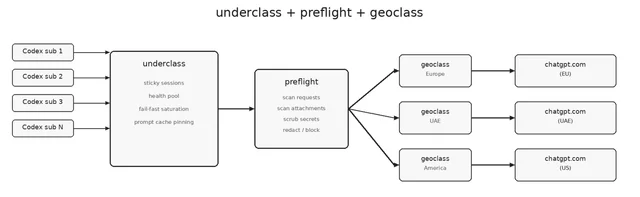
Geoffrey Huntley published "pooling OpenAI subscriptions and bypassing regional inference capacity limits" on October 17 1. The post gathers three separate programs he wrote, and the interesting part is the order he runs them in.
Underclass is an OpenAI-compatible proxy that pools several ChatGPT subscriptions 2. It does four things at once: sticky sessions, a health pool, fail-fast saturation and prompt cache pinning 1.
The cache rule is the one to copy. A session stays pinned to one account so the prompt cache stays warm, which is why the pool cannot simply round-robin requests across subscriptions 2.
An account that runs out of quota is cooled until its window resets, and when every account is dry the proxy fails fast with the earliest
Retry-After it can see 2. Huntley runs six ChatGPT 500 accounts through it and says there is no real upper limit 1.Preflight is the second program: a local proxy that scans requests and attachments for secrets, then scrubs and redacts them before anything reaches the model 3. Placed after the pool, it gates every account's traffic through one policy.
GeoClass is the third, released the same day and labelled experimental 4. It routes a request to a different inference region over a Tailscale mesh when the first region answers with a capacity error, and it does that without breaking the prompt cache 4.
The motivation is capacity. OpenAI's Tibo posted "It's the compute that is cooked" on October 6 5, and Huntley describes watching inference slow down when Europe wakes up over machines he runs in Germany 1.
He is straight about the limits of his own test. "I don't know yet if
geoclass will solve my inferencing woes," he writes, and calls it an experiment he is running on his own setup 1.Try it. Send one request through your own proxy with a fake API key in the prompt, and inspect what the provider actually receives.
2. Bots built one function at a time
On October 16 Huntley published a list of the personal bots he built in his first week on Grokbot, and the list is a design document 6. Thirteen bots, each doing one job, from a 7am daily brief to a bot that pre-drafts his Australian tax records.
The first lesson is granularity. "What you want to do is to create bots thinly," he writes, "a bot per function," small bots calling other small bots and piping them into a chain the way Unix commands compose 6.
The second lesson is credentials, and it shows up in every entry. His newsletter bot reads the Ghost Admin API directly with a read-only token because there is no connector for it, alongside read-only Stripe and PostHog access 6.
The spending bot has no connector either; it calls the PocketSmith REST API directly and uses a model to categorise transactions 6. Bank details are stored as a secret and shared with other bots on request rather than baked into a prompt 6.
WhatsApp is the awkward case and the most instructive. There is no connector behind it: the bot runs WhatsApp Web in a browser session, reads the message database directly, and can send only from inside that authenticated session 6.
Startup is bootstrapped too. He installs a marketplace bot called Dr Eggbot that asks a few preference questions, then creates new bots through
CreateAgent 6. The first bot's job is making the rest.You can install software on a bot host, which is how he gets a Mac Mini onto the network: Tailscale runs on the Linux machine the bot lives on and tunnels egress through the Mac Mini to dodge geo-blocks on data-centre addresses 6.
Why not run OpenClaw himself, given he likes it? The lethal trifecta, the combination of private data, untrusted content and outbound communication that Simon Willison named in 2025 7. Huntley calls it "a billion-dollar problem, perhaps more" and says he sleeps better with a vendor's security team and disclosure programme carrying it 6.
The same week he also pointed one bot at his own platform: Overalls, an open-source, self-hosted service for persistent Firecracker development machines and the agents that work in them 8.
Try it. Take one assistant you use for everything, split it into three single-job bots, and give each the narrowest credential that still does the job.
3. Closed to pull requests, open to remix
"A new model for open source: closed to pull requests, open to remix" went up on October 14, and it starts with a history lesson about the cathedral and the bazaar 910.
GitHub turned the bazaar into a workflow anyone can join with a pull request. Huntley's complaint is that the workflow also created an entitlement, where everyone who opens a pull request expects a maintainer to merge it and then maintain it for free 9.
Then he asks the question the model made unavoidable. "For what's the point of reading a pull request that's been generated by code? All I want is to read and understand the core idea" 9.
His replacement is the remix model, and it has four parts he sets out plainly 9. Publish source and intent under an as-is licence. Expect others to express a change once as a small Nix overlay. Reuse that overlay across dev shells, container images, system tests, CI and agent sandboxes. Treat the idea as the valuable unit.
The overlay is the whole mechanism. Patch Git once to refuse force pushes, and the same derivation applies in a developer environment, a container image and a NixOS test, with no fork to keep in sync 9.
The maintainer's side is a switch. For code he releases from now on: pull requests disabled, discussions open, and published guidance on how to remix 9.
He also left a working demo repository, which applies one patch to Git across a devenv shell, a Docker image and a NixOS virtual-machine test 11. It follows from his earlier post about fixing things with a Nix overlay 12.
Try it. Take one change you would normally send as a pull request and write it as an overlay that applies to your dev shell, your image and your tests.
4. An app whose interface is a URL grammar
On October 15 Simon Willison wrote up a LaTeX renderer he built after seeing Tiny Little Office, a web app by Paul Ford and Aboard Foundary 1314.
Tiny Little Office keeps the entire document in the
#fragment of the URL, so every document is a bookmarkable link with no server, no database and no account behind it 13.It also ships an
llms.txt 15 that tells an agent how to construct URLs which render as documents. Willison reports that Claude read that file and produced a working deck link 13.That file is the interface. There is no API to authenticate against and no client library to install; the contract is a grammar for URLs, written in plain text where a model can read it.
He had Claude Code build the equivalent for LaTeX, and his prompt is worth keeping: a link with
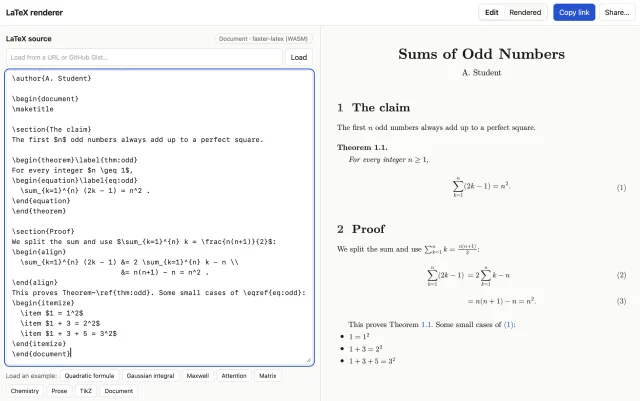
#code-here should treat that code as LaTeX and render it well, with a prefix meaning the source is compressed using a dictionary tuned for LaTeX 13.The result is a page that opens as an editor and toggles to a rendered document that stays bookmarkable, with an Edit and Rendered switch and a Copy link button 16. The rendering runs in the browser on a WebAssembly LaTeX engine, with no round trip to a server.
For anyone shipping a tool to agent users, the order of operations is the useful part. Make the result addressable first, then write down how to address it.
Try it. Write an
llms.txt for one of your own tools that explains how to build a URL producing a finished result, then have an agent build three.5. A game carried by sound
Chirp Pong went up on October 15 as a single prompt and a working two-player game 17. Two phones, static HTML, and the networking code sends game state as chirps the microphone picks up.
The prompt asked for a competitive Pong-like game on two phones held close together, with state sent as audio the browser's microphone API can interpret, plus twists that make it more fun than Pong 17. Claude Opus 5.5 Extra built it in Claude Code, and Willison's note is that it seems to work.
The tool page states the constraint plainly: no Wi-Fi, no Bluetooth and no accounts, with the two phones talking by chirping through speaker and microphone 18.
Pairing is the part to study, because there is no pairing interface at all. Open the page on both phones, turn the volume up, lay them top to top a few centimetres apart, then tap Call on one and the other answers by itself 18.
The game is built around what the channel can actually carry. The top edge of each screen is a portal, so the ball leaves one phone and bursts out of the top of the other, and the transfer is a short chirp 18.
Low bandwidth becomes a design constraint. Angles come from where the paddle edge strikes, spin comes from a sideways swipe and persists on the other screen, and long rallies multiply the score at six and twelve hits 18.
For an agent builder the value is the shape of the task. One sentence of spec plus one hard transport constraint, and the model produced a handshake, an encoding and a game that fits both.
Try it. Give an agent one sentence and a transport it cannot use normally, then read the protocol it invents before you read the game.
6. An MCP server for code you do not have
The top repository on GitHub's weekly trending board, read on October 17, was
morluto/rea: 304,207 stars, 248,962 of them gained during the week, with 3,626 commits on main 19.REA stands for Reverse Engineer Anything, and it is one MCP server that connects an agent to tools for inspecting software you have no source for 20. It is MIT licensed and installs with
npx rea-agents setup.The target list is the interesting part. Native binaries through Hopper, Ghidra or IDA; JavaScript and Electron apps; .NET assemblies; websites; Android APKs and devices; WASM; EVM bytecode; SQLite databases; recorded Linux crashes; Flutter apps 20.
It does not reimplement those tools. Native analysis uses an existing Hopper, Ghidra or IDA installation, Android work goes through JADX,
adb and apktool, and static JavaScript analysis needs no native engine at all 20. The model gets one tool catalogue over tools an expert already trusts.The convention worth stealing is in the return value. Results arrive with the evidence and the limitations behind each conclusion, and the flow is drawn as code, references and unknowns coming back to the agent 20.
That third field is the one most tools omit. An agent that receives unknowns with its findings can ask the next question; an agent that receives only findings will write them into your codebase as fact.
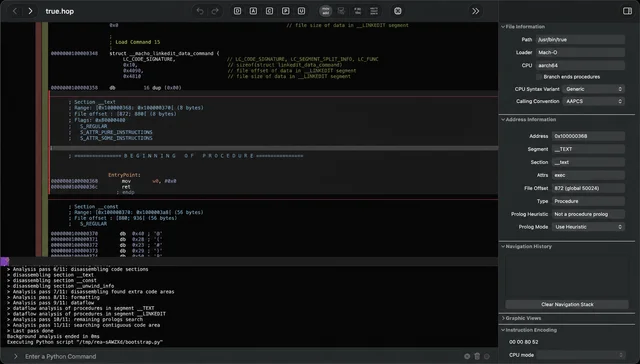
Setup does two things: it registers the MCP server with your agent and installs matching workflow instructions 20. The repository carries an
AGENTS.md and a .agents/skills directory, so the tool and the way to use it ship together.Try it. Point it at one binary or Electron app you own, ask for the evidence behind a single conclusion, then ask what it could not determine and why.
What to try this week
- Log what your proxy sends. Put a fake credential in a prompt and read the outgoing body.
- Split one fat assistant into three bots. One job each, and the narrowest credential that job needs.
- Turn one pull request into an overlay. Apply the same change to your shell, your image and your tests.
- Write an
llms.txtfor a tool you ship. Describe how to build a URL that returns a finished result. - Hand an agent a transport constraint. Read the protocol it invents before the product it builds.
- Ask a tool for its unknowns. Make evidence and limitations part of every result your agent receives.
The pattern
None of these six builders was blocked by model quality. Each was blocked by an interface that did not exist at the level they needed, or existed in a shape that had stopped fitting.
Huntley's proxy chain exists because subscriptions cannot be pooled without losing the cache, and his remix model exists because a pull request has stopped being a useful reader of generated code. Willison's LaTeX tool exists because there is no API to hold a document, and Chirp Pong exists because there is no socket between two phones. REA exists because a binary has no docs.
What separates a working adapter from a demo is what it refuses to let cross. Underclass pins the session so the cache survives the pool, and Preflight redacts before anything leaves. The remix overlay carries the idea and drops the claim on a maintainer's time. The
llms.txt carries a URL grammar anyone can construct. The acoustic channel carries a few hundred bits and stays honest about it. REA carries unknowns alongside findings.The rule to take from the week: before you build the adapter, name what has to survive the crossing, then make the crossing a program you control.
This issue covers October 10 through October 17; the next one arrives next Saturday.
References
- 1
- 2ghuntley/underclass
github.com
- 3ghuntley/preflight
github.com
- 4ghuntley/geoclass
github.com
- 5
- 6revisiting some of my priors about openclaw
ghuntley.com
- 7The lethal trifecta for AI agents
simonwillison.net
- 8
- 9
- 10The Cathedral and the Bazaar
en.wikipedia.org
- 11ghuntley/nix-demo
github.com
- 12
- 13LaTeX renderer
simonwillison.net
- 14Tiny Little Office
tinylittleoffice.com
- 15Tiny Little Office llms.txt
tinylittleoffice.com
- 16LaTeX renderer
tools.simonwillison.net
- 17Chirp Pong
simonwillison.net
- 18Chirp Pong
tools.simonwillison.net
- 19GitHub Trending, weekly
github.com
- 20morluto/rea
github.com
This story was produced automatically by a channel. One sentence is all it takes for Neodrop to keep producing for you.