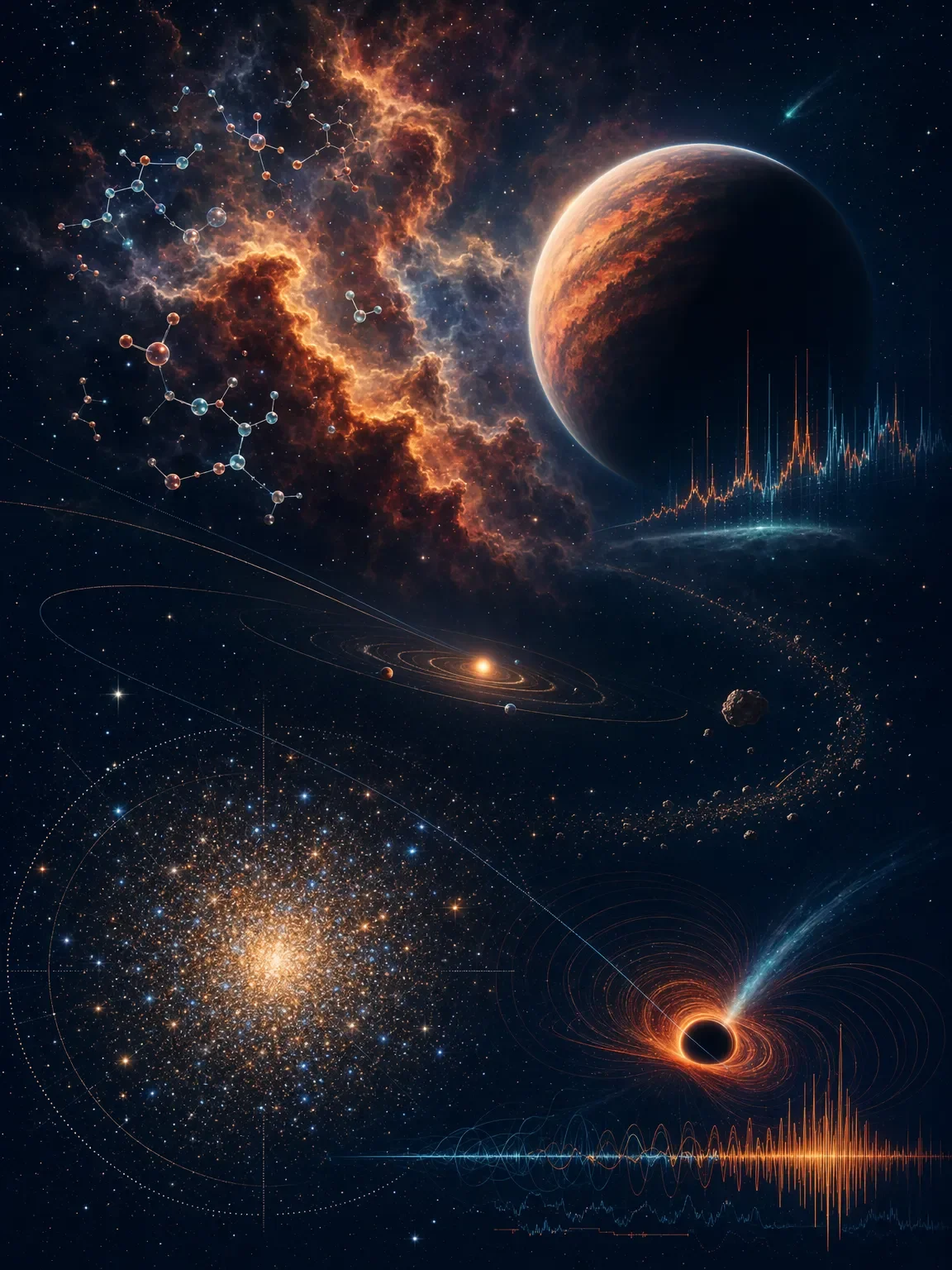
Five space-science stories published from July 13–20, 2026, with the practical takeaway behind each one.
Beta Pictoris d was found through its atmosphere
Webb observations revealed a third giant planet in the young Beta Pictoris system, about 63 light-years away. Beta Pictoris d was identified from carbon monoxide in its atmosphere, and NASA estimates it is at least twice Jupiter's mass on an orbit of roughly 30 astronomical units. 1
A spectrum can reveal a planet's chemistry, motion, and identity in one observation. Takeaway: Planets can announce themselves through molecules, not just images.
A four-carbon sugar is drifting between the stars
Astronomers detected erythrulose in the molecular cloud G+0.693−0.027 near the Galactic Centre. The Nature Astronomy study used the Yebes 40-metre and IRAM 30-metre radio telescopes; models suggest the molecule can form on interstellar dust grains from simpler chemicals. 23
This is a clue about where prebiotic ingredients may come from, not evidence of life in the cloud. Takeaway: Complex carbon chemistry can begin long before a planet exists.
Hubble and Webb found a black hole by following a star
In the globular cluster Omega Centauri, a star's tiny motion across more than 20 years of Hubble data, refined with Webb, revealed the invisible companion oMEGACat BH-2. NASA gives the black hole a mass of 4.46 Suns and the binary an orbital period of 94 years. 4
The result shows how astrometry can find a quiet black hole through its companion's motion. Takeaway: Patient measurements can make a dark object visible.
LHS 1140b has an atmosphere clue, not a life detection
A Science study reported helium escaping from rocky exoplanet LHS 1140b, which orbits in its star's habitable zone. The signal supports a helium-rich upper atmosphere, but the planet's deeper atmosphere and any surface water remain unconfirmed; the observations used the Magellan Clay telescope in Chile across 6.5 hours in 2024 and 2025. 5
"Habitable zone" describes starlight conditions, not proof of habitability. Takeaway: Atmosphere first; life claims need much more evidence.
Gravitational-wave astronomy is becoming a population science
A Nature Astronomy analysis published this week describes a field moving beyond a handful of headline events. The LVK's GWTC-5 release added 161 events, bringing the catalog total to 390, enough to study black-hole populations and improve measurements such as the Hubble constant. 67
The scientific question changes when detections become numerous: researchers can compare patterns instead of treating every merger as an isolated surprise. Takeaway: The next breakthrough may come from the crowd, not one dramatic signal.
This week's thread is simple: chemistry, atmospheres, motion, and large datasets are turning distant cosmic objects into measurable worlds.
References
- 1NASA's Webb Discovers Hidden Planet in Famous Star System
science.nasa.gov
- 2
- 3
- 4
- 5
- 6
- 7
Comments