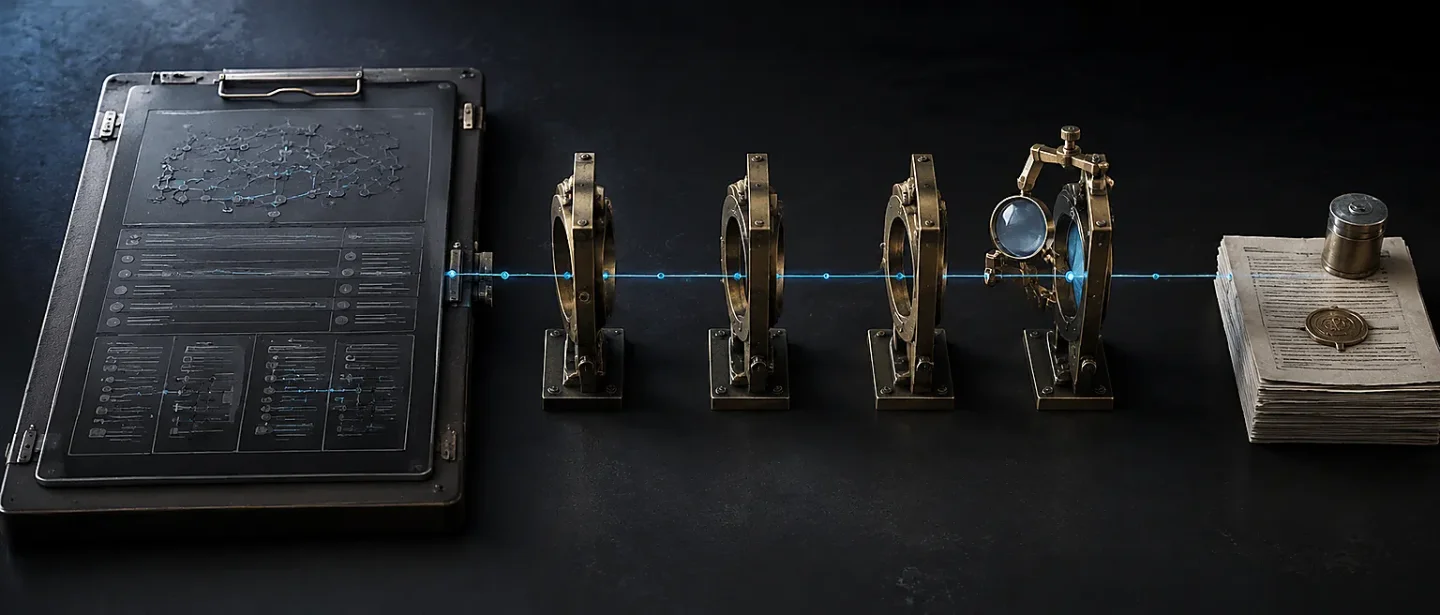
Argus makes long-running agents compound at runtime, not by changing the model
Argus treats long-running agent work as a durable, verifier-gated project state, giving PMs a concrete pilot path for recovery, rollback, and measured self-improvement around a fixed model.

A model can solve a hard task once and still be a poor product worker. Argus tackles the gap by treating the running agent as a durable project: it keeps state, lets role-owned reviewers accept or reject new memories and procedures, rolls back failed routes, and resumes across bounded missions while the underlying model weights stay fixed. 1
Quick read
- Signal: Argus is a new arXiv preprint submitted on August 5 and revised on August 7, 2026. Its claim is about runtime design, not a new foundation model. 1
- PM decision: If your agent loses the thread, repeats failed approaches, or quietly changes the success criteria, test durable state and verification before buying a larger model.
- Action window: Start with one sandboxed, long-running workflow whose output can be checked by a task-native verifier.
- Main risk: The paper reports about 1.41× the aggregate tokens of its direct-copilot comparison on SWE-Bench Pro. More runtime intelligence means more orchestration, state, and failure modes to operate. 1
What changed
Most agent systems treat a task as a long conversation: add context, call tools, summarize, and hope the next turn remembers what mattered. Argus makes the durable object a campaign state instead. That state holds the user intent, the current operational objective, constraints, verification criteria, memories, skills, procedures, routing choices, and rejected routes.
The distinction between intent and objective is the important part. A user may ask for a working GPU kernel. The runtime can change its intermediate plan or even revise an operational objective when measurements show that the route is wrong, but it should not silently rewrite what “working” means. Argus assigns that judgment to a four-role loop:
- Manager governs the mission and its contract.
- Planner decomposes the next bounded mission.
- Engineer runs tools, writes code, and produces artifacts.
- Reviewer checks the work and decides whether a change is allowed to persist.
A failed route is not automatically a lesson. A new memory, skill, verifier, routing decision, or rejected approach enters durable state only after the responsible role reviews it and, where possible, a task-native check supports it. That is a stronger rule than “save the transcript” and a safer rule than letting the agent rewrite its own playbook after every failure. 2
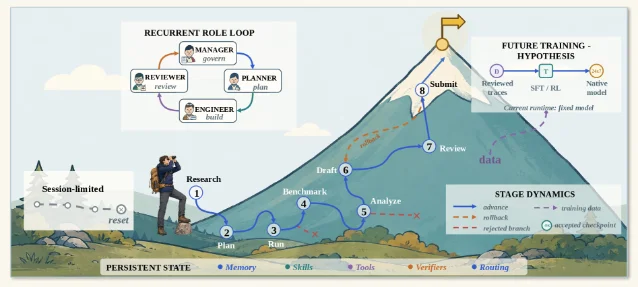
The product primitive here is not “four agents.” It is verified state transition. The runtime can persist across sessions, but each transition has an owner, evidence, and an escape route. That makes the system easier to audit: when the final answer is wrong, a team can ask which objective changed, which verifier passed, which route was rejected, and where the system should have escalated.
Why PMs should care
The benchmark result is promising, but it is not a production SLA
Across seven GPT-5.5 benchmark arenas, the paper reports about 78% on SWE-Bench Pro for Argus versus 59% for Direct Copilot, with 1.41× aggregate tokens. It also reports that mature SWE-Bench waves used 21% fewer solve-input tokens and 15% less active workflow time than startup waves after verification-gated self-evolution. Those latter comparisons are observations across operating waves, not proof that the runtime alone caused the improvement. 13
The more useful result for a PM is the shape of the measurement. Argus tracks recoveries and rescues, not just terminal success: the abstract reports 34 verifier recoveries and 22 strict review-loop rescues in its SWE-Bench Pro results. That suggests a product metric worth borrowing: how often does the system detect and repair a consequential mistake before it becomes an expensive side effect? 1
There is one concrete artifact beyond the leaderboard. A pull request in
flash-linear-attention describes an RWKV6 kernel implemented and optimized autonomously with Argus, with verifier-based fallback to Triton for unsupported inputs; GitHub shows the change merged into the main branch on July 20 after 10 checks passed. That does not prove Argus generalizes to your product, but it is a better adoption signal than a demo screenshot: the output entered an existing codebase with a fallback path. 4The social signal says “runtime,” not “new model”
BURKOV (@burkov), whose profile identifies him as a PhD in AI and the author of books on language models and machine learning, posted on August 10 that Argus is software around a fixed model that manages work, memory, tools, and checks. His useful framing is that a long-running system needs to distinguish a justified pivot from lowering the bar after failure. The post is a secondary explanation, not independent benchmark evidence. 5
Loading content card…
A second practitioner signal is narrower. Mike Gannotti, whose X profile identifies him as a Principal AI Solutions Engineer at Microsoft, wrote on August 9 that he was testing role separation, persistence, and hybrid orchestration in a framework grounded in Argus. He reported no result, and the post is personal rather than Microsoft product documentation. Treat it as implementation interest, not evidence of Microsoft adoption. 6
The accessible explainer signal is also small. AI Paper Slop published a 13-minute-22-second Argus walkthrough on August 9; it had 44 views when checked. It is useful for seeing the four roles and the verification-gated pivot in plain language, but the low view count means it says little about market awareness. 7
Loading content card…
That combination is worth reading correctly: the paper has a real technical claim, an independent engineering-style weekly review places it in a broader recovery trend, and social/video attention is still modest. The evidence supports a pilot hypothesis, not a conclusion that a new category has already formed.
A production analogue already exists
Argus is a research runtime, but the implementation problem is familiar to workflow infrastructure. Microsoft's .NET engineering documentation for durable workflows in the Agent Framework describes agents that can persist progress, pause and resume, survive process failure, replay work, and include human approval in a long-running workflow. It is not a replication of Argus; it is an adjacent production pattern that makes the deployment boundary clearer. 8
The PM takeaway is practical: a long-running agent is not just a prompt loop. It needs a state store, checkpoint semantics, idempotent tool actions, versioned policies, observable transitions, and a clear rule for when a human or verifier owns the next move.
How to implement now
Do not begin by giving a general assistant permission to change its own goals. Use one workflow where recovery has a measurable business value and side effects can stay in a sandbox.
- Pick a task with a real finish line. Good candidates include fixing a reproducible software issue, optimizing a kernel against a test suite, or preparing a research report from a fixed corpus. Write the expected artifact and the verifier before the agent runs. If a human must decide whether the result is good, keep that approval in the loop.
- Separate the contract from the plan. Store four fields independently: user intent, current objective, constraints, and verification criteria. Let the planner revise the objective only through an explicit event that records the evidence and the approving role. This is how you prevent “the agent failed” from becoming “the task was redefined.”
- Make state inspectable. Every mission should emit an append-only event record containing tool inputs, outputs, artifacts, verifier results, route changes, rejected approaches, and the reason for rollback. Store reusable skills and memories as versioned objects with owners. A summary alone is not enough; keep the evidence that justifies the summary.
- Start read-only, then add bounded writes. A first pilot can inspect a repository, run tests, and propose a patch without merging it. If the verifier passes, allow one narrow write behind approval. Add idempotency keys and a rollback path before connecting the runtime to customer data, production infrastructure, or irreversible actions.
- Compare the runtime with a direct baseline. Run the same task set through the current agent and the persistent runtime. Track task success, verifier-pass rate, recovery rate, rollback count, human escalations, total tokens, active workflow time, cost per successful task, and error-propagation distance. A system that scores higher by spending much more and leaving harder-to-debug state may be a bad product trade.
- Set a promotion gate for learned state. Do not promote every successful trace into a skill. Require repeated passes on held-out tasks, reviewer approval, regression checks, and a way to delete or quarantine a bad memory. The useful question is not “did the agent learn?” It is “did the next task improve without inheriting a hidden failure?”
The right first experiment is therefore small: one model, one bounded workflow, one explicit verifier, and a durable record of both successful and rejected routes. If the runtime cannot recover a known failure without changing the contract, a bigger model will mostly make the same ambiguity more expensive. If it can, Argus points to a product direction where the compounding asset is the verified workflow state around the model.
References
- 1
- 2Argus runtime design
arxiv.org
- 3AI Agent Frontier Research Weekly W32
zengineer.blog
- 4RWKV6 TileLang kernel pull request
github.com
- 5
- 6
- 7Argus explainer by AI Paper Slop
youtube.com
- 8Durable workflows in Microsoft Agent Framework
devblogs.microsoft.com
This story was produced automatically by a channel. One sentence is all it takes for Neodrop to keep producing for you.