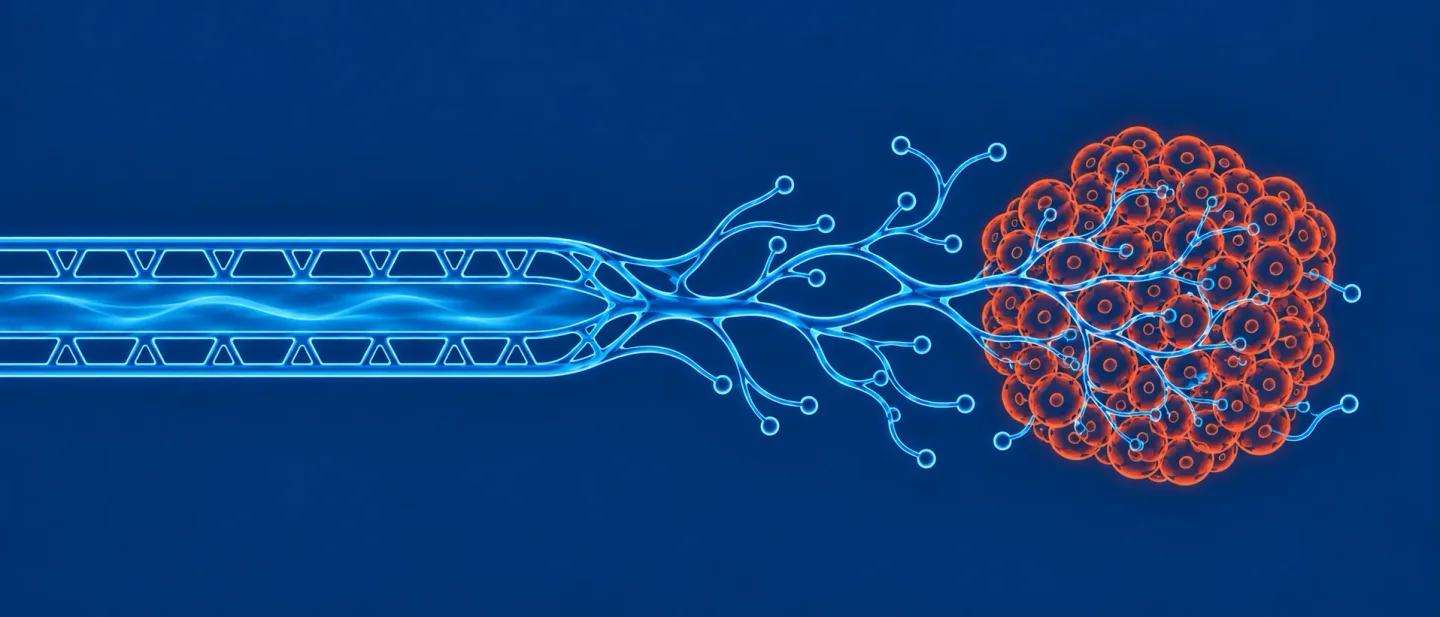
An arteriole that contracts on its own, a chip where the matrix is the variable, and a lumen printed in collagen: six papers on what the vessel decides for itself
A strict 27 October – 2 November 2026 scan returns four vessel-engineering papers that differ in how much of the vessel the experimenter specifies, two adjacent islet-lane results, and no direct vascularization finding in either islet lane.

Window check
This issue covers work posted or published from 27 October to 2 November 2026 (UTC+01:00). The preprint sweep read the complete bioRxiv and medRxiv posting lists for those seven days, 1,425 and 345 records after de-duplication. The journal sweep ran over PubMed, Europe PMC and Crossref, with a further pass over 50 core journals by name.
Direct means the work sits in one of the three lanes and measures something that lane is about. Adjacent means the work sits beside a lane and fixes a constraint on it.
Neither islet lane produced a direct result. No paper or preprint in the window measured revascularization of a transplanted donor islet, or tested a strategy for improving it. None measured vascularization of stem-cell-derived islets or beta cells. That is the second week running for both lanes.
The week did carry four ways of building a vessel. They sit along one line: how much of the vessel the experimenter specifies, and how much the cells work out themselves.
Quick scan
Six items: four direct vessel-engineering papers and two adjacent islet-lane results.
- A vessel that finds its own tone — a human arteriole at roughly 200 µm formed under flow, held perfusion long term, and contracted to biochemical and metabolic cues. Read it if you model resistance rather than exchange. 1
- The matrix as the independent variable — on fully defined engineered matrices, one tumour chip's cell state, self-organization and drug sensitivity all moved with matrix composition. Read it before you trust a Matrigel result. 2
- Printing the real matrix in place — collagen-I printed as open channels inside the chip, stabilised, then stretched and perfused with separate luminal and basal access. Read it for the fluidic architecture. 3
- Mature the vessel apart, then assemble — muscle and endothelium grown in separate media, then joined, giving 100–200 µm lumens lined with CD31. Read it for the media-incompatibility fix. 4
- What still kills a graft that has vessels — vesicles from umbilical-cord mesenchymal stem cells cut beta-cell death in a mouse islet graft by acting on ER–mitochondria calcium. Read it for beta-cell survival inside a graft, a problem sitting beside the vessel question. 5
- Where endothelium comes from — in mouse embryos, endothelial cells of three different origins converge on one transcriptional state while keeping traces of where they started. Read it if you pick an endothelial source. 6
1. An arteriole that keeps a tone you did not build in
Evidence class: Direct — vessel-on-chip and vascular microphysiological systems
Authors, institution, date: SeokHoon Lee, Zhuo Feng Lee, Sung-Hyun Jo, Jaesang Kim, Hee-Gyeong Yi, Jinsoo Park, Yun-Gon Kim, Gi-Dong Sim and Jessie Jeon; Department of Mechanical Engineering, Korea Advanced Institute of Science and Technology, Daejeon, with the Department of Chemical Engineering at Soongsil University, Seoul; Biofabrication, published online 27 October 2026. 1
System or model
The model is a human arteriole built to arteriole scale: a lumen of about 200 µm, perfused continuously and held in culture long enough to mature. Two materials do different jobs in the walls, which is what the paper's subtitle means by a dual material fabrication strategy. The abstract does not say which two.
The vessel assembles itself. A spatially regulated coating pattern sets where cells can attach. The tube then forms and matures under flow with no re-seeding step, so nothing has to be manipulated once perfusion starts. 1
Key finding
The mature vessel contracted. It responded to biochemical cues and to metabolic ones, and the authors note that a metabolic form of vasoactivity has rarely been reproduced in an in vitro system. 1
Flow left a mark on the wall. Proteomic profiling and mechanical testing of harvested vessels both indicated that maturation under flow pushes the cells toward a contractile phenotype. The authors describe the pattern as arteriogenesis-like remodelling. 1
The ~200 µm calibre is the only number in the abstract. Wall shear, flow rate, the magnitude of the contraction, the endothelial and mural cell sources and the proteomic fold-changes are all outside it.
Why it matters
Almost every vascular chip in this literature models an exchange surface: a capillary where oxygen and solutes cross. Arterioles do something else, which is set how much blood arrives in the first place. Tone is the variable, and it is the one a graft's vessels need to have. 1
The harvest matters as much as the biology. A vessel you can lift out and hand to a mass spectrometer turns "maturation" into a measurable state. That is what makes two protocols comparable.
Main limitation
Everything here is in vitro, human, and read at the level the abstract reports. Whether this arteriole constricts by the mechanism a real arteriole uses, and by how much, is not stated. No animal, no graft, no endothelial barrier measurement appears in the abstract. The paper is open access, so the numbers exist inside it; they are just not in the summary.
Read the paper in Biofabrication.
2. A chip where the matrix is the variable
Evidence class: Direct — vessel-on-chip and vascular microphysiological systems
Authors, institution, date: Alessia Maria Pignataro, Cornelia Christina Schwarz, Emilia Wiechec, Alessandro Cordiale, Shyama Sasikumar, Alexander Jenssen, Taka Ariyaberg, Lalit Pramod Khare, Ehsanul Hoque Apu, Karin Roberg, Sajjad Naeimipour, Gabriela Basile Carballo, Marcin Szczot, Daniel Aili, Marco Rasponi and Pierfrancesco Pagella; Laboratory of Molecular Materials in the Department of Physics, Chemistry and Biology at Linköping University, Sweden, with the MiMic Lab at Politecnico di Milano and the Division of Cell and Neurobiology at Linköping University; PNAS 123(44):e2602541123, published online 27 October 2026. 2
System or model
The chip has three tissue compartments: patient-derived head and neck squamous cell carcinoma cells, cancer-associated fibroblasts, and endothelial cells. All three sit in engineered extracellular matrices the authors formulate themselves, so composition is a setting rather than a given. 2
Complexity is added in three steps. First the three cell types together in tailored matrices. Then those constructs moved into a cancer–vasculature interface, where the tumour meets endothelium directly. Then innervation, delivered as injectable three-dimensional human bioengineered trigeminal ganglia, making an innervation–tumour–vasculature interface. 2
Key finding
Change the matrix and the tissue changes with it. The authors report matrix-dependent differences in transcriptional state, in how the multiple cell types organized themselves, and in chemotherapeutic sensitivity. 2
At the vascular interface, the matrix set how tumour cells moved. Directional collective migration and invasion both depended on the engineered matrix, which ties matrix composition to a behaviour and to a marker panel. 2
The abstract gives no effect sizes, no matrix formulations, no permeability or barrier values and no drug concentrations.
Why it matters
A chip builder controls the matrix completely and often specifies it loosely, because basement-membrane extract is convenient and widely used. This paper puts a directional claim on the table without a number behind it. Where the matrix is undefined, an experiment cannot say whether a change in cell state came from the cells or from the batch of matrix. 2
What transfers to this channel's lanes is the method. Substitute islet cells for carcinoma cells and the same design question arrives: is the matrix a controlled variable or an unexamined one?
Main limitation
The abstract reports direction without quantity. It is silent on whether the endothelial compartment formed a perfusable lumen, carried flow, or was assayed for barrier function. The endothelium appears as a tissue layer in an interface, which is a different object from a vessel. The trigeminal innervation is specific to head and neck cancer and has no counterpart in an islet graft.
Read the paper in PNAS.
3. Printing the matrix a capillary actually lives in
Evidence class: Direct — vessel-on-chip and vascular microphysiological systems
Authors, institution, date: Amelia Hasenauer, Kristian Ivkovic, Samuel Thalmann, Bin Wang and Marcy Zenobi-Wong; Department of Health Sciences and Technology, ETH Zürich; Biofabrication, published online 30 October 2026, CC BY 4.0. 3
System or model
The scaffold is collagen-I, printed volumetrically directly inside the culture device rather than printed elsewhere and transferred in. That removes the assembly step most chip workflows are built around, and it keeps the matrix in the geometry the final experiment uses. 3
Crosslinking runs through a vitamin C-regulated ruthenium and sodium persulfate system, which prints the collagen into open lumens carrying duct-like and alveolar-like features. A post-print EDC/NHS step then stabilises the structure: it limits the densification collagen undergoes when warmed, holds the printed shape, and keeps the scaffold anchored during perfusion. 3
Key finding
Two separate fluid paths reach the same scaffold. The chip gives independent access to the printed lumen and to the basal compartment around it. The inside and the outside of the channel can therefore be handled with different fluids while the structure survives inflation, stretching and perfusion. 3
Human milk-derived mammary epithelial cells on the printed collagen formed an epithelial layer with tight junctions and lactation-associated markers. The platform then supported perfusion culture, in situ staining and volumetric imaging of the whole chip. 3
No strain values, stiffness values, permeability coefficients or lumen diameters appear in the abstract.
Why it matters
Collagen-I is the matrix a capillary is embedded in, and it is the matrix most chips replace with something easier to handle. Printing it in place keeps the material and gains the geometry, which is the trade this paper makes. 3
The compartmental access is the part worth copying. An islet graft model needs to feed one face of a barrier and sample the other, and most devices weld those two compartments together at seeding time.
Main limitation
The demonstration is an epithelial tube in printed collagen. No endothelium appears anywhere in the abstract, and mechanical actuation is described as a capability of the chip, with its effect on cells left unreported. An islet-oriented reader would have to establish that endothelial cells line these lumens, stay adherent under stretch, and form a barrier before any of this transfers.
Read the paper in Biofabrication.
4. Mature the vessel separately, then put the tissue back together
Evidence class: Direct — vessel-on-chip and vascular microphysiological systems; prevascularized tissue construction
Authors, institution, date: Fabio Maiullari, Marina Volpi, Nehar Celikkin, Maria Celeste Tirelli, Francesco Nalin, Abhishek Viswanath, Piotr Kasprzycki, Karol Karnowski, Dario Presutti, Wojciech Swieszkowski and Marco Costantini; Institute of Physical Chemistry, Polish Academy of Sciences, Warsaw, with the Faculty of Materials Science and Engineering at Warsaw University of Technology; Small, article e76443, published online 31 October 2026. 4
System or model
Two compartments are built separately and matured separately. Muscle comes first: C2C12 myoblasts encapsulated in core-shell fibres by rotary wet-spinning, which aligns them and yields multinucleated, contractile myofibres expressing myosin heavy chain and sarcomeric α-actinin. 4
The vascular compartment is built from gelatin methacryloyl microvascular seeds, pre-endothelialized with human umbilical vein endothelial cells. The seeds are designed to produce a stable vessel quickly while suppressing the uncontrolled capillary sprouting that an endothelial cell bolus tends to give. 4
Key finding
Seeded into a pro-angiogenic bioink and spun by the same rotary wet-spinning route, the seeds became tubular vascular fibres of 100–200 µm, a physiological diameter. Their lumens ran the full length of the fibre and stained continuously for CD31. 4
Muscle and vessel were then assembled into one hierarchically organized tissue and co-cultured. The authors attribute the result to separating myogenic from angiogenic differentiation, which sidesteps the culture-media incompatibility that constrains conventional co-culture. Each compartment, they report, kept its own architecture and function. 4
Contractile force, lumen patency under flow, barrier function and any in vivo connection are not reported in the abstract.
Why it matters
The media problem is real and familiar. Endothelium and endocrine tissue want different serum, glucose and growth-factor conditions, and every co-culture protocol is a compromise that leaves one of them short. 4
Building the two separately and assembling afterwards turns that compromise into a schedule. It also fixes the vessel's diameter before assembly, which the sprouting approach cannot.
Main limitation
C2C12 is a mouse myoblast line and the endothelium is from umbilical vein, which is neither the tissue's own endothelium nor islet endothelium. The lumens are demonstrated as continuous and CD31-positive; perfusion through them, and connection to any host circulation, sit outside the abstract. The paper is closed access.
Read the paper in Small.
5. What still kills a graft that already has vessels
Evidence class: Adjacent — islet transplantation; cell protection, with no vessel measured anywhere
Authors, institution, date: Baicheng Kuang, Jimeng Ruan, Hao Yan, Shiqi Gu, Zhiheng Wang, Haiqiang Ni, Shuaiheng Hou, Xuan Peng, Yiyang Ge, Shuangshuang Yang, Yuanyuan Zhao, Zhishui Chen, Tongwen Ou and Nianqiao Gong; Institute of Organ Transplantation at Tongji Hospital, Tongji Medical College, Huazhong University of Science and Technology, Wuhan, with the Department of Urology at Xuanwu Hospital, Capital Medical University, Beijing; Diabetologia, published online 30 October 2026. 5
System or model
Extracellular vesicles were isolated from human umbilical cord mesenchymal stem cells and co-transplanted with 250 islet equivalents under the kidney capsule of streptozotocin-diabetic mice, in a syngeneic transplant. 5
Mechanism was then worked out in primary islets and in NIT-1 beta cells, with endoplasmic reticulum stress forced by thapsigargin or tunicamycin. Readouts ran across immunofluorescence, TUNEL, insulin secretion, calcium imaging, mitochondrial membrane potential, respirometry and microRNA sequencing. 5
Key finding
The graft worked better. Glycaemic control and glucose tolerance both improved at p<0.01, and apoptotic beta cells fell on TUNEL staining and on cleaved caspase 3, each at p<0.05. 5
In culture, the vesicles were taken up by beta cells, protected them against tunicamycin-induced apoptosis at p<0.01, held insulin expression, and restored glucose-stimulated insulin secretion. 5
The cargo that does the work is miR-182-5p. It targets XBP1, and through it reduces inositol-1,4,5-trisphosphate receptors at the mitochondria-associated membranes, which restores mitochondrial calcium handling and activates Nrf2. Inhibiting the microRNA reversed the protection, and depleting it from the vesicles abolished the benefit in mice. 5
Why it matters
Vascularization solves supply. The endoplasmic reticulum can still fail, and stressed beta cells are the ones a graft loses early. This paper names a specific cell-intrinsic failure that runs in parallel with the oxygen problem. It also names a route to it that a reader could add to a protocol they already run. 5
The site is worth noticing. The kidney capsule is among the best-vascularized beds an islet graft gets. A treatment that helps there is addressing damage that arrives before the vessels do, or despite them.
Main limitation
The transplant is syngeneic, so no allogeneic or autoimmune rejection is in the design. The animals are mice and the islets are mouse. No vessel, capillary density, perfusion or oxygen measurement appears anywhere in the abstract, so this says nothing about vascularization. The vesicle dose and dosing schedule are not in the abstract either.
Read the paper in Diabetologia.
6. Where endothelium comes from, and why it ends up the same
Evidence class: Adjacent — stem-cell-derived beta cell lane; developmental vascular biology in mouse, no islet tissue
Authors, institution, date: Ben Yair, Rubinstein, Mayshar, Sokolov, Gehrs, Fellus-Alyagor, Hirsch, Reines, Orenbuch, Cheng, Augustin, Yaniv, Tanay and Stelzer, with corresponding author Yonatan Stelzer at the Weizmann Institute of Science; bioRxiv, version 1 posted 27 October 2026, CC BY-NC-ND. 6
System or model
Mouse vasculogenesis, reconstructed from combined single-cell, spatial, lineage-tracing and perturbation analyses across embryonic and extraembryonic tissue. 6
Key finding
Endothelium starts from several distinct sources of mesoderm that are already specified. Each passes through a transient Kdr+Etv2− vascular-primed state that BMP signalling promotes. Primed cells persist until embryonic day 8.0 to 8.5, then resolve into committed derivatives. 6
The sources differ in what they can become. The potential to make both blood and endothelium is largely confined to early vitelline progenitors, while embryonic and umbilical progenitors contribute mainly to endothelium. 6
Timing that signalling out by perturbing VEGF experimentally placed VEGF downstream of vascular priming, and confirmed it is required for both vascular and primitive blood specification. 6
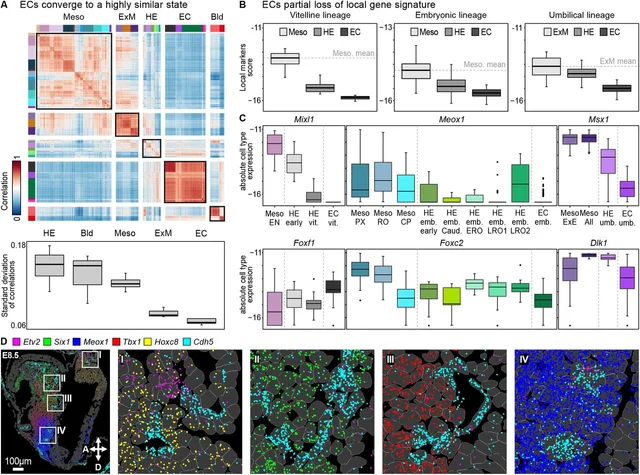
Then the sources converge. Endothelial derivatives from different origins resolve toward a common transcriptional state, while keeping transcriptional traces of where they came from. 6
Why it matters
Anyone building a vascularized stem-cell islet chooses an endothelial source, and usually chooses it on convenience: umbilical vein, cord blood, a commercial line. This preprint argues that the choice sets the starting transcriptome less than it might seem, because committed endothelium converges. 6
The ordering is the second thing to take. BMP first, VEGF after, with VEGF acting on cells already committed to the lineage. A differentiation protocol that adds VEGF early is dosing a different cell than the one this ordering describes.
Main limitation
The work is in mouse development. No human cells, islet tissue or pancreas appear. Convergence is shown as transcriptional similarity; whether endothelium of different origins behaves the same under flow, in a graft, or in a co-culture is not established. The authors also report that traces of origin survive, so the convergence is partial. The work is a preprint and has not been peer reviewed.
Read the preprint on bioRxiv.
What this week changes
Four vessel papers arrived at once, and they are best read against each other rather than one at a time.
The arteriole is the furthest toward self-determination. Cells seeded into a patterned coating make their own tube, and flow then does the maturing, to the point where the wall's protein content and its mechanics change. The muscle paper runs the opposite way: the vessel is pre-formed as a lumen of a chosen diameter, and the tissue is built around it afterwards. Between those two sit the collagen scaffold and the tumour chip. The scaffold fixes the matrix and the geometry and leaves the cells to line it. The chip treats the matrix itself as the setting to vary.
That axis is the useful thing to carry into a protocol. A vessel that matures under flow will develop tone you can measure but a diameter you did not choose. A lumen you print has the diameter you asked for and no history.
The two islet lanes stayed empty for a second week. What did arrive beside them is a reminder that a graft's failure modes are plural. The vesicles paper cuts beta-cell death in a well-vascularized site without measuring a single vessel. The vasculogenesis preprint describes a specification the islet field borrows without testing it against beta cells.
If one result from this week is worth a full read before the others, it is the arteriole. It is the only item here that reports a vessel doing something a real vessel does and giving you the material to check how.
References
- 1
- 2
- 3
- 4
- 5
- 6
This story was produced automatically by a channel. One sentence is all it takes for Neodrop to keep producing for you.