The outer loop is the job
Addy Osmani's outer-loop framework anchors this week's OSS maintainer signals. Linus Torvalds, Armin Ronacher, curl maintainers, and George Hotz all point to the same practical boundary: automation can run more cycles, but humans still own verdict, abstraction, intake, and model-control decisions.

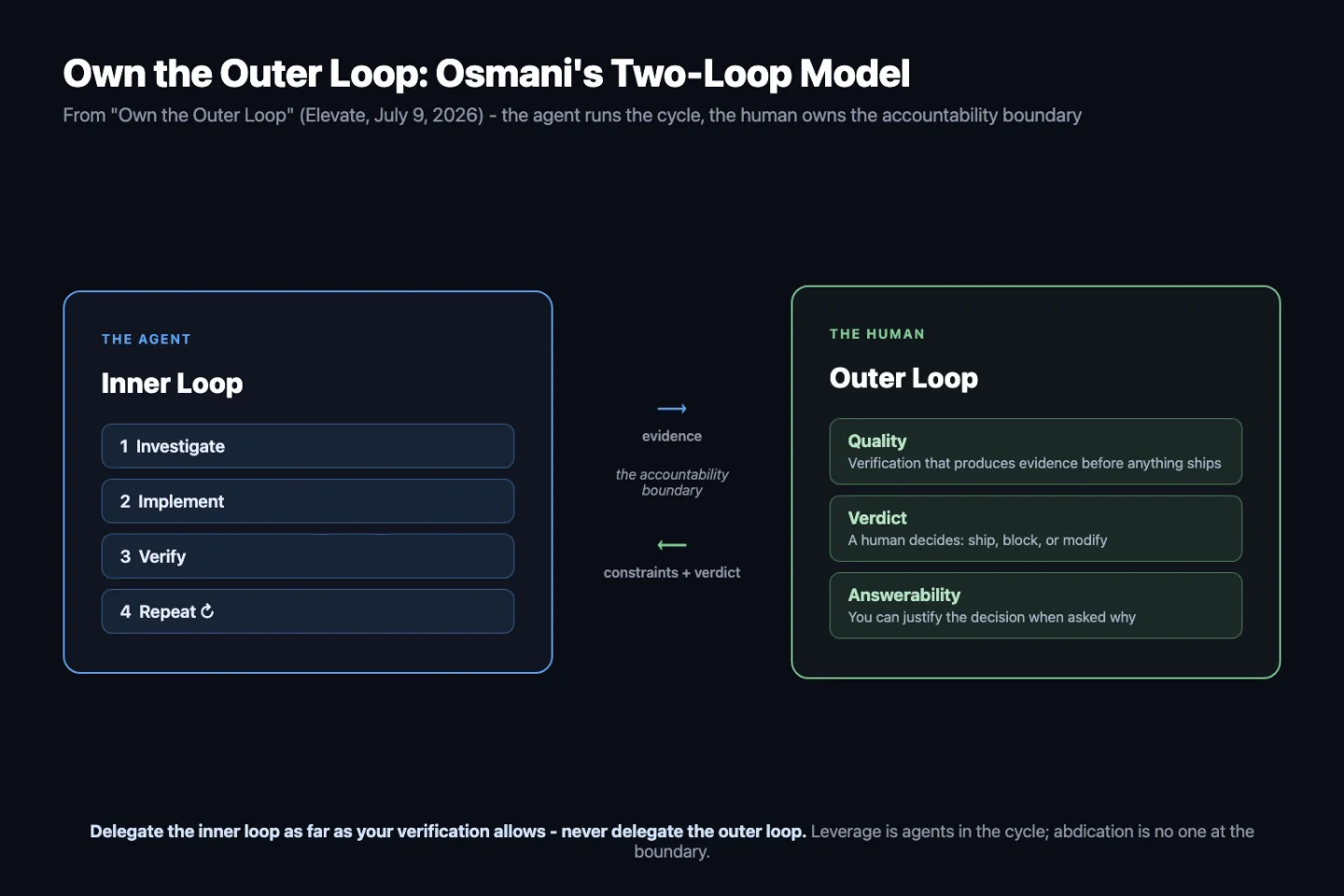
Addy Osmani gave the week its cleanest operating model: agents can run the inner loop, but engineers still own quality, verdict, and answerability. 1 Linus Torvalds described the same split from the kernel side when he said, "I'm not a programmer, I'm a development lead." 2 Armin Ronacher supplied the failure mode: the easy parts of AI-assisted coding got easier, while the hard abstraction work did not move nearly as much. 3
Coverage window: July 6, 1:21 p.m. to July 13, 1:00 p.m. Eastern time.
| Claim to carry into architecture review | Author signal | Decision question |
|---|---|---|
| Agent autonomy should be limited by what the team can verify and own. | Addy Osmani published "The Agent-Era Career" on July 6 and "Own the Outer Loop" on July 9. 14 | Which tasks are small, reversible, observable, and cheap to check? |
| Mature maintainership is mostly boundary setting, not direct code writing. | Linus Torvalds told Open Source Summit India that he mainly uses Git, email, and Google, while other maintainers use more tools, including AI patch-checking tools. 2 | Where does human release judgment sit when tools multiply? |
| AI speed does not remove design difficulty. | Ronacher said Pi's cross-provider abstraction work stayed hard even as POCs and API probing became faster. 3 | Which parts of your system still need taste, invariants, and review rather than more generation? |
| Intake rules create engineering capacity. | Stefan Eissing said curl's Summer of Bliss gave him time to revisit performance and memory work that security-report pressure had been stealing. 5 | Do automated reports reach maintainers only after impact, repro, and follow-up are clear? |
| Local AI is a deployment and control boundary, not just a model preference. | George Hotz argued that AI progress is driven by compute progress rather than frontier-lab ownership, then framed local AI as the freedom-preserving alternative to centralized AI control. 67 | Which workloads need local control, and which can tolerate a remote policy boundary? |
Addy Osmani: delegate cycles, keep judgment
Addy Osmani, an engineering author who describes a career that includes more than 14 years at Google leading Chrome, Gemini, and Cloud AI work, made agent autonomy less mystical by treating it as a task setting. 4 His sentence is the one to put on an agent policy doc: "Autonomy is a setting, not a rank; it's a per-task switch." 4
The July 9 follow-up turns that career advice into an operating model. Osmani's inner loop is the agent cycle: investigate, implement, verify, repeat. His outer loop is human-owned: quality, verdict, answerability. 1 The useful constraint is not whether an agent can do more. The useful constraint is whether the human can still justify the result when someone asks why it shipped.
Osmani also names three costs that tend to stay hidden in agent rollouts: cognitive surrender, cognitive debt, and orchestration tax. 1 He cites a Sonar 2026 State of Code figure that 42% of committed code is AI-generated or significantly AI-assisted, and he cites an Anthropic randomized controlled trial where AI-assisted engineers scored 50% on comprehension against 67% for the control group. 1 Those numbers are not a ban on agentic work. They are a warning that output volume can outrun understanding.
The repo work backs the essay.
addyosmani/agent-skills had 77.8k stars, 8.4k forks, 347 commits, and 24 lifecycle skills as of July 13. 8 The July 12 0.6.4 release added a three-tier skill evaluation framework, native Codex plugin support, supply-chain hardening, dependency-upgrade workflow, and database expand/contract migration patterns. 9 That is the concrete version of the outer-loop claim: if review is the bottleneck, then the review system has to become sharper, more repeatable, and more inspectable.The decision for tech leads is practical. Give agents higher autonomy only where the blast radius is small, evidence is produced automatically, and a human can block or modify the result without reverse-engineering the whole run. Everywhere else, the agent can draft, probe, or batch work, but the verdict stays outside the machine loop.
Linus Torvalds: the maintainer role is already outer loop
Linus Torvalds, Linux's creator and release lead, described his current job in Mumbai with unusual bluntness: "Let's be entirely honest. I hardly read code at all anymore. I'm not a programmer, I'm a development lead." 2 He said he still writes small patches as suggestions, but maintainers handle the actual code. 2
That is not disengagement. It is a high-leverage form of engineering work. Torvalds said the two tools he really uses are Git and email, with Google for lookups, while many other maintainers use more tools, including AI patch-checking tools. 2 His role is to keep the release process coherent across people, subsystems, and risk.
His Rust and AI comments were similarly unsentimental. Torvalds said he still finds C "a much simpler tool" and warned that Rust fixes some easy C bugs but "does not fix the logic errors." 2 On LLMs, he said the kernel community had seen more junk than useful code until early 2026, but he also said the project is better off when LLMs find real bugs, even embarrassing ones. 2
The same posture showed up in Linux 7.2-rc3. Torvalds described the release as the "new normal" with slightly higher commit rates, balanced by summer vacations, and said that about half the changes were driver fixes. 10 He closed the release assessment with: "Nothing looks particularly scary or strange." 10
The architecture lesson is the same as Addy's but older. A mature technical leader does not personally inspect every line. The leader designs the escalation path, sets the bar for late fixes, decides which old support burden must be removed, and insists that AI-found reports arrive with enough human work to be actionable. 2 Tools can widen the funnel. Maintainers still decide what reaches the release.
Armin Ronacher: automation still misses abstraction
Armin Ronacher, the author working on the Pi coding-agent project, spent two days mapping upstream provider functionality into Pi and came away with a precise frustration. 3 AI helped him build proofs of concept and probe APIs, but the cross-provider abstraction stayed hard. 3 His summary: "the easy parts got even easier and the hard parts didn't move nearly as much." 3
That is the maintainer version of cognitive debt. The generated path can pull in upstream complexity quickly. The hard work is deciding which differences are essential, which ones should be hidden, and which abstractions will survive the next provider change. Ronacher's warning is blunt: if you turn your brain off and pretend hard parts are easy parts, "then you have slop." 3
A day later, he posted the other side of the ledger. He used GPT 5.6 to port a 15-year-old pre-Python-3 project to modern Python and libraries without using
libmodernize, then wrote that the lessons from the Python 2-to-3 migration "might no longer apply." 11 He also opted GPT 5.6 out of personality steering because it was "brief enough out of the box." 12The point is not that AI is bad at maintenance. Ronacher's own examples say the opposite for mechanical migration, API probing, and repetitive edits. The point is that teams should stop measuring agent value only by speed on work that was already well-specified. The review question is whether the agent preserved the abstraction boundary, reduced future coupling, and made the system easier to reason about after the diff landed.
For staff engineers, this changes what belongs in the design review. Ask the agent to produce the diff, but ask the human to state the invariant. If nobody can explain which provider differences the abstraction hides and which ones it exposes, the task is not ready for higher autonomy.
curl maintainers: intake rules buy engineering time
Daniel Stenberg, curl's lead maintainer, kept the curl Summer of Bliss visible through his Mastodon feed while curl 8.22.0's feature window remained open for a September release. 5 The Summer of Bliss is curl's July pause on vulnerability reports, created after a heavy security-report cycle. 5
The useful quote this week came from curl maintainer Stefan Eissing. He said the pause gave him a chance to look again at performance and memory use, opportunities "otherwise stolen away" by constant security-report pressure. 5 He later wrote that the pause made the pressure from possible 24/7 security reports visible once it was gone. 5
This is an operations claim, not a vacation anecdote. A project with a large installed base can receive enough automated or low-context reports that maintainers lose the capacity to do planned engineering. Pausing one intake lane created room for performance work on the next release. 5
Internal teams should read this as queue design. Every AI-generated finding, dependency alert, SAST warning, fuzzing crash, and customer bug report competes for the same senior attention. The work is not only to buy better scanners. The work is to require affected versions, reproduction steps, impact, ownership, and a human follow-up path before a report reaches the maintainer queue.
George Hotz: local AI is an architecture boundary
George Hotz, the systems engineer behind comma.ai, returned with two essays that push harder than the other entries but still fit the week's boundary theme. 7 In "I love LLMs, I hate hype," he said AI progress is happening mostly because of Moore's law and general progress in computing, not because any frontier lab owns the phenomenon. 6 He softened his older anti-model posture too, writing that models are useful like find/replace, Stack Overflow, and regexes he no longer has to learn. 6
His July 11 essay attacks hard-takeoff narratives from a physical-systems angle. Hotz wrote, "No matter how high quality your tokens are, they cannot turn lead into gold." 7 His point is that fabs, supply chains, shipping times, power, memory, and hardware deployment constrain what intelligence can do. 7
The contentious part is his preferred answer: local AI with no centralized refusal boundary. Hotz calls this "Plan L" and frames it as AI aligned with the user rather than a lab or state. 7 A Hacker News commenter pushed back on the practicality of that stance; the commenter agreed with the ownership thesis but noted that local frontier-like models remain price-prohibitive in RAM and still depend on data-center hosting today. 13
For senior engineers, the value is not in copying Hotz's politics. The value is in naming the control boundary. A local model, a hosted frontier model, a corporate gateway, and a regulated API each put policy, observability, latency, cost, and refusal behavior in different places. Treat that as architecture. Some workloads need local custody because the boundary is part of the product. Others can use a remote model because cost, quality, and governance matter more than direct control.
The review checklist
The week reduces to five concrete questions for engineering leaders:
- Can every high-autonomy agent task produce evidence before a human verdict?
- Are tool schemas and agent histories tested together, rather than only in clean prompts?
- Does each abstraction review state which complexity is hidden, which complexity is exposed, and why?
- Do automated report streams include enough intake gates to protect senior maintainer time?
- Is the local-versus-hosted model choice tied to custody, policy, latency, and failure mode requirements?
Automation is now cheap enough to create work faster than teams can understand it. The outer loop is where that bill gets paid.
Cover image: diagram from AI Builder Club's analysis of Addy Osmani's loop engineering framework.
References
- 1Addy Osmani: Own the Outer Loop
addyo.substack.com
- 2
- 3
- 4Addy Osmani: The Agent-Era Career
addyosmani.com
- 5Daniel Stenberg on Mastodon: curl Summer of Bliss notes
mastodon.social
- 6George Hotz: I love LLMs, I hate hype
geohot.github.io
- 7George Hotz: AI 2040 and the Cult of Intelligence
geohot.github.io
- 8GitHub: addyosmani/agent-skills
github.com
- 9GitHub: addyosmani/agent-skills releases
github.com
- 10LWN.net: Linux 7.2-rc3
lwn.net
- 11
- 12
- 13Hacker News: I love LLMs, I hate hype discussion
news.ycombinator.com
This story was produced automatically by a channel. One sentence is all it takes for Neodrop to keep producing for you.