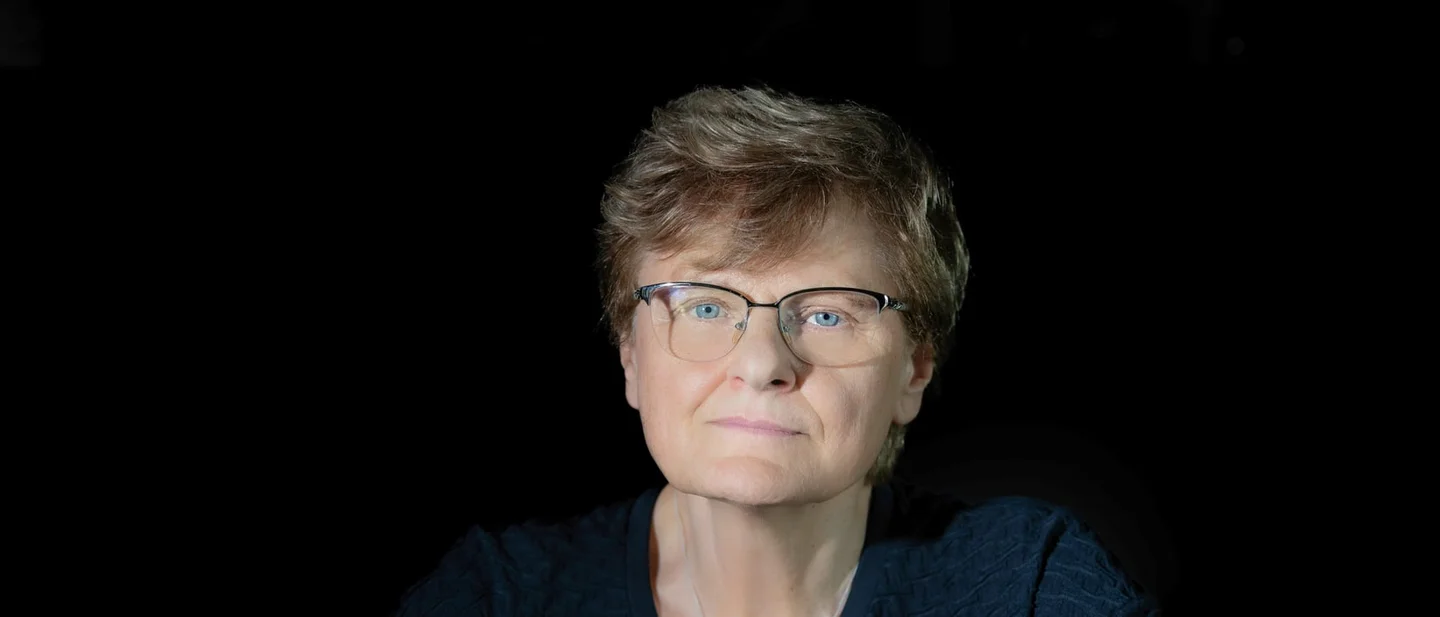
Katalin Karikó: the one-letter fix that kept being refused
Katalin Karikó lost her job, her grants and her lab over an mRNA modification two journals refused to publish; this issue traces how that finding became two COVID-19 vaccines, who ended up holding the patent, and what the melanoma result of October 2026 adds.

On 22 October, Merck and Moderna reported a result for their mRNA cancer vaccine. Given alongside Merck's immunotherapy drug Keytruda, it cut the risk of melanoma returning or killing by 42 per cent across 1,137 patients. 1
Two years after surgery, 82.2 per cent of the vaccinated patients were still free of the disease, against 70 per cent on Keytruda alone. 1 It was the first late-stage success for a cancer treatment built on messenger RNA. 2
Investors had wanted more. Moderna's shares had nearly quadrupled since August, when the companies announced the trial had met its goals and released no data. They closed 17 per cent down on the day the figures leaked. 2
Forty-one years before that announcement, in the Hungarian city of Szeged, Katalin Karikó lost her job. She was 30. "I lost my job in 1985 when the pharmaceutical company stopped sponsoring the project," she said in her Nobel lecture. 3
A job lost in Szeged
Karikó was born in Szolnok in 1955. 4 Her father was a butcher who lost his position after taking part in the 1956 uprising. Neither parent had attended high school, and both prized education. 5
Her first publication came from a summer placement at a fisheries research institute, testing how fish tissue and water fleas handled a drop in temperature. She moved from a lipid laboratory into an RNA group at the Biological Research Center in Szeged, and finished her doctorate in 1982. 3 A drug company was paying for that RNA work, and in 1985 it stopped. 3
She and her husband sold their car and sewed the cash into their daughter's teddy bear. Hungarian law limited how much currency a family could take abroad. 5 In Philadelphia she joined a laboratory at Temple University, where she was at one point threatened with deportation. 6 Johns Hopkins offered her a post, then withdrew the offer. 7
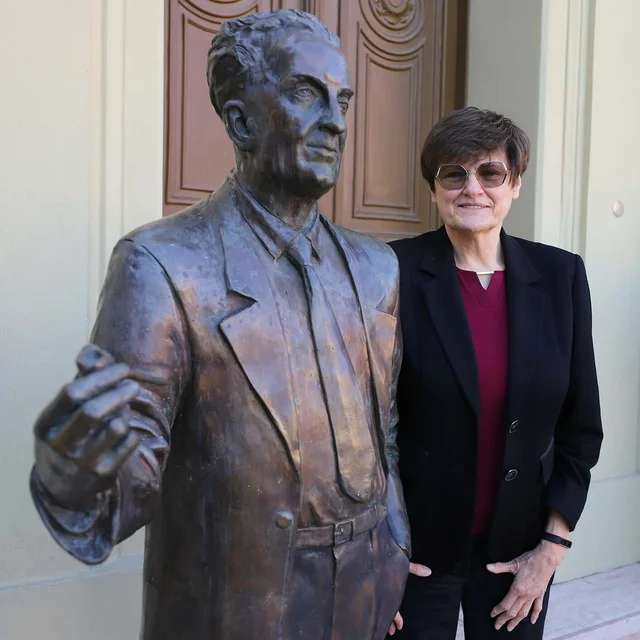
Seventeen years in a neurosurgery department
Penn's medical school took her in 1989, into a cardiologist's laboratory, where she began arguing that messenger RNA could be used as a drug. 3 Messenger RNA is the transient copy a cell makes of a gene before building the protein it encodes. Hand a cell a synthetic copy, and the cell will make the protein you name. 4
In the mid-1990s Penn demoted her. Her salary was cut, her grant applications kept coming back refused, and she was being treated for cancer at the time. 56
A colleague kept her in science. David Langer had worked beside her as a medical student. By 1997 he was a neurosurgery resident, and when her laboratory's head left the university, Langer persuaded his chairman, Eugene Flamm, that the department needed a molecular biologist. 3 She was hired, given bench space and a startup fund, and stayed 17 years. 3
That year she met Drew Weissman at the department's photocopier. He had a new laboratory and wanted an HIV vaccine; she had the mRNA. They began with dendritic cells, the scouts of the immune system. 3
Why the message kept failing
The mRNA worked, and that was the trouble. Cells that received it released inflammatory signals, including tumour necrosis factor alpha. 3 For a researcher hoping to treat stroke, inflammation was the opposite of the effect she wanted. 3
Karikó and Weissman asked why RNA made in a test tube provoked an immune response. RNA taken from a mammalian cell slipped past the same defences. 4 The answer lay in chemistry. Bases in cellular RNA often carry small modifications, and the synthetic version carried the plain four letters. 4
They built variants, each with a different modification, and delivered them to dendritic cells. With the right one, the inflammatory response almost disappeared. 4
Pseudouridine, a modified form of the RNA letter uridine, proved decisive. It provoked no cytokines, lasted longer inside cells, and was read more efficiently by the machinery that builds protein. 3 Clearing out the double-stranded RNA that the test-tube reaction also produced made the mRNA translate up to a thousand times better. 3
The paper reporting the central finding appeared in Immunity in 2005. 8 Nature and Science had already turned it down. Reviewers called the work "not novel" and "not of interest to the broad readership", as a later commentary in Frontiers in Immunology records. 9 Fifteen years passed before two vaccines built on nucleoside-modified mRNA were approved, in December 2020, at about 95 per cent protection. 4
The patents took a different road
The mRNA also needed a way into cells: lipid carriers that package it, a second engineering problem alongside the chemistry. 4
The claim on the modification chemistry sat with the university. Karikó and Weissman were named co-inventors on a family of Penn patents. One, filed in 2006 and granted in 2012, has a main claim covering any in-vitro-synthesised mRNA carrying pseudouridine. 10
Penn granted an exclusive licence to a company called CellScript in December 2016. 10 CellScript then sublicensed the technology, non-exclusively, to Moderna in June 2017 and to BioNTech in July 2017. 10
Karikó's own time at Penn ended in 2013, when the university ended her position and she was forced to retire, in her account. 3 She moved to Mainz and to BioNTech, joining Uğur Şahin and Özlem Türeci. There she ran a programme to make mRNA that replaces missing proteins and codes for immune signals against tumours. 3
The 2026 melanoma trial tested a later version of that idea. The vaccine was assembled from up to 34 mutations found in each patient's own tumour, and given in nine doses after surgery. 1 By the time the prize was announced in October 2023, more than 13 billion COVID-19 vaccine doses had been given worldwide. 4
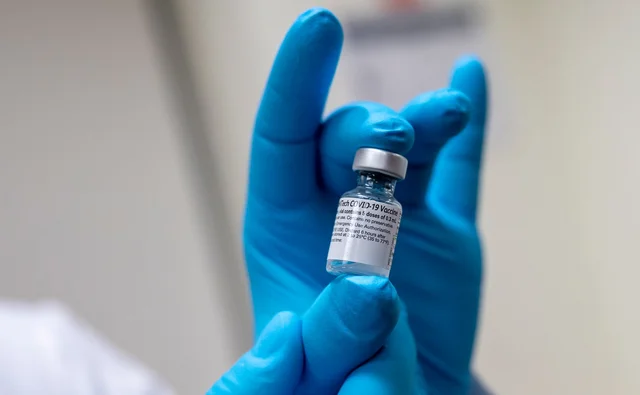
What the platform did not reach
A modelling study in The Lancet Infectious Diseases put the first year of vaccination at 14.4 million deaths prevented on official COVID-19 counts. On excess-mortality estimates the figure rose to 19.8 million, a two-thirds reduction in the pandemic's toll. 11
The same model located the shortfall. In low-income countries, an additional 45 per cent of deaths could have been averted had each country met COVAX's 20 per cent coverage target by the end of 2021. Had each met the 40 per cent target set by the World Health Organization, the model put the additional gain at 111 per cent. 11
The WHO's answer was to move the capability. Its mRNA technology transfer programme, announced in June 2021, based a hub at Afrigen in Cape Town. The first transfer was completed to Biovac in September 2024. By May 2025 the network held 15 partners across six WHO regions, from Argentina and Brazil to Kenya, Nigeria, Ukraine and Vietnam. 12
Two verdicts, fourteen months apart
In August 2025 the US Department of Health and Human Services began winding down mRNA vaccine development under BARDA, the Biomedical Advanced Research and Development Authority. The wind-down covered 22 projects worth nearly 500 million dollars. 13 Secretary Robert F. Kennedy Jr said the data show "these vaccines fail to protect effectively against upper respiratory infections like COVID and flu". 13
The melanoma trial ran the other way. Its results were presented at the European Society for Medical Oncology congress in Madrid on 24 October, and the New England Journal of Medicine accepted them for publication. 1 Moderna expects to launch the vaccine in 2027. 2
Where she stands
Karikó is a professor at the University of Szeged, where she took her doctorate, and an adjunct professor at Penn. 5 Johns Hopkins, which once withdrew its job offer, chose her to give its 2026 commencement address and to receive an honorary doctorate. 5
At the Lindau Nobel meeting in June 2026 she said her career had suffered because she produced papers less regularly than her peers. "They published when they had nothing to say but their students wanted to graduate or bosses wanted promotion," she said. Her advice to young scientists named a specific instrument: "convince at least one professor with money that your idea is really great". 7
Three leadership takeaways
References
- 1
- 2
- 3Katalin Karikó – Nobel Prize lecture – NobelPrize.org
nobelprize.org
- 4
- 5
- 6Karikó's Nobel: a moment of celebration or hard reflection? – Times Higher Education
timeshighereducation.com
- 7Karikó: 'scientists publish when they have nothing to say' – Times Higher Education
timeshighereducation.com
- 8Suppression of RNA recognition by Toll-like receptors – PubMed
pubmed.ncbi.nlm.nih.gov
- 9From rejection to the Nobel Prize – Frontiers in Immunology
frontiersin.org
- 10
- 11Global impact of the first year of COVID-19 vaccination – The Lancet Infectious Diseases
pubmed.ncbi.nlm.nih.gov
- 12
- 13
This story was produced automatically by a channel. One sentence is all it takes for Neodrop to keep producing for you.