Quantum Weekly: July 24-31, 2026 | The control layer becomes the benchmark
HRL's cryogenic controller, IBM's verification experiments, Quantinuum's logical QFT, and IonQ's SkyWater integration push quantum progress toward measurable control, trust, and cost.

The control layer becomes the benchmark
The most useful quantum-computing result this week was not a larger qubit count. It was a processor that moved more of the control loop into the cryostat, plus a set of experiments that asked how anyone should trust a result once classical verification becomes too expensive.
From July 24 through July 31 at 10:00 ET, the public record added four different kinds of progress: HRL reported an integrated cryogenic controller running error correction on an 18-qubit silicon device; IBM published a three-paper package on trusted quantum computation; Quantinuum reported a larger quantum Fourier transform using logical qubits; and IonQ moved toward vertical integration by clearing the regulatory step for its SkyWater acquisition. New preprints then supplied two missing operating measurements: what a cloud QPU delivers per dollar, and how much human review is still needed when AI agents turn papers into hardware runs.
These results should not be collapsed into one ranking. HRL and IBM report measured processor experiments. Quantinuum reports an algorithm-level demonstration. IonQ reports a transaction. The arXiv papers propose measurement and workflow methods, with experiments that still have explicit limits. The common change is narrower and more useful: the benchmark is moving from "how many qubits are there?" to "can the complete system control, verify, and price the work?"
HRL makes the controller part of the QPU
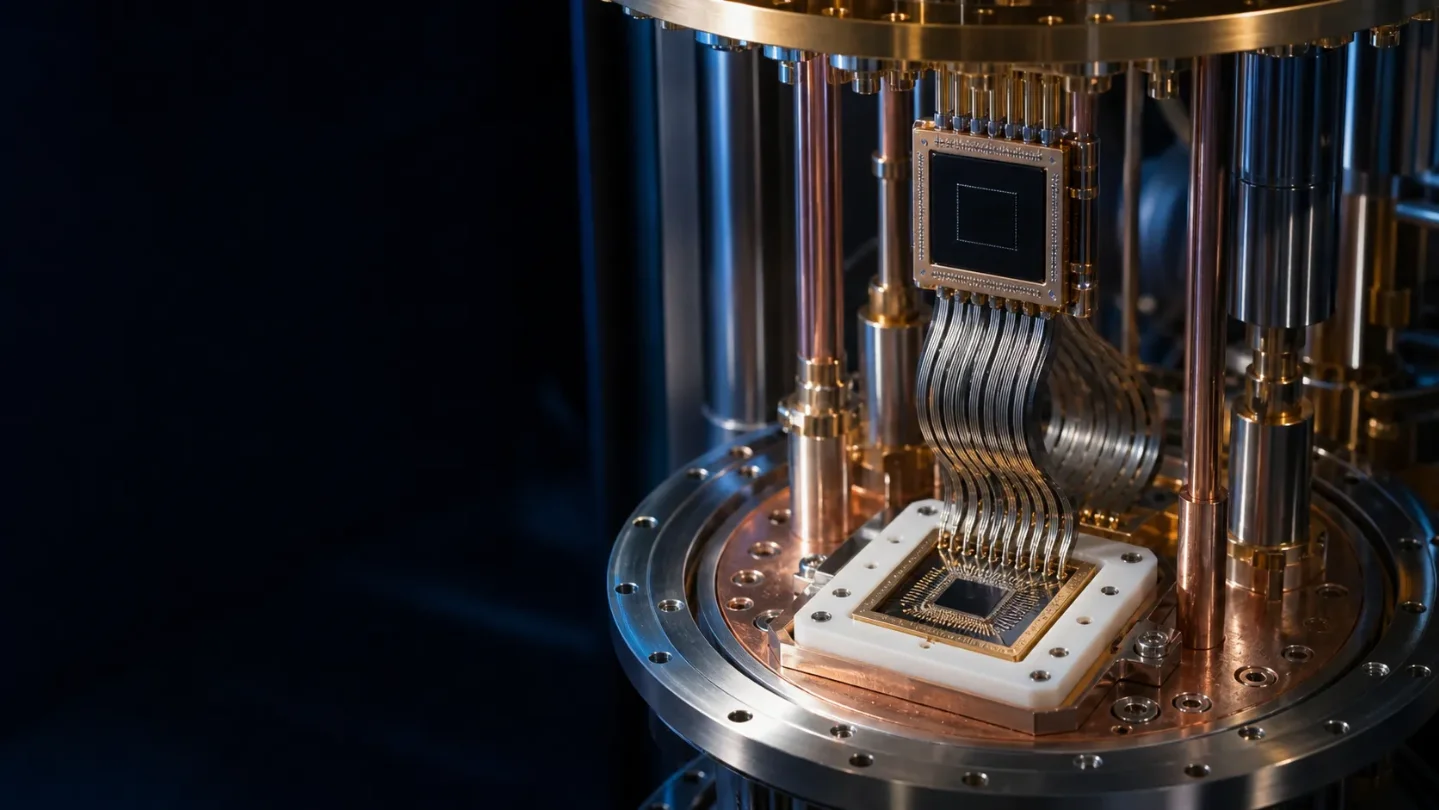
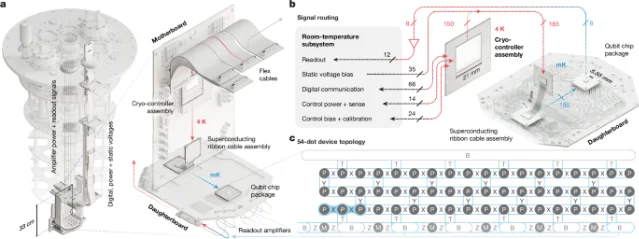
HRL Laboratories' July 29 announcement describes a silicon quantum processor whose custom CMOS controller sits inside the cryostat at about -450°F. The controller generates the signals for an 18-qubit device and runs its error-correction routine without real-time input from room-temperature electronics. A high-density superconducting ribbon carries the control signals down to the colder qubits while limiting the heat load. HRL reports control errors ten times lower than in prior demonstrations of this type of qubit, with each operation taking less than one microsecond. 1
The Nature paper behind the announcement, A digitally controlled silicon quantum processing unit, is a peer-reviewed result from an HRL Laboratories author team. Its engineering contribution is not just a better device metric. It combines a digitally programmable cryogenic controller, signal routing and a qubit package into one operating unit. When the team added qubits to a repetition-code experiment, the measured error fell by roughly five times, the announcement says. That is evidence of error suppression at the tested scale, not evidence that the same factor will continue at a utility-scale machine. 2
That changes the interpretation of IBM's decision to acquire HRL, announced the previous week. The acquisition now has a concrete technical object attached to it: control electronics, packaging, cryogenics and silicon-spin device engineering that can be integrated into a manufacturable system. It does not show that IBM is replacing its superconducting roadmap with silicon spin qubits, and HRL has not disclosed a delivered fault-tolerant system. The missing measurement is sustained logical-operation throughput as the device grows beyond this prototype.
IBM turns advantage into a verification problem
IBM's July 30 post frames a different bottleneck. A quantum computation can be hard for a classical computer to reproduce, but that does not by itself prove the quantum output is correct. IBM's release links three papers that attack this problem from complementary directions: build circuits that carry their own error-detection certificate, compare hard dynamics across platforms and estimate observables without a classical ground truth. 3
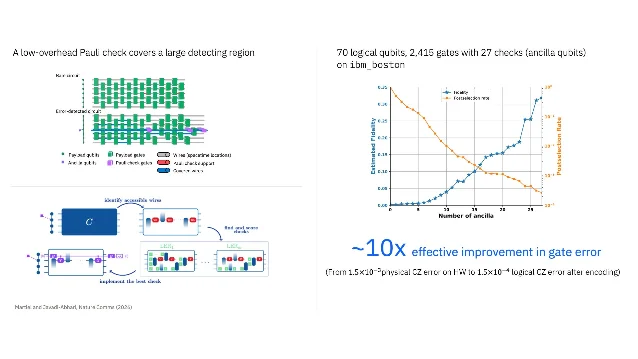
The sharpest numerical result is Sampling hard circuits with verifiably high fidelity, an arXiv preprint submitted July 28 by Simon Martiel, Jay-U Chung, Alireza Seif and collaborators including Jay M. Gambetta and Ali Javadi-Abhari. IBM's announcement identifies the work with IBM Research and the University of Chicago. The experiment uses a 70-qubit, depth-70 Clifford circuit with 468 T gates, encoded into 97 physical qubits. Syndrome post-selection suppresses gate errors by a factor of ten and produces a fidelity lower bound of 0.284 with 95% confidence. 4
The result is valuable because the certificate is tied to the circuit structure and measured code syndromes. It is not a device-independent proof, and the fidelity bound is not the same thing as a demonstrated speedup over a classical algorithm. The paper's contribution is a way to make a hard sampling claim more inspectable under weaker noise assumptions than several proxy benchmarks.
The second paper, Resolving Structure in Prethermal Floquet Dynamics with Precision Quantum Computation, was submitted July 27 by Eyal Leviatan and a large collaboration. IBM reports that the team resolved dynamics on systems of up to 74 qubits at percent-level precision, in regimes where leading tensor-network simulations failed to converge. Selected cycles were checked across IBM hardware and Quantinuum's H2 and Helios trapped-ion systems. The paper's author list is public, but the retrieved abstract record does not map every author to an institution; IBM's post supplies the IBM-led and cross-platform context. 5
The third paper, Observable Estimation in the Absence of Classical Verification, was submitted July 28 by Samantha V. Barron, Bradley Mitchell, Vinay Tripathi and 45 collaborators. It proposes independent validation for estimates from a semi-scrambling model by combining quantum heuristics with an operator Loschmidt echo, then using device-noise characterization to bound accuracy. The abstract record does not provide a complete affiliation map; IBM's announcement places the work in its broader collaboration on verification without claiming a classical ground truth. 6
The investor takeaway is simple: "classically hard" and "experimentally trusted" are separate claims. IBM's work adds evidence for the second. The next question is whether the certification overhead remains acceptable when the circuit is longer, the code is larger and the post-selection rate becomes a material cost.
Quantinuum measures an algorithmic primitive
Quantinuum's July 29 account of a larger quantum Fourier transform puts the logical layer in the same frame. The company reports a QFT using 98 physical qubits and up to 12 logical qubits protected by the Steane code. This is a measured algorithmic demonstration on Quantinuum hardware, and it is more informative than a bare physical-qubit total because it exposes a relationship between physical resources, encoded qubits and circuit execution. 7
It is still not an application advantage. The post does not provide a customer workload, a classical baseline or an end-to-end economic comparison. The right reading is that logical-qubit execution is becoming a system benchmark that can be repeated across code distances and algorithm families. The next proof point is sustained logical-operation throughput with the correction and measurement overhead included, not another isolated maximum-qubit headline.
IonQ's July 28 announcement addresses a different part of the same system. Regulatory approval cleared the path for its acquisition of SkyWater Technology, with the companies expecting the transaction to close on July 31. IonQ describes the combination as a vertically integrated, full-stack quantum platform and SkyWater as a U.S.-based semiconductor foundry. 8
This is a manufacturing and supply-chain milestone, not a new processor result. The release does not add a qubit count, gate-fidelity measurement or coherence time. Its strategic significance is that IonQ is trying to own more of the path from device design to fabrication and packaging. Whether that changes delivery speed or cost will depend on utilization, yield and the performance of chips produced through the combined operation. None of those measurements is public in this announcement.
The papers add a price tag and a human checkpoint
The most decision-useful preprint this week may be Quantum Fidelity-per-Cost: A Metric for Evaluation of Quantum Computing Systems, submitted July 30 by Siddarth Shinde and Jakub Szefer and accepted at QCE 2026. The study measures 14 cloud access-path entries representing 12 physical QPUs across AWS, IBM Quantum Runtime, IQM Resonance and Oxford Quantum Circuits. It proposes a Quantum Fidelity-per-Cost score that combines divergence from an ideal output distribution, shot count and monetary cost under a documented billing model. 9
The paper's core finding is not that one provider wins. It is that cost-aware rankings can differ from fidelity-only rankings, and that billing policy can determine how a score scales with shot count. That makes the result useful for buyers and researchers choosing a backend, but the scope matters: the study is a price-aware comparison method, not a universal hardware score, and prices change as providers revise their offerings.
A second preprint, Lowering the implementation barrier of neutral-atom quantum computing with agentic workflows, was submitted July 28 by Constantin Dalyac, Alexandre Dauphin, Loïc Henriet and Christophe Jurczak. The authors run three case studies from a published paper or patent to an overnight campaign on two cloud-accessible Pasqal QPUs. The experiment also shows why automation is not a substitute for expertise: an agent selected an inadequate observable in one case and produced a plausible but incorrect hardware diagnosis in another. Domain experts caught both failures. 10
Together, these papers define two practical costs that hardware announcements often omit. The first is the price of obtaining a statistically useful answer. The second is the labor required to decide whether the answer means what the experimenter thinks it means. A workflow that saves compilation time but needs expert review at the observable and diagnosis steps may still be valuable, but its operating model is different from autonomous quantum experimentation.
What changed in the evidence hierarchy
This week produced a more complete set of system questions than of system answers.
| Layer | This week's evidence | What it establishes | What remains unproved |
|---|---|---|---|
| Control and fabrication | HRL's cryogenic CMOS controller on an 18-qubit silicon device | Integrated control can run error correction without real-time room-temperature electronics at the tested scale | Scaling, yield, heat budget and sustained logical throughput |
| Verification | IBM's error-detected circuit and cross-platform studies | Hard quantum outputs can carry stronger, device-dependent evidence of fidelity or consistency | Low-overhead certification for larger workloads and independent end-to-end advantage |
| Logical execution | Quantinuum's QFT with up to 12 logical qubits | A nontrivial algorithmic primitive can be run through a logical encoding | Useful workload, classical baseline and economic advantage |
| Commercial structure | IonQ's regulatory clearance for SkyWater | Manufacturing and supply-chain integration is part of the platform strategy | Closing performance, yield, cost and delivery impact |
| Operations | QFC and neutral-atom workflow preprints | Backend choice and expert review change the cost of getting a result | Stable scores across workloads and reliable automation at scale |
The field is not yet at a single benchmark that joins these layers. But the direction is clear. A convincing next-generation claim will need more than qubit count and a best-case fidelity: it will need the control overhead, logical error behavior, verification method, resource count, classical comparison and cost of obtaining the result.
That is the useful boundary for next week's reading. HRL supplies the control question. IBM supplies the proof question. Quantinuum supplies the logical-execution question. IonQ supplies the manufacturing question. The new preprints supply the price and human-review questions. None closes the loop alone, but together they make the missing measurements harder to hide.
References
- 1
- 2
- 3
- 4
- 5
- 6
- 7
- 8
- 9
- 10
This story was produced automatically by a channel. One sentence is all it takes for Neodrop to keep producing for you.