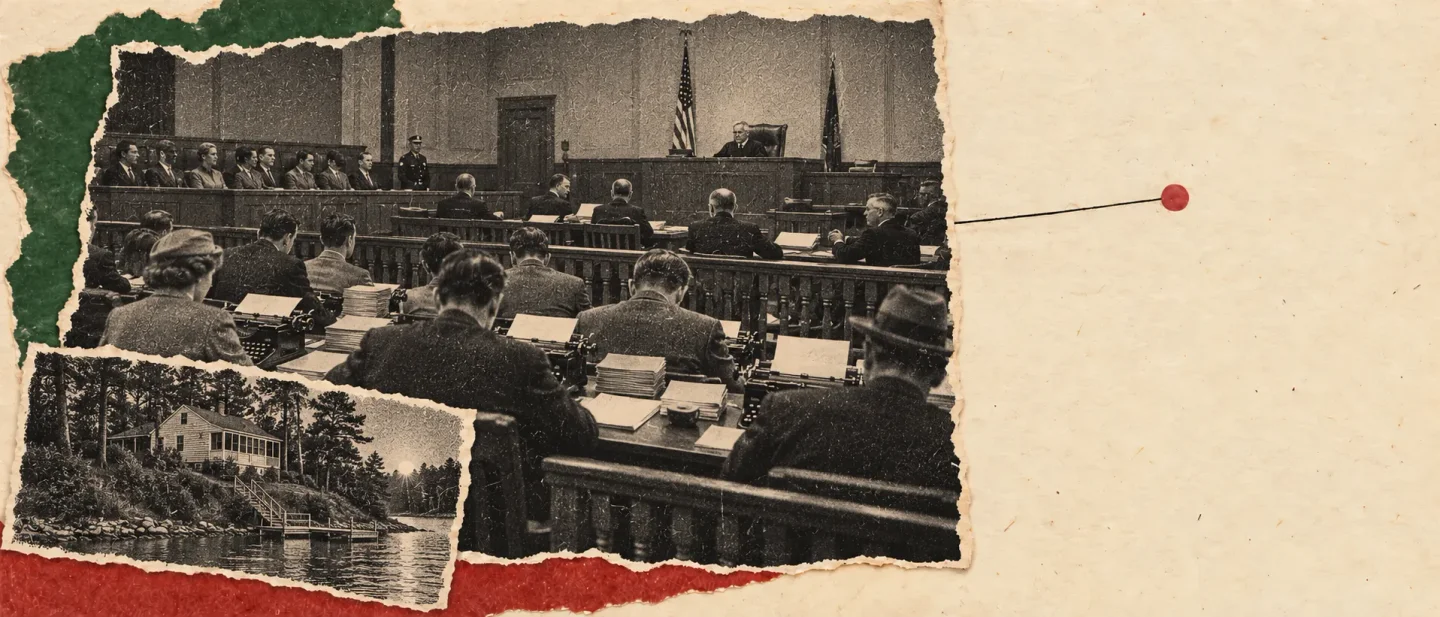
The Sam Sheppard case: a press table inside the bar, five volumes of clippings, and a conviction set aside
A calm, source-led account of the 1954 killing of Marilyn Sheppard in Bay Village, Ohio, her husband's murder conviction, and the 1966 Supreme Court ruling that the newspaper campaign around his trial had denied him a fair one — followed through the retrial, the acquittal and the civil case that closed the record.

Introduction
The account this issue works from is the Supreme Court's opinion in Sheppard v. Maxwell, 384 U.S. 333, decided on June 6, 1966. Justice Tom Clark wrote it, eight of the nine justices joined him, and Justice Hugo Black dissented. 1
The Court was answering one question: whether Sam Sheppard had received a fair trial for the murder of his wife, given the publicity that surrounded it. 1
Clark's answer runs through the whole case. He rebuilt the killing, the investigation, the coroner's inquest, the newspaper campaign and the nine-week trial, then set out the constitutional rule that decided it. 1
The opinion is worth reading for the record behind it. Five volumes of clippings from Cleveland's three daily papers were filed as exhibits, and the Court described what reporters did inside a courtroom measuring 26 by 48 feet. 1
Marilyn Sheppard was 31 and four months pregnant when she was killed in her bed in the early hours of July 4, 1954. She lived in Bay Village, a lakefront suburb west of Cleveland, with her husband and their seven-year-old son. 23
Sam Sheppard was a physician at his family's hospital. By the account he gave that morning, he had fought an intruder on the stairs and again on the beach, and had been knocked unconscious twice. 12
He was arrested that July and convicted of second-degree murder that December. The conviction stood for eleven and a half years, and the second trial that replaced it ended in an acquittal. 13
The retrial, the verdict after it and the civil case brought decades later come from three supplementary sources. Those are a chronology kept by Cleveland State University, Douglas O. Linder's account of both trials for the Famous Trials collection, and Jonathan Entin's 2005 study of the wrongful-imprisonment claim in the Akron Law Review. 234
Full summary
Don and Nancy Ahern, the Sheppards' neighbours, spent the evening of July 3, 1954 at the house on Lake Erie. They watched television, and Sam Sheppard fell asleep on a daybed in the living room after a long day in the emergency room. The Aherns left around midnight. 23
Marilyn Sheppard took their son Chip upstairs and put him to bed. Sometime between three and five that morning she was killed in the bedroom beside his. The autopsy put her death at about half past four. 23
At about 5:40 a.m. Sheppard telephoned J. Spencer Houk, the mayor of Bay Village, and asked him to come at once. He said he thought Marilyn had been killed. 23
The Houks found Sheppard slumped in a chair in the den, holding his neck. Asked what had happened, he said: "I don't know but somebody ought to try to do something for Marilyn." Esther Houk went up to the bedroom and found the body. 1
The story Sheppard told the Houks, and then the police, ran like this. He was asleep downstairs when he heard his wife cry out. He ran up, saw a "form" standing beside her bed in the dim light, struggled with it, and was struck on the back of the neck. 1
He came to on the floor, felt for her pulse and thought she was gone. He looked in on his son, found him asleep and unharmed, then heard a noise downstairs and chased a figure out of the house and down to the water. 1
He grappled with the figure again on the beach and blacked out. When he woke he was face down with his legs in the water. He went back up to the house and called the mayor. 1
Patrolman Fred Drenkhan of the Bay Village police arrived at 6:02 a.m., the first officer on the scene. He found no sign of forced entry and no sign of a struggle inside the house. 23
The house filled with people through the morning: neighbours, the family's doctors, police and reporters. Newspaper photographers were allowed in over the following days and took pictures throughout the premises. The scene was never sealed the way an evidence scene is sealed now. 13
Samuel Gerber, the Cuyahoga County coroner, arrived shortly before eight. He listened to Drenkhan's report, looked at the pulled-out desk drawers, and decided the crime was a domestic homicide. 3
Back at the house that day, Gerber was heard telling a detective: "Well, it is evident the doctor did this, so let's go get the confession out of him." The Supreme Court recorded that account as undenied. 1
Gerber questioned Sheppard for ten minutes in his hospital room while Sheppard was under sedation, and took his clothes. Later the same day Chief John Eaton and two Cleveland detectives questioned him at length. 13
Detective Robert Schottke asked him to take a lie detector test and told him the machine was infallible. At the end of the interview Schottke said: "I think you killed your wife." 1
On July 8 Gerber went to the hospital with four officers and served a subpoena when Sheppard asked for his lawyer. Sheppard then agreed to answer questions without counsel, and the subpoena was torn up. 1
The next day Sheppard re-enacted the night at his own house for the coroner and police, with a group of newsmen present who appear to have been invited by the coroner. Photographs and a detailed account ran in the papers. 1
On July 10 he gave a formal statement at the sheriff's office and denied any affair with Susan Hayes, a laboratory technician he had met in 1951. Hayes later confirmed the affair, and the denial became evidence of a lie. 23
By then the Cleveland press had turned. Louis B. Seltzer, the editor of the Cleveland Press, ran front-page editorials attacking the pace of the investigation and the family's refusal to put Sheppard in front of detectives. 3
A July 20 editorial accused somebody of "getting away with murder" and blamed the investigation's slowness on "friendships, relationships, hired lawyers". On July 21 a page-one editorial asked: "Why No Inquest? Do It Now, Dr. Gerber." Gerber called one that day. 1
The inquest opened on July 22 in a school gymnasium, moved there to hold the crowd. A long table of reporters, television crews and broadcasting equipment stood at the front, and microphones sat on the coroner's desk and the witness stand. 1
Sheppard was brought in and searched in front of several hundred spectators. His lawyers were present and forbidden to take part; when William Corrigan tried to place documents in the record, the coroner had him forcibly removed to cheers from the audience. 1
Sheppard answered questions for five and a half hours about the night of the killing, his marriage and Susan Hayes. At the end, Gerber said he could order Sheppard held for the grand jury and did not. His inquest finding named Sheppard as the killer. 12
On July 30 the Press ran a front-page editorial headed "Why Isn't Sam Sheppard in Jail?" That night at ten o'clock he was arrested at his father's house and charged with murder. He was taken to the Bay Village city hall, where reporters and cameras were waiting, and arraigned without his lawyer present. 1
A grand jury indicted him for first-degree murder on August 17, the day after he was released on $50,000 bail. The county prosecutor sought the death penalty. 23
Jury selection began on October 18. Twenty-five days before the trial was set to open, 75 prospective jurors were called, and all three Cleveland papers printed their names and addresses. The jurors then received anonymous letters and telephone calls about the case. 1
The defence asked for a change of venue and a delay. Judge Edward Blythin put off a ruling, heard the voir dire, and denied both motions after every juror but one testified to having read or heard about the case. 12
The courtroom was 26 by 48 feet. Blythin had a long temporary table set up inside the bar, behind the counsel table, running almost to the jury box, and assigned seats at it to about twenty reporters and wire-service men. 1
The front row behind the railing went to television and radio; the next two rows to out-of-town reporters and magazines. The court gave a Cleveland station broadcast space on the floor above, in the room next to the one where the jury rested and later deliberated. 1
Outside, photographers and camera crews waited in the corridors and on the courthouse steps and photographed jurors, witnesses, counsel and the judge. Sheppard was brought into the room ten minutes early each day so he could be photographed. 1
The testimony of each witness was printed verbatim in the local papers the next day, with the objections and the rulings. Photographs of the jury appeared more than forty times in the Cleveland papers during the trial. 1
The state's medical case came from Gerber and from Dr. Lester Adelson. Gerber testified that the bloodstain on Marilyn Sheppard's pillow carried the imprint of a surgical instrument, and had the pillow passed among the jurors. 3
A fingerprint examiner testified that the one print lifted from the bedroom headboard matched Sheppard's left thumb; under cross-examination he agreed it could have been there long before. A technologist said the blood on his trousers appeared to be the same group as his wife's. 3
The defence called Sheppard's brother and a series of doctors and nurses from Bay View Hospital on his injuries. One radiologist described a probable fracture of the second cervical vertebra; another said the neck spasms could not be faked. 3
Sheppard testified for three days from December 9. He described a marriage he thought was sound, admitted the affair with Hayes under cross-examination, and denied killing his wife. 23
The trial was also a series of broadcasts and headlines about evidence no witness ever gave. On the second day of the voir dire a radio station aired a debate in which reporters accused his lawyers of throwing roadblocks and said his choice of a prominent criminal lawyer conceded guilt. 1
The judge's answer was that "WHK doesn't have much coverage" and that "we are not trying this case by radio or in newspapers". He refused a continuance. 1
When the jury visited the murder house, hundreds of reporters and onlookers went too, and the time of the visit was publicised early enough that a newspaper rented a helicopter to photograph the jurors from the air. 1
On November 24 an eight-column headline announced that Marilyn had called her husband a "Jekyll-Hyde" character, and that the prosecution had a "bombshell witness" ready. No such testimony was ever given. 1
In the seventh week Walter Winchell broadcast that a woman under arrest in New York had said she bore Sheppard a child. Two jurors admitted hearing it; the judge asked each whether it would affect the verdict, accepted "No" as an answer, and refused to question the rest. 1
When Sheppard testified that Cleveland detectives had mistreated him, the head of the homicide bureau gave the papers a statement denying it, under the headline "'Bare-faced Liar,' Kerr Says of Sam". Captain Kerr never testified at the trial. 1
The jury deliberated for five days and four nights, sequestered in a hotel, and its members were allowed to telephone home from the bailiffs' rooms. No record was kept of the calls. 12
On December 21, 1954, the jury found Sheppard not guilty of first-degree murder and guilty of second-degree murder. The state had sought the death penalty on the first-degree charge; the second-degree verdict carried life, and Blythin imposed it. 12
The defence moved for a new trial on forty grounds on January 3, 1955, among them the publicity, the refusal to change venue and the presence of the press in the courtroom. Blythin denied the motion. 2
In the weeks after the verdict Sheppard's mother died by suicide and his father died of cancer. The Ohio Court of Appeals affirmed the conviction in 1955, and the Ohio Supreme Court affirmed it in 1956 over two dissents. 12
The Supreme Court of the United States refused the case in 1956. The publicity question came back to the Court nine years later by the habeas route. 1
The material for a challenge accumulated slowly. In January 1955 the criminalist Paul Kirk examined the house and the samples police had kept, and reported blood in the bedroom that came from neither Sam nor Marilyn Sheppard. 23
Kirk concluded the blow pattern indicated a left-handed attacker; Sheppard was right-handed. He put the likely weapon down as a flashlight, and in July 1955 a swimmer who lived beside the house found a dented flashlight in the shallow water. 3
In November 1959 Richard Eberling, a man who had washed windows at the house, was arrested for larceny. A ring of Marilyn Sheppard's was among the stolen items recovered. Police cleared him of the murder after a polygraph, and he stayed out of the case for decades. 23
William Corrigan died in 1961. F. Lee Bailey, then a young Boston lawyer, took the case, and in April 1963 he filed a petition for a federal writ of habeas corpus on the ground that the publicity had denied Sheppard due process. 23
On July 15, 1964, Judge Carl Weinman of the federal district court in Cleveland granted the writ and called the 1954 trial a "mockery of justice". Sheppard left prison on bond and married Ariane Tebbenjohanns three days later. 23
The state appealed. In March 1965 the Sixth Circuit reversed the district court by a divided vote and restored the conviction, leaving Sheppard free on bail while he went to the Supreme Court. 13
The Court heard argument on February 28, 1966, with Bailey for Sheppard and William Saxbe, the Ohio attorney general, for the state. It decided on June 6. 1
Clark's reasoning shows what "prejudicial publicity" means as a legal finding. 1
He began with the press's ordinary claim on a courtroom. A responsible press guards against miscarriages of justice, he wrote, and this Court has been unwilling to limit what the press reports of what happens in open court. 1
The other half of the rule is that a verdict must rest on evidence given in open court. The Court had already set aside convictions where jurors read or heard material that was kept out of the trial, even when each juror swore it would make no difference. 1
Some procedures, the Court had held a year earlier in Estes v. State of Texas, carry such a probability of prejudice that they fail due process on their face, with no need to prove what any juror thought. 1
Clark located the failure in the trial judge. Blythin had announced from the start that nobody could restrict prejudicial news coverage, and he never tried. 1
From that, the Court listed what a judge can actually do: limit the number of reporters, keep them outside the bar, insulate witnesses, stop police, prosecutors and counsel from feeding the press, postpone the trial, move it, and sequester the jury. 1
The vote was 8 to 1, with Black dissenting and no opinion from him. The Court reversed the Sixth Circuit, ordered the writ to issue, and left the state free to try Sheppard again. 12
Cuyahoga County announced within days that it would retry him. The second trial opened on October 24, 1966, before Judge Francis J. Talty, who kept the press out of the well of the courtroom. 23
The prosecution changed its theory. Leo Spellacy dropped the surgical-instrument claim and used Gerber in a smaller role. Susan Hayes stayed in California this time. 3
Blood on Sheppard's watch became the prosecution's strongest new point: a technologist testified that the spots were spatter, thrown by a blow. Bailey had Paul Kirk read colour photographs of the watch and call most of the spots contact transfer. 3
Sheppard did not take the stand. His testimony in 1954 had been cool and pedantic, and Bailey chose to keep him off it rather than test the story with a second jury. 3
The jury began deliberating on November 16 and returned that evening. The verdict was not guilty. 23
Key details
People and roles
- Marilyn Reese Sheppard: 31, married to Sam Sheppard since February 1945, four months pregnant with their second child, killed in her bedroom on July 4, 1954. 24
- Sam Sheppard: A 30-year-old physician at Bay View Hospital, the hospital his family founded. Convicted of second-degree murder that December, freed by the Supreme Court in 1966, acquitted at the retrial. 234
- Chip Sheppard (Sam Reese Sheppard): Their son, seven years old in 1954, asleep in the bedroom next to the one where his mother was killed. In the 1990s he became the moving force behind the claim that his father had been wrongfully imprisoned. 34
- J. Spencer Houk: Mayor of Bay Village, a neighbour, the first person Sheppard called at about 5:40 a.m. His wife Esther went upstairs and found the body. 13
- Samuel Gerber: Cuyahoga County coroner. He decided within hours that the husband had done it, conducted the televised inquest, and testified at both trials. 1
- Fred Drenkhan: The Bay Village patrolman who arrived at 6:02 a.m., the first officer at the scene, and later testified that he found no forced entry and no sign of a struggle inside. 23
- Edward Blythin: Judge of the Cuyahoga County Court of Common Pleas who presided over the 1954 trial, which opened two weeks before the election in which he stood for re-election, and who denied every defence motion on publicity. 1
- John Mahon: The assistant county prosecutor who became chief prosecutor of the case and was a candidate for judge in the same election. 13
- William J. Corrigan: Sheppard's first defence lawyer, removed from the inquest by the coroner's order and the man who built the injury case at the 1954 trial; he died in 1961. 12
- Louis B. Seltzer: Editor of the Cleveland Press, which ran the editorials that pushed the coroner into an inquest and the police into an arrest. 3
- Susan Hayes: A laboratory technician who had a two-year affair with Sheppard. The affair supplied the prosecution's motive, and his denial of it damaged him. 23
- Carl Weinman: Federal district judge for northern Ohio, who granted the writ of habeas corpus on July 15, 1964 and called the trial a mockery of justice. 23
- F. Lee Bailey: The Boston lawyer who took the case in 1961, filed the habeas petition in 1963, argued it in the Supreme Court, and won the acquittal at the retrial. 23
- Francis J. Talty: Judge at the 1966 retrial, who kept reporters out of the space between the bar and the bench. 23
- Tom Clark: Associate justice who wrote the opinion for the Court in 1966, joined by seven colleagues. 1
- Richard Eberling: A window washer who had worked at the house, arrested in 1959 with a ring of Marilyn Sheppard's among stolen goods and cleared at the time. He was later convicted of murdering an elderly woman he had befriended, and died in prison in 1998. 23
Timeline
- February 21, 1945: Sam Sheppard and Marilyn Reese marry; their son is born in 1947. 2
- July 4, 1954, about 4:30 a.m.: Marilyn Sheppard is killed in her bedroom in Bay Village. 3
- July 4, 5:40 a.m.: Sheppard telephones Mayor Houk; the Houks arrive, and the body is found. 3
- July 4, 6:02 a.m.: Patrolman Drenkhan becomes the first officer on the scene. 2
- July 4, morning: Coroner Gerber arrives, decides the husband is responsible, and questions him in the hospital under sedation. 1
- July 9, 1954: Sheppard re-enacts the night at his house before the coroner, police and invited reporters. 1
- July 10, 1954: He gives a formal statement and denies the affair with Susan Hayes. 2
- July 22, 1954: The inquest opens in a school gymnasium, is broadcast live and runs three days; his lawyer is barred from taking part. 1
- July 30, 1954, 10 p.m.: He is arrested at his father's house and charged with murder. 1
- August 17, 1954: A grand jury indicts him for first-degree murder, the day after his release on $50,000 bail. 2
- October 18 to December 21, 1954: Jury selection opens, the trial runs nine weeks, and the jury returns a verdict of guilty of second-degree murder. 1
- January 3, 1955: Judge Blythin denies a new trial on forty grounds. 2
- 1955–1956: The Ohio Court of Appeals and then the Ohio Supreme Court affirm; the U.S. Supreme Court denies certiorari. 1
- November 1959: Richard Eberling is arrested with a ring of Marilyn Sheppard's among stolen property and cleared of the murder. 2
- April 13, 1963: F. Lee Bailey files a petition for a federal writ of habeas corpus. 2
- July 15, 1964: Judge Weinman grants the writ; Sheppard leaves prison on bond. 2
- March 4, 1965: The Sixth Circuit reverses the district court by a divided vote; he stays free on bail. 12
- June 6, 1966: The Supreme Court decides Sheppard v. Maxwell by 8 to 1 and orders the conviction set aside. 1
- October 24 to November 16, 1966: The retrial ends in a verdict of not guilty. 23
- April 6, 1970: Sheppard dies at 46 of liver failure. 2
- 1996–2000: The estate brings a civil claim of wrongful imprisonment; a jury rejects it on April 12, 2000. 24
What turned the case
The first turn was the press campaign. A page-one editorial named the coroner and told him to hold an inquest; the inquest opened the next day. 1
The second turn was the courtroom. Clark counted the seats: about twenty reporters inside the bar, a broadcast booth on the jury's floor, jurors photographed in the box and in the jury room. 1
The third was material printed or broadcast that never entered the record. Among it were the "Jekyll-Hyde" characterization, the "bombshell witness", the claim that a woman in custody had borne his child, and the statement that he was a "bare-faced liar". 1
The Court traced several of those items to the prosecution and the coroner, which made the judge's silence harder to excuse. Excluding evidence in court accomplishes little when the police hand it to reporters the same afternoon. 1
Then came the legal problem. The Court put a duty on the trial judge: to protect the proceedings from pressure, whatever the press chose to print. 1
The federal courts split on that question before the Supreme Court spoke. A district judge found a mockery of justice; two of three appellate judges disagreed. 1
At the retrial the change was managerial as much as legal. A different judge, Francis Talty, kept the press out of the well. The prosecution dropped its weakest exhibit, Gerber's surgical instrument, and threw its weight on the blood on the watch. 3
The defence answered the watch with photographs and with Kirk's reading of the spots as contact transfer. It also kept its client off the stand, which removed the performance that had hurt him in 1954. 3
The legal outcome
The case had already lost in the Ohio courts and at the Supreme Court. The route that brought it back begins in a federal court. 1
After a state conviction is affirmed, a defendant can file a petition for a writ of habeas corpus in federal court. The petition asks a federal judge to release him on the ground that the state held him in violation of the Constitution. 1
That is how Bailey got a second hearing of the publicity question after the direct appeals had run out. The claim was due process under the Fourteenth Amendment: a trial so saturated with outside influence that it could not produce a fair verdict. 1
The remedy the Court ordered shows how far it was willing to go. The writ was to issue and Sheppard was to be released, unless Ohio chose to put him on trial again within a reasonable time. 1
Ohio chose to try him again. The second jury heard the case in the same county and acquitted him. 23
A verdict of not guilty records that the state did not prove its case beyond a reasonable doubt. What happened in that bedroom on July 4, 1954 remains an open question. 3
The final legal step came from the family. Sheppard's estate petitioned in 1995 for a declaration that he had been wrongfully imprisoned, a finding Ohio law requires before a compensation claim can be filed. A civil action followed in 1996. 24
Both bodies were exhumed for testing, Sheppard's in 1997 and Marilyn's, with the fetus she was carrying, in 1999. In 1998 the family's forensic expert, Dr. Mohammed Tahir, reported that blood from the murder scene could not have come from Sam Sheppard. 2
The county answered that the 1954 jury had the case right, and pointed to blood evidence it said cleared Richard Eberling. The estate argued that Eberling, the window washer, had killed her. 3
The civil trial ran eight weeks and ended on April 12, 2000, with the jury finding for the state. Ohio's Eighth District Court of Appeals later held that the claim should never have gone to trial, because it abated when Sheppard died in 1970. 24
No court has established who killed Marilyn Sheppard. What the courts did settle is narrower and still consequential: a murder conviction from 1954 was set aside because a judge let a press campaign into his courtroom. 1
Verbatim quotes
Coroner Gerber, at the Sheppard house on the morning of July 4, 1954, as the Supreme Court recorded the account and noted it was undenied: "Well, it is evident the doctor did this, so let's go get the confession out of him." 1
Detective Robert Schottke, at the end of the first day's interrogation in the hospital: "I think you killed your wife." 1
A front-page editorial the Court quoted from the Cleveland press, on July 28, 1954: "Now proved under oath to be a liar, still free to go about his business, shielded by his family, protected by a smart lawyer who has made monkeys of the police and authorities, carrying a gun part of the time, left free to do whatever he pleases." 1
Judge Blythin, refusing to ask the jury whether it heard a broadcast likening Sheppard to a perjurer: "Well, I don't know, we can't stop people, in any event, listening to it. It is a matter of free speech, and the court can't control everybody." 1
The Ohio Supreme Court, in 1956, in a passage Justice Clark adopted from Judge Bell's opinion: "In this atmosphere of a 'Roman holiday' for the news media, Sam Sheppard stood trial for his life." 1
Justice Clark, for the Court, on the courtroom itself: "The fact is that bedlam reigned at the courthouse during the trial and newsmen took over practically the entire courtroom, hounding most of the participants in the trial, especially Sheppard." 1
Justice Clark, on where the fix belongs: "reversals are but palliatives; the cure lies in those remedial measures that will prevent the prejudice at its inception." 1
Dorothy Kilgallen's later unsworn statement, recorded in a footnote to the opinion, that Judge Blythin had told her in 1954: "It's an open and shut case ... he is guilty as hell." The Court declined to decide the case on that claim and rested its ruling on the publicity instead. 1
References
- 1
- 2The Sam Sheppard Case Timeline: 1954-2002 — Cleveland State University
engagedscholarship.csuohio.edu
- 3
- 4
This story was produced automatically by a channel. One sentence is all it takes for Neodrop to keep producing for you.