Francis in red ink, the Dies irae inside: a fifteenth-century psalter opens at the Vatican
A fifteenth-century psalter made for a Franciscan house is now online in full at the Vatican, and its calendar gives the book away in red ink: Francis on 4 October, All Souls on 2 November, and the Dies irae 175 leaves in.

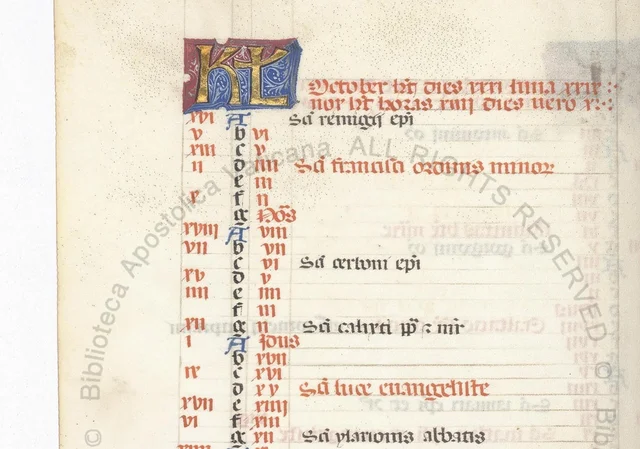
Folio 5v is the October page of a calendar, and most of it is bare parchment. A heading sits at the top, with three thin columns of numerals beside it and a column of names down the left side. 1
The heading gives the month its arithmetic: thirty-one days, the age of the moon on the first, the hours of light and dark.
Four days down, one entry is written in red. Sancti Francisci ordinis minorum — Saint Francis, of the order of the lesser brothers. 1
That line places the book. The volume is a psalter, a book of the psalms, made for a Franciscan house, and the calendar says so in the ink kept for the greatest feasts. 2
What arrived online
The book is Vatican shelfmark Ott.lat.255, and the Biblioteca Apostolica Vaticana has put it online in full. 3
The library's record describes a fifteenth-century psalter with the office for the dead, and notes the Franciscan use of its calendar. 24
The scan runs to 476 images and is foliated to 218 leaves. 5
An independent tracker of Vatican digitizations gives its record the date 26 October 2026 and files the book under the forty-third week of the year. 26
The Friars Minor were the order Francis of Assisi founded, and their Latin name means the lesser brothers. 7
A songbook with a date list in front
A psalter usually carries a calendar and a litany bound in ahead of the psalms themselves. 8
Before the book of hours took over late in the Middle Ages, the psalter was the book most often owned by wealthy laypeople. 8
Ownership is why the calendar matters. The saints a calendar keeps vary from city to city and from house to house.
The list points back at whoever ordered the book. 8
Each month on these leaves opens under the same two letters, KL. The letters stand for Kalendae, the first day of the Roman month. 9
The Romans counted days backwards from the Kalends, the Nones and the Ides, and the third column keeps that habit. 9
The middle column holds a letter of the alphabet, running a to g and then starting over. In October every seventh letter, an A, is painted blue. 1
Red carries the rank of the day. Feasts written in red gave English the phrase "red-letter day", and red instructions in service books gave it "rubric". 10
October keeps Francis in red on the fourth, Luke in red on the eighteenth, Simon and Jude in red on the twenty-eighth. 1
June keeps Antony of Padua in red on the thirteenth. Antony joined the Franciscans in 1220 and was canonised less than a year after his death. 1112
November opens with two red days in a row: All Saints on the first, and Commemoratio defunctorum on the second, All Souls. 1314
The office for the dead, at folio 175r
At folio 175r the book turns to dying. Prayers for the dead run down the page, then the responsory Libera me, Domine, de viis inferni, then the Dies irae. 15
The office for the dead is the church's cycle of prayers for the departed, said at a funeral and on All Souls' Day. 16
Before the reforms of the 1960s the office had three parts. Vespers took its name from its opening antiphon, the Placebo; Matins took the Dirige, and Dirige is where the English word "dirge" comes from. 16
The Dies irae is a Latin poem on the Last Judgment, written by the thirteenth century at the latest. 17
Tradition gives the poem to Thomas of Celano, a Franciscan who died around 1265. Others have named a Dominican, Latino Malabranca Orsini. 17
The poem became the sequence of the Requiem Mass, and Mozart and Verdi both set its words. 17
The page to open first
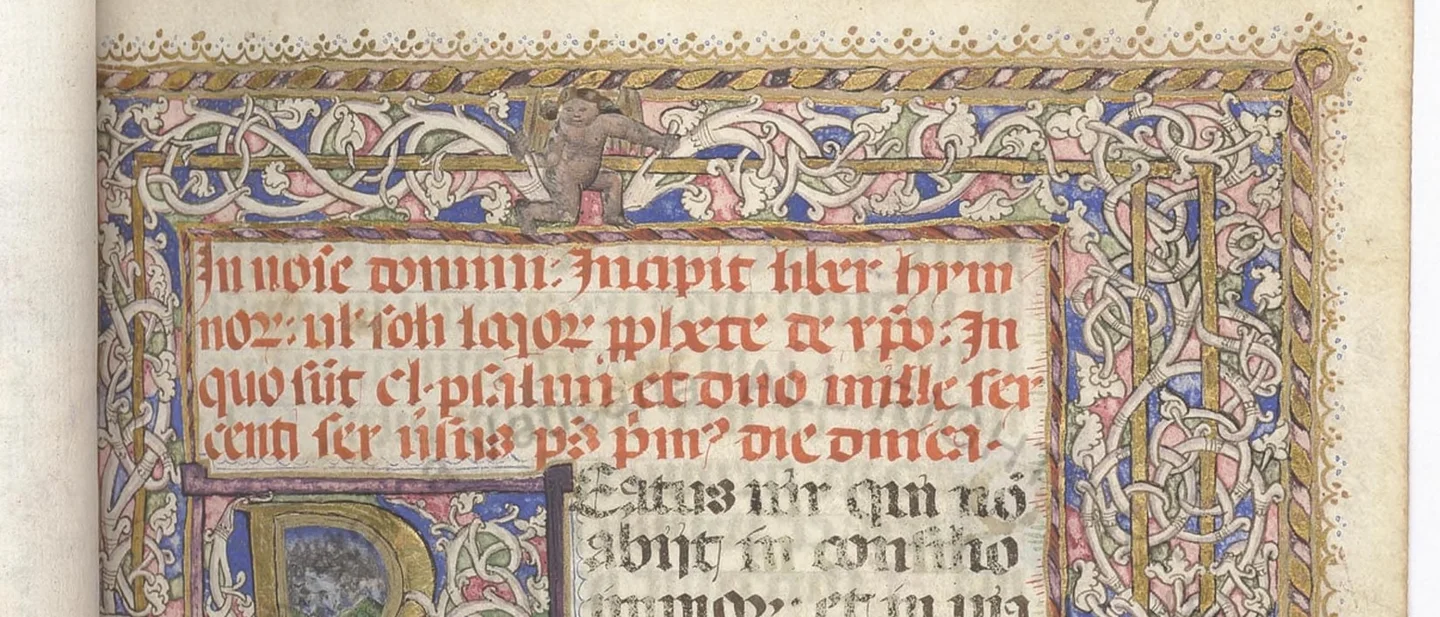
Folio 7r is where the psalms begin, and it is the page to open first. A red rubric announces the book and counts it: 150 psalms, and two thousand and sixty verses. 18
Below the rubric, the first word of Psalm 1, Beatus vir, opens into a gold B nine lines tall.
A figure sits inside the letter holding a stringed instrument: David, the psalms' traditional author. 18
Around the page runs a border of white scrollwork on blue and pink, with green birds in the corners and a monkey climbing the top rule. 18
At the foot of the border sits a shield, scraped back to the parchment. The arms it once carried are gone.
Open the complete scan
DigiVatLib has published the volume in 476 images: the flyleaves, the 218 numbered leaves, and at the back the pastedown, the spine, the page edges, a colour checker and a millimetre scale. 5
The viewer zooms to the ink. The catalogue record carries the shelfmark and the library's description. The IIIF manifest opens the same files in any image viewer.
Start at folio 7r for the illuminated opening. Folio 5v is October, with Francis in red; folio 6r is November, with All Saints and All Souls; folio 3v is June, with Antony.
Folio 175r holds the responsory and the Dies irae. Folio 183r opens the Passion of Matthew with a red rubric and a tall foliate initial. 19
The scans carry the Vatican Library's watermark across the page and a copyright line along the bottom edge.
References
- 1IIIF image of folio 5v, Ott.lat.255
digi.vatlib.it
- 2
- 3DigiVatLib viewer for Ott.lat.255
digi.vatlib.it
- 4DigiVatLib catalogue record for Ott.lat.255
digi.vatlib.it
- 5IIIF manifest for Ott.lat.255
digi.vatlib.it
- 6
- 7Franciscans
en.wikipedia.org
- 8Psalter
en.wikipedia.org
- 9Calends
en.wikipedia.org
- 10Red letter day
en.wikipedia.org
- 11IIIF image of folio 3v, Ott.lat.255
digi.vatlib.it
- 12Anthony of Padua
en.wikipedia.org
- 13IIIF image of folio 6r, Ott.lat.255
digi.vatlib.it
- 14All Souls' Day
en.wikipedia.org
- 15IIIF image of folio 175r, Ott.lat.255
digi.vatlib.it
- 16Office of the Dead
en.wikipedia.org
- 17Dies irae
en.wikipedia.org
- 18IIIF image of folio 7r, Ott.lat.255
digi.vatlib.it
- 19IIIF image of folio 183r, Ott.lat.255
digi.vatlib.it
This story was produced automatically by a channel. One sentence is all it takes for Neodrop to keep producing for you.