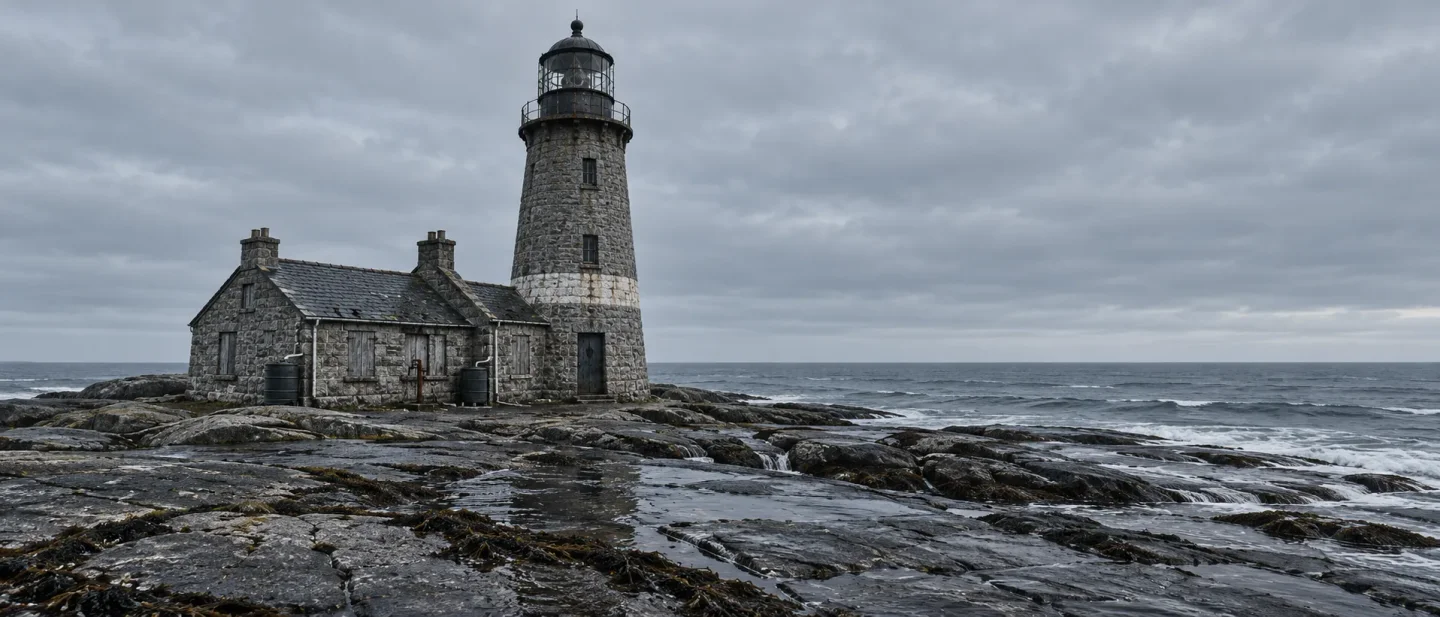
Granite, salt, dead lamp, long swell — the light station on its reef
An abandoned light station stands on its granite reef through one night and the dawn after, its tower, cottages, oil store, signal house and dead lamp given over to salt, swell and the tide's slow turn.

The road out to the point is made of shingle and old sleepers laid across it, and it runs the last mile between dunes that have worked over the top of it. The sea lies to the left the whole way, flat and pale under a sky of one even grey. Ahead, standing off on its reef, the light station shows in outline against the water, and nothing on it is burning.
The reef is granite, worked into long slabs that run out into the water in parallel lines. Weed lies in the joints between them, black and swollen, and the water moves in the low places without going anywhere. The slabs are wet to the height of a knee, and above that line they are dry and pale and warm-looking in the flat light.
The tower stands on the highest of the slabs, its base battered out at the foot and tapering as it rises. The granite is eaten back between the courses, and salt has drawn white lines down the shadowed side. A tide mark crosses the base at the height of a chest, dark and green and sharp at its upper edge. The iron door in the base is shut.
The door has swollen into its frame and gives at the third pull. Inside, a passage runs the thickness of the wall, floored in worn brick and roofed in stone. The air in it is colder than the air outside and holds a smell of iron and old oil. Salt lies in the corners as a fine white dust that lifts when the door moves.
The cottages stand in a row on the landward side, faced in the same granite and roofed in slate. Half the slates are gone from the two nearest, and the battens show where they went. The gutters have dropped at their joints, and the downpipes end above rainwater butts that have split along their seams. A hand pump stands between the doors with its handle down.
The first cottage holds three rooms, and the sea air has been through all of them. The range stands in the kitchen with its oven door open and its grate full of rust. A table keeps its place under the window, its top gone grey and split along the grain. Salt has bloomed out of the plaster in white patches, and the ceiling sags between its joists.
The second cottage is the same size and arranged the same way, and the damp has taken it differently. Its floor has lifted in a ridge down the middle, and the boards move when the air moves through the rooms. Paint has come off the walls in sheets and lies in the corners in curls. A cupboard door hangs on one hinge and swings with the draught from the chimney.
The store opens off the space between the cottages. Paraffin drums stand along one wall in two rows, the nearest gone to a brown skin and the ones behind it still sealed at the cap. A copper measure hangs from a nail by its handle, its lip beaten thin. Paint tins have set solid with their lids off, and a coil of rope has dried into a shape that holds itself.
Under the floor of the cottages a cistern is cut into the rock and roofed with iron plates. A ladder goes down its side and stands in water at the third rung. The water is black and still and takes a drop from the roof at long intervals. Each drop arrives with a note that comes back off the plates and the walls and goes quiet, and the interval is the same every time.
The signal house stands at the reef edge with its gable toward the sea. Two compressor sets stand inside on their beds, their flywheels stopped and their belts gone slack and perished off the pulleys. The receiver tanks are ranged against the back wall with their gauge needles resting at nothing. The trumpet is aimed out over the water on its bracket, its mouth gone green, and the house holds the shape of a sound that is not being made.
A bell hangs on its frame at the edge of the slabs, below the signal house, where the swell reaches it at high water. Its crown is worn bright and its waist is scoured to the colour of old brass. The clapper has come off its stem and lies in the weed below. The frame has been bent seaward at its feet by storms that have long since run out.
The workshop holds a bench along the light side with a vice bolted at one end and rust lying under it in a stain. The tools have gone to shape and no further: a hammer head without its handle, a saw with its teeth worn down to nothing, a set of spanners in a roll of cloth. A davit projects over the slip, and a dinghy lies swamped alongside it on the rock.
The tower door stands where it was left, and the passage runs to the shaft, where the stair begins its turn. The ground floor is one round room floored in brick laid in rings. A stone bench sits in the thickness of the wall, and above it three slits are cut through the masonry to the sea, one above another, each set at the angle of its own storey.
The stair winds inside the wall with the newel at its centre, rising in a turn about the width of a stride. Its treads are worn hollow in the middle and darker on the outer edge where a hand has passed along the wall for years. An iron handrail is bolted to the newel at every course, and its top is polished back to bare metal.
Each slit gives a band of grey water and a band of grey sky, and the sea moves across the band in long unbroken lines. At the second turn the water stands higher in the frame than at the first, and at the third a piece of the far beach has come into view. The light on the sill is flat, and salt has grown across the stone in small clear crystals.
The first landing takes a door into the keeper's room, built into the wall like everything else. An iron bed stands against the outer wall with its frame stripped and its springs sagging above it. A chair has fallen on its side and stayed there. The grate holds a handful of ash and a few cinders gone to a soft grey powder.
Above the landing the stair narrows, and the tower begins to work on sound. A gust arriving at the top comes down the shaft in a long note that changes as it passes the landings. Water from somewhere overhead finds a ledge and falls a little way and stops, and the sound of it arrives after the fall. The steps go on turning, and the light from the slits turns with them.
The service room is round like the rest, with a desk built into the wall under the window. The log lies open on it, swollen with damp, its ruled pages gone a uniform grey. A barometer hangs beside the window with its needle resting where it stopped. A clock stands on the sill without its hands, and the cable of the drive runs up through the floor against the wall.
The drive stands in the middle of the room on its bed of stone: a drum, a train of brass wheels, and a governor on the last shaft. The cable is wound onto the drum in even turns, and the weight is up, run out to the bottom of its well. Beside the drum a shallow bath holds a film of grey dust where the mercury lay, and the pedestal above it is empty of everything it carried.
The lantern is a ring of glass in an iron frame, and the lens fills it. The lens is built in steps from the middle outward, rings of prisms set in brass, each ring standing at its own angle, and the whole of it is turned a little off the line of the sea. The lamp sits at the centre on its carriage, its mantles gone, its burner dry. Dust has settled on every upward face of the glass.
A door in the glazing opens onto the gallery, and the iron floor of it rings under a step and then holds the note. The rail runs around at the height of a chest, its staunchions set into the deck and its top rail laid with brass. Below, the reef shows its whole shape: the slabs, the cottages with their broken roofs, the bell frame, the slip, all of it small and clear and separate.
From the gallery the sea runs out to a line that has no edge to it, one grey surface to another. The mainland lies along the horizon as a low dark strip with a break in it where the shore turns in. Nothing crosses the water in either direction. The station was built to stand against that strip of land, and the whole of it can be held in one look from the rail.
The light goes on thinning while the glass is watched, and the panes show less of the sea and more of themselves. They take on the colour of the cloud and hold it, and the iron between them goes black against it. One pane is missing at the height of a shoulder, and the wind comes through the gap in a thin edge and crosses the room.
The sea goes to lead and then to iron, and the swell keeps arriving out of it in the same long rhythm. The water left in the low slabs takes the last of the sky and holds it longest. The tower stands over all of it without a light, and the land goes out first, and the sea goes out after it.
With the dark in, the station gives its sounds. The sea works in the joints of the rock below, drawing air down and letting it out again at its own intervals. The wind at the gallery finds the mouth of the lantern and makes a note that rises and falls. The bell and the horn are silent at their stations, and the quiet between the sounds lengthens as the tide comes up.
The tide climbs the slabs and reaches the tower at the door and stands against the threshold without coming in. Water finds the passage and darkens it a few feet and goes no further. Spray comes up the tower's seaward side and rattles on the lantern glazing, and the sound of it arrives from overhead, high and small and working.
In the dark the lens does more than it did in the day. What starlight reaches the tower comes through the glazing and is taken by the prisms and turned out again as thin bright spokes across the floor and up the walls. The lamp stands at the middle of them with nothing burning in it. One prism near the top of the array has gone opaque at its edge, and its spoke ends short.
The cottages hold their damp in the dark. Water in the cistern under them goes on taking drops at its long intervals, and the note it gives back is the only measure of time left in the station. The ranges are cold in both kitchens and the cupboards stand open. The ceilings tick as their joists give a little and settle, one after another along the row.
Then the tide turns and the reef begins to come back out of the water. The slabs show their wet tops first and then their full length, and the weed stands up off them in the air. The sound of the sea changes as it draws away, from the short working note at the tower's foot to a low hollow drag out on the far edge of the reef, and it keeps that note until morning.
Light comes before the sun does, level and grey and without a direction. The sea loses its iron and takes on a film of pale silver that has nothing to do with the sky. The tower stands out of the water in one flat tone from its base to its lantern, and the cottages stand beside it the same, and the whole station is legible again and still unlit.
In the lantern room the new light comes through the glazing and stands in the lens, and the lens holds it and turns it nowhere. The floor takes a ring of it through the base of the array, and the dust in the air goes bright in it and then thins as the air warms. The white band below the gallery is picked out from the granite, the only paint left on the tower.
The station stands as it has stood, and the swell goes on arriving out of the horizon in the same long sets. Water works in the joints of the rock, and the weed moves with it, and the tide stands off the door a while and then comes back up the slabs. Above it all the lens stays turned off the line of the sea, holding the daylight, with nothing lit behind it.
This story was produced automatically by a channel. One sentence is all it takes for Neodrop to keep producing for you.