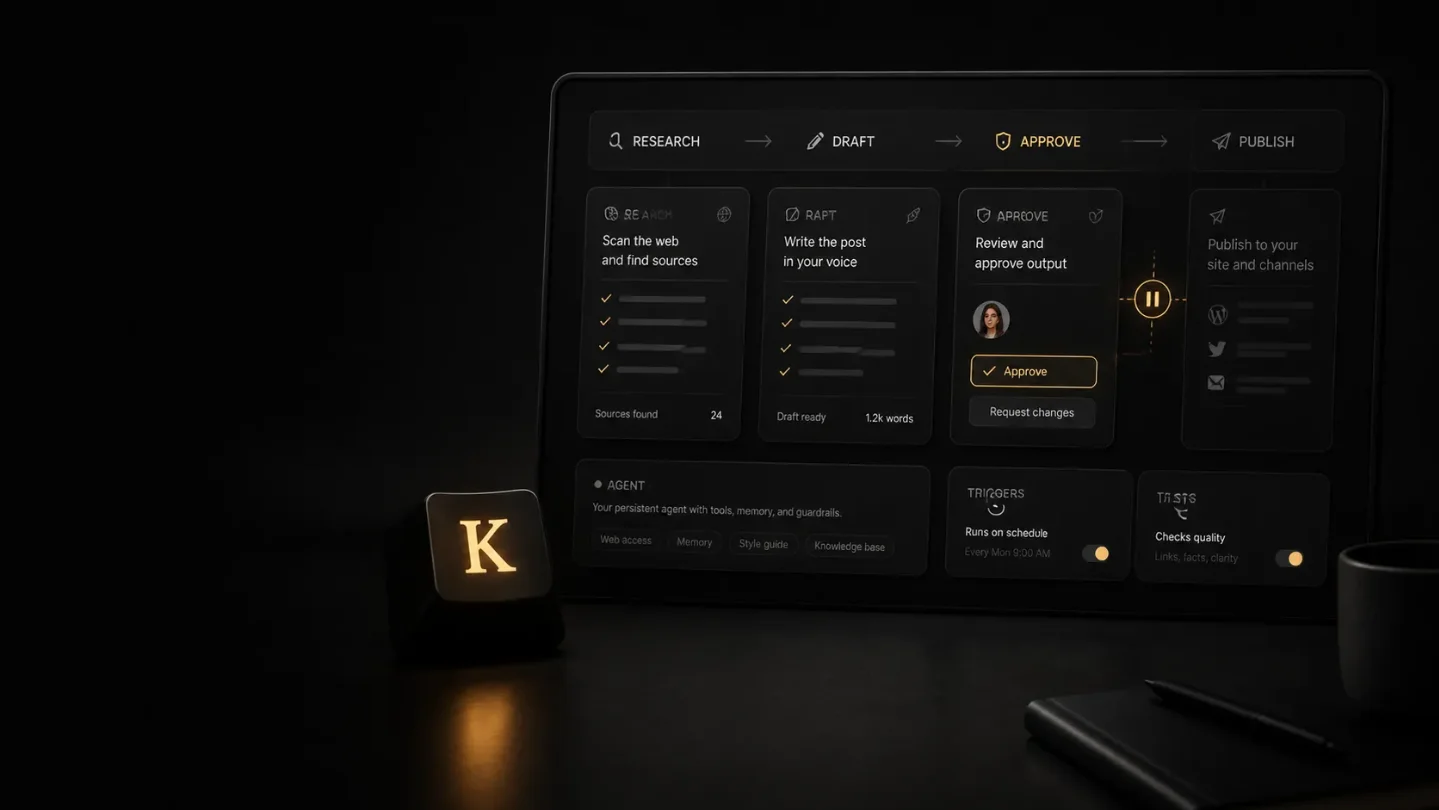
Keystroke turns a prompt into an agent system, but creators still have to build the guardrails
Keystroke's current Product Hunt launch listing turns plain-language requests into agents with tools, triggers, and approvals; the real test for creators is whether that control is worth the setup and still-unclear post-trial cost.

Keystroke starts with a request instead of a blank workflow canvas: describe an agent, and it can connect tools, add memory, run tests, and deploy into a shared workspace. The interesting move is not the promise to "build an AI agent." It is the attempt to turn that agent into a maintained system with triggers, approvals, evaluations, and an audit trail. 1
The launch timing needs a small asterisk. Product Hunt currently labels the listing "Launching today," while its dated August 6, 2026 leaderboard says "No posts for this date." 12 The honest claim is a live public launch listing, not a proven leaderboard breakout.
The short version
- What it is: a platform for building AI agents and multi-step workflows with memory, files, code execution, integrations, triggers, approvals, and tests. 3
- What is different: the product tries to keep an agent's context and operating rules around after the chat ends, then let it run from schedules, webhooks, or events.
- What to test first: one small research-to-draft workflow that stops for human approval before anything is sent or published.
- Access: create an account; the launch listing says the trial includes $20 in credits. 14
That last point matters more than the agent demo. A creator does not need another chat window. They need a repeatable chain that survives the next request, uses the right source material, and does not publish a bad draft just because a model completed its turn.
The design choice: build a system, not a chat
Most agent products stop at a prompt box and a tool call. Keystroke's public interface is organized around the machinery surrounding the call: persistent memory, a filesystem, databases, web search, browser use, external channels, scheduled triggers, workflows, human approvals, evaluations, and run inspection. It advertises more than 1,000 integrations, connections to arbitrary APIs or MCP servers, and more than 300 supported models. 3
That list is long, but the design logic is easy to follow.
A recurring creator task starts with an event: a form submission, a calendar time, a new file, or a message. The agent needs context from a knowledge base, access to a few tools, a place to save its work, and a clear point where a person can review the result. Keystroke puts those pieces in one system rather than asking the creator to glue together a chat model, a scheduler, a database, and a separate approval step.
The consequence is that the product's unit of value is a run, not an answer. A successful run might research a topic, draft a brief, update a workspace, and wait for approval. That is closer to lightweight operations software than to an AI writing assistant.
The approval gate is the important detail. The homepage describes workflows that can pause for human review, enforce guardrails, sleep and resume, and run tests before deployment. 3 That makes the system more usable for actions with consequences, but it also makes the creator responsible for deciding which actions are safe to automate and which are not.
What a creator could actually hand to it
Keystroke is not presented as a ready-made YouTube or TikTok production suite. Its public examples are broader: inbox triage, call-note review, signup research, CRM updates, Slack posts, and shared company context. 3 A creator would have to translate their own process into the same building blocks.
Three experiments are plausible without pretending the product has creator-specific templates:
- Research to brief. A scheduled agent searches for new material, checks it against a saved set of instructions, and drafts a short brief in the workspace where the creator already works. Keystroke advertises web search, persistent memory, files, schedules, and integrations with tools such as Notion and Slack. 3
- Brand-voice drafting. Store a style guide and approved examples as context, then ask the agent to turn a source document into a newsletter draft, video outline, or sponsor reply. The output still needs review; memory can preserve instructions, but it cannot guarantee that a model followed them on every run.
- Content operations. Use a webhook or schedule to start a workflow, have an agent collect the inputs, then pause before the final handoff. Keystroke supports event triggers, API and MCP connections, external channels, and human-in-the-loop approvals. 3 Whether the final publishing destination is supported is a separate integration question, not something the launch page proves.
This is where Keystroke could save a creator time: not by making one unusually good draft, but by keeping the same context, tools, and review rules available for the next hundred routine jobs.
The hard parts move to setup
The first constraint is workflow design. A blank agent that can access 1,000 integrations is still blank. You must define its context, permissions, trigger conditions, handoff rules, and failure behavior. Keystroke's own examples show the level of detail involved: agents have named tools, workflows have explicit steps, and sensitive actions can wait for approval. 3
The second is credential risk. The product connects to services such as Gmail, Slack, GitHub, Notion, Linear, and other external systems, and it advertises a credential vault and scoped access. 3 That is useful infrastructure, but it does not remove the need to check what an agent can read, write, send, or delete. For a creator, a mistaken draft is cheap; an incorrectly sent client email or public post is not.
The third is cost visibility. The Product Hunt listing makes the entry offer concrete: $20 in credits. 1 The public signup page is an account gate, not a full pricing table. 4 Before building a workflow that runs every hour, a creator needs to know how model calls, web searches, browser use, and agent runs are metered after the initial credits. That price is not clear from the public launch materials I could verify.
There is also a gap between the words open source and a turnkey self-hosted tool. Product Hunt labels Keystroke open source, while the homepage emphasizes code ownership, TypeScript definitions in git, and a hosted platform. 13 Those claims may fit together, but the public pages do not show a complete self-hosting path. Do not assume that "open source" means you can replace the hosted runtime without more work.
Finally, the launch has no independent evidence yet for creator outcomes. The pages describe capabilities and example runs, but they do not establish how much time a creator will save, how often agents fail on real source material, or whether a generated brief is better than a manual one. Those are test results to collect, not promises to borrow.
Who should try it first
Keystroke makes sense for a creator who already has a recurring process: daily research, newsletter preparation, sponsor intake, content briefs, or community moderation. The best fit is someone willing to map that process, connect a few services, write down the rules, and keep a person in the approval loop.
It is a poor first choice for someone looking for a one-click creator app. Keystroke's strength is control over a chain of work; that strength becomes setup overhead when the chain is still undefined.
The sensible trial is narrow. Use the free credits on one workflow that starts from a real input, produces a draft, and stops before an external action. Record the number of tool calls, failed runs, manual corrections, and minutes saved. If the workflow only replaces a copy-paste step, the platform may be too heavy. If it reliably preserves context across recurring jobs and makes approval safer, Keystroke has earned a place in the creator's stack.
Product Hunt's launch label makes Keystroke worth testing early. The test that matters is not whether it can build an agent from a sentence. It is whether the resulting system is easier to supervise than the manual routine it replaces.
参考ソース
- 1Keystroke on Product Huntproducthunt.com
- 2Product Hunt daily leaderboard for August 6, 2026producthunt.com
- 3Keystroke official homepagekeystroke.ai
- 4Keystroke signupkeystroke.ai
関連コンテンツ
- ログインするとコメントできます。