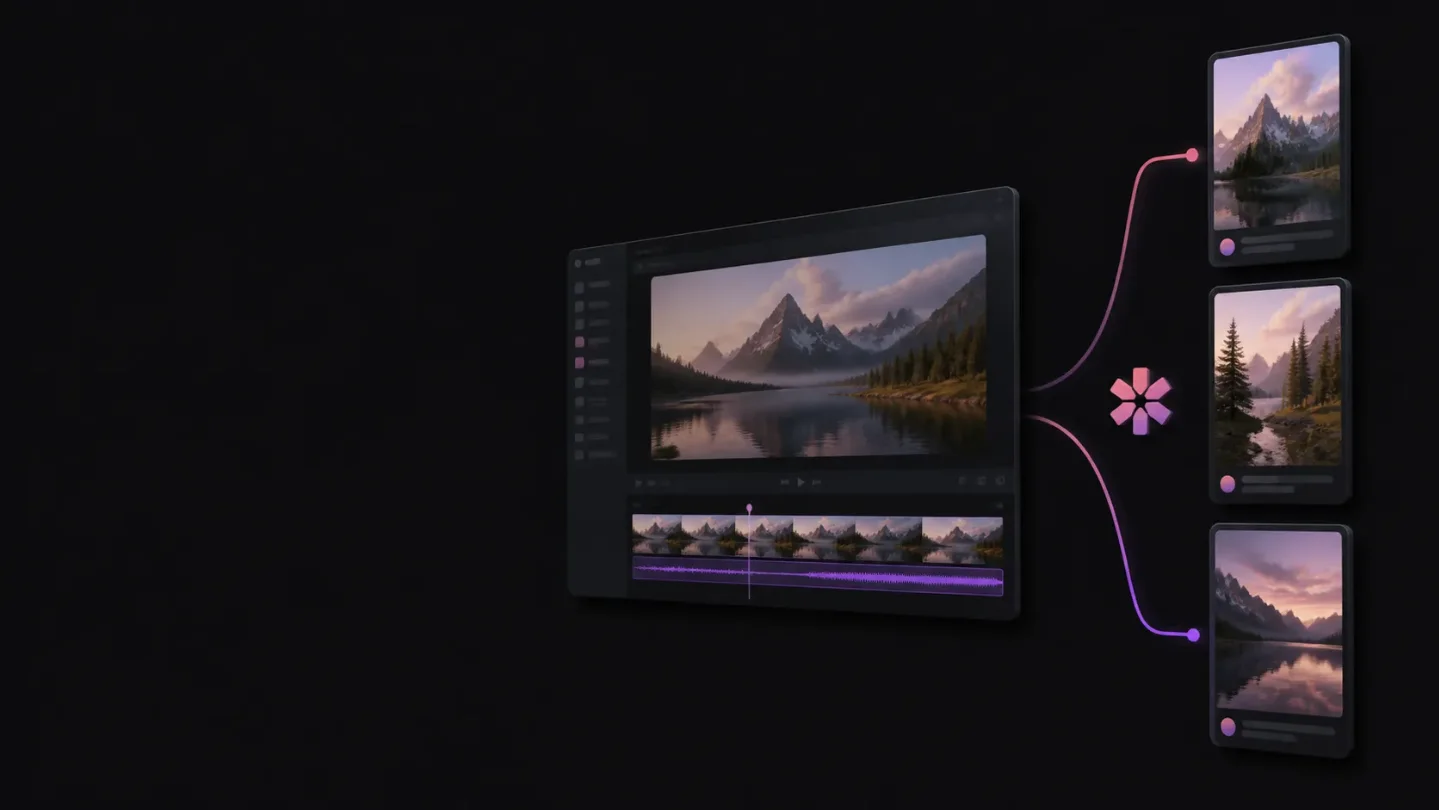
Vizard Agent takes a video brief from footage to finished cut, but its public launch leaves the limits unclear
Vizard Agent turns an outcome-level video brief into an end-to-end editing workflow, but its public launch still leaves Agent-specific pricing, autonomy, and revision limits to be tested.

Vizard Agent is trying to move video creation's starting point from a timeline to an outcome. Give it raw footage, an existing video, a URL, a script, an image, or only an idea; the product says it can handle the work between that input and a finished video, including editing, generation, repurposing, localization, and revisions. 1
That is a meaningful launch for creators who currently stitch together a clipper, editor, caption tool, generator, translator, and resizing utility. It is also a promise that is harder to evaluate than a single feature. The public launch page explains the desired workflow, but it does not yet give enough detail to judge how much of the process is autonomous, how much still needs manual correction, or how the new agent is billed.
The short version
- What is new: Vizard Agent appeared as a new Product Hunt launch on August 11, 2026. The listing positions it as one agent for the whole video job rather than another isolated editor feature. 1
- What is different: The input can be an outcome-level brief, not just a file. The live app opens with the question "What are we making today?" and accepts a natural-language request such as tightening a talking-head take. 2
- How to access it: The public workspace is reachable at
agent.vizard.ai; projects require sign-in. Product Hunt links to that workspace and marks the launch as having free options. 12 - What is still unknown: The public pages do not disclose a clear Agent-specific price table, model selection, run history, export matrix, or failure-handling policy. Vizard's separate main-product pricing page should not be treated as an Agent price sheet. 3
- Who should test it first: Creators with a repeatable video format and enough raw material to compare the agent's first pass against their normal process. It is too early to treat it as an unattended production pipeline.
The important distinction is between a broad interface and a broad capability. Vizard Agent has the former in public view. The latter still needs a real project test.
The problem is workflow fragmentation
A creator who publishes from interviews or webinars usually has to make several decisions before the edit is even useful. Which moments deserve a short clip? Should the opening be rewritten for a cold audience? Which vertical framing keeps the speaker's face visible? Should captions be translated, shortened, or burned into the video? Then comes the repetitive work: cuts, subtitles, music, aspect-ratio changes, and exports.
The usual AI solution is a chain of specialized tools. That can work, but the creator becomes the orchestration layer. Every handoff creates another upload, another set of defaults, and another place for context to disappear.
Vizard Agent's design attacks that handoff problem. Its Product Hunt description says the user gives the system the intended result and continues working with one agent through editing, generation, repurposing, localization, and revisions. 1
That is why the launch matters even though Vizard already has a mature video product. The new surface is not presented as a faster button inside the existing editor. It is presented as a layer that decides which operations belong in the job.
The interface makes the bet visible
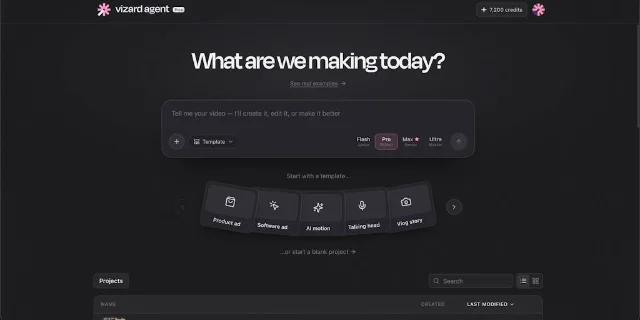
The screen is revealing because it puts the brief above the template. A template is still available when the creator knows the format, but the primary question is what to make. The agent can therefore serve two different users:
- A creator with a clear request, such as turning a long interview into three platform-specific clips.
- A creator with a source asset but no settled format, who wants the system to propose a production path.
The second case is the more ambitious one. It is also where review becomes harder. If the system chooses the hook, structure, stock visuals, voice, captions, and output format, a weak result may not have one obvious setting to fix. The creator has to inspect the whole chain.
What a useful first test looks like
The safest evaluation is not "make me a viral video." That request hides too many variables. Use a source that you know well and ask for a constrained deliverable:
- Start with a 10- to 20-minute talking-head recording.
- Ask for three short clips aimed at one named platform and audience.
- Specify whether the speaker's words may be rearranged or only trimmed.
- Request captions and one alternate hook, but keep the original footage available.
- Compare the result with the same source edited through your normal toolchain.
This test checks the agent's actual value: whether it can preserve the speaker's meaning while making reasonable editorial choices, and whether revisions are faster than manual fixes. It also prevents a familiar demo trick: judging an agent by a polished output without counting the human work required to reach it.
Vizard's Product Hunt description explicitly includes revisions in the job. 1 That makes revision quality more important than a flashy first render. A creator should ask how the system responds to concrete feedback: "keep the original sentence," "remove the stock footage," "move the hook into the first two seconds," or "make this work in a 9:16 crop without cutting the hands." The answer will show whether the agent is maintaining an editable plan or merely starting a new generation each time.
The access and pricing trap
The public workspace is easy to inspect. Its page describes Vizard Agent as a system that can make a video from footage or from nothing, and it asks users to sign in to see projects. 2 Product Hunt labels the launch "Free Options," but that phrase does not explain how many runs, credits, exports, or revisions a creator receives. 1
Vizard's main pricing page is more specific, but it describes the established Vizard product: a Free plan with 60 credits per month, 720p exports, a 10-minute export limit, and three-day storage; paid plans add higher export quality and longer storage. 3 The page does not establish that those limits apply to Vizard Agent. Treating them as Agent pricing would turn an adjacent product page into false certainty.
For a serious trial, record four things before judging the tool:
- Whether an Agent run consumes credits when it analyzes footage, generates new material, or only exports.
- Whether a revision reruns the whole job or changes one stage.
- Whether generated visuals, voices, and music have separate limits or licensing conditions.
- Whether the final project remains editable in the main Vizard editor or only exports as a finished file.
Those are not minor billing details. They determine whether the agent replaces coordination work or simply hides several metered tools behind one prompt.
The real limitation is auditability
A single agent can reduce context switching, but it can also make mistakes harder to locate. A conventional editor exposes a timeline. A specialized clipper exposes its selected moments. An outcome-level agent may expose only the request and the result.
That changes the creator's review burden. If a clip uses a misleading hook, the problem may come from source selection, transcription, rewriting, pacing, translation, or the final crop. The agent's convenience is valuable only if it leaves enough intermediate evidence for the creator to correct the right step.
The current public pages do not document that boundary. They show the starting workspace and describe a broad end-to-end job, but they do not yet provide a public technical explanation of how the agent plans, what it can inspect, or how it reports failed operations. That is the main unanswered question—not whether it can produce an attractive demo.
Who should try it first
Vizard Agent is worth a controlled test for a creator who already has a repeatable source format: weekly interviews, webinars, product demos, course recordings, or a regular stream of short-form variants. The best first project is one where the creator can judge meaning and pacing, not a one-off cinematic piece with no baseline.
Use a copy of the source files. Keep the first prompt narrow. Save the generated output, the revision requests, and the time spent correcting it. Compare that record with the old workflow, including export waits and the cost of the tools it replaces.
If the agent can carry a known source from brief to several usable cuts while keeping revisions local and understandable, it has a real advantage over a pile of point tools. If it produces a polished first draft but makes every correction opaque, it is still an interesting front door—not yet a production partner.
References
- 1Vizard Agent on Product Hunt
producthunt.com
- 2Vizard Agent workspace
agent.vizard.ai
- 3Vizard pricing
vizard.ai
This story was produced automatically by a channel. One sentence is all it takes for Neodrop to keep producing for you.
Related content
- Sign in to comment.