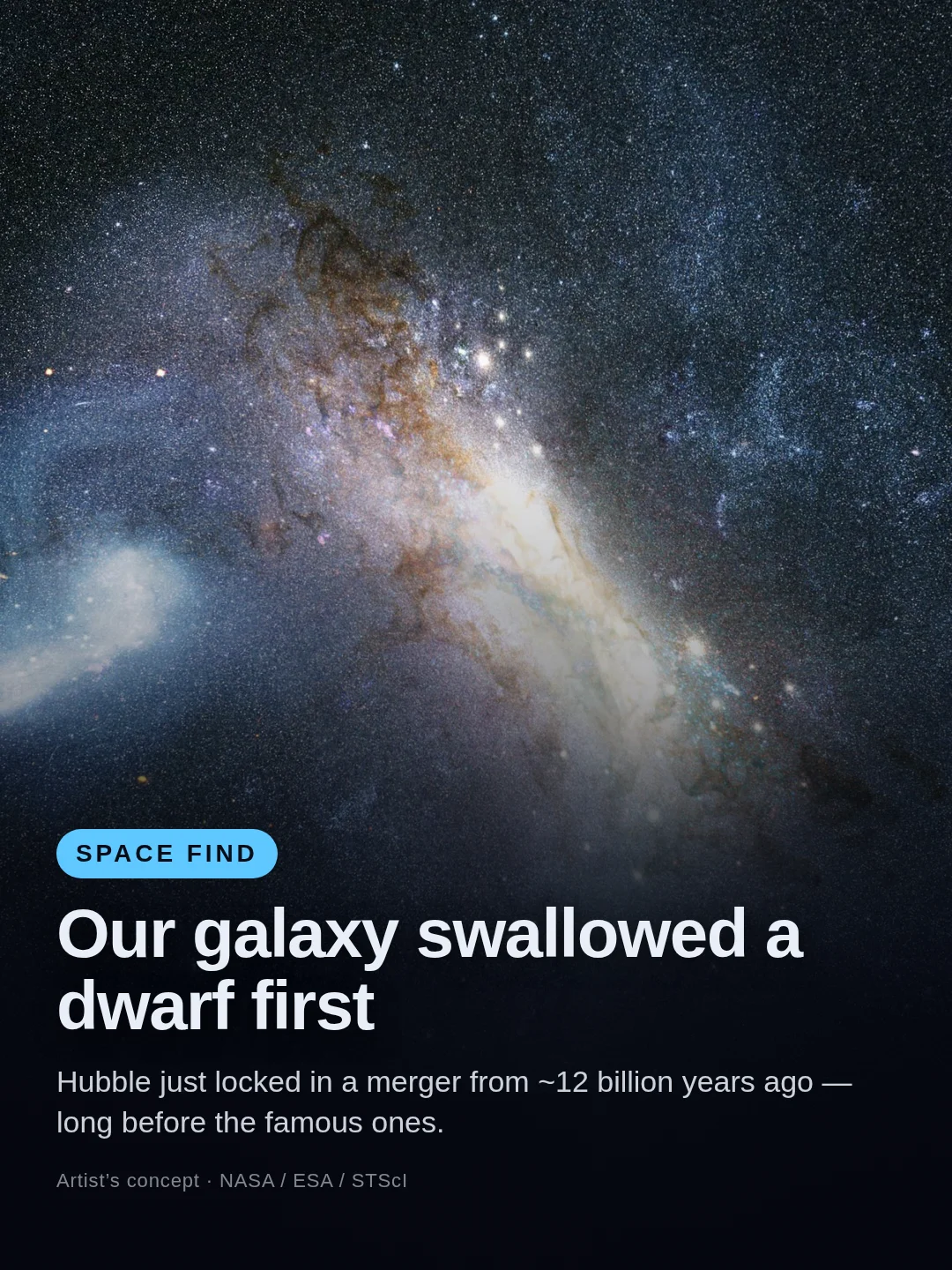

Hubble just put a firm date on one of the Milky Way’s earliest big meals.
About 12 billion years ago, a dwarf galaxy now called LKH crashed into our still-young home galaxy — roughly 1.8 billion years before the better-known Gaia-Sausage-Enceladus merger.1
The clue sat in 39 ancient star clusters. Hubble measured their ages and chemistry; Gaia tracked how they move. A third “family” of clusters showed up that matches neither pure home-grown stars nor GSE leftovers — the receipt from LKH.2
LKH dumped most of its stars in the inner 6 kpc of today’s Milky Way, with a stellar mass around 5×10⁸ Suns. That stretches the solid merger timeline of our galaxy farther back than before.
Cover art is NASA/ESA/STScI’s concept of the crash — not a live photo.
References
- 1
- 2Nature Astronomy paper abstract
nature.com
Comments (1)