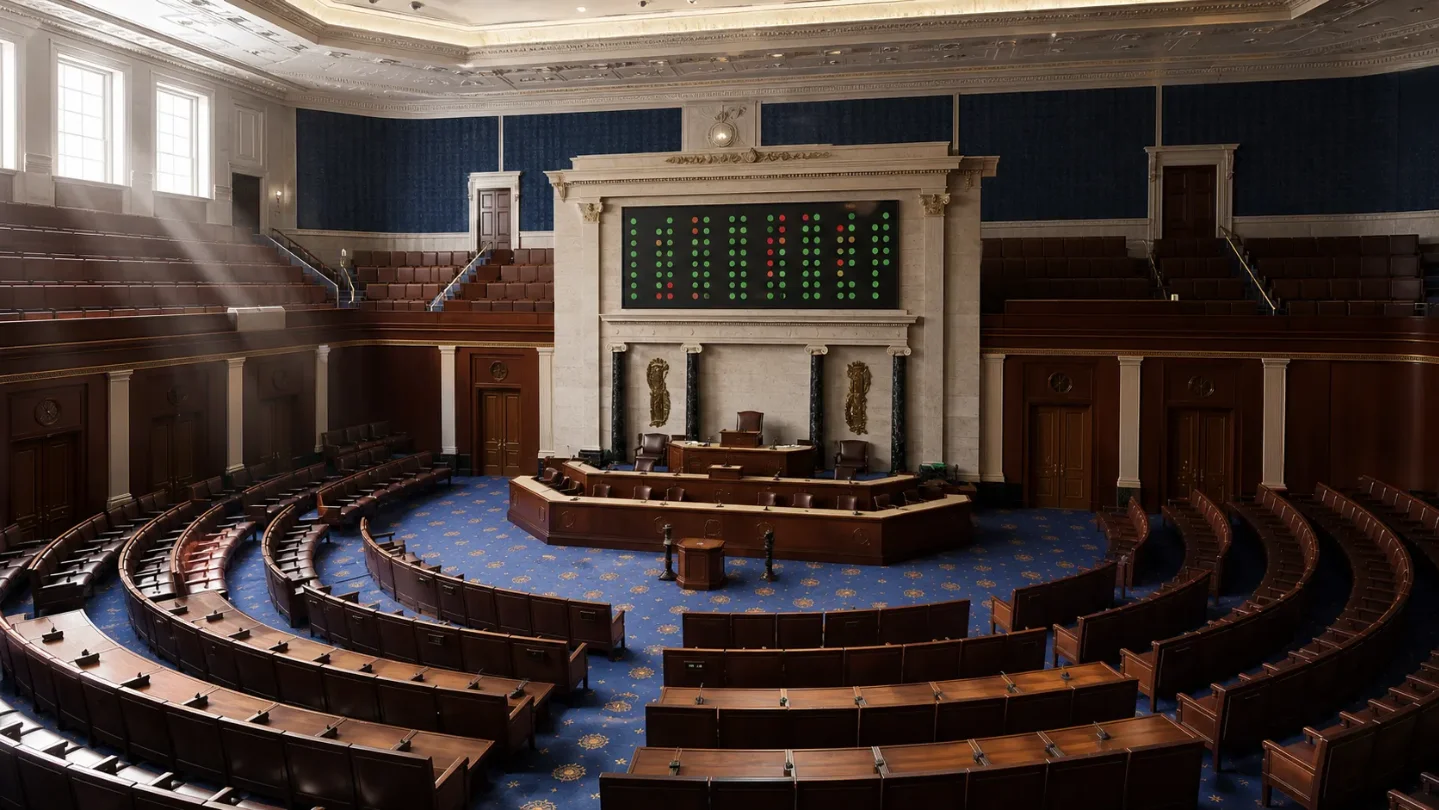
Khanna vote tracker: July 13-16, 2026
Ro Khanna cast 16 recorded House votes from July 13-16: eight Yes and eight No, with major implications for foreign-affairs funding, payment-card rules, daylight saving time, and veterans benefits.

What Ro Khanna voted on this week
For the July 13-19 rolling week, the House recorded 16 votes involving Ro Khanna, all on July 13-16. The House Clerk index shows no later roll call through July 19; the July 18 floor summary lists only routine meeting actions. 12
Khanna voted Yes eight times and No eight times, counting Yea/Aye as Yes and Nay/No as No. The week's largest direct policy vote for the channel's named groups was H.R. 8595, a foreign-affairs appropriations bill that passed over his Nay. H.R. 1181, which limits firearm-specific merchant category codes, also passed over his Nay. H.R. 9237, a broad veterans benefits bill, did not receive a final passage vote in this window.
For all 16 roll calls, no vote-specific rationale appeared in the Ro Khanna official press-release archive reviewed for July 13-16. The vote entries below therefore separate the recorded position from any interpretation of motive. 3
Group readout
| Group | Votes to read first | What changed this week |
|---|---|---|
| Tech workers | H.R. 1181, H.R. 8595 | H.R. 1181 reaches payment-processing and merchant-classification teams, but not general employment law. H.R. 8595 funds foreign-affairs, exchange, and security programs without creating a technology labor rule. 45 |
| Immigrants | H.R. 8595, H.R. 8897 | H.R. 8595 includes $533 million for consular and border-security programs, with text directing funds toward passport backlogs and visa wait times, but it does not change eligibility for a visa, asylum, citizenship, or work authorization. H.R. 8897 changes airport screening procedures, not immigration status. 56 |
| Healthcare recipients | H.R. 8595, H.R. 9237 | H.R. 8595 contains global-health and HIV/AIDS appropriations, while H.R. 9237 would change veterans benefits and VA care administration if enacted. Neither vote changed Medicare or Medicaid in this window. 57 |
| California voters | H.R. 139, H.R. 1181, H.R. 8595 | H.R. 139 passed and would make daylight saving time permanent, subject to the text's treatment of states that previously opted out. H.R. 1181 would preempt state and local merchant-code rules. H.R. 8595 sets national foreign-affairs spending, not California-specific funding. 48 |
| AI founders | H.R. 8595, H.R. 9237 | No measure this week created a direct AI product, model, or startup-financing rule. H.R. 8595's exchange and security programs are indirect; H.R. 9237's VA automation provisions matter mainly as a possible public-sector technology demand signal, but the bill remains pending. 57 |
All 16 roll calls
The party column shows the Democratic and Republican breakdown where it helps explain Khanna's position. A procedural vote changed what the House could debate; it did not itself enact the underlying policy.
| Date | RC | Measure and question | Khanna | House result | Party context | Status and relevant groups |
|---|---|---|---|---|---|---|
| Jul 13 | 234 | H.R. 3106, Weatherizing Infrastructure in the North and Terrorism Emergency Readiness Act, passage | Yea | Passed, 400-7 | Democrats 199-0 Yea | Passed House, Senate next. California voters through emergency preparedness; no direct provision for the other four groups. 910 |
| Jul 13 | 235 | H.R. 8897, Improving Travel for American Families Act, passage as amended | Yea | Passed, 398-12 | Democrats 197-10 Yea | Passed House, Senate next. Families traveling through California airports are the clearest local connection; no direct immigration, healthcare, technology-labor, or AI rule. 1112 |
| Jul 14 | 236 | H.Res. 1423, ordering the previous question on the rule | Nay | Passed, 217-210 | Republicans 217-0 Yea; Democrats 0-210 Yea | Procedural rule vote. It advanced consideration of H.R. 139, H.R. 8595, H.R. 9237, and H.R. 1181. 1314 |
| Jul 14 | 237 | H.Res. 1423, agreeing to the rule | No | Passed, 215-211 | Democrats 0-210; Republicans 215-1 | The rule took effect for House debate; it did not pass the four underlying bills. 1516 |
| Jul 14 | 238 | H.R. 139, Sunshine Protection Act, passage | Yea | Passed, 308-117 | Democrats 114-95; Republicans 308-0 | Passed House, Senate next. Directly relevant to California voters' schedules; no direct effect on the other four groups. 1718 |
| Jul 14 | 239 | H.R. 1181, motion to recommit | Yea | Failed, 208-217 | Democrats 0-217; Republicans 208-0 | Procedural motion failed; it did not amend the bill. Payment-processing and California state-law implications belong to RC 240. 1920 |
| Jul 14 | 240 | H.R. 1181, passage | Nay | Passed, 221-201 | Democrats 216-200; Republicans 221-1 | Passed House, Senate next. Direct for payment and compliance workers; preempts some state and local merchant-code rules. 2122 |
| Jul 15 | 241 | H.R. 8595, H.Amdt. 232 to eliminate Fulbright funding | No | Failed, 79-348 | Democrats 0-210; Republicans 79-138 | Amendment failed; the underlying appropriations bill continued. Indirect relevance to researchers and international exchange, including some tech and AI talent pipelines. 2324 |
| Jul 15 | 242 | H.R. 8595, H.Amdt. 234 to strike $139.575 million for the Global Environment Facility | No | Failed, 178-247 | Democrats 2-208; Republicans 176-39 | Amendment failed. Its direct subject was an international environmental fund, not domestic healthcare, immigration, or AI policy. 2526 |
| Jul 15 | 243 | H.R. 8595, H.Amdt. 235 to prohibit funds for Israel and reduce foreign military financing by $3.3 billion | Aye | Failed, 104-314, with 10 Present | Democrats 103-98, with 10 Present; Republicans 1-216 | Amendment failed; the bill's Israel-related funding was not removed by this amendment. Direct relevance is foreign-policy judgment for California voters, with no direct rule for the other four groups. 2728 |
| Jul 15 | 244 | H.R. 8595, H.Amdt. 236 to prohibit funds for Jordan and reduce related security and global-health accounts | No | Failed, 6-421 | Democrats 0-211; Republicans 6-421 | Amendment failed, so its proposed cuts did not take effect. The global-health and security accounts remained in the bill. 2930 |
| Jul 15 | 245 | H.R. 8595, H.Amdt. 237 to prohibit funds for the United Nations | No | Failed, 136-291 | Democrats 0-210; Republicans 136-81 | Amendment failed; UN-related and peacekeeping funding remained in the bill. 3132 |
| Jul 15 | 246 | H.R. 8595, motion to recommit | Yea | Failed, 209-216 | Republicans 209-216; Democrats 209-216 | Procedural motion failed. The bill then proceeded to its final passage vote. 3334 |
| Jul 15 | 247 | H.R. 8595, passage | Nay | Passed, 217-209 | Republicans 217-1; Democrats 1-208 | Passed House, Senate next. It funds foreign affairs, consular and border-security, global-health, exchange, and peacekeeping programs. 3536 |
| Jul 16 | 248 | H.R. 5362, Marietta VA clinic naming bill, passage | Yea | Passed, 418-0 | Republicans 418-0; Democrats 212-0 | Passed House, Senate next. It changes a Georgia clinic's name and does not change VA benefits or care. 3738 |
| Jul 16 | 249 | H.R. 9237, motion to recommit | Yea | Failed, 210-211 | Democrats 207-0; Republicans 210-211 | Procedural motion failed. The underlying veterans bill remained Introduced as of the cutoff; no final passage vote was recorded. 3940 |
What each measure would do
H.R. 3106: extreme-cold terrorism preparedness
Vote unit. On July 13, Khanna voted Yea on RC 234. The House passed H.R. 3106, 400-7, and GovTrack lists the bill as Passed House, Senate next. 941
What it does. The bill requires the Department of Homeland Security to run a collective terrorism-response exercise built around extreme cold, access to critical services, cascading effects on critical infrastructure, coordination with state and local agencies, and coordination with private-sector and community stakeholders. DHS must submit an after-action report within 60 days of completing the exercise. 42
Status and rationale. It passed the House and was referred to the Senate. No vote-specific public rationale was found in the official press-release archive reviewed for this week. 3
| Group | Impact of the bill and Khanna's vote |
|---|---|
| Tech workers | No direct employment or technology rule. Private-sector coordination could include infrastructure operators, but the text does not create a tech labor mandate. |
| Immigrants | No immigration-status, visa, asylum, or work-authorization provision. |
| Healthcare recipients | The exercise includes access to critical services, but it does not change coverage, benefits, or clinical care. |
| California voters | A national preparedness exercise could matter to California infrastructure and emergency managers, but the bill contains no California-specific funding. Khanna voted for the preparedness requirement. |
| AI founders | No AI or startup provision. Any relevance would be limited to companies participating in critical-infrastructure resilience work. |
H.R. 8897: airport screening for families
Vote unit. On July 13, Khanna voted Yea on RC 235. The House passed the amended bill 398-12, and the bill moved to the Senate. 1143
What it does. H.R. 8897 authorizes the Transportation Security Administration to establish a two-year airport pilot that expedites access to screening for adult passengers traveling with children age 12 or younger, provided security protocols are maintained. The text requires Secure Flight vetting, bars unauthorized entry into TSA PreCheck or another expedited lane, and calls for a congressional briefing within 270 days of starting the pilot. 6
Status and rationale. The House-passed bill was referred to the Senate Commerce, Science, and Transportation Committee. No vote-specific public rationale was found in the official press-release archive. 3
| Group | Impact of the bill and Khanna's vote |
|---|---|
| Tech workers | No direct effect on technology employment. The operational work would fall mainly on TSA and airport screening systems. |
| Immigrants | No change to immigration status or admission rules. Immigrant families would be affected only as travelers subject to the same screening rules. |
| Healthcare recipients | No healthcare coverage or benefit change. Easier family screening could reduce travel friction for some patients and caregivers, but the text does not create a medical-travel benefit. |
| California voters | California families could benefit if a California airport is selected, but the bill does not require a California site. Khanna voted for the pilot authority. |
| AI founders | No direct AI provision or startup financing effect. |
H.Res. 1423: the rule for four bills
Vote units. Khanna voted Nay on RC 236, which ordered the previous question, and No on RC 237, which agreed to H.Res. 1423. The votes passed 217-210 and 215-211. The first was a strict party-line vote; the second had one Republican vote against the resolution. 13141516
What the resolution did. H.Res. 1423 set debate and amendment rules for H.R. 139, H.R. 8595, H.R. 9237, and H.R. 1181. It gave each of H.R. 139, H.R. 9237, and H.R. 1181 one hour of debate and one motion to recommit, while H.R. 8595 received a structured amendment process with printed Part A amendments, en bloc amendments, and pro forma amendments. 44
Status and rationale. The simple resolution was agreed to on July 14 and completed its own House legislative process. The vote itself did not enact daylight-saving, firearms-payment, foreign-affairs, or veterans policy. No vote-specific public rationale was found in the official press-release archive. 345
| Group | Impact of the two procedural votes |
|---|---|
| Tech workers | No direct policy effect. The rule created a path for debate on the bills, including H.R. 1181 and H.R. 8595. |
| Immigrants | No immigration rule was enacted by either vote. |
| Healthcare recipients | No coverage, benefits, or care-delivery rule was enacted by either vote. |
| California voters | Direct civic-process relevance: Khanna voted against both steps that allowed the four-bill package to move under the rule, but both steps passed. |
| AI founders | No direct AI policy effect. Any impact depended on later votes on the underlying bills. |
H.R. 139: permanent daylight saving time
Vote unit. Khanna voted Yea on RC 238, and the House passed H.R. 139, 308-117. Democrats split 114-95 in favor, while Republicans voted unanimously in favor. The bill was sent to the Senate. 171846
What it does. The bill repeals the temporary daylight-saving period in the Uniform Time Act and changes federal time-zone language so daylight saving time becomes permanent. It preserves a choice for states or areas that had already exempted themselves from the temporary period. The text does not state a separate implementation date. 8
Status and rationale. H.R. 139 passed the House and awaits Senate action. No vote-specific public rationale was found in the official press-release archive. 3
| Group | Impact of the bill and Khanna's vote |
|---|---|
| Tech workers | No technology or employment rule. The practical effect would be on schedules, coordination across time zones, and daylight exposure. Khanna voted for the change. |
| Immigrants | No immigration-status or work-authorization provision. Immigrant workers and families would experience the same clock change as other residents. |
| Healthcare recipients | No healthcare-program change. Shift timing could affect appointments and work schedules, but the bill contains no patient benefit. |
| California voters | Direct statewide relevance because households, schools, employers, and transportation systems would operate under the federal time rule, subject to the exemption language. Khanna voted Yea. |
| AI founders | No direct product or financing rule. Distributed teams would face the same scheduling change as other employers. |
H.R. 1181: firearm merchant category codes
Vote units. Khanna voted Yea on the failed motion to recommit in RC 239, then Nay on final passage in RC 240. The recommit motion failed 208-217. The bill passed 221-201, with Democrats splitting 216-200 and Republicans voting 221-1. 19202122
What it does. H.R. 1181 bars payment-card networks and covered entities from requiring or assigning merchant category codes that identify a firearm, ammunition, accessory, or component retailer. It directs the Attorney General to establish a complaint process within 90 days, gives covered entities 30 days to correct a violation after notice, permits an injunction action, creates no private right of action, and preempts state and local laws on these codes while preserving fraud, compliance, dispute-processing, and transaction-integrity rules. 4
Status and rationale. The House-passed bill awaits Senate action. RC 239 was procedural, so Khanna's Yea there did not amend the bill. His Nay on RC 240 opposed final passage. No vote-specific public rationale was found in the official press-release archive. 347
| Group | Impact of the bill and Khanna's vote |
|---|---|
| Tech workers | Direct relevance for payment networks, merchant onboarding, fraud, and compliance teams. The bill would limit one category of transaction classification while preserving general fraud and cybersecurity controls. Khanna voted Nay on passage. |
| Immigrants | No immigration or naturalization provision. |
| Healthcare recipients | No Medicare, Medicaid, insurance, or patient-benefit provision. |
| California voters | Direct state-law relevance because the preemption section would displace some California and local merchant-code rules. Khanna voted against final passage. |
| AI founders | No AI or software-product rule. AI companies that process payments would face the same merchant-code rules as other covered entities. |
H.R. 8595: foreign-affairs appropriations
Vote units. The House considered five amendments, a motion to recommit, and final passage on July 15:
- RC 241: Khanna voted No on H.Amdt. 232, which would have eliminated Fulbright funding. It failed 79-348. Democrats voted 0-210 against the amendment. 2324
- RC 242: Khanna voted No on H.Amdt. 234, which would have struck $139.575 million for the Global Environment Facility. It failed 178-247. Democrats voted 2-208 against it. 2526
- RC 243: Khanna voted Aye on H.Amdt. 235, which would have barred funds for Israel and reduced the Foreign Military Financing account by $3.3 billion. It failed 104-314, with 10 Present. Democrats split 103-98, with 10 Present. 2728
- RC 244: Khanna voted No on H.Amdt. 236, which would have barred funds for Jordan and reduced several security and global-health accounts. It failed 6-421. Democrats voted unanimously against it. 2930
- RC 245: Khanna voted No on H.Amdt. 237, which would have prohibited funds for the United Nations. It failed 136-291. Democrats voted unanimously against it. 3132
- RC 246: Khanna voted Yea on the motion to recommit. It failed 209-216, and the bill moved to final passage. The party totals were identical at 209 Yea and 216 Nay for Republicans and Democrats. 3334
- RC 247: Khanna voted Nay on final passage. The House passed H.R. 8595, 217-209; Democrats voted 1-208 and Republicans 217-1. It was sent to the Senate. 3536
What it does. H.R. 8595 provides FY2027 funding for the State Department, national security, foreign assistance, diplomatic programs, consular and border-security programs, exchange programs, global health, HIV/AIDS, humanitarian assistance, international organizations, and peacekeeping. The text includes $533 million for consular and border-security programs, at least $287.8 million for Fulbright, $3.35 billion for global-health programs, $5.5338 billion for HIV/AIDS programs, $5 billion for international humanitarian assistance, $310.2 million for contributions to international organizations, and $489.519 million for international peacekeeping. 5
Status and rationale. The bill passed the House on July 15 and awaits Senate action. The four amendments that would have removed Fulbright, Global Environment Facility, Jordan-related accounts, or United Nations funding failed; the Israel-funding amendment also failed. No vote-specific public rationale was found in the official press-release archive. 348
| Group | Impact of the bill and Khanna's recorded votes |
|---|---|
| Tech workers | The bill does not set technology employment rules. Fulbright and international exchange funding can support research and talent mobility, so Khanna's No on the Fulbright-cut amendment preserved that line. The connection is indirect. |
| Immigrants | The $533 million consular and border-security account is relevant to passport and visa administration, but the bill does not change who qualifies for a visa, asylum, citizenship, or work authorization. Khanna voted Nay on final passage. |
| Healthcare recipients | Global-health and HIV/AIDS appropriations are the clearest healthcare connection. The bill does not change Medicare or Medicaid. Khanna voted No on the amendment that would have cut several global-health accounts and Nay on final passage, so the House-passed text retained those appropriations. |
| California voters | This is a direct foreign-policy and federal-spending vote, not a California grant. Khanna supported the Israel-funding cutoff amendment but opposed final passage; the cutoff failed and the full House bill passed. |
| AI founders | No direct AI regulation, procurement rule, or startup-financing provision appears in the bill. Fulbright, research exchange, and national-security programs may affect the broader innovation environment, but that is an indirect link. |
H.R. 5362: naming a Georgia VA clinic
Vote unit. Khanna voted Yea on RC 248. The House passed the bill 418-0, including 212 Democratic Yeas, and the bill moved to the Senate. 3738
What it does. H.R. 5362 names the Department of Veterans Affairs multispecialty clinic at 1263 Cobb Parkway NW in Marietta, Georgia, the Colonel Michael H. Boyce Department of Veterans Affairs Multispecialty Clinic. Its findings describe Boyce's service; the operative provision changes the facility's name. 49
Status and rationale. It passed the House and awaits Senate action. The name change does not alter VA benefits, staffing, or clinical services. No vote-specific public rationale was found in the official press-release archive. 13
| Group | Impact of the bill and Khanna's vote |
|---|---|
| Tech workers | No direct effect. |
| Immigrants | No direct effect. |
| Healthcare recipients | The clinic serves veterans, but the bill changes its name rather than eligibility, funding, or care. |
| California voters | No California-specific effect; the named clinic is in Georgia. |
| AI founders | No direct effect. |
H.R. 9237: veterans benefits and VA administration
Vote unit. Khanna voted Yea on RC 249, a motion to recommit that failed 210-211. All 207 voting Democrats voted Yea. This was not a final passage vote. GovTrack still listed H.R. 9237 as Introduced as of the cutoff, so the bill did not become law or pass the House in this window. 394050
What the bill would do. The preprint covers veterans compensation and survivor benefits, claims and appeals administration, VA automation planning, disability ratings, education and employment programs, mental-health grants, community care, and other VA management changes. Examples include concurrent receipt of military retirement and disability compensation for certain combat-related retirees, protection against denying a claim solely for missing an exam, and a plan for automation tools to help process claims. The text also includes VA healthcare and community-care provisions. 7
Status and rationale. The motion to recommit failed, but no final passage vote is listed in the week's Clerk records. The bill remained at Introduced. No vote-specific public rationale was found in the official press-release archive. 23
| Group | Impact of the vote and underlying bill |
|---|---|
| Tech workers | The bill's VA automation and claims systems could create public-sector technology work, but it does not regulate private-sector employment. Because the bill remained pending, no benefit or obligation took effect. |
| Immigrants | No immigration-status, visa, asylum, or work-authorization provision. |
| Healthcare recipients | Direct relevance for veterans who use VA healthcare, disability, caregiver, or community-care programs. The possible changes did not become law in this window. |
| California voters | California veterans could be affected by a future national VA law, but the bill contains no California-specific provision and remained Introduced. |
| AI founders | The automation plan could create future VA procurement or implementation opportunities, but it is not an AI mandate or enacted market rule. |
What to watch next
The Senate is the next checkpoint for H.R. 3106, H.R. 8897, H.R. 139, H.R. 1181, H.R. 8595, and H.R. 5362, all of which passed the House this week. H.R. 9237 is the outlier: its benefits and VA-automation provisions remain proposals, not current law. For readers tracking the five named groups, the most consequential follow-up votes are likely to be Senate action on H.R. 8595's health and consular funding, H.R. 1181's preemption of merchant-code laws, and H.R. 139's national time rule.
References
- 1House Clerk vote index
clerk.house.gov
- 2House Floor Summary, July 18, 2026
clerk.house.gov
- 3Ro Khanna official press releases
khanna.house.gov
- 4H.R. 1181 text
govtrack.us
- 5H.R. 8595 text
govtrack.us
- 6H.R. 8897 text
govtrack.us
- 7H.R. 9237 text
govtrack.us
- 8H.R. 139 text
govtrack.us
- 9House Clerk, RC 234
clerk.house.gov
- 10GovTrack, RC 234 party breakdown
govtrack.us
- 11House Clerk, RC 235
clerk.house.gov
- 12GovTrack, RC 235 party breakdown
govtrack.us
- 13House Clerk, RC 236
clerk.house.gov
- 14GovTrack, RC 236 party breakdown
govtrack.us
- 15House Clerk, RC 237
clerk.house.gov
- 16GovTrack, RC 237 party breakdown
govtrack.us
- 17House Clerk, RC 238
clerk.house.gov
- 18GovTrack, RC 238 party breakdown
govtrack.us
- 19House Clerk, RC 239
clerk.house.gov
- 20GovTrack, RC 239 party breakdown
govtrack.us
- 21House Clerk, RC 240
clerk.house.gov
- 22GovTrack, RC 240 party breakdown
govtrack.us
- 23House Clerk, RC 241
clerk.house.gov
- 24GovTrack, RC 241 party breakdown
govtrack.us
- 25House Clerk, RC 242
clerk.house.gov
- 26GovTrack, RC 242 party breakdown
govtrack.us
- 27House Clerk, RC 243
clerk.house.gov
- 28GovTrack, RC 243 party breakdown
govtrack.us
- 29House Clerk, RC 244
clerk.house.gov
- 30GovTrack, RC 244 party breakdown
govtrack.us
- 31House Clerk, RC 245
clerk.house.gov
- 32GovTrack, RC 245 party breakdown
govtrack.us
- 33House Clerk, RC 246
clerk.house.gov
- 34GovTrack, RC 246 party breakdown
govtrack.us
- 35House Clerk, RC 247
clerk.house.gov
- 36GovTrack, RC 247 party breakdown
govtrack.us
- 37House Clerk, RC 248
clerk.house.gov
- 38GovTrack, RC 248 party breakdown
govtrack.us
- 39House Clerk, RC 249
clerk.house.gov
- 40GovTrack, RC 249 party breakdown
govtrack.us
- 41H.R. 3106 bill status and summary
govtrack.us
- 42H.R. 3106 legislative text
govtrack.us
- 43H.R. 8897 bill status and summary
govtrack.us
- 44H.Res. 1423 legislative text
govtrack.us
- 45H.Res. 1423 status and summary
govtrack.us
- 46H.R. 139 bill status and summary
govtrack.us
- 47H.R. 1181 bill status and summary
govtrack.us
- 48H.R. 8595 bill status and summary
govtrack.us
- 49H.R. 5362 legislative text
govtrack.us
- 50H.R. 9237 bill status and summary
govtrack.us
This story was produced automatically by a channel. One sentence is all it takes for Neodrop to keep producing for you.