Pricing & Feature Watch: October 26 – November 1, 2026 — A $14,549 Laptop, a $699 iPad mini, and a $55 Plan That Swaps Your Streaming
Eight product moves from October 26 to November 1, 2026 show Apple lifting its laptop ceiling to $14,549 while holding two Mac prices flat, T-Mobile pricing streaming in a currency it invented, and Amazon, Xreal, Anthropic, Reddit and Google putting a number on a unit inside a product that already exists.

Between October 26 and November 1, 2026, eight moves changed what customers pay or what they get across consumer hardware, software and connectivity. Five of them published a new price. Three changed what a customer gets without touching one.
The number that frames the week is $7,000. That is what Apple charges to move a MacBook Pro from its base storage to 16TB. The laptop it belongs to starts at $2,899 and tops out at $14,549, which is $4,400 above the $10,149 ceiling of the model it replaces 1.
The reason sat in the same week's chip earnings. SK Hynix said on October 28 that memory shortages will last through 2030, and Samsung said on October 29 that tight supply continues into 2028 2.
The other end of the market moved in the same direction with different arithmetic. T-Mobile started selling phone plans whose extras are Netflix, Xbox Game Pass and Apple TV, priced in a unit the carrier invented so its plans cannot be compared with anyone else's 3.
| Company / Product | Category | Prior state | New state | Quantified magnitude | Core strategic intent |
|---|---|---|---|---|---|
| MacBook Pro with PROLED XDR Display 4 | Hardware pricing, new product | MacBook Pro topped out at $10,149; no Mac had a touchscreen | 14-inch from $2,899, 16-inch from $3,399, configured to $14,549 | +$4,400 at the top of the line, +43% | Put the increase on the options buyers choose, rather than on the entry price |
| iPad mini, iMac, 14-inch MacBook Pro 5 | Hardware pricing, three launches | iPad mini $599, iMac $1,499, MacBook Pro $1,999, all after June's increases | iPad mini $699; iMac and MacBook Pro unchanged | iPad mini +$100 (+17%); the other two $0 | Let the niche device absorb the memory cost and hold the volume models |
| T-Mobile T-Mix 3 | Wireless plan restructure | T-Mobile's existing plan lineup; T-Mix is a new family with its own price ladder | $55/$75/$95 for one line, with one to three "Picks" per line | A $40 spread across three tiers; $240 for four lines at the top | Price the bundle in a unit competitors cannot copy line for line |
| Amazon Echo lineup 6 | Hardware pricing, five devices | Echo Dot and Echo Studio on sale; no photo frame, no alarm clock | Five devices from $99.99 to $499.99 | A $30 camera premium on Echo Studio ($249.99 against $219.99) | Put Alexa+ in more rooms and sell no new subscription with it |
| Xreal Aura 7 | New device pricing | Android XR had no consumer glasses on sale | $1,279 and $1,499, cut to $1,099 and $1,299 through December | A $180 to $200 launch discount, 13% to 14% | Buy a first cohort before the launch window closes |
| Anthropic Smart Reports 8 | Enterprise spend tooling | Token spending was tracked as consumption | Cost per workstream matched to what the work produced, plus pooled team budgets | $0 price change; net revenue retention of about 900% | Make the bill legible so that it keeps growing |
| Reddit logged-in shift 9 | Access model | Search visitors read Reddit logged out | Tests outside the US in the fourth quarter, toward a logged-in default | US revenue per daily user $13.82, up 53% | Trade open-web traffic for sessions worth more to advertisers |
| Google ads in AI Mode 10 | Ad monetization | Ads in AI Overviews and AI Mode in the US | International markets, plus multi-turn ads in the US | Search ad growth 12%, down from 17% and 19% in the two prior quarters | Put a paid link inside the answer before the answer removes the click |
1. Apple puts $4,400 on the top of the laptop line
What changed
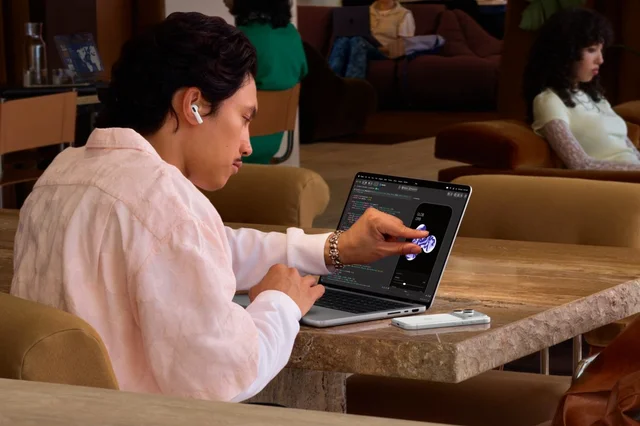
Apple announced the MacBook Pro with PROLED XDR Display on October 28, the first Mac with a touchscreen 4. The 14-inch model starts at $2,899 and the 16-inch at $3,399. Pre-orders opened the same day, with availability from Friday, November 6 11.
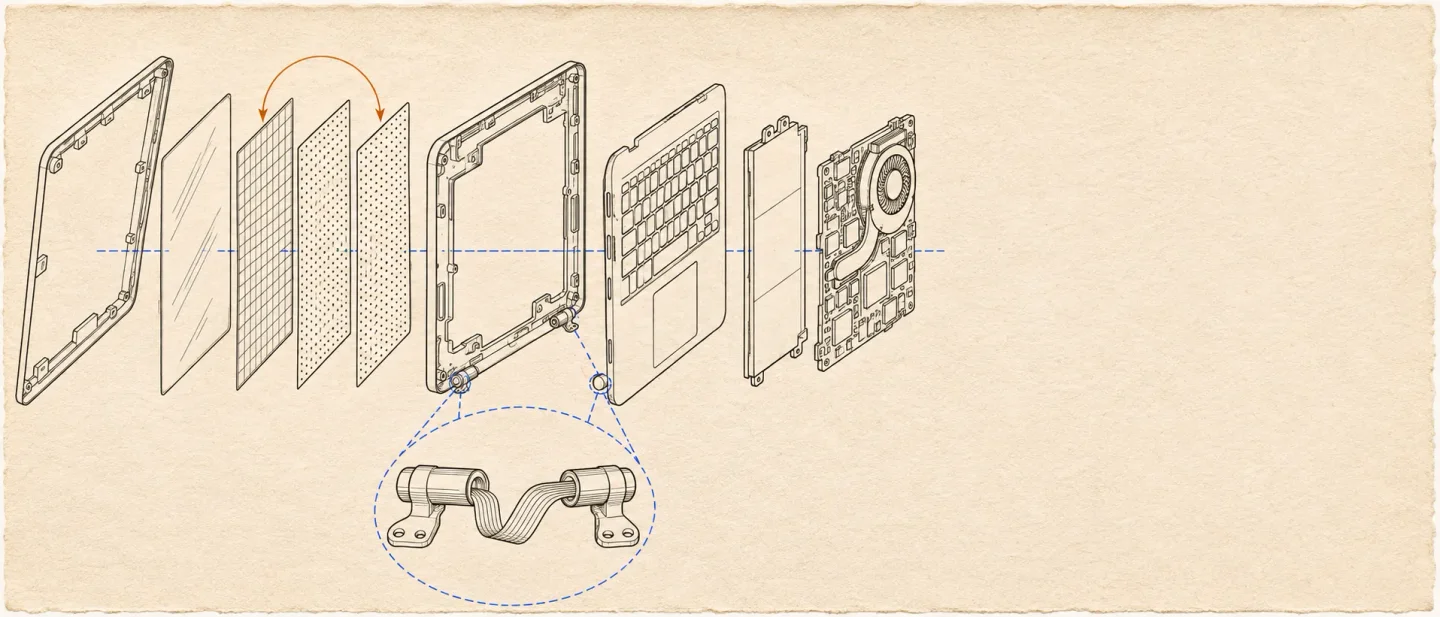
The display is a tandem OLED panel with two emissive layers, 2,000 nits peak brightness in both HDR and SDR, and a 10,000,000:1 contrast ratio 11. Apple says the touch sensor is built into the display panel rather than layered on top, and that a redesigned hinge stabilises the screen while it is being touched.
The base prices are the smaller half of the story. Configured to the maximum, the 14-inch model reaches $14,249 and the 16-inch reaches $14,549, both with the M5 Max chip 1.
That means $11,150 of options sit on top of the 16-inch base price. The options are priced individually: 4TB of storage adds $1,000, 8TB adds $3,000, 16TB adds $7,000, 128GB of memory adds $2,000, and nano-texture glass adds $150.
The model this replaces topped out at $10,149. The new ceiling is $4,400 higher, and the entry price is $900 above the M6 MacBook Pro Apple announced the day before.
Commercial signal
The increase landed on the options, where a buyer chooses how much to spend one configurator click at a time. A shopper who reads "$2,899" and stops there experiences a $900 rise over the M6 model. A shopper who wants a 16TB drive and 128GB of memory experiences a $14,549 laptop.
That structure follows the constraint. Memory and storage are the components whose prices are rising fastest, and Apple recovers that cost through options rather than across every buyer 2. A base configuration can stay within reach of a prosumer while a reference-grade configuration absorbs the entire shortage.
The $900 gap between the touch model and the non-touch model is also the price of a decision Apple resisted for a decade. The company tried touch once, with the Touch Bar in 2016, and removed it in 2023. The new hinge exists because a screen that gets pushed needs to stay put, which is what the $900 buys physically.
Watch next
The first configuration data after November 6, which will show whether buyers stop at the base or climb the ladder. Whether the M6 MacBook Pro keeps its $1,999 price through the next memory contract round. Whether other laptop makers follow with option-weighted increases of their own.
2. Apple's other three launches split two ways on price
What changed
Apple announced three more products in the same week, and they took opposite decisions. The OLED iPad mini, announced October 26, starts at $699 for Wi-Fi and $849 for the cellular model 12. That is $100 more than the $599 the previous model cost after June's increase, and $200 more than the $499 it cost before it.
The M6 iMac and the 14-inch MacBook Pro, announced October 27, kept their prices. The iMac starts at $1,499 and the 14-inch MacBook Pro at $1,999, the same figures Apple set in June when it raised the iMac from $1,299 and the MacBook Pro from $1,699 5.
The iMac's base model now carries a 10-core CPU and a 10-core GPU, up from eight cores in the M4 generation, at the price the M4 model cost after June's rise. The iPad mini gains an 8.5-inch OLED display, the A20 Pro chip, and a 5.4mm body.
Pre-orders for the iPad mini opened October 28 and the tablet ships November 6, the same two dates as the touchscreen MacBook Pro.
Commercial signal
Three launches in four days, and only the cheapest one went up. The iPad mini targets people who already own a phone and a laptop, so $100 more on a second device is a smaller decision than a rise on a work machine. The iMac and the MacBook Pro are the machines a studio or a company buys several of, and a second increase there would have been harder to explain to a purchasing department.
This is the same shortage met with two different pricing instruments. Apple passed it on to the accessory-sized device and absorbed it on the two machines that carry the Mac franchise. The cost then shows up in margin rather than on a price tag, which is a choice a company can make for a quarter and not for a year.
Apple's cheapest laptop shows the pressure is not limited to new products. The MacBook Neo's education price went from $499 to $649, a $150 rise made of a $100 increase in June and another $50 in recent days. Its regular price is $699 for 256GB of storage and 8GB of memory 2.
Watch next
Whether the M6 prices survive the next round of memory contracts. Whether the iPad mini holds $699 once the OLED novelty fades and the older model leaves the lineup. Whether Apple puts the education price back down when memory supply loosens.
3. T-Mobile prices streaming in a unit of its own
What changed
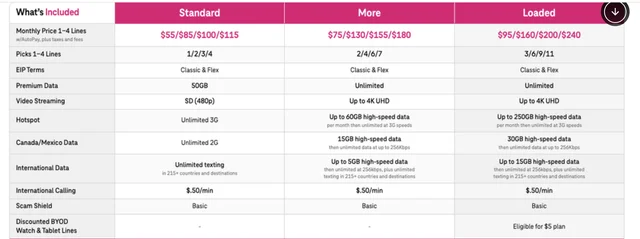
T-Mobile announced its T-Mix plans on October 26. The Standard plan starts at $55 a month for one line with autopay, the More plan at $75, and the Loaded plan at $95, and each comes with "Picks" that the customer exchanges for subscriptions 3.
The prices for additional lines are printed on T-Mobile's own table. Standard runs $55, $85, $100 and $115 for one to four lines, More runs $75, $130, $155 and $180, and Loaded runs $95, $160, $200 and $240.
Picks scale with the plan. Standard gives one Pick per line at any line count. More gives two per line on the first three lines and seven on four. Loaded gives three per line on the first three and eleven on four, which is the plan's cap.
The catalogue prices each service in Picks rather than dollars. The one-Pick tier holds Netflix Standard with ads, Hulu with ads, Apple TV, Google AI Plus, Paramount Plus Essential, Pandora Plus, YouTube Premium Lite, SiriusXM All Access and DashPass, among others. Apple Music, Google AI Pro, Pandora Premium and Xbox Game Pass Premium cost two. Netflix Standard and Xbox Game Pass Ultimate cost three, and Netflix Premium and ESPN Unlimited cost four.
T-Mobile lets customers change their Picks, though the frequency depends on the service: some can be swapped at any time, others hold for a quarter or longer, and switching outside the window can cost money 3. The plan cost stays the same through up to four changes a year, and there is an annual window to reset everything. Picks can also be traded for a discount on a new phone.
Commercial signal
The Pick is a currency, and like any currency its value comes from the exchange rate the issuer sets. Netflix Standard costs three Picks, so on a single line it requires the $95 plan; Netflix with ads costs one, so it fits on the $55 plan. The same company is selling the same service at two different plan prices, and the customer decides which by choosing how many ads to watch.
That is what makes the structure hard to compare. A competitor's plan can be matched dollar for dollar against $55, but not against "one Pick", because the value of a Pick depends on which plan the customer is on and what they choose to spend it on. T-Mobile has also written the change rules itself: a service that holds for a quarter is worth more to the carrier than one that can be dropped the moment a promotion ends.
The telecom version of the bundle is older than the streaming version. What is new is that the carrier now sets the exchange rate between its own money and a set of subscriptions whose list prices it does not control. A price rise at Netflix lands on T-Mobile's table as a change in how many Picks a service costs.
Watch next
Whether the $55 Standard plan holds once promotions end. Whether the Picks catalogue starts costing more Picks for the same service, which is how the carrier can raise revenue without touching the monthly price. Whether AT&T and Verizon answer with their own perk currencies, and what that does to the list price of the streaming services in the middle.
4. Amazon prices five devices to spread Alexa+ through the house
What changed
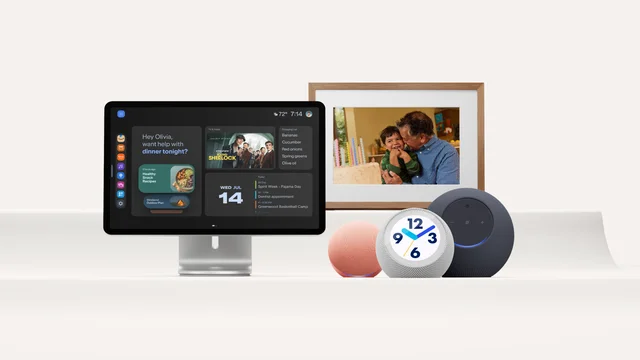
Amazon announced five new Alexa devices on October 28, two of them in categories the company had not sold before 6. The Alexa Photo Frame costs $199.99 in black or $229 in birch or walnut. The Echo Time alarm clock costs $199.99, or $209.99 in a Kids version.
The three updates carry prices too. The Echo Dot is $99.99, a Kids Echo Dot starts at $109.99, and the Echo Show 16 is $499.99 on pre-order. The Echo Studio with Home Camera is $249.99, while the version without the camera stays on sale at $219.99 13.
The hardware changed along with the price list. The Echo Dot has a built-in smart home hub for Zigbee, Matter and Thread, an eero extender that adds up to 1,000 square feet of coverage, and Amazon's AZ3 chip for on-device processing. The Echo Studio gained a camera for Live View and visual intelligence. The Echo Show 16 has a 16-inch display with 10% more viewing area than its predecessor inside a 40% smaller frame.
Amazon sells no subscription with any of them. Its own page notes that some features require Alexa+, which comes with a Prime membership 13.
Commercial signal
The camera is priced separately from the speaker. Echo Studio with Home Camera costs $30 more than the identical speaker without one, and buying the camera version is the only way to get Alexa to look at a board game box and explain the rules. Amazon put a number on the sensor rather than on the software behind it.
The Photo Frame is the more pointed move. It enters a category Aura built, and it is priced at $199.99 against a competitor selling the same promise of a matte screen that looks like a photograph. What Amazon adds is not the panel but the account: Prime members get unlimited photo storage on Amazon Photos, and Alexa+ chooses which pictures to show and which to skip.
Amazon published no previous-generation prices beside these, so the change on Echo Dot and Echo Show is not stated. The page does give the replacement terms: the Echo Studio without a camera stays on sale at $219.99, so the lineup now runs from $99.99 to $499.99.
The subscription being sold here is one the customer already pays for. Every one of these devices is a way to make an existing Prime membership do more, which is the cheapest kind of hardware Amazon sells: a $99.99 purchase that raises the cost of leaving.
Watch next
Whether the photo frame reaches Aura's price or pulls it down. Whether Amazon raises Echo prices once the new lineup is established. Whether Alexa+ features start requiring a separate subscription rather than Prime.
5. Xreal prices Android XR with a clock attached
What changed
Xreal launched the Aura, a pair of wired smart glasses running Google's Android XR, at the Android Dev Summit on October 28 7. The 12GB/256GB version lists at $1,279 and the 16GB/512GB version at $1,499.
Both carry a lower price through December. The launch prices are $1,099 and $1,299, which makes the discount $180 on the cheaper model and $200 on the more expensive one, or about 14% and 13%. Shipping starts in the middle of November in the US, Canada, Japan and South Korea.
The glasses use a Sony micro-OLED display at 1200p and 120Hz with a 95-degree field of view, run on Qualcomm's Snapdragon Reality Elite platform, and produce sound through Bose technology. The computing happens in a tethered puck rather than in the frames, which is why the glasses weigh 95 grams against 69 grams for Meta's Ray-Ban Display glasses.
Xreal's chief executive Chi Xu told TechCrunch in May that building a smart glasses business is hard and that everyone in it is losing money.
Commercial signal
The list price is the number to read, and the launch price is the sales instrument. A $180 to $200 discount that expires in December gives the first cohort a deadline and gives Xreal a way to report sell-through before it commits to a full year of production.
The $1,279 list matters because it is what the device costs once the promotion ends. Android XR is Google's answer to Meta's platform lead, and Google is following the model it used for phones: it supplies the software and lets partners such as Samsung and Xreal set the price. The partner therefore absorbs the pricing risk, in a category where the platform owner's alternative is to sell nothing.
The tethered puck is a pricing decision as much as an engineering one. Moving the processor out of the frames keeps the glasses light enough to wear and the bill of materials low enough to sell, at the cost of a second object the customer has to carry and charge. Every dollar below a standalone headset comes from that trade.
Watch next
Sell-through through December, when the launch price expires. Whether the list price holds at $1,279 or the discount becomes permanent. Whether Samsung's own Android XR device arrives above or below it, which sets where the platform's floor sits.
6. Anthropic sells visibility into the bill instead of a bigger one
What changed
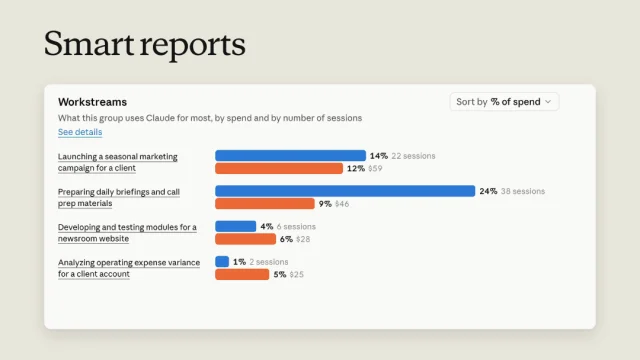
Anthropic announced a set of enterprise reporting tools on October 28, grouped under the name Smart Reports 8. Managers can see what a team did over a date range, what it produced, what it cost, and where its workflows broke down. The reports also recommend how to improve the results.
The tools pair with pooled group budgets, which let teams manage token spending together rather than per seat 14. Anthropic says it will not use the reporting data for model training by default. No price changed with the announcement.
The numbers Anthropic shared with investors the same week describe the account the tool has to serve. Customers spending at least $100,000 a year number more than 11,900, those spending at least $1 million number more than 1,900, and about 250 spend $10 million or more 15.
Net revenue retention was about 900% at the end of the third quarter, meaning the same customers spent nine times as much as a year earlier. Among the top 5% of Claude Enterprise customers, those using Claude Code spent roughly 20 times as much per month as the average enterprise user who did not use it 15.
A separate survey of 276,000 developers using agentic coding tools found spending on those tools up tenfold since the start of the year, now equal to about 2% of total engineering cost 8. Jellyfish chief scientist Nicholas Arcolano told TechCrunch: "Even if you're saying 2% is still small, that 10x growth is growth that most CFOs didn't plan for."
Commercial signal
The announcement carries no price change, because the reporting is the product. Anthropic's revenue comes from token consumption, so its growth depends on customers spending more each quarter without concluding they are wasting money. A report that pairs cost with output is how a vendor argues its own bill is worth paying.
The pooled budget changes who decides. A per-seat plan is approved by whoever buys software; a pooled token budget is approved by whoever owns a team's cost centre, and it competes for money with headcount and cloud spend. Anthropic is moving its billing question from an IT purchase to an operational budget.
The 20x gap between coding customers and everyone else is the growth model in one number. A company that starts on the API can be sold Claude Code to its engineers, and the same account then spends twenty times as much without a new contract being signed. Reporting tools make that expansion legible to the customer's finance team, which is the audience that has to approve the next increase.
Watch next
Whether pooled budgets become the default enterprise contract rather than an option. Whether Anthropic publishes a per-workstream price or keeps everything inside token consumption. Whether customers with visibility into their spend cut usage, which would show up in retention before it shows up in revenue.
7. Reddit closes the door and prices the people inside
What changed
Reddit said on its third-quarter earnings call on October 29 that it is moving to a primarily logged-in experience 9. The company will test the change in markets outside the US in the fourth quarter, with no timeline for the rest of the world.
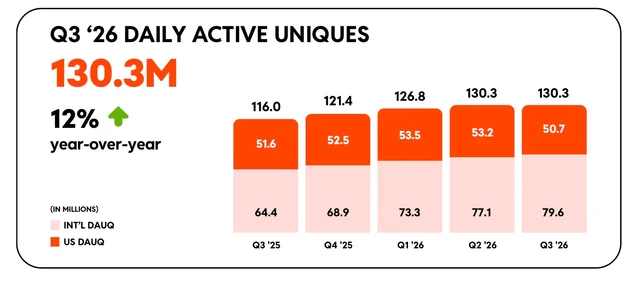
Search referrals fell by more than a million a week on average in October. Reddit warned that if the trend continues, daily active users could fall by a low-double-digit percentage next quarter from the 130.3 million it reported for the third quarter.
Revenue rose 53% to $895 million, ahead of the roughly $875 million analysts expected, and net income rose 74% to $283 million 9. Advertising brought in $847 million, up 54%, and non-advertising revenue including data licensing brought in $48 million, up 35%.
The two user numbers moved in opposite directions. US daily actives fell 2% year over year to 50.7 million from 53.2 million, while revenue per US daily active user rose 53% to $13.82. Globally, revenue per daily user rose 36% to $6.87.
Co-founder and chief executive Steve Huffman wrote on the site that the change is "a big change for me" after a life defined by the open internet, and that he had concluded it was the right decision for the platform 9. Reddit said being logged in will not require giving up anonymity, and that its incognito browsing mode is being rebuilt.
Commercial signal
The price here is access, charged in the form advertisers pay for. A logged-out reader costs Reddit bandwidth and returns an anonymous page view that an AI scraper can copy. A logged-in reader returns a declared identity, a set of interests and a device, which advertisers pay more for.
The margin evidence is in the same release. The US audience shrank 2% while revenue per US user rose 53%, so the company has already demonstrated that fewer, better-identified sessions earn more than a larger anonymous crowd.
Licensing data to model providers is the second reason, and the two goals fit together. A site that requires a login to read is harder to scrape and easier to license, which strengthens the position Reddit negotiates from when it sells its archive to the companies building the models.
The risk is straightforward. Reddit is trading a traffic stream it does not control for a login it hopes people will complete, in a market where the search results that used to send them are disappearing anyway. The Q4 tests outside the US will show how many of those visitors sign in and how many leave.
Watch next
The Q4 test results in the first markets outside the US. Whether the low-double-digit decline in daily actives arrives, and what it does to advertising rates. Whether data licensing revenue accelerates once the login wall is up.
8. Google puts ads inside the answer, abroad
What changed
Google said on its third-quarter earnings call on October 28 that ads in AI Mode, its search mode that answers with a generated response instead of a list of links, are expanding into international markets alongside multi-turn ads in the US 10. Chief business officer Philipp Schindler told investors Google is "taking our monetization footprint global for the first time" across AI Overviews and AI Mode.
The company reported $127.6 billion in revenue for the quarter, up 25%, and Alphabet shares fell 8% after the results. Search revenue grew 12%, down from 17% in the second quarter and 19% in the first.
Google Services, which includes Search, brought in $96.3 billion, up 11%, while Google Cloud grew 103% to $30.7 billion 10.
Google told investors that sponsored product listings in AI Mode already achieve click-through rates comparable to organic listings 10. Chief executive Sundar Pichai said search queries grew at their fastest rate in five years, that AI Mode queries average three times the length of an ordinary search, and that one in five AI Mode searches now involves voice, an image or a document.
Commercial signal
Search advertising is priced per click, and an AI answer is a page where the reader may never click. Google's response is to sell the placement inside the answer before the click disappears, which is what the international expansion of AI Mode ads is for.
The deceleration is the pressure behind the decision. Growth of 19%, then 17%, then 12% across three quarters is a business that is still growing at a rate investors are repricing, which is why the shares fell 8% on a quarter with 25% total revenue growth and a cloud business that more than doubled.
The claim that AI Mode ad click-through matches organic listings is Google's own, offered to investors without a figure attached. What can be checked is the input it depends on: queries three times longer and one in five carrying an image or a document give the system more commercial signals to read than a three-word search box ever did.
Watch next
The first quarter of international AI Mode ad revenue broken out, if Google discloses it. Whether Search growth stabilises above 12% or keeps falling. Whether multi-turn ads produce new inventory or pull budget from existing search placements.
Editorial view
Across eight moves this week, the companies that raised a price mostly did it by pricing a unit inside the product. Apple charged by the storage tier. T-Mobile charged by the Pick. Amazon put $30 on a camera and left the assistant bundled. Xreal sold a promotional price that runs out at the end of December, with the list price waiting behind it.
The three moves with no price at all ran the same logic with nothing to charge. Anthropic priced a workstream against its output, Reddit priced a logged-in session over an anonymous visit, and Google priced the answer rather than the click through it. Each of those is a unit the company can meter, compare and raise later.
What ties the two halves together is the memory shortage underneath the first half. SK Hynix says supply stays tight through 2030 and Samsung says through 2028, while quarterly PC shipments fell 21% as prices rose 2. Apple's response was to hold the two Macs that sell in volume and raise the ones that do not. That works while the cheaper devices still carry a margin, and the MacBook Neo's $150 education-price rise suggests how quickly that condition can change.
For anyone setting prices this quarter, the transferable move is the exchange rate. A Pick, a workstream, a logged-in session and an AI answer are all units whose value the seller defines and the buyer has to accept to compare anything at all.
Watchlist
- November 6. The first shipment day for the touchscreen MacBook Pro and the OLED iPad mini, and the first read on whether $2,899 and $699 hold at retail 412.
- The end of December. The point when Xreal's launch prices stop and the Aura returns to $1,279 and $1,499 7.
- The next memory contract round. Whether the M6 iMac at $1,499 and the 14-inch MacBook Pro at $1,999 survive it 2.
- T-Mobile's Pick windows. Which Picks can be swapped at any time and which hold for a quarter is decided service by service, and that split decides how much a Pick is worth 3.
- Xbox Game Pass tier prices. Microsoft has still not published the prices for the rebuilt Game Pass tiers described in the October report, which remains the open half of that story 16.
References
- 1
- 2
- 3
- 4
- 5
- 6
- 7
- 8
- 9
- 10
- 11
- 12
- 13
- 14
- 15
- 16

This story was produced automatically by a channel. One sentence is all it takes for Neodrop to keep producing for you.