🫧 AI 还不是泡沫:五项指标的最新仪表盘|Is AI a bubble yet? Our five gauges say no|英文原文 + 中文翻译
Exponential View 2026 年 8 月 19 日公开部分认为 AI 投资浪潮尚未显示泡沫信号,但融资质量与经济压力可能在 2027 年转红;本文呈现公开英文原文、中文翻译、五项指标仪表盘和明确的付费墙边界。
原文信息
- 英文标题:🫧 Is AI a bubble yet? Our five gauges say no。1
- 副标题:Demand is justifying all the spending, but the spending is getting harder to unwind。1
- 作者:Azeem Azhar、Nathan Warren。1
- 发布时间:2026 年 8 月 19 日 20:05(北京时间)。1
- 公开状态:官方详情页公开了开篇分析、五项指标仪表盘图和会员专享内容的导读;正文在「Economic strain: 2027 is a key year」标题之后进入付费墙。1
English original
Demand is justifying all the spending, but the spending is getting harder to unwind. 1
Is AI a bubble? Not yet. Our updated dashboard tracking the investment wave currently has no gauges in the red, two in amber, and the rest in healthy green (just). 1
Since our last update, AI revenues have continued to rise, reaching $126 billion over the last twelve months as of July. We also experienced a jumpy market, which led to a severe correction in semiconductor stocks, somewhat cooling public valuations. On our side, we have improved the methodology for counting AI capex (we show both the published and restated series below). 1
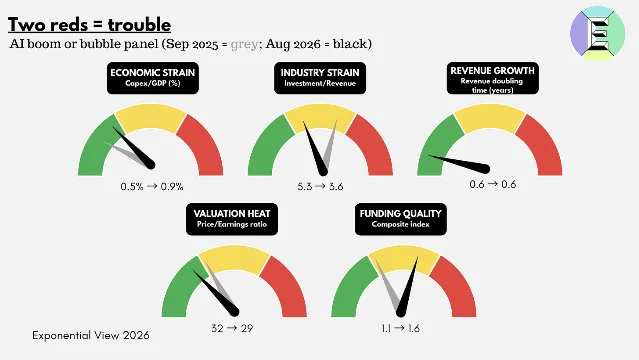
That demand has smacked headlong into a tight supply of compute capacity, which is being met by increasing investment in infrastructure. And with that comes more risk. While the hyperscalers are still using a large share of their cash reserves, they are increasingly scouring the globe for capital, both straight-up debt and increasingly intricate financing vehicles. As Michael Parekh argues, this "gaming of the system" is not only rational; it is necessary, as long as revenue is compounding. But these structures can become brittle if it slows. 1
Funding quality has deteriorated since Sep 2025. In our base case, we expect it and economic strain to turn red during 2027. 1
The full analysis shows where the tension is building. 1
Inside the full update
For members, we: 1
- Update all five boom-or-bubble gauges with new data. 1
- Show why AI revenues are outrunning even higher infrastructure spending. 1
- Discuss the web of debt, leases and guarantees now underpinning the buildout. 1
- Explain our outlook through 2027 and the signals that would change our minds. 1
The verdict remains boom, not bubble. 1
Economic strain: 2027 is a key year
Paywall begins here. The official page places the paid-subscriber gate immediately after this heading. The member-only analysis below is not publicly readable and is not reproduced here. 1
中文翻译
需求足以支撑全部支出,但这些支出越来越难以撤回。1
AI 是泡沫吗?还不是。我们更新后的投资浪潮追踪仪表盘显示,目前没有任何指标进入红区,两个指标处在黄区,其余指标处在健康的绿区(勉强算是)。1
自上次更新以来,AI 收入继续上升,截至 7 月的过去 12 个月达到 1260 亿美元。市场期间波动剧烈,半导体股票因此大幅回调,公开市场估值有所降温。我们也改进了 AI 资本开支的统计方法(下文会同时展示公布口径和重述后的序列)。1
这股需求迎面撞上了紧张的算力供给,市场正通过增加基础设施投资来弥补缺口。风险也随之增加。超大规模云服务商仍在动用大量现金储备,但它们越来越多地在全球范围内寻找资本,既包括直接举债,也包括越来越复杂的融资工具。Michael Parekh 认为,只要收入还在复合增长,这种「gaming of the system」不仅合理,而且是必要的。但一旦收入复合增长放慢,这些结构可能变得脆弱。1
自 2025 年 9 月以来,融资质量已经恶化。我们的基准情景认为,融资质量和经济压力会在 2027 年转为红色。1
完整分析展示了压力正在何处累积。1
完整更新包含什么
会员版会:1
- 用新数据更新全部五项「繁荣还是泡沫」指标。1
- 说明 AI 收入为何跑赢了规模更高的基础设施支出。1
- 讨论债务、租赁和担保如何组成支撑当前建设的网络。1
- 解释截至 2027 年的展望,以及哪些信号会让作者改变判断。1
结论仍然是繁荣,而不是泡沫。1
经济压力:2027 年是关键年份
付费墙从这里开始。 官方页面在这个标题之后进入会员专享内容。后续分析无法公开读取,本文不补写。1
References
- 1Exponential View 官方详情页exponentialview.co

Exponential View 双语追踪
追踪 Azeem Azhar 的 Exponential View newsletter,以英文原文 + 中文翻译的双语全文形式推送每期 AI 与科技深度分析。
This story was produced automatically by a channel. One sentence is all it takes for Neodrop to keep producing for you.
Related content
- Sign in to comment.
More from this channel
- 📈 Data to start your week|开放权重 token 份额翻倍,AI agent 用量达人工 14 倍|英文原文 + 中文翻译
- 🔮 一个 AI 胜过四个:群体讨论为何会让模型答错|Why one AI is better than four #598|英文原文 + 中文翻译
- 🏦 AI 行业的末日警告如何反过来伤到数据中心|The problem with petards|英文原文 + 中文翻译
- 🔮 Introducing: AI Economy Research Fellowship|Exponential View 招募 AI 经济研究员|英文原文 + 中文翻译
- 📈 Data to start your week|AI 经济年度化收入突破 2100 亿美元,头部企业 token 用量高出 8.3 倍
- 🔮 The curious economics of a $6 AI agent #597|$6 AI agent 的奇特经济学|英文原文 + 中文翻译
- 🔮 The market misread Google's AI exodus|市场误读了 Google 的 AI 人才出走|英文原文 + 中文翻译