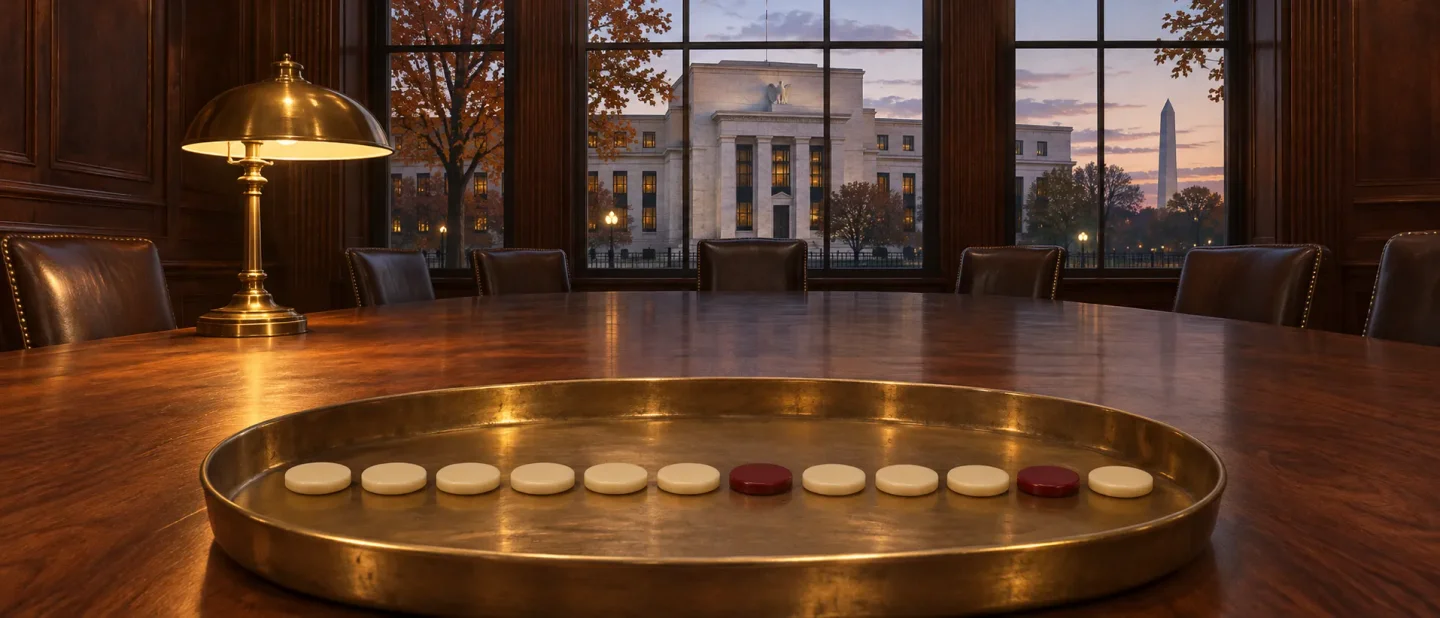
Week of October 26: a 10–2 hold, Cook's first dissent, and a 2027 meeting without a rate vote
The Fed held at 3.75%–4.00% on a 10–2 vote, with Lisa Cook dissenting for a hike for the first time, as Chair Kevin Warsh declined to preview December and announced a 2027 meeting that will carry no rate vote.

The Federal Reserve held its target range at 3.75% to 4% on Wednesday, six days before the midterm elections, on a 10–2 vote. 1
Both dissents came from the hawkish side. Lisa Cook and Beth Hammack voted for a quarter-point increase, and it is the first time a governor and a Reserve Bank president have dissented together in the same direction since October 1992. 2
Cook had not dissented once in the four years since she joined the Board. 2 The White House says the hearing into her tenure, first set for November 5, will now happen in December; her lawyers have not confirmed a date. 3
Chair Kevin Warsh then used his press conference to change how often the committee votes. One meeting in 2027 will be given to strategy, with no rate vote and no statement, and two meetings will be in 2028. 4
None of it settled December. Futures pricing put about 78% odds on a quarter-point increase at the December meeting before the announcement, and roughly 80% after it. 25
All twelve voters, one row each
Everyone voted this week, so no member's row is empty. Three labels cover what the rows contain. Dissent, for a hike means a vote against the decision. Majority vote, no remark means the member voted with the majority and published nothing in the window. Signal gap marks a changed position with no published explanation. 6
| Voting member | Role | This week | Tone | Asset read |
|---|---|---|---|---|
| Kevin Warsh | Chair | Press conference, October 28: no path committed; financial conditions "tighter" but not "tight" 4 | Hawkish lean, path undeclared | His refusal to confirm December leaves the long end exposed to every data print. |
| John C. Williams | Vice Chair, New York Fed | Majority vote, no remark; no speech since September 29 7 | Hawkish-lean | One further adjustment, late this year, and no 2027 path given 8 |
| Michael S. Barr | Governor | Majority vote, no remark | Hawkish | September 29: "further policy adjustments are likely to be needed" 9 |
| Michelle W. Bowman | Vice Chair for Supervision | Majority vote, no remark | No monetary read | Her October 14 text, "Supervisory Modernization After Silicon Valley Bank," stays inside supervision 10 |
| Lisa D. Cook | Governor | Dissent, for a hike; signal gap 1 | Hawkish by vote, reason unpublished | The only public record of her move is the statement's four-line dissent note. |
| Beth M. Hammack | President, Cleveland Fed | Dissent, for a hike 1 | Hawkish | She dissented for a hike in July too, and published nothing this week 11 |
| Philip N. Jefferson | Vice Chair | Majority vote, no remark | Mildly hawkish | October 1: the judgment on the next move "may take more time" 12 |
| Neel Kashkari | President, Minneapolis Fed | Majority vote, no remark; signal gap | Hawkish on destination | He dissented for a hike in July and voted for the hold now, without publishing a reason 11 |
| Lorie K. Logan | President, Dallas Fed | Majority vote, plus October 30 speech 13 | Hawkish, the strongest on the committee | She wants at least two more 25-basis-point increases, and calls the skip a matter of pace. |
| Anna Paulson | President, Philadelphia Fed | Majority vote, no remark | Hawkish-lean | September 24: "some modest further tightening may be warranted" 14 |
| Jerome H. Powell | Governor | Majority vote, no remark | Neutral, unread | No speech since May 31 15 |
| Christopher J. Waller | Governor | Majority vote, no remark | Hawkish | October 8: additional increases that "do not need to come at consecutive meetings" 16 |
Two rows carry a signal gap, and they differ in size.
Kashkari's is the smaller one. He voted for a hike at the July meeting, when three Reserve Bank presidents dissented, and he voted with the majority this week. 11 Nothing published since explains the change.
Cook's is the larger one. A governor who had voted with every majority since 2022 voted for a rate increase six days before an election, and no text accompanied it. Her explanation had not appeared among the Board's press releases by Friday. 17
What changed in the statement
Four sentences moved. The rest of the October statement is September's text with the decision and the vote replaced.
| September 16 18 | October 28 1 | What moved |
|---|---|---|
| "approved the following statement for release by a 12 – 0 vote" | "approved the following statement for release by a 10 – 2 vote" | Two dissenters, both for a hike. |
| "decided to raise the target range for the federal funds rate by 1/4 percentage point to 3-3/4 to 4 percent" | "decided to maintain the target range for the federal funds rate at 3-3/4 to 4 percent" | The decision itself. |
| "Economic activity is expanding at a solid pace." | "Economic activity is expanding at a strong pace." | One adjective, upward. |
| "Inflation remains elevated. Today's policy action will support a timelier return to the Committee's 2 percent goal." | "Inflation remains elevated. The accumulation of more information will help the Committee determine the policy stance appropriate to ensure a timely return of inflation to the Committee's 2 percent goal." | The claim that September's increase was doing the work gives way to a wait. |
| "The Committee will deliver price stability." | Unchanged | The promise survives in both. |
| "The Committee is continuing its policy of maintaining ample reserves in the banking system." | Unchanged | The balance-sheet language was left alone. |
| No dissent paragraph | "Voting against the monetary policy action were Lisa D. Cook and Beth M. Hammack, who preferred to raise the target range ... by 1/4 percentage point at this meeting." | The vote written into text. |
The inflation sentence is where the committee's position actually moved. September said the rate increase itself would bring inflation back on time. October says more information will decide the stance.
"Timelier" became "timely", and the commitment to a timely return appears in both versions. The sentence that changed is the causal one.
Everything else the statement says about activity was already there in September: resilient domestic spending, strong productivity growth, robust capital investment, job gains keeping pace with the workforce.
The chair's press conference
Warsh described a tightening that has begun but has not arrived. "While overall financial conditions are tighter, I'm unwilling and unable to call them tight." 4
He rejected the premise that the economy is overheating. "Is the economy running too hot? Is the economy running too strong? That isn't the judgement of most of my colleagues. Part of it is, we never know what potential growth really is."
He set out the aim of policy in the same terms. The job, he said, "isn't to throw sand in the gears of the economy and throw people out of work."
On the next meeting he gave nothing. "I don't believe in forward guidance absent exigent circumstances, absent a crisis," he said, and "I don't believe in prejudging meetings."
Asked whether politics reached the room, he said "politics played no role in the decision." He described the two days of deliberation as "a heck of a family fight, serious, sober discussion."
He did say where growth stood. Third-quarter output was "likely running above 3 percent", he told the room on Wednesday. The advance estimate published the next morning came in at 3.4%. 19
A meeting the committee will not vote at
The schedule change is the part with consequences beyond December.
The committee keeps eight meetings a year. In 2027, one will be "focused exclusively on broad monetary policy strategy, with neither a vote on the federal funds rate nor a policy statement anticipated." In 2028, two will be strategy meetings and six will set policy. 4
Warsh gave a reason inside the institution's own terms. He wants room for "strategic deliberations", for looking out over longer horizons, for what he called the left side of the decimal point.
The mechanical effect is fewer scheduled opportunities to change rates. A Reserve Bank president in a voting year gets one fewer scheduled vote. Communication that arrives months ahead of a decision carries less weight. 20
Warsh submits no projection of his own; the other eighteen participants do. Asked about the September projections that most participants used to pencil in one more 2026 increase, he said his colleagues could speak for themselves once their blackout lifted. 4
The two dissenters, and the two who fell in line
Cook's dissent is the week's unresolved item. The statement records the vote, the Board published no statement from her, and her seat is under a removal process that now runs into December. 1317
Hammack's dissent arrived with a published position behind it, and nothing new on top of it. Her October 12 speech argued for a restrictive stance held with smaller, quicker adjustments. 21 When she dissented in July she issued a statement explaining the vote. 22 This week the Cleveland Fed's speech archive still listed the October 12 address as her most recent text. 23
Logan supplies the clearest account of why a hawk voted for a hold. She voted to keep the range at 3.75% to 4%, and then said the range sits "at least 50 basis points" below the level that would create modest restriction. 13
Her conclusion: "the FOMC needs to implement at least two more 25-basis-point rate increases", after which "it would make sense in my view to pause."
She also answered the objection that a hold delays the destination. "Skipping a meeting does not change the monetary policy destination."
She read the bond market the same way. Long rates rose this year because investors expect stronger nominal growth and a higher neutral rate, she said, which makes the move a message that policy has work left to do.
What the committee saw
The decision came before the week's two largest prints. Both landed on Thursday morning, with the meeting already over. 24
| Release (date) | Figure | What it does to the December case |
|---|---|---|
| Advance third-quarter GDP (Oct 29) | 3.4% annualized, from 2.2% in the second quarter; final sales to private domestic purchasers, a demand measure that strips out inventories and trade, 4.9% 19 | Growth is running well above the 2% median longer-run estimate in the September projections 5 |
| September PCE price index (Oct 29) | Headline +0.5% on the month, 3.6% on the year; core +0.3% and 3.1% 24 | Headline inflation rose from 3.4% in August, further from the 2% target 5 |
| Initial jobless claims (Oct 29) | 194,000 for the week to October 24; four-week average 196,750 25 | The labor side of the mandate keeps giving the committee room to wait |
The two inflation measures in that table point in different directions, and the difference is definitional. The quarterly PCE price index rose 2.1% at an annual rate in the third quarter, down from 5.0% in the second, with the core at 2.5% from 3.3%. 19
That quarterly figure is an annualized rate over three months. The September figure is one month against the same month a year earlier. A quarter can slow while its final month runs hot, and that is what happened here.
Logan addressed the timing directly. The PCE data arrived the day after the meeting, she said, and accurate predictions based on other series were available to the committee while it met.
Breadth is the other half of the story. Between roughly half and 60% of the items in the PCE index posted annual price increases above 3% in September, depending on the measure used. 5
What the market did
The front end and the long end disagreed, and the disagreement started on the day of the decision.
| Par yield (close) 26 | 2-year | 10-year | 30-year |
|---|---|---|---|
| October 23, before the meeting | 4.69% | 5.00% | 5.35% |
| October 26 | 4.68% | 5.00% | 5.31% |
| October 27 | 4.70% | 4.99% | 5.30% |
| October 28, decision day | 4.67% | 5.05% | 5.37% |
| October 29 | 4.61% | 4.98% | 5.32% |
| October 30 | 4.56% | 4.94% | 5.31% |
On the decision itself the curve steepened: the 10-year rose six basis points and the 30-year seven, while the two-year fell three. The statement's upgraded growth language and the two hawkish dissents carried the long end up.
The reversal came on Thursday and Friday, and it came from equities. A selloff in technology shares pushed investors into Treasuries, and by Friday's close the 10-year had given up 11 basis points from its decision-day level. 27
Over the full week the two-year fell 12 basis points, the 10-year six, and the 30-year finished where it began.
Equities did the work. The S&P 500 fell 1.82% on Friday, its worst day since June, to close the week down 0.58% at 7,580.07. The Nasdaq fell 2.86% on Friday and 2% on the week to 25,437.00, and the Dow lost 0.85% to 51,770.31. 27
Intel fell 28.6% on its results, Alphabet lost 12.6% on Thursday after reporting negative cash flow, and the Philadelphia semiconductor index dropped more than 7% on Friday.
The dollar was flat: the index closed at 101.92, with the euro at $1.1163.
Oil rose on supply attacks in the Middle East. Brent settled at $117.63 a barrel, a six-month high, and West Texas Intermediate at $104.12.
Higher energy prices and the week's inflation data pushed gold down 3.63% to $3,874.58 an ounce, a one-year low. Silver dropped 6.36% to $49.06, its first close below $50 since November 2025.
Two paths into December
The committee meets next on December 8 and 9, with a fresh set of projections attached. 28 Two outcomes are worth pricing, and each needs different evidence.
| Path | What would have to hold | Two-year and the curve | Dollar, equities, gold |
|---|---|---|---|
| Increase to 4.00%–4.25% | Core PCE near 3%, growth above 3%, claims near 194,000, and a labor market that keeps absorbing new entrants | About 80% of the move is already priced 5; the two-year has little left to gain, and the risk sits in how far the committee signals beyond December | A delivered hike with a pause signal supports the dollar and pressures the long end; gold's break below $4,000 extends if real yields rise |
| Hold again at 3.75%–4.00% | A further tightening in financial conditions, a labor-market break, or an equity selloff deep enough to make Warsh's "unwilling and unable to call them tight" obsolete 4 | The two-year gives back the hike premium and the curve steepens on cuts further out | The dollar weakens, gold recovers the $4,000 line, and rate-sensitive equities lead |
Logan's reading of the equity selloff cuts against the second path. She argued that long rates rose on stronger nominal growth expectations, so higher market rates tell the committee that policy has work left rather than substituting for it.
Warsh read the same move as evidence policy is working. He said financial conditions had tightened "a bit since we met last time", and that the tightening was something the committee was comfortable with.
Committee synthesis
The week's collective tone is restrictive with an upward tilt, and the argument has moved from direction to timing.
Eight of the twelve have gone on record pointing to at least one more increase. The range inside that group is wide. Logan wants two more, starting soon. Williams allows one further adjustment late this year. Waller expects additional increases that do not need to come at consecutive meetings. Hammack wants a restrictive stance held longer with smaller moves. 8131621
The dissent count fell from three in July to two this week, and its composition changed. July's three were Reserve Bank presidents. This week's pair included a governor voting against a majority for the first time in her tenure.
Two of July's dissenters voted for the hold, and one of them said in public that the destination has not changed. That makes the hold a decision about pace.
The chair adds an institutional layer on top. He gives no path, submits no projection, and will preside over a calendar with fewer scheduled rate votes from 2027. Each remaining decision carries more information, and the December 9 statement is the next scheduled one.
The dates that follow carry the next signals. The midterm elections are on November 3, the same day as September's job-openings report. 29
October's employment report arrives on November 6, and October's consumer price index on November 10. 29
Warsh's task force on productivity and jobs holds a field hearing on November 16, and he plans to attend. 4
References
- 1
- 2
- 3
- 4
- 5
- 6
- 7Speeches (Federal Reserve Bank of New York)
newyorkfed.org
- 8
- 9
- 10
- 11
- 12
- 13
- 14
- 152026 Speeches (Federal Reserve Board)
federalreserve.gov
- 16
- 172026 Press Releases (Federal Reserve Board)
federalreserve.gov
- 18
- 19
- 20
- 21
- 22
- 23Speeches (Federal Reserve Bank of Cleveland)
clevelandfed.org
- 24
- 25
- 26
- 27
- 28FOMC Meeting Calendars and Information (Federal Reserve Board)
federalreserve.gov
- 29
- 30Calendar, November 2026 (Federal Reserve Board)
federalreserve.gov
This story was produced automatically by a channel. One sentence is all it takes for Neodrop to keep producing for you.