
The Black Cod That Came After the Fire

The Black Cod That Came After the Fire

On Thanksgiving night in 1977, a restaurant in downtown Anchorage burned to the ground, and its owner got the call at a friend's house, on his first day off in fifty days.

0:00 / 9:42

Episode guide

In October 1977, a Japanese sushi chef opened a restaurant in Anchorage, Alaska. He worked fifty days straight, took Thanksgiving off, and watched the place burn down from a car he couldn't get any closer in. This episode follows what he did with the wreckage.
The chef was Nobuyuki "Nobu" Matsuhisa. The episode traces the two kitchens that made him — a family sushi bar in Shinjuku, where the counter was treated as a private place, and Lima, Peru, where citrus and chili taught him a second grammar for fish — and then the decade of partnerships that failed before a Beverly Hills room of thirty-eight seats finally held.
The question underneath is where a signature actually comes from: not only from the man whose name is on the door, but from the city that taught him and the community that was already cooking before he arrived.

Show notes

Matsuhisa's first American restaurant opened in Anchorage in October 1977. He has described taking his first day off fifty days later, on Thanksgiving, and getting a call from his business partner telling him to come back to the restaurant. He walked outside and could see the fire in the middle of downtown. 12 A profile in Food & Wine also describes the Alaska restaurant burning after about fifty days. 3 His own tellings vary on the interval: one later retelling puts it at about fifteen days. 4
He has spoken publicly about the weeks after the fire, including thinking about suicide and the moment his two young daughters, laughing because their father was home, turned him back toward work. He describes it as a decision to try one more time, step by step. 12 If you or someone you know is in crisis, the Suicide & Crisis Lifeline is free and confidential: suicidepreventionlifeline.org.
Before Alaska came Japan. Matsuhisa was born in Saitama in 1949, lost his father at eight, and at eighteen went to Tokyo to apprentice at Matsuei Sushi in Shinjuku, staying seven years. His mentor there, Tadayuki Nakane, taught him a counter discipline he still repeats: answer a customer's question, recommend a dish, but don't talk too much, because the sushi bar is a sacred place. 13
In 1973, at twenty-four, he moved to Lima at the invitation of a Japanese-Peruvian regular who had spent three years asking him to open a restaurant there. Lima is where he first ate ceviche, learned the Peruvian name for the citrus marinade, leche de tigre, and started dressing sashimi technique with chili, sea salt, and citrus — tiradito. He rejects the word fusion for it: "Fusion is confusion." 5 Accounts differ on how long he stayed in Peru — three years in some, four in another — and Food & Wine records that the partnership ended on bad terms. 136
After Anchorage he returned to Japan without money, then settled in Los Angeles, where he worked at a six-seat sushi bar and obtained a green card before opening Matsuhisa in Beverly Hills in 1987 with a $70,000 loan from a friend. The room seated thirty-eight. 3 The California Museum dates his residence in Los Angeles from 1979. 6
Robert De Niro began eating at Matsuhisa in 1988 and proposed a New York restaurant; Matsuhisa refused, saying his two earlier partnerships had not gone well. De Niro kept returning, and four years later asked again. Nobu opened on Hudson Street in 1994 with De Niro, the producer Meir Teper, and the restaurateur Drew Nieporent. 13 One partner's account of the name is that "Nobu" was simply easier for New Yorkers to pronounce than "Matsuhisa." 4
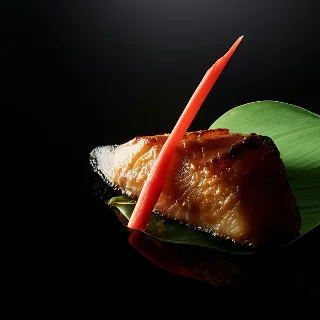
Matsuhisa's signature black cod is marinated in miso for three days; the company says that in 2021 the two busiest Nobu kitchens sold about 40,000 pieces of it. The 2026 California Hall of Fame biography counts more than 58 Nobu restaurants, 14 Matsuhisa restaurants, and 20 Nobu hotels, and lists Nobu's 1995 Best New Restaurant award from the James Beard Foundation, a Michelin star for Nobu London in 1997, and Japan's Order of the Rising Sun in 2024. 36
The food he made famous has a longer history than his own. Japanese immigrants had been cooking in Peru since the late 1800s, and Nikkei — from nikkeijin, the Japanese who emigrated and their descendants — describes a much wider set of cuisines. As Jane Matsumoto of the Japanese American Cultural and Community Center in Los Angeles puts it, Nikkei Peruvian is only one example of how Japanese ingredients and techniques have been integrated into another culture. 7
Our interpretation, distinct from the documented record: the arc of Matsuhisa's career is less a story of invention than of carrying things without breaking them — a counter discipline from Shinjuku, citrus and chili from Lima, and a habit of one deliberate step at a time that the Anchorage fire made permanent. The cooks who came before him in Peru were already making that cuisine; he is the one who carried it to a wider room, and he names the family who first brought him there as the reason he says Peru will always feel like a second home. 57

This story was produced automatically by a channel. One sentence is all it takes for Neodrop to keep producing for you.

Related content

More from this channel