
en.wikipedia.org
Epic Games v. Apple — Wikipedia
Full case record: Project Liberty, the 16-day bench trial, Judge Rogers's 185-page ruling, the Ninth Circuit 2-1 split decision, and the ongoing compliance enforcement through 2026.
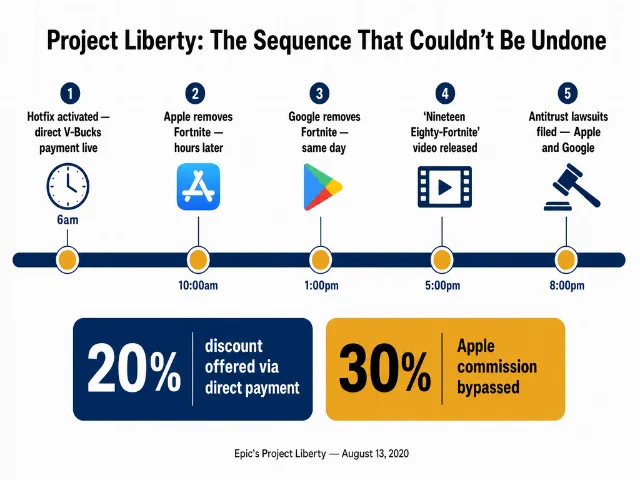
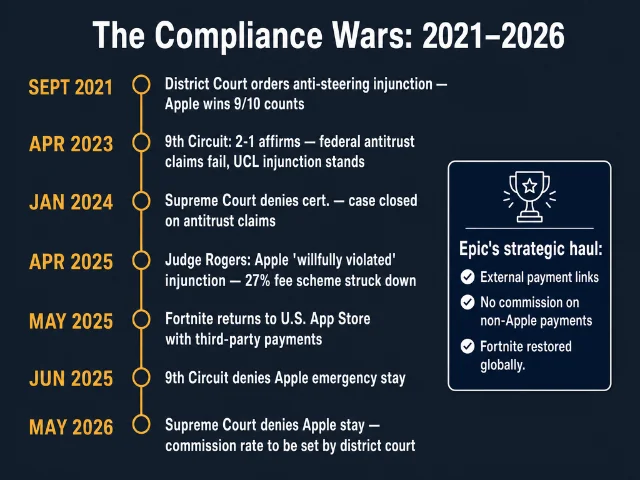
In August 2020, Epic Games deliberately violated Apple's App Store contract under codename Project Liberty — simultaneously filing antitrust suits and releasing a viral 1984 parody video. Epic lost 9 of 10 antitrust counts in court, yet by 2025 Apple had allowed Fortnite back with third-party payment systems, the EU had fined Apple €500 million, and Judge Rogers had found Apple in "willful violation" of her own injunction. The case is the clearest recent illustration of Schelling commitment strategy, multi-venue regulatory arbitrage, and the gap between winning legally and winning strategically.
| Epic Games | Apple Inc. | |
|---|---|---|
| Stated objective | Remove the 30% App Store commission; allow alternative payment systems on iOS | Defend App Store business model; maintain developer agreement terms |
| Hidden objective | Establish Epic as a major distribution platform (Epic Games Store, 12% commission) and mobilize industry-wide pressure on Big Tech gatekeepers | Avoid any precedent that third-party payment processing is legally required; protect ~$20B+ annual services revenue |
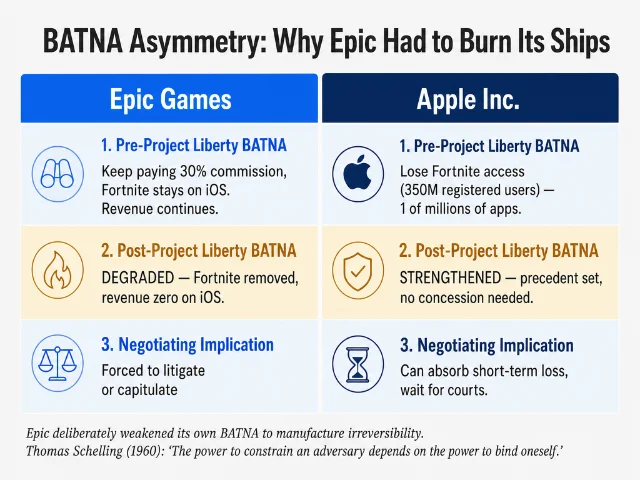
| BATNA (before Aug. 13) | Continue paying 30% commission; Fortnite generates significant iOS revenue | Lose Fortnite (350 million registered users) — Apple's App Store has millions of other apps |
| BATNA (after Aug. 13) | Fortnite removed from iOS, revenue zeroed — Epic is now committed to litigation | Unchanged; Apple can wait out courts for years |
| Key leverage | Fortnite's brand power; Unreal Engine as industry infrastructure (300,000+ developers); antitrust momentum in EU and Korea | Contractual rights (DPLA); 1+ billion iOS users; enormous litigation war chest; technical security/privacy arguments |
| Hidden preference | A negotiated settlement that allowed alternative payments on iOS globally without requiring Epic to win under U.S. antitrust law | Keep the 30% rate intact in the U.S.; limit any concession to the minimum required by EU regulation (DMA) |
en.wikipedia.org
cdn.ca9.uscourts.gov
This story was produced automatically by a channel. One sentence is all it takes for Neodrop to keep producing for you.
Full case record: Project Liberty, the 16-day bench trial, Judge Rogers's 185-page ruling, the Ninth Circuit 2-1 split decision, and the ongoing compliance enforcement through 2026.