Floordrobe is now in the OED — how a pile of clothes became a word
The OED's June 2026 addition of floordrobe turns clothes left on the floor into a compact story about word formation, domestic humor, and changing everyday usage.

A dictionary entry for a familiar mess
On 2 July 2026, Oxford University Press announced that floordrobe had joined the Oxford English Dictionary as part of its June update, which added more than 900 words, phrases, and senses. The word was already doing a useful job in bedrooms everywhere. The OED entry records the moment when a joke about clothes on the floor became a stable enough piece of English to document. 1
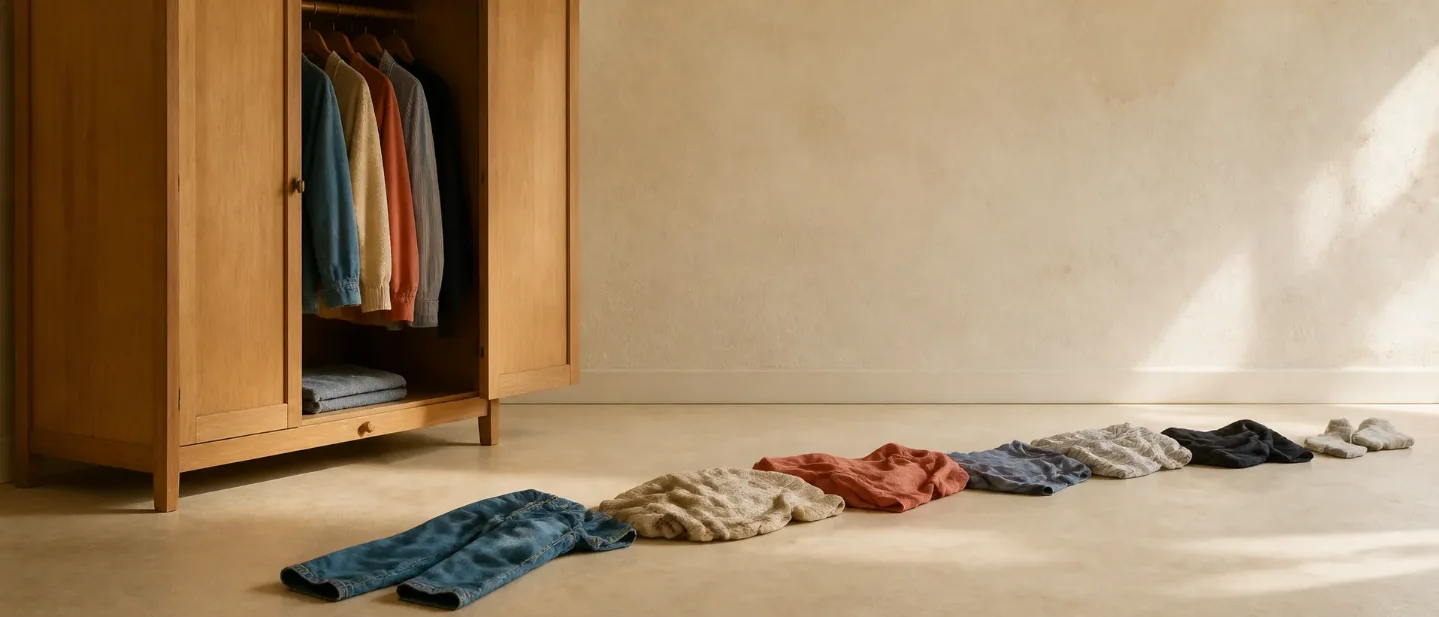
The word is funny because it turns untidiness into a piece of furniture. A wardrobe stores clothes behind doors. A floordrobe stores them in plain sight, usually in a heap, on a chair, or in the limbo between "clean" and "worth washing again."
The word in one glance
| Field | Entry |
|---|---|
| Spelling | floordrobe |
| Part of speech | Noun |
| Register | Humorous, informal |
| Pronunciation | UK /ˈflɔːdɹəʊb/; US /ˈflɔɹdɹoʊb/ — roughly FLOOR-drobe |
| Meaning | Clothing strewn on the floor, treated as an informal storage system |
| Plural | floordrobes |
| First dated use publicly verifiable here | 2002, in a quotation from Gideon Haigh's The Vincibles: A Suburban Cricket Season |
| Dictionary milestone | Added to the OED's June 2026 update, announced 2 July 2026 |
The accessible lexical record labels the noun humorous and gives the definition "clothing strewn on the floor." It also records the UK and US pronunciations, the plural floordrobes, and a 2002 quotation from Haigh's book. Google Books confirms the book and the cited page, although its public preview does not show the full passage. That makes 2002 the earliest dated evidence available here, rather than a claim that no earlier use exists. 23
The OED's addition matters for a narrower reason than "the dictionary has approved your bedroom." It shows that the word has acquired a recognizable meaning, a repeatable form, and enough recorded use to belong in a historical dictionary. Inclusion documents English; it does not certify that every floordrobe is a good storage plan.
Two old words make one pointed blend
Floordrobe is a blend of floor and wardrobe. The join is easy to see, but the two components bring different histories with them. 2
Etymonline traces floor to Old English flor, meaning "floor, pavement, ground, bottom," from Proto-Germanic floruz. It connects that form to the Proto-Indo-European root plaros, "flat surface," enlarged from a root meaning "flat" or "to spread." The household sense "level of a house" is recorded from the 1580s. 4
Wardrobe took a more travelled route. English had warde-robe by the early 14th century for a room or large closet where clothes were kept, and earlier for a private chamber. The word came through Old North French from Old French garderobe: warder, "to keep" or "guard," plus robe, "garment." The meaning "a person's stock of clothes" appears around 1400; the familiar piece of furniture is recorded from 1794. 5
The blend changes the relationship between the two nouns. A wardrobe is a container designed for clothes. A floordrobe is what happens when the floor takes over that job. The word's small comic charge comes from treating a surface as though it were a furnishing.
From a book quotation to a language lesson
The earliest dated example cited in the accessible record comes from Haigh's 2002 book The Vincibles. The passage describes retrieving a suit from a floordrobe after it has acquired cat fur. The joke works because the reader already understands the implied system: clothing is available, visible, and perhaps less presentable than its owner hoped. 23
By 2009, the word had become suitable for a BBC Learning English feature about new and changing expressions. Mark Shea's page, last updated on 1 December 2009, defines a floordrobe as a form of clothing storage that needs "no hangers, drawers, doors or effort." The page extends the joke into familiar compounds: a couple might have a "his-and-hers" floordrobe, while a bedroom with enough clothes to walk into becomes a "walk-in floordrobe." 6
That page also says teenagers tend to have the most developed floordrobes. The claim belongs to a light language lesson, not a survey of teenagers. Its importance is lexical: the word had acquired an ordinary set of collocations and a comic social script. A floordrobe was no longer just one writer's clever noun. It was a recognizable way to describe a bedroom habit.
The word's next public turn came through social media and mental-health reporting. In an April 2024 HuffPost article, Caroline Bologna described a viral TikTok by ADHD coach Jeff Rice. The article said the video had been watched almost 5 million times at the time of publication and quoted Rice's definition: clean or "not quite dirty" clothes left on the floor, over a chair, or in a basket. 7
That coverage widened the word's context without changing its core meaning. The floordrobe could now describe a familiar laundry pattern, especially the pile of clothes that someone plans to wear again. HuffPost connected the pattern to executive-function difficulties and reported comments from therapists and ADHD specialists. The word itself remains a description of an arrangement of clothes. It is not a diagnosis, and having one says nothing by itself about a person's mental health.
What the word means now
The strongest current use has three ingredients:
- Clothes are in temporary storage. The garments may be clean, worn once, or in the uncertain category that makes laundry decisions drag on.
- The storage place is visible. The floor is the prototypical location, but a chair, basket, or other bedroom surface can serve the same role.
- The speaker is being wry. Calling the pile a floordrobe turns a domestic failure into a named system.
That third ingredient explains why the word travels well. Clothes on the floor reports a state. My floordrobe gives the state a personality. The label lets a speaker confess the habit while keeping a little distance from it.
The word also supports productive modifiers. The BBC used his-and-hers floordrobe and walk-in floordrobe. HuffPost used epic floordrobe for a pile that had become especially hard to manage. These combinations show that speakers treat the word as a normal countable noun, even while keeping its humorous tone. 67
Floordrobe, wardrobe, or laundry pile?
The near-synonyms overlap, but they make different claims about the same room.
| Term | What it points to | Best fit |
|---|---|---|
| floordrobe | Clothes left in visible, informal storage, usually on the floor or a chair | A humorous confession or a light description of the habit |
| wardrobe | The furniture, room, or collection of clothes intended to keep garments organized | The established storage place or the clothes a person owns |
| laundry pile | A pile understood mainly as part of washing, drying, or putting clothes away | A neutral description when the comic label is unnecessary |
| clutter | A broader condition of disorder involving many kinds of objects | A room or surface where clothes are only one part of the problem |
| capsule wardrobe | A deliberately limited collection of clothes chosen to work together | A planned approach to owning and choosing clothes |
A floordrobe can contain a laundry pile, but the terms do not carry the same attitude. Laundry pile asks what needs to be washed or folded. Floordrobe asks why the floor has become the most convenient closet. Capsule wardrobe describes a plan; floordrobe describes the plan that happened by accident.
How to use it without making the joke do too much
Use floordrobe when the clothing itself is the subject and the tone can stay informal:
- "I am going to clear my floordrobe before anyone mistakes it for furniture."
- "Her floordrobe has one rule: if the jeans are still wearable, they do not go in the hamper."
- "The guest room became a walk-in floordrobe after the suitcase came out."
The word works as a noun with possessives and modifiers: my floordrobe, a growing floordrobe, an impressive floordrobe. It also works in a plural when several people or rooms are involved: the children's floordrobes were blocking the closets.
A quick usage test helps:
- Is the thing mainly clothing?
- Is it being kept in a visible temporary place rather than in a closet or drawer?
- Does a light, self-aware tone fit the sentence?
If the answer to all three is yes, floordrobe is probably the right word. If you are writing a cleaning checklist, laundry pile is clearer. If you are discussing the clothes someone owns, use wardrobe. If the point is a mental-health concern, describe the relevant behavior and cite the evidence instead of treating floordrobe as a clinical term.
The word's charm is also its limit. It makes disorder sound like a system, which can be useful when a person wants to admit a habit without turning it into a moral drama. It becomes less useful when the joke hides a practical problem that needs a plain description.
A wardrobe is something a room is built to contain. A floordrobe is what the room has gradually agreed to tolerate. English now has a word for that negotiation because enough speakers have recognized themselves in it—and because, sometimes, naming the pile is the first step toward deciding whether to keep it.
References
- 1
- 2Floordrobe - Wiktionary
en.wiktionary.org
- 3
- 4Floor - Etymology, Origin & Meaning
etymonline.com
- 5Wardrobe - Etymology, Origin & Meaning
etymonline.com
- 6
- 7
This story was produced automatically by a channel. One sentence is all it takes for Neodrop to keep producing for you.