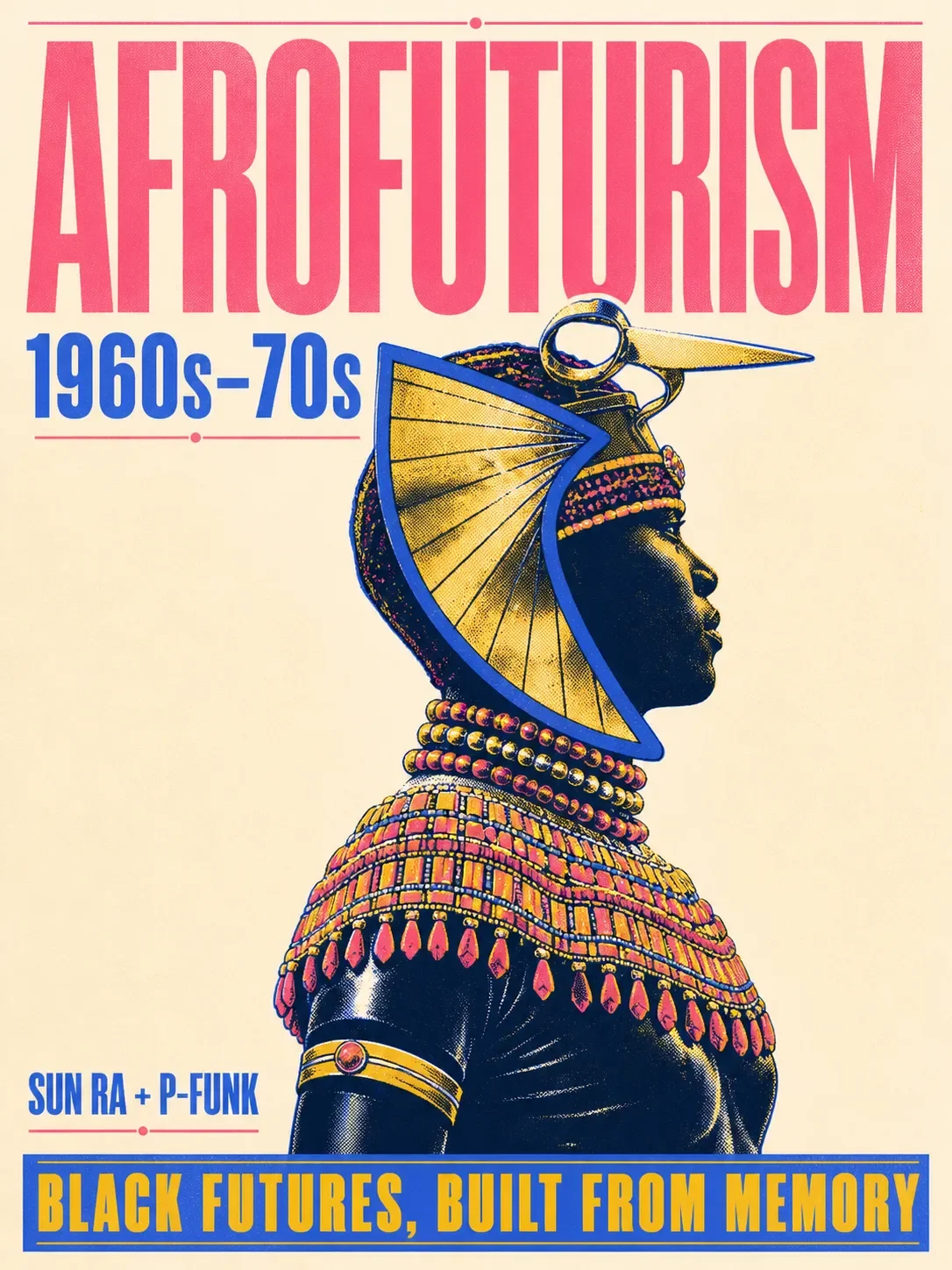

Afrofuturist fashion is better read as a visual language than a fixed uniform: it uses clothes, adornment, and performance to place Black life in the future while staying in conversation with ancestry. PBS’s history of Sun Ra places an early wardrobe grammar in 1960s–70s stage culture: sculptural headpieces, necklaces, rings, turbans, glittery body-skimming boubous, and hand-knit caps. The same account connects his cosmic logic to Parliament-Funkadelic and later Janelle Monáe. 1
That gives the style its tell: ancestral reference plus speculative construction. Look for a headpiece or turban, shell-and-bead adornment, a body-skimming boubou, a hand-knit cap, a heavy cuff, or armor-like panels. Douriean Fletcher’s jewelry pushes the same logic through brass, gold, shells, and stones; her Black Panther pieces turn adornment into part of the character’s world-building. 2
The current revival is visible in institutions as much as in outfits. Vogue World: Hollywood gave Afrofuturism its own sixth act in 2025, with Ruth E. Carter and Balmain creative director Olivier Rousteing attached to the program. That same year, the Museum of Arts and Design mounted Douriean Fletcher: Jewelry of the Afrofuture, a 150-plus-work survey that ran from October 4, 2025 to March 15, 2026. 234
Who is carrying it now? At Vogue World, Jodie Turner-Smith wore a custom Diotima look by Rachel Scott; Teyana Taylor and Danai Gurira wore Ruth E. Carter’s Dora Milaje costumes, while Angela Bassett reprised Queen Ramonda. In 2026, Janelle Monáe’s Christian Siriano Met Gala gown used electrical cables, moss, succulents, and circuit-board fragments to fuse technology with nature. The names change; the permission to build a future from Black cultural memory stays. 567
References
- 1
- 2
- 3
- 4Douriean Fletcher: Jewelry of the Afrofuture
madmuseum.org
- 5
- 6
- 7
Comments