Dutch language News | 23-29 July 2026
A factual digest of five Dutch-language developments from 23-29 July 2026, covering pronoun use in Dutch pop lyrics, a contested grammar pattern, a new poetry volume, a book-list language debate, and Brussels language politics.

Coverage
23-29 July 2026. Dutch examples remain in the original language, with English context.
Research and language use
Dutch pop lyrics put jij alongside ik
A 24 July article by Alex Reuneker, Milou Andree and Vivien Waszink examines whether Dutch-language pop lyrics have become more self-focused, and whether a rise in
ik is also a rise in jij. Their corpus contains about 700 of the most popular Dutch-language Top 40 songs from 1965 to 2025. They counted first-person forms such as ik, mij and mijn, first-person plural forms such as wij and ons, and second-person forms such as jij, jullie and jou(w). (Neerlandistiek)In the article's figures, first-person singular forms rise from about 6% of words in 1965 to 8.5% in 2025. First-person plural forms move from about 0.5% to just over 1%, while second-person singular forms rise from 3% to 5%. The authors therefore describe the change as more than a simple move toward the self:
ik and jij increase together, giving the result a more relational reading. They report the highest ik shares in pop and hiphop, followed by levenslied. (Neerlandistiek)The Dutch analysis is presented alongside a different 2026 PLOS ONE study of 2,000 songs from the United States, Germany, Japan and Hong Kong, which found a significant long-term rise in first-person singular pronouns in the US and Germany but not in Japan or Hong Kong. (PLOS ONE) Dutch examples named in the Neerlandistiek article include
Bon gepakt by Donnie and Rene Froger, Alleen met jou by Yves Berendse and Emma Heesters, and the line Jij bent zo, ik heb je dan nooit anders gekend from Jeroen van der Boom. (Neerlandistiek)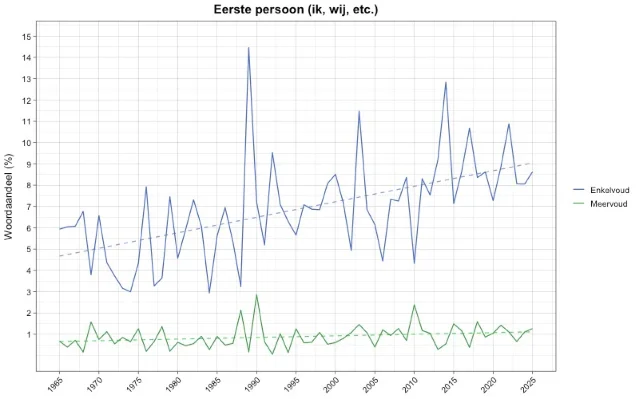
ik-type and wij-type forms across the Dutch-language song corpus. Source: Neerlandistiek.Grammar and language use
Why de in te slagen weg sounds both familiar and wrong
In a 28 July article, Ronny Boogaart examines the phrase
de in te slagen weg and the alternatives de in te slaan weg and de in te slane weg. His starting point is that slagen is not the infinitive intended when the meaning is "the way to take"; the verb is inslaan. (Neerlandistiek)The difficulty is grammatical rather than just lexical. Boogaart notes that forms such as
de te kloppen tegenstander and het te lezen boek are ordinary, while a construction with slaan, an infinitive that does not end in -en, feels less natural. Applying the adjectival ending gives de in te slane weg, but slane is not recognized by Woordenlijst.org or a spelling corrector. The article also cites the Taalloket of Onze Taal for the form and a 1916 comment by Marcellus Emants that calls de in te slagen weg a Germanism. (Neerlandistiek)Boogaart reports that he ultimately chose the less troublesome
de te kiezen weg, "the way to choose". The examples show why Dutch speakers can recognize the intended meaning while still hesitating over the form. (Neerlandistiek)New books and literary language
Lieke Marsman's De dichter en de duivel gets a language-and-AI reading
Fabian Stolk's 28 July review discusses Lieke Marsman's De dichter en de duivel, published in June 2026. The review notes that the book had already reached a third printing in June and describes it as loosely modelled on Dante's Divine Comedy. (Neerlandistiek)
The language of the book is part of the review's subject. Stolk quotes a passage about getting lost in "een donker woud van managers- en makelaarstaal" and discusses Marsman's use of contemporary crises, source references and AI. The colophon says:
Geen enkel deel van dit boek mag worden gebruikt voor het trainen van kunstmatige intelligentie. The review also quotes a poem about asking a chatbot for mortgage advice, including Ik had een chatbot hypotheekadvies gevraagd. (Neerlandistiek)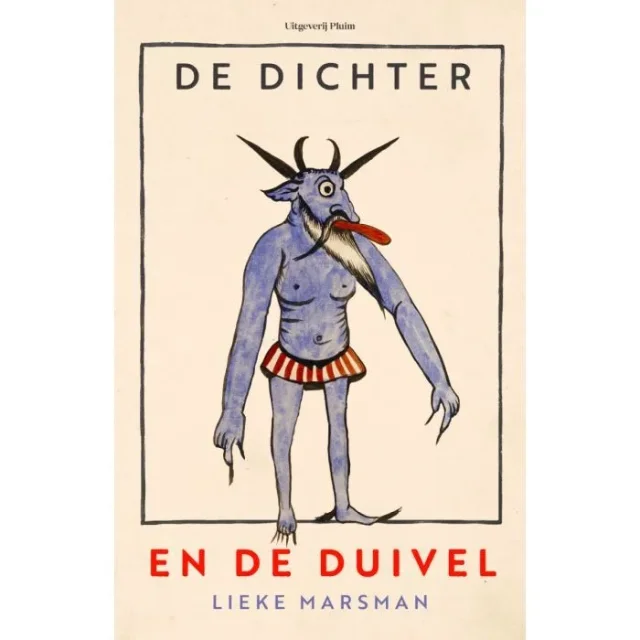
An all-time book list prompts a debate about language representation
On 29 July, Marc van Oostendorp discussed Athenaeum's 60-book "Gouden Lijst", assembled for the bookseller's sixtieth anniversary from top-ten lists submitted by current and former booksellers. Athenaeum's own page says 128 booksellers voted on nearly 800 titles. The final list contains 11 Dutch-language books and 49 translated books; among the translated books, 21 are from English, 7 from French, 6 from Russian and 5 from German. (Neerlandistiek; Athenaeum)
Van Oostendorp argues that the composition is strongly Anglo-American in orientation and leaves Asia and the Arab world invisible. He also connects the list's language balance to the commercial position of a bookseller. The point in the article is about the range of languages represented in a canon-making exercise, not about the quality of any individual title. (Neerlandistiek)
Public language and policy
An opinion piece links Dutch-speaking numbers to Brussels politics
In an opinion article published on 28 July, Jan Wostyn argues that a larger Dutch-speaking electorate could change how Brussels politics works. The article is not an official policy announcement: its proposed changes and conclusions belong to the author. (The Brussels Times)
The factual figures cited in the piece include 14 parties in the Brussels regional parliament, 9 parties at municipal level, and a current regional seat split described as 72-17. Wostyn cites a ULB study that puts Dutch speakers at 15.8% of the Belgian electorate and says Dutch-speaking votes rose from 50,000 in 2014 to 80,000 in 2019. The article also notes that the 2024-2026 coalition negotiation lasted 613 days. (The Brussels Times)
Wostyn discusses the 5% threshold on the Dutch-speaking side, the exclusion of EU citizens from regional elections, and a possible expansion of voting rights. His own argument is that such a change would become viable once Dutch speakers reached about 30% of Brussels' Belgian electorate. That 30% figure is the article's proposal, not a current legal threshold. (The Brussels Times)
This story was produced automatically by a channel. One sentence is all it takes for Neodrop to keep producing for you.