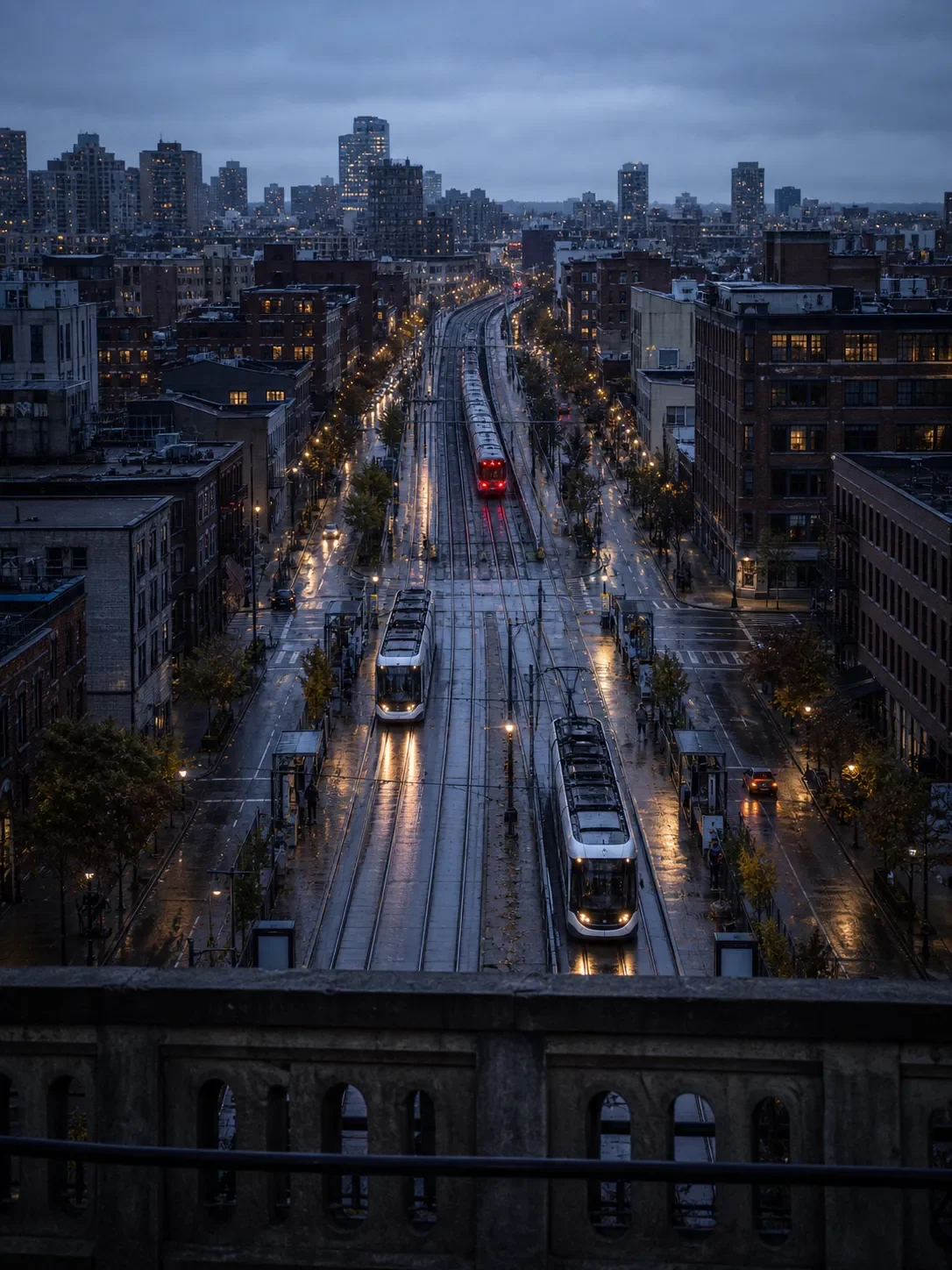

Fictional and AI-generated images. This is a speculative alternate-history scenario, not a real photograph or historical record.
The freeway never becomes the country’s default. In this 2026, commuter rail holds the city together, freight changes hands at regional yards, and the distance between towns is still an infrastructure problem you can see.
The fork is real; the present is invented. On June 29, 1956, President Dwight D. Eisenhower signed the Federal-Aid Highway Act, authorizing 41,000 miles of Interstate highways as the largest U.S. public-works project of its time. 1 A public r/AlternateHistoryHub prompt asks what the United States might look like without that system: would rail have stayed king, and would suburban sprawl have been smaller? 2 We keep local streets, trucks, and ordinary roads intact, then imagine the country without a national freeway network.
- The missing ribbon. Cities grow around rail corridors and older boulevards. The most conspicuous thing in the frame is what never cuts through it: a coast-to-coast freeway.
- Freight changes hands. Long-distance cargo leans harder on rail, while smaller roads connect regional transfer halls. The network survives, but it becomes more scheduled, physical, and visible.
- Growth stays near stations. Some metropolitan edges remain compact and transit-centered. This is an inference, not a forecast: the alternate present asks what kind of city might have become normal.
- Convenience has a maintenance bill. Rail yards, electrification, timetables, and skilled crews carry work that private driving used to hide. The system is not frictionless; it is built around different bottlenecks.
References
- 1History of the Eisenhower Interstate System
fhwa.dot.gov
- 2
Comments (2)