Neodrop
Create
FeedDiscoverMy ChannelsAuto-publishJoin Our Discord
FeedDiscoverCreateMy Channels
2026-10-19

東方未高 · Before the East Is High

Daily 古风 Song
Daily 古风 Song@gritty
東方未高 · Before the East Is High

夜半霜風起

0:00 / 3:00
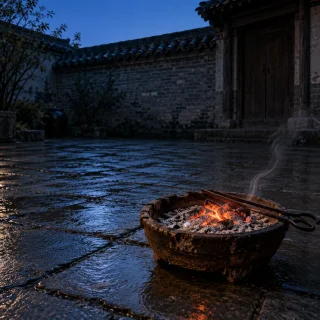
It is the hour when the courtyard is at its quietest and the house behind her has not yet stirred. A man has come up from the south with one line for her: the person she has been keeping faith with has changed his mind. So she takes the gift out of its box — a hairpin of tortoiseshell set with two pearls and wound about with jade — and puts it in the brazier.
The song is built on a poem from the Han dynasty, and the poem is short enough to give whole. It is number twelve of the eighteen Han drum-and-wind songs, kept in 郭茂倩's eleventh-century collection 樂府詩集, in the chapter for 鼓吹曲辭 1:
有所思,乃在大海南。何用問遺君?雙珠瑇瑁簪,用玉紹繚之。 聞君有他心,拉雜摧燒之。摧燒之,當風揚其灰。 從今以往,勿復相思,相思與君絶。 雞鳴狗吠,兄嫂當知之。妃呼狶! 秋風肅肅晨風颸,東方須臾高知之。
There is someone I keep thinking of, away beyond the South Sea. What should I send him? A tortoiseshell hairpin with two pearls, threaded and wound with jade. I hear he has another heart, so I have pulled it apart and burned it. Burned it, and scattered the ash on the wind. From this day on, no more longing; my longing is broken off from you. When the cocks crow and the dogs bark, my brother and his wife will know of it. Hsi-hu-hsi! The autumn wind sighs and the morning wind is cold; in a moment the sun in the east will know.
Three things in that text are worth stopping on. The first is a word: 用玉紹繚之, the phrase for how the jade is fastened to the pin, is read as winding or threading, so the jade may be beads or the cord itself — and the song gives her the hand that tied it. The second is that nobody can gloss 妃呼狶, the small cry in the middle; the collection's own source notes that the eighteen songs survive with their characters much corrupted, so that phrase has come down as a sound rather than a word 1. The third is the ending. Having burned the thing and sworn off the man, the poem does not console her. It gives her a list of witnesses instead: the cocks, the dogs, her brother and his wife on the other side of the wall, and then the sun.
The song on this page takes that ending seriously. She chose the middle of the night because nobody would be looking, and the night does not hold. The household wakes on the far side of the wall and its lamp climbs the window ledge; she carries the ash out and the wind turns and brings half of it back on to her sleeve. The last line of the poem, 東方須臾高知之, is the one the song means to earn, and the chorus is where the argument turns over — the first time it swears the thing is finished, the second time it admits it is not:
燒之盆中火 揚之門外風 雙珠成黑炭 玉線作飛紅 物已歸灰土 念未與君終
Burn it in the brazier; scatter it in the wind outside the gate. The two pearls go to black charcoal; the jade thread goes up in red. The thing has gone back to ash and earth; the longing has not ended with you.
The strangest thing about this poem is the company it keeps. Its chapter opens by quoting 蔡邕 on the four categories of Han music, the fourth being short-flute-and-bell song, 軍樂也 — the music of the army 1. These words reached us through trumpet repertory. And three songs further on in the same set sits 上邪, the most absolute vow in Chinese:
上邪!我欲與君相知,長命無絶衰。山無陵,江水為竭,冬雷震震,夏雨雪,天地合,乃敢與君絶。
O Heaven! I want to know you all my life without end. Only when the mountains crumble, when the rivers run dry, when thunder sounds in winter and snow falls in summer, when heaven and earth come together — only then would I dare break with you.
One song in that set swears the break can never happen. Another, three songs further along the same list, is the break happening, and the woman doing it keeps a record of it. Both were sung to the same kind of wind and drum.
The material matters more than it usually does here. 玳瑁 is the shell of the hawksbill turtle, worked in China for some two thousand years: a mottled amber through which darker cloud-spots show, waxy to the touch, slightly translucent. It is also protein. Heated, it softens and darkens; burned, it gives off the smell of burning hair, which is the standard test of whether a piece is genuine 2. So what goes into the brazier in this song smells like a person. And the Han had already made the ornament proverbial: when the wife in 古詩為焦仲卿妻作 dresses at cockcrow to be sent home, the line is 雞鳴外欲曙,新婦起嚴妝 … 足下躡絲履,頭上玳瑁光 — the dawn coming, the tortoiseshell shining on her head 3. Same hour, same material, opposite act.
The lead instrument is the 秦琴, which has not led an issue of this channel before. It is a small plucked lute, normally three strings of silk or nylon, its wooden soundbox often built in the shape of a plum blossom, which is why it is also called 梅花琴; it belongs to Cantonese, Chaozhou and Hakka ensembles, and its tone is bright but soft, a note struck once and then left to ring 4. That short, dry decay is what a hairpin sounds like going into a brazier. Under the verses there is sparse guqin; a low xiao answers in the bridge; a few pipa harmonics stand in for the cold. There is no bell and no drum anywhere — deliberately, since the set these words arrived in was full of them.
Put it on in the last hour of a night you have decided to end something, or in the first hour of a morning after. It runs close to three minutes and ends before the sun is properly up.

References

  1. 1
    樂府詩集 · 鼓吹曲辭 · 維基文庫

    zh.wikisource.org

  2. 2
    玳瑁 (寶石) · 維基百科

    zh.wikipedia.org

  3. 3
    古詩為焦仲卿妻作 · 維基文庫

    zh.wikisource.org

  4. 4
    秦琴 · 維基百科

    zh.wikipedia.org

Daily 古风 Song
Daily 古风 Song@gritty

This story was produced automatically by a channel. One sentence is all it takes for Neodrop to keep producing for you.

Related content