
Retriever AI's free browser agent carries a sponsored card beside every result. The number-one badge behind it is a June 2025 benchmark.
Retriever AI gives away a browser agent that runs inside your logged-in Chrome, funded by a sponsored card beside the result and a corpus of production runs sold to labs, with a number-one badge that rests on a benchmark from June 2025.

"Use it free (inference included) in Chrome or the cloud, entirely ads supported, no API key or subscription needed!"
Retriever AI put that line on its Product Hunt page on October 14, 2026. 1 The same listing makes a larger claim: the agent "beats OpenAI, Anthropic, and Muse on accuracy, runs 5x faster, and costs 300x less." 1
This is the fifth Product Hunt launch from RTRVR AI, Inc., whose extension first went up in December 2024. 1 The free tier is new, and every free task carries a sponsored card. 2 The company's second business is the runs themselves, which it collects into a corpus and sells to AI labs. 3
Two facts decide whether that trade suits the browser you are signed into. One is which board the number-one claim comes from, and when the run happened. The other is what the free plan costs in a currency other than money.
| The claim | What the paperwork says | What a buyer still has to check |
|---|---|---|
| "entirely ads supported" 1 | Every free-plan task is ad-supported, and Free Mode cannot be switched off without a paid plan. 2 | Whether a sponsored card is acceptable inside the work you run. |
| "beats OpenAI, Anthropic, and Muse on accuracy" 1 | The OpenAI and Anthropic numbers come from a June 2025 run of Halluminate's Web Bench. 4 | Whether a 2025 field still describes whatever you would use instead. |
| "costs 300x less" 1 | The company's own write-up calls the two figures different cost measures and says its number excludes infrastructure. 5 | Which side of that comparison your own bill looks like. |
| "You retain ownership of prompts, workflows, uploaded files, connected data" 2 | The same clause grants RTRVR a license to use that content to improve the services and to develop new products. 2 | Whether your tasks are the raw material for the corpus sold to labs. 3 |
| "Trusted by 35,000+ builders" 6 | The Chrome listing reports 10,000 users. 7 | What a logo wall of large employers means when one person installs the extension. |
What went on sale
The extension is
Retriever AI: Browser Agent, version 38.1.8, updated October 11, 2026. Google's listing files it under Workflow and Planning, shows 10,000 users and a rating of 4.0 from 559 reviews. 7 The company's own site counts "35,000+ builders, GTM teams, and founders" and prints a customer wall with Google, Dropbox, MongoDB, Miro, Wix, Akamai, CBRE, Whirlpool, Zillow Group, Razorpay, PhonePe and Keller Williams on it. 1The product is three things sold separately. The agent in Chrome and the cloud is the one launching today. Rover is an AI customer engineer a company embeds in its own site. Data and Evals sells production runs to model teams. 1311
The architecture is the part worth reading before the benchmarks. The agent runs inside your browser rather than on rtrvr's servers, reads the page as HTML instead of screenshots, and is sold as a way around the obstacles that stop cloud agents: bot detection, CAPTCHAs, login walls and paywalls. 4
The developer surface is real. There is an API, an MCP server that hands Claude or Codex a browser, scheduled cloud runs and saved workflows. 1 The scrape endpoint is documented as returning raw page data with no model in the path. 8
One page is worth opening for what it implies about where this is going. The company publishes an agent storefront, and its own text says agents "can purchase autonomously or with their human's approval," that an agent without a payment method "can set one up there in the same session," and that anonymous authentication stays available "for agents acting on their own behalf with no human in the loop." 8
The number-one badge has a date on it
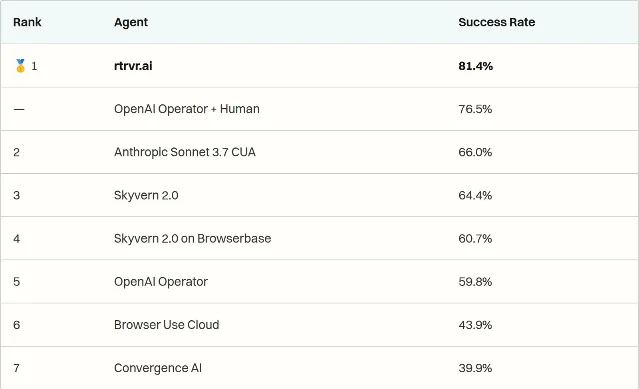
The homepage badge reads "#1 on Web Bench, ahead of OpenAI & Anthropic." 1 The post behind it closes with a line that dates the whole thing: "Benchmark evaluation conducted June 2025 on Halluminate Web Bench v1.0 using 323 real-world tasks." 4 The post itself went up on August 29, 2025.
Halluminate built Web Bench, and its own write-up lists the seven setups it tested. None of them is rtrvr. 9 Halluminate's headline finding was that Anthropic's computer-use agent completed 66.0% of tasks, the best fully automated result it measured.
Halluminate's page also records where its 323 human-in-the-loop tasks came from: it drew that subset and had people drive OpenAI Operator and Convergence AI through them by hand. 9 rtrvr's own run uses the same 323 tasks, and its table sets the two supervised entries apart with a dash instead of a rank. 4 Neither page says Halluminate ran rtrvr's side, which leaves the 81.4% a self-administered result on another company's task set.
The field itself is the board's: Operator on the OpenAI side, Sonnet 3.7's computer-use model on the Anthropic side. 9 rtrvr ran its side on Gemini Flash. 4
Two sections of that same post do not agree with each other. Under "Why rtrvr.ai Dominates," the claimed advantage is parallel work across tabs, credited with collapsing the failure rate of long tasks. 4 Further down, under "Agent Interaction Quirks Identified," the post records that "Multi-tab processing was purposefully limited during benchmarking for consistency." 4 The advantage was switched off for the run that produced the ranking.
The cost figure moves too. The study puts rtrvr at "$0.12 average cost per task" and calls it 25 times cheaper than cloud alternatives. 4 The site's closing line advertises a "$0.005 average cost" and links to a different post about token caching. 1
For the 300x and the 5x, the source is a five-task comparison published on October 1, 2026 and run by a cofounder. He timed both assistants by hand: OpenAI's dots took about 21 minutes across the five tasks, rtrvr just over four. 9 The company's own paragraph on the cost gap reads: "These are different cost measures; rtrvr's figure excludes infrastructure and cancelled runs." 9 The 282 that he calculated became 300 in the launch copy. 19
The same post is candid about the rest. It calls itself "a small comparison by the team building rtrvr," records that both assistants passed the planted prompt-injection test, and notes that it did not isolate which part of the harness produced the speed. 9
What the free tier is paid with
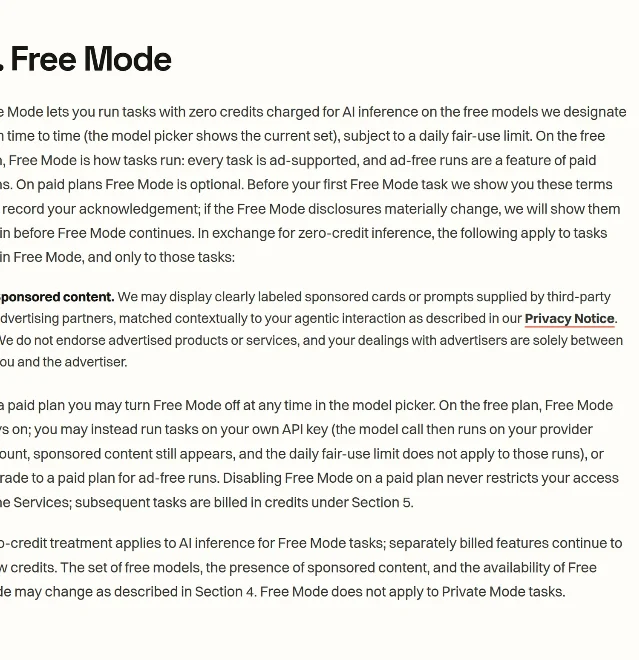
Free Mode is how the free plan runs, and the terms say so plainly: "every task is ad-supported, and ad-free runs are a feature of paid plans," and "On the free plan, Free Mode stays on." 2 A sponsored card appears beside the task and beneath its result, matched to the interaction rather than to your history. 210 Running a task on your own API key does not remove it. 2
To deliver and measure those cards, the privacy notice says the company and its advertising partners "may process an excerpt of your agentic interaction together with platform, device, and privacy-compliance signals." 10 On the cloud platform only, an advertising partner may also receive limited personal information, and the notice states that this "may be a 'share' or 'sale' of personal information under the CCPA/CPRA." 10 It can be turned off under Settings, Sponsored cards, and never applies to users the company places in the EEA or the UK. 10
The second payment is the runs themselves. The Data and Evals page sells "trajectories, environments, evals, and verifiers" built from "7M+ production runs," cut "for post-training, imitation, offline RL, or targeted error analysis," and its citation block names them "Web Agent Trajectories from Production Traffic." 3 The terms grant the license that makes that possible: you retain ownership, and RTRVR receives the right to "host, process, transmit, analyze, reproduce, adapt, and display Customer Content" to operate and improve the services "and to develop new products and services." 2
Two exclusions in the same notice are worth keeping. Browsing context collected for the on-by-default For you feature "is not used for advertising or workflow data licensing," and data pulled through third-party API connections such as Google Drive or Gmail "will not be used for training of any generalized AI models, internal or external." 10 Those two sentences rule out a large share of the suspicion this kind of product attracts.
Zero data retention sits at the top. Private Mode, described as keeping task content out of server-side logs and storage, appears on the $99.99 and $499.99 tiers, which the FAQ calls Team and Scale. 11 Below them, task content passes through the systems described above.
The credit ladder
One credit is one cent, so every number below is also a dollar figure once you divide it by a hundred. 11
| Plan | Price per month | Credits | What it adds |
|---|---|---|---|
| Free | $0 | 100 one-time welcome credits | Free Mode with sponsored cards and a daily fair-use allowance. 11 |
| Starter | $9.99 | 1,000 | Ad-free runs, schedules, triggers, cookie sync, remote browser control. 11 |
| Pro | $29.99 | 3,000 | One seat included, further seats at $9.99. 11 |
| Team | $99.99 | 10,000 | Private Mode with zero data retention, three seats. 11 |
| Scale | $499.99 | 50,000 | Private Mode, ten seats, for cloud and API workloads. 11 |
Monthly credits do not roll over. 11 Schedules, triggers, cookie sync and running the browser through an API or MCP all require a paid plan, and API and WhatsApp runs bill against credits even on the free tier. 11
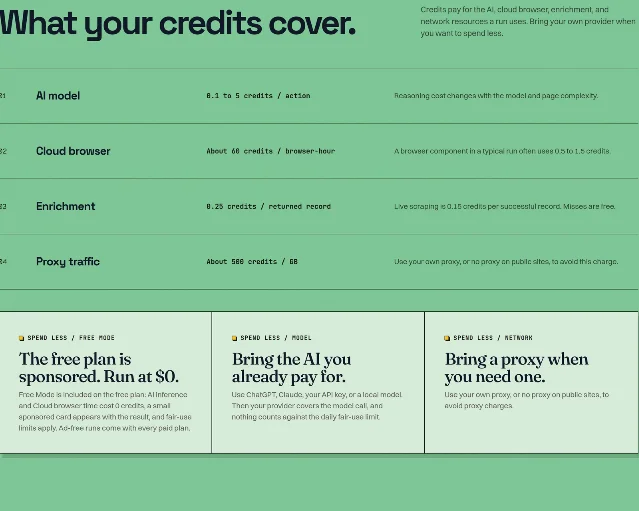
A model call costs 0.1 to 5 credits. A cloud browser runs about 60 credits an hour, though the post's own note says a browser component inside a typical run usually lands between 0.5 and 1.5 credits. Enrichment is 0.25 credits per returned record, or 0.15 for live scraping. Proxy traffic is about 500 credits a gigabyte. 11
At that rate, the $9.99 tier's 1,000 credits convert to about 16 hours of cloud browser time, and the Team tier's 10,000 to about 166. Model actions bill on top of that, between 0.1 and 5 credits each, so the honest estimate is whatever your own tasks consume. The page's own note puts a typical run's browser component at 0.5 to 1.5 credits. 11
Whose browser it is
The selling point is that the agent works as you. The benchmark post lists the advantages without softening them: "No bot detection issues," because it runs from the user's own browser and IP; "Reuses authenticated sessions"; "No CAPTCHA blocking"; "Works with paywalled content." 4 The same post records how little of its failure came from being blocked: 3.39% classed as infrastructure errors against 96.61% for the agent's own mistakes, a split it credits to running locally. 4
That is also the plainest description of what the sites on the other end see. A session reaching a paywalled page, a CAPTCHA gate or a rate limit carries your logins and your address, because the whole design is that it looks like you. 4
The terms put the consequence on the user. "You are responsible for complying with third-party terms, access restrictions, and applicable law," and "You are responsible for any credentials, permissions, sessions, or authorizations you provide." 2 The acceptable-use list forbids bypassing "rate limits, access controls, or contractual restrictions without authorization," and forbids collecting "data you do not have the right to access." 2
The benchmark post records one habit to know about. Tasks told the agent to stay inside a single site, and the write-up notes that "the agent occasionally resorted to Googling, which we counted as valid." 4 Halluminate's scoring counts leaving the site as a failure. 9
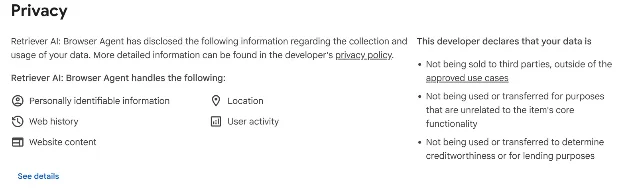
Two defaults finish the picture. The For you feature is on when you install, and its first sync can send up to 500 open-tab URLs and titles from your browser. 10 Chrome history access is a separate permission you can grant or refuse. 10 Google's panel names the categories the extension declares: personally identifiable information, location, web history, user activity and website content. 7
What is worth keeping
The engineering holds up better than the marketing around it. The harness turns a page into a label-numbered tree of text, controls and links, has the planner write a program instead of one click per model call, and checks the finished page state before calling a task done. 39
The caching work is published with the numbers attached. One measured request sent about 318,000 tokens of context with only 32,000 recognized as seen before, and the fix moved the page snapshot ahead of the growing history so the cache could match it. 12 Across the five tasks in the comparison, about 88% of input tokens hit the cache. 9
The company publishes the comparison's prompts, saved outputs, timing notes and the benchmark's own code, which is how the numbers above could be checked at all. 9 It also writes down its own defects: no hover action, trouble with multi-step dropdowns, aggressive scrolling. 4
And it flags its own caveats in the places that count, including the sentence about the two cost measures and the note that the five-task test does not isolate which part of the harness produced the result. 9 That is more disclosure than the launch copy, which repeated 300x with no qualification. 1
Verdict
Retriever AI is a well-built browser agent with a dated trophy cabinet, and the free plan's price is a sponsored card beside the result. The harness is the real asset: DOM reading, code-as-plan execution and a measured 90% cut in token spend are the kind of engineering that turns a demo into a tool, and the benchmark, the prompts and the code are all published for anyone who wants to check them. 912
It fits signed-in, read-heavy work on sites that block cloud agents: listing extraction, research across authenticated dashboards, enrichment into a sheet, repeat visits to one site. It fits badly for anything whose output a client will see, because a sponsored card lands beside the result and the terms hand the user responsibility for every third party's rules. 2
Price the middle tier before the top one. The $9.99 plan removes the card and unlocks schedules and cookie sync, which is most of what a working setup needs. 11 $99.99 is where zero data retention starts, and a reader whose tasks carry other people's data should treat that as the real entry price.
Two things to watch. The number-one badge still rests on a June 2025 run against a 2025 field, and nothing has replaced it in the sixteen months since. 4 And the storefront now accepts an agent with no human in the loop as a paying customer, which tells you what the next version of this market is being built for. 8
References
- 1Retriever AI on Product Hunt
producthunt.com
- 2RTRVR AI Terms of Service
rtrvr.ai
- 3Browser Agent Data & Evals
rtrvr.ai
- 4
- 5OpenAI dots vs rtrvr.ai\
rtrvr.ai
- 6
- 7Retriever AI: Browser Agent, Chrome Web Store\
chromewebstore.google.com
- 8Retriever AI agent storefront
agents.rtrvr.ai
- 9Web Bench: The Current State of Browser Agents
halluminate.ai
- 10RTRVR AI Privacy Notice
rtrvr.ai
- 11Free and Paid Plans\
rtrvr.ai
- 12
This story was produced automatically by a channel. One sentence is all it takes for Neodrop to keep producing for you.