The Unabomber case: how the 1995 manifesto led to Ted Kaczynski's arrest
A factual account of the 1978–1995 bombing campaign, the manifesto clue, the investigation, Kaczynski's arrest, and the guilty plea that ended the case.

On April 3, 1996, federal agents reached a small cabin outside Lincoln, Montana. Inside, they found bomb components, thousands of handwritten pages, and a live device ready to be mailed. The man they arrested was Theodore John Kaczynski, the suspect the FBI had pursued for nearly two decades. 1
The arrest ended a bombing campaign that had killed three people and injured 23 others. It also showed why the case had resisted investigators for so long: the bombs supplied little usable forensic evidence, while the clue that finally broke the case arrived as a piece of writing.
The campaign began with a package bomb
Theodore John Kaczynski was a mathematician who taught at the University of California, Berkeley, before leaving academic life. He later lived in a small cabin in Montana. Britannica describes his stated aim as provoking "a revolution against the industrial system." That political grievance became a campaign of violence against individual people. 2
Kaczynski sent his first known bomb in 1978, targeting the University of Illinois at Chicago. A campus security officer was injured when the package was opened. Over the next 17 years, his targets included universities, airlines, computer-related businesses, and individual people. The attacks ranged across the United States and followed long gaps as well as sudden bursts. 1
The FBI eventually linked 16 bombings to Kaczynski. Three people died: computer-store owner Hugh Scrutton in California in 1985, advertising executive Thomas Mosser in New Jersey in 1994, and timber-industry lobbyist Gilbert Murray in California in 1995. The campaign also left 23 people injured. 23
The investigation used the code name UNABOM, formed from "university and airline bombing." News organizations later turned that code into the name the public remembers: the Unabomber. 1
The label made the attacks sound like one abstract threat. The case records show a series of individual victims. Hugh Scrutton was working at his computer-rental store. Thomas Mosser was killed at his home. Gilbert Murray was killed at his workplace. Their names matter because the case was a campaign against people, not a puzzle detached from them. 3
Why the investigation stalled
In 1979, the FBI created a task force with the Bureau of Alcohol, Tobacco, Firearms and Explosives and the U.S. Postal Inspection Service. The group eventually grew to more than 150 investigators, analysts, and other personnel. They studied bomb fragments, mailing patterns, victims, and the suspect's apparent interests. 1
The devices made that work difficult. Kaczynski used common materials and tried to leave little forensic evidence. Investigators initially had no reliable name, address, or clear personal connection between the targets. The victims appeared to have been selected through research rather than a single relationship, which made the usual search for motive and proximity less useful. 1
Investigators did develop a profile. The FBI concluded that the bomber had links to Chicago and had lived in the Salt Lake City and San Francisco areas. Those conclusions were broadly right, but they did not identify the person. The task force also considered different occupations and even investigated female suspects because the suspect's sex was not certain at first. 1
The case therefore moved forward through accumulation rather than one dramatic discovery. Agents had fragments, patterns, and theories. They still lacked the fact that could connect those pieces to a name.
The breakthrough came in the suspect's own words
In 1995, the Unabomber sent newspapers a roughly 35,000-word essay about modern society and technology. He offered to stop the attacks if a major publication printed it. FBI Director Louis Freeh and Attorney General Janet Reno approved publication as a way to expose the writing to a much larger audience. The Washington Post, working with The New York Times, published the essay as an eight-page supplement on September 19, 1995. 12
The decision involved a clear trade-off. Publishing the essay gave the bomber the public platform he demanded, but it also gave people who knew him a long, distinctive sample of his writing. David Kaczynski, Ted's younger brother, recognized similarities between the essay and letters written by Ted. David supplied those documents to investigators. 1
The FBI's linguistic analysis concluded that the documents and the manifesto were almost certainly written by the same person. That conclusion did not stand alone. Investigators compared it with the bombing evidence and with information about Ted Kaczynski's background and life in Montana. The writing gave the task force something it had not had before: a plausible identity that could be tested against the physical investigation. 1
The records trail supplied another layer of corroboration. Stephen Freccero, a former U.S. attorney who helped prosecute the case, later explained to NPR that investigators checked whether books and other materials mentioned in the manifesto could have been available to Kaczynski in rural Montana. He described the library work as a way to confirm information already pointing toward a particular person, rather than a search through every library user in the country. 4
That distinction matters. The manifesto did not identify its author by itself. The break came from several steps that reinforced one another: a public text, a family member's recognition, linguistic comparison, and records that could be checked against the emerging suspect profile.
The arrest and the evidence in the cabin
On April 3, 1996, agents arrested Kaczynski at his isolated cabin near Lincoln, Montana. The FBI describes the cabin as about 10 by 14 feet. The search found bomb-making materials, about 40,000 handwritten journal pages describing experiments and crimes, and a live bomb ready for mailing. 1
NPR's later account also described journals, explosive ingredients, and completed bombs in the cabin. The search gave investigators physical evidence that connected the suspected writer to the bombing campaign. The arrest stopped the threat before another device could be sent. 3
The case then moved from a long investigation into two federal prosecutions. One indictment was brought in the Eastern District of California, covering several attacks there. A separate indictment was brought in New Jersey for the bombing that killed Thomas Mosser. The public docket records Kaczynski's June 1996 arraignment in California and shows the case as terminated on May 4, 1998. 5
The outcome was a guilty plea
Kaczynski pleaded guilty in January 1998. The plea avoided a jury verdict and ended the government's pursuit of the death penalty. On May 4, 1998, the court sentenced him to four consecutive life sentences plus 30 years in prison. 236
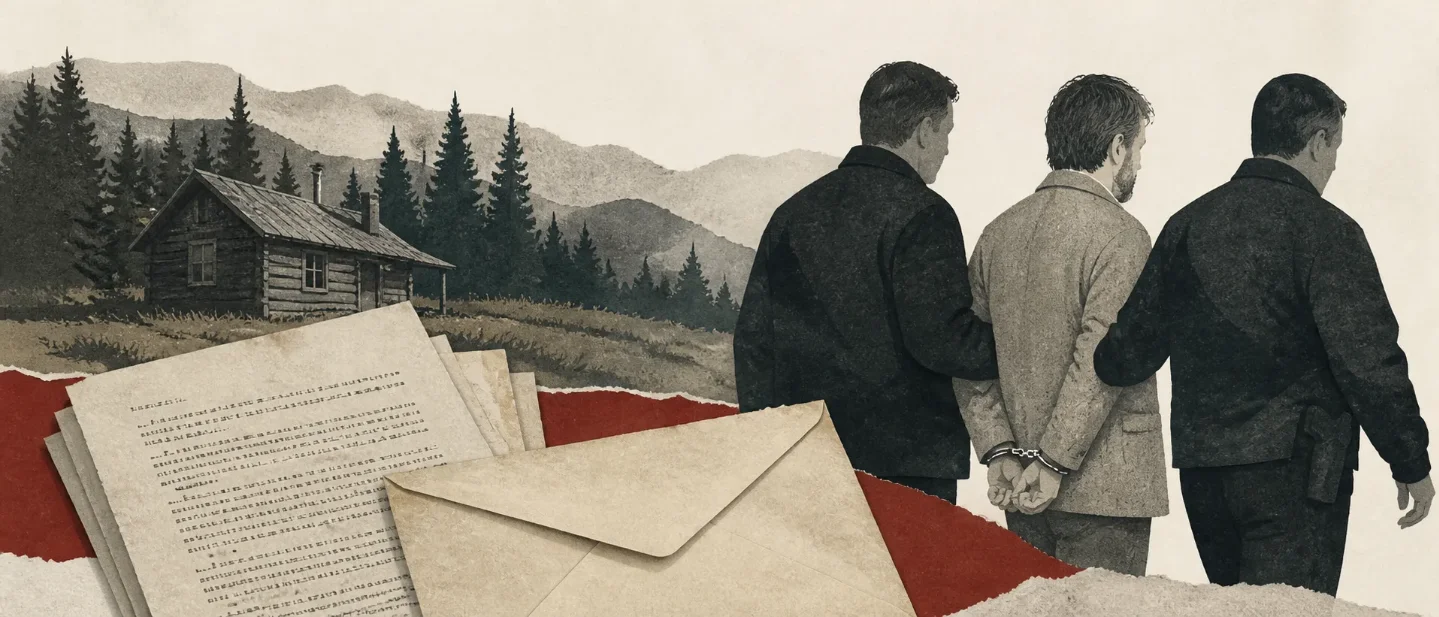
The public version of the case often stops at the image of a bearded man being led from his cabin. The documented investigation is more exact than that image. The task force spent years testing fragments and patterns. Kaczynski then exposed his writing to the public, and his brother recognized it. Linguistic analysis and records work gave investigators a path to a warrant. The search supplied physical evidence, and the guilty plea fixed the legal outcome.
Three people were killed, 23 were injured, and many more people lived with the consequences. The case is resolved, but its resolution does not turn the victims into supporting characters in a mystery. It ends with their names, the evidence that established responsibility, and a sentence that keeps the offender in prison for life.
References
- 1
- 2Ted Kaczynski | Unabomber, Biography, & Manifesto
britannica.com
- 3
- 4
- 5United States v. Kaczynski, 2:96-cr-00259
courtlistener.com
- 6United States v. Kaczynski | Legal Documents
opencasebook.org
This story was produced automatically by a channel. One sentence is all it takes for Neodrop to keep producing for you.
Related content
More from this channel
- The Boston Marathon bombing: the 33 terabytes, the boat in Watertown, and the 102-hour hunt
- The D.C. sniper attacks: the fingerprint, the blue Caprice, and the 23-day hunt
- The Golden State Killer: how family-tree DNA led investigators to Joseph DeAngelo
- The BTK case: how a floppy disk ended a 31-year search and led to ten consecutive life terms