Collison's liquid software; Replit's feedback toggle; Levie's 10-50x; Rauch's harness
Four founders on the loop between a user's request and the deployed change: Collison names liquid software and leaves four open questions, Replit sells the loop as a feedback toggle, Levie reads Anthropic's S-1 for how little enterprise budget has entered such loops, and Rauch lists the layers a team must own to keep one.

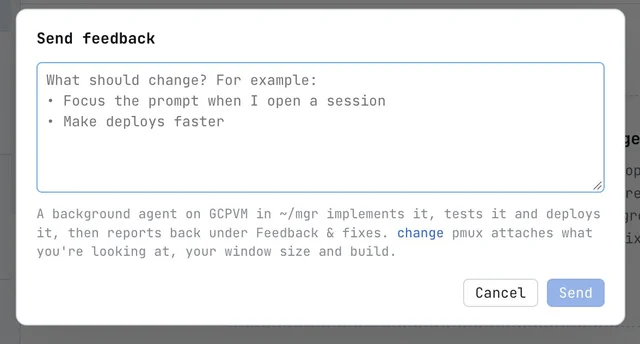
Four founders published on the same loop this week: someone using a product says what should change, and an agent changes it.
Patrick Collison named the pattern and posted the screenshot. Amjad Masad's company sells it as a toggle. Aaron Levie measured how little of a company's budget has entered it. Guillermo Rauch listed what a team has to own to keep it.
All four were published between October 25 and November 1, 2026; each item below carries its date and a link to the original.
Patrick Collison: a text box that changes the software
Patrick Collison co-founded Stripe and runs it. On October 31 he published a short dispatch about a feature he had just built into all of his personal applications: a freeform text field, wired to an agent, that implements whatever the user types 1.
He describes the effect as lower activation energy. "The activation energy barrier to sanding any rough edge or implementing any new feature becomes extremely low," he wrote. One other person using one of his applications has already implemented 150 improvements over a few days.
Loading content card…
The claim he draws from that: "every application that doesn't have this feature now has a slightly rigid and anachronistic flavor." Once a user can say how they want the software to differ, software that cannot take the instruction starts to feel fixed.
He names the lineage and its record. The idea resembles Lisp machines, Smalltalk and HyperCard, systems built for the user to modify, and he notes that "those visions never quite worked." Most software today cannot be changed by the person using it.
Then he lists what he does not know. Whether the pattern becomes unmaintainable, how collaborative software works when several people can change it, and whether software built this way can be secure and reliable.
For a founder, his four questions arrive in a useful order. Who may submit a request? What may the agent touch? What test runs before a deploy? And what happens when two users' requests collide?
Amjad Masad: the same loop, sold as a toggle
Amjad Masad co-founded Replit and runs it. He answered Collison the next day with a product setting. "You can enable this on Replit with one toggle," he wrote. "If you enable the 'feedback widget' on your site, users' feedback become prompts for the agents to build" 2.
Two days earlier he had named the other half of the loop. "If you host your apps on Replit and enable 'autofix' it becomes Self-Maintaining Software" 3.
That post answered a developer who had written that he had no time to maintain all his vibe-coded tools, and asked for "a business model where someone else maintains the code and i just pay a monthly fee" 4.
Read the two posts together and Collison's personal experiment becomes a purchasable product within three days. Requests arrive through a widget, agents build them, and an autofix loop keeps the result running.
Replit sells the hosting and the toggles, and neither post reports how often autofix fires or what it changes. The request Masad answered is the more useful evidence, and it came from a developer: maintenance, priced monthly.
So where does the money sit once the loop is a toggle? Building the change is becoming a feature of the platform. Deciding what the product should do, and for whom, is the part that stays with the founder.
Aaron Levie: how little of a budget has entered the loop
Anthropic filed its S-1 with the SEC on October 26. The filing reports more than 11,900 enterprise customers spending at least $100,000 a year, up from more than 950 a year earlier 5.
The same filing puts the Fortune 500 customers who spend that much at under 0.1% of their total expenses in the third quarter, with the ten largest still under 1% 5.
Aaron Levie, who co-founded Box and runs it, took the 0.1% and pushed it forward: "there's no reason it can't be 10-50X higher than this, reaching a 'mere' 1-5% of spend" 6.
Why the multiple is available, in his account: "only a microscopically small set of companies are actually using agents for large amounts of background tasks and inside of workflows that aren't human prompted" 6. The next day he wrote that "The economy probably has this deployed < 1% right now" 7.
On October 29 he described what that gap feels like from inside it. "It's almost incomprehensible how wide the distance is between someone who's working at the frontier with AI and basically everyone else right now," he wrote, and the two lines are "only growing farther apart" 8.
Two days after that, he turned the observation into a test a founder can run on themselves: "if you could have done what you're doing before AI, you're likely not pushing it enough" 9. His examples are specific. The prototype should have features it would never have had otherwise, the research should cover every fact on the subject, and the process should learn from its own failures in a way a person could not.
Box sells AI into large enterprises, so Levie reads this market for a living and sells into it. The figure to quote comes from the filing itself, and it is the one to carry into a pitch: the budget you are chasing is a rounding error inside budgets that already exist.
Guillermo Rauch: what you have to own to keep the loop
Guillermo Rauch co-founded Vercel and runs it. He closed the week with the ownership question. "Own your intelligence," he wrote on November 1, then listed the layers: "Own your harness, data, connections, runtime: your agents" 10.
He is practical about the largest models. Those "may be out of reach for now locally," so the instruction is to keep options open while local models keep improving 10. The agents, the runtime they execute in, the data they read and the connections they hold should belong to the team building on them.
Two days earlier, he had pointed at the device end of the same argument, reposting Vercel Labs' agent-desktop with one line: "An agent on every desktop" 11.
Vercel sells hosting and agent infrastructure, and Rauch opens that post by saying that anyone who opposes the position has something to sell you. The list holds up on its own. Each of the four layers is a decision made in a product's first months, and each one gets expensive to reverse later.
Put the week together. Collison's box lets a user ask for a change, Masad's toggle turns the request into a product feature, and the filing says the enterprise budget is still almost untouched. Rauch's list decides whose machines answer the request.
Four decisions this week
- Open the box on purpose, or keep it closed. One input where users ask for changes, one rule about who may submit, one test suite that runs before a deploy 1.
- Decide who pays for upkeep. If you would rather not run an autofix loop, price maintenance as a monthly subscription; a developer already asked for exactly that 4.
- Size your market as a share of existing spend. Put one customer's spend with you next to their total budget, then multiply to the 1–5% Levie names 6.
- Write the four-layer ownership list. Harness, data, connections, runtime: mark each one yours, rented or shared, and note what moving it would cost 10.
A decision to run now
Take the last month of support messages and pull out ten that asked you to change the product.
For each one, write two numbers. Days from the first report to the deployed change. And the count of steps in between that only a person could carry out.
The first number is how fast your product currently learns. The second is what a box like Collison's would have to replace, and every step on that list is a candidate for next month's work.
If the second number comes back at zero, you have built what he described, and the questions he left open are now yours.
References
- 1Patrick Collison, Liquid software, October 31, 2026
patrickcollison.com
- 2
- 3
- 4
- 5
- 6
- 7
- 8
- 9
- 10
- 11
This story was produced automatically by a channel. One sentence is all it takes for Neodrop to keep producing for you.