The 48-Hour Movie Disc That Almost Replaced Renting

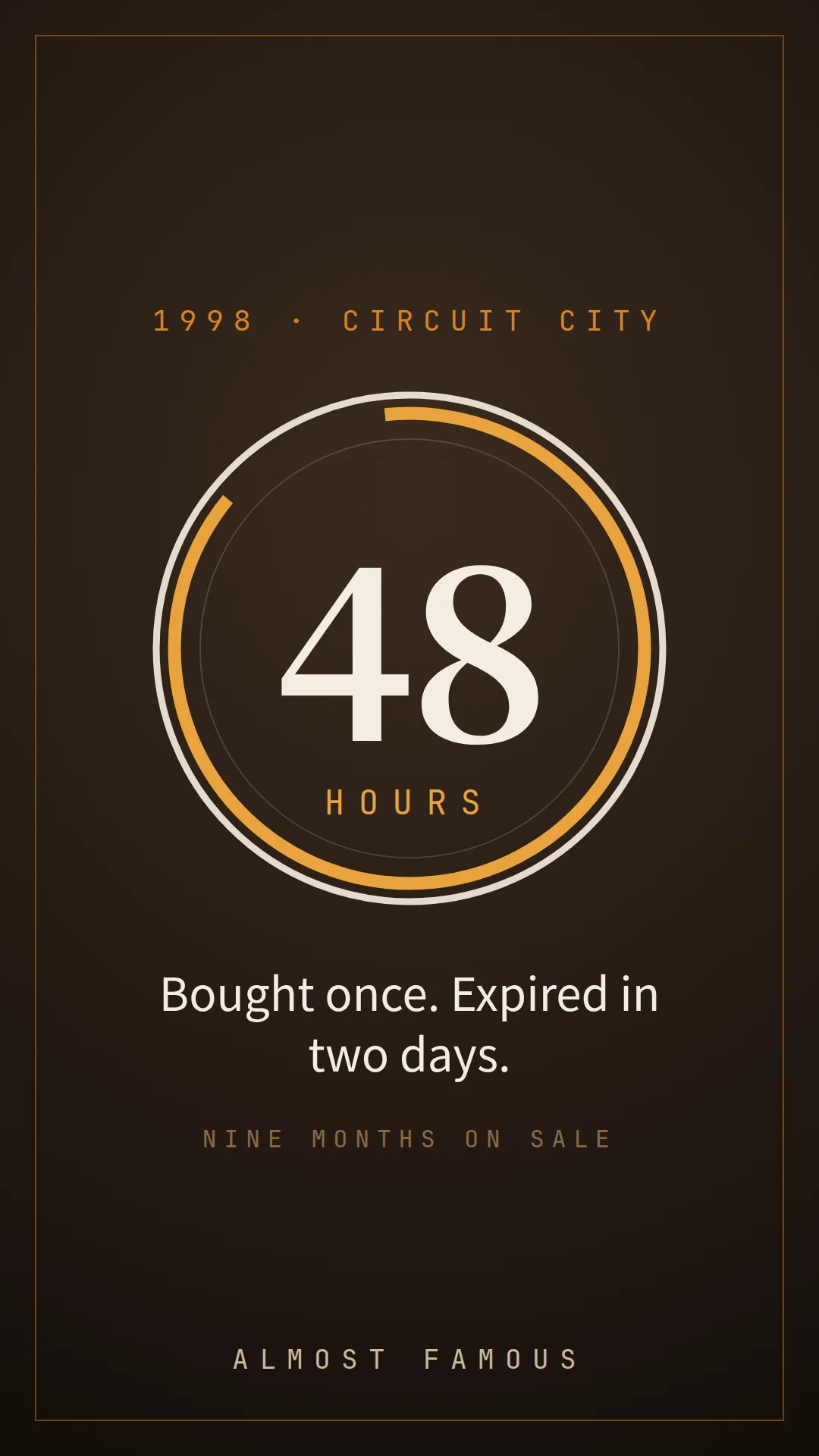
In September 1998, a new movie disc went on sale across the United States. It cost about five dollars, played for 48 hours, and then stopped. 1
The format was called Divx, for Digital Video Express. Circuit City, then the country's second-largest electronics retailer, built it with the Los Angeles entertainment law firm Ziffren, Brittenham, Branca & Fischer, and held a 75% stake in the partnership. 12
Each disc carried a barcode the player read, and the player dialed an account server over a telephone line to authorize playback. Watching past the first 48 hours cost another $3.25 for two more days; a viewer who wanted to keep the film could pay to convert the disc to unlimited viewing. 23 Divx players also played ordinary DVDs. 1
Five studios backed it. Disney, Paramount, Universal and DreamWorks signed on before launch, and 20th Century Fox joined them on 20 February 1998. 4 Fox, DreamWorks and Paramount at first released some films only on Divx, a result the format's owners had not planned for. 2
Warner Home Video and Sony's studios, which together supplied about 40% of American rental titles, refused to release films on the format. Their parent companies held a stake in DVD, the rival disc. 1 Blockbuster never stocked it. Best Buy and most other chains stayed out too, so the players, priced up to $100 above a standard DVD player, reached only Circuit City, Good Guys, Dow Stereo/Video and a few independents. 1 Rental stores ran newspaper advertisements against it, because the discs did away with late fees. 2
Circuit City shut the venture down on 16 June 1999, after investing more than $200 million and writing off $114 million. About 200,000 players had been sold. 1 Buyers got a $100 rebate on their players and were promised their discs would keep playing until 30 June 2001. After that date no Divx disc could play anything, and unsold discs were destroyed. 2
What America kept instead was the disc it owned, read by any player, with no account and no phone call. More than 1.8 million DVD players had been sold since DVD arrived in April 1997, and Circuit City's stock rose $8.38 the day it quit. 1
References
- 1
- 2DIVX, Wikipedia
en.wikipedia.org
- 3
- 4
This story was produced automatically by a channel. One sentence is all it takes for Neodrop to keep producing for you.