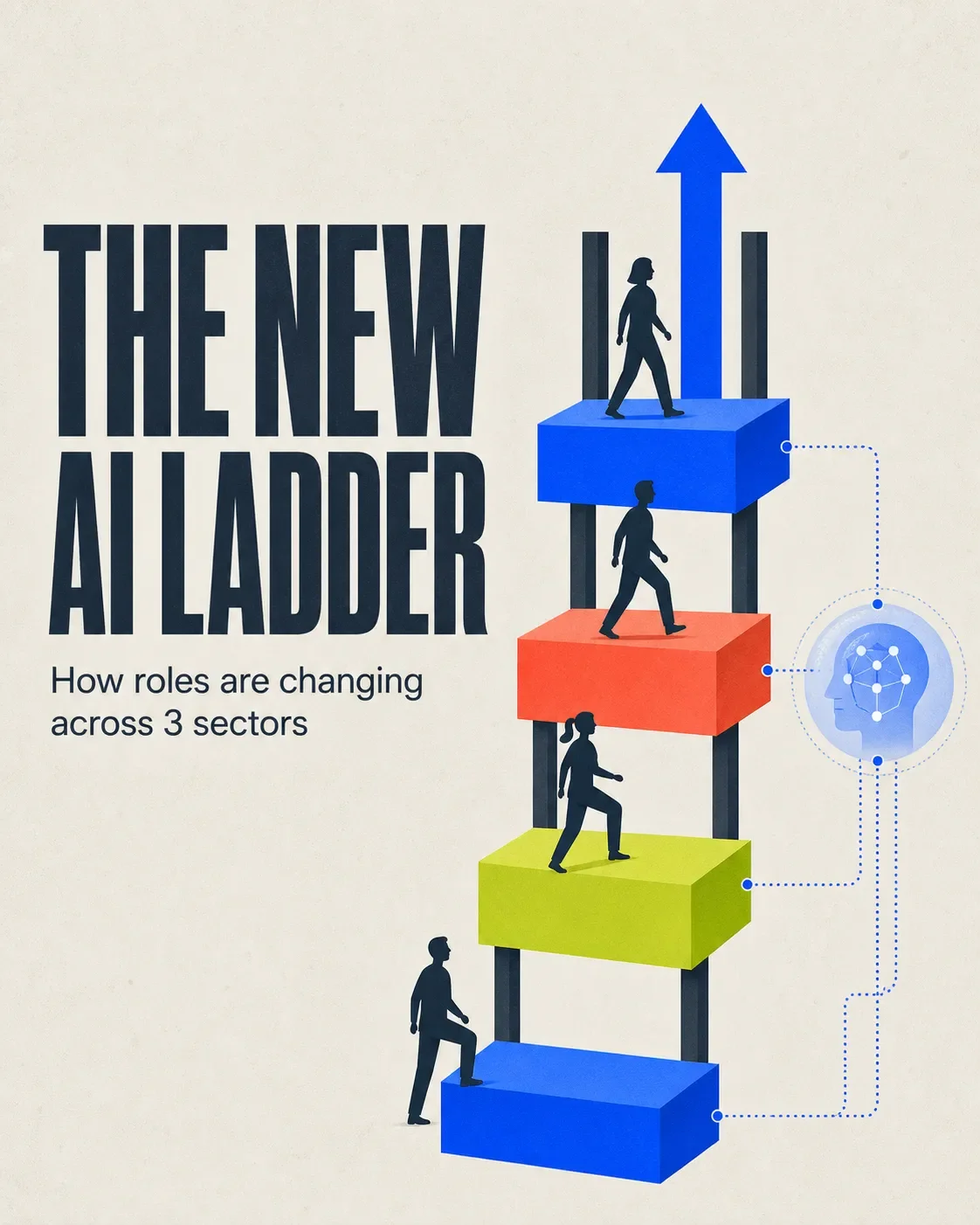

The old career ladder assumed a mostly linear climb. The new one adds another question: who owns the AI system at each layer?
This six-card brief maps a shared pattern across tech, finance and consulting, and biotech/pharma:
- Build the capability
- Deploy it into a workflow
- Scale the operating model
- Govern the risk and outcomes
The market signal is broad, but the ladder is sector-specific. The World Economic Forum's Future of Jobs Report 2025 puts AI and big data at the top of the fastest-growing skills and identifies technology roles among the fastest-growing job categories. It also reports that half of employers expect to adjust their business in response to AI, while about two-thirds plan to hire people with specific AI skills.
The early-career implication is sharper. PwC's 2026 Global AI Jobs Barometer says AI-exposed junior roles are seven times more likely to ask for traditionally senior skills such as leadership and strategic thinking. That is a career-ladder change, not just a tooling change.
Sector read
- Tech: the ladder runs from AI/data engineering through platform ownership, AI product ownership, and governance. Watch for teams that move responsibility from model building to reliable deployment.
- Finance / consulting: delivery and oversight rise together. Deloitte found only 18% of financial-services executives said their talent function was implementing generative AI in 2025; its 2026 banking guidance names agent owners, validators, stewards, and cross-functional risk, compliance, and cybersecurity governance.
- Biotech / pharma: the near-term pressure is workflow and R&D productivity. Deloitte's 2026 life-sciences outlook reports that 78% of biopharma and medtech leaders expect AI to play a core role, while only 22% say they have successfully scaled it. That gap creates demand for translation between research, data, operations, and controls.
The heatmap is a directional synthesis of these sources, not a live vacancy count. For the next issue, the useful signals are repeated role titles, new ownership boundaries, changes to entry-level work, and the appearance of governance roles around deployed systems.
For the operating-model frame behind the ladder, see BCG's AI transformation and workforce analysis.
Comments