Meta put an 816-billion-parameter model up for download, and the catch is in the memory bill, the licence and its own benchmark table
Meta's downloadable 816-billion-parameter Muse Spark Open runs on two Mac Studios, and its own benchmark table, its memory requirement and its $20 million licence gate are what decide whether a workload of yours can leave a hosted API.

The downloadable models worth building on have mostly come out of China, and since April 2025 Chinese labs have led the category outright. Alibaba's Qwen, Moonshot's Kimi and Z.ai's GLM set the standard, and they took the volume that came with it: by September 2026 Chinese releases held more than 80% of open-model usage on the OpenRouter gateway, and roughly twice America's cumulative downloads on Hugging Face. 1
On 15 October Meta published the weights for Muse Spark Open. Weights are the trained numbers behind a model; with them you can run it on your own machines, change it, and ship the result. 2
Muse Spark Open holds 816 billion parameters and reads text, images, video and audio. It writes text, and its context window — the text it can hold at once — runs to one million tokens. 3
Meta calls it "the most capable US open-weight model to date" and says it runs on two Apple Mac Studios sitting on a desk. 2 Mark Zuckerberg's own post credited the work with Apple, and Apple's chief executive replied that running a model of that scale "right from your desk" was amazing. 45
Two other releases landed the same day, and each answers the same question differently: how much of a frontier model does a lab hand over? Nvidia published a 120-billion-parameter agent model under a licence that permits commercial use, and shipped its training recipes and datasets next to the weights. 6 Microsoft finished pre-training a 2.8-trillion-parameter model and said it would license the weights to trusted partners instead of publishing them. 7
RepoChad's same-day breakdown walks the architecture, the memory overhead, the hardware bill and what the licence actually allows.
Loading content card…
What the model is, and which rows it loses
Muse Spark Open is a mixture of experts: 816 billion parameters in total, of which 42 billion are used for any single token. 3
Activating a small slice keeps the arithmetic down while all 816 billion weights still have to be held in memory. 3
Meta names long-horizon agent work, coding, tool use and document understanding as the intended jobs, and recommends its highest reasoning setting for coding and agent work. 3
The table below is Meta's own, from the model card. 3
| Benchmark | Muse Spark Open | GLM 5.3 | Kimi K3 | Qwen3.8-2.4T-A95B |
|---|---|---|---|---|
| Artificial Analysis Intelligence Index | 39 | 45 | 44 | 40 |
| MCP-Atlas (tool use) | 89.2 | 84.2 | 82.3 | 84.5 |
| JobBench | 61.8 | 61.4 | 54.3 | 52.7 |
| GDPVal-AA v2 (professional work) | 1,401 | 1,653 | 1,537 | 1,613 |
| OSWorld Verified (computer use) | 80.4 | — | 84.8 | — |
| Toolathlon Verified | 72.8 | 73.0 | 76.5 | 72.5 |
| Terminal-Bench 2.1 | 76.4 | 83.9 | 85.0 | 82.0 |
| DeepSWE 1.1 | 60 | 67 | 68 | 57 |
| SWE-Atlas-QnA | 58 | 59 | 66 | 62 |
| HLE-Diamond, no tools | 26.1 | 16.4 | 22.2 | 17.3 |
| ZeroBench, with tools | 50.0 | — | 41.0 | — |
Two patterns come out of those rows. Muse Spark Open leads the tool-use and hard-knowledge rows — MCP-Atlas, JobBench, HLE-Diamond without tools, ZeroBench with tools. It trails GLM 5.3 and Kimi K3 on every software-engineering row in the table, and sits behind Kimi K3 on the two rows that score an agent doing a professional's job: professional work and computer use. 3
Meta also reports the strongest safety numbers in that table. Muse Spark Open refused 99.2% of jailbreak attempts on Meta's internal cyber benchmark, against Kimi K3's 75.5%, and held attack success to 0.5% on the adaptive StrongREJECT v2 suite, where Kimi K3 reached 66.6% and lower is better. 3
The card adds the boundary in Meta's own words: these evaluate the released checkpoint under the tested conditions, and downstream modification can degrade them. 3
Where the headline claim gets its qualifier
"Most capable US open-weight model" is true as written, and the qualifier is carrying most of the weight. 2
Meta's own table lists the two other American open-weight models on the same index: Thinking Machines' Inkling at 26 and Nvidia's Nemotron 3 Ultra at 23. Against those, 39 is a wide lead. 3
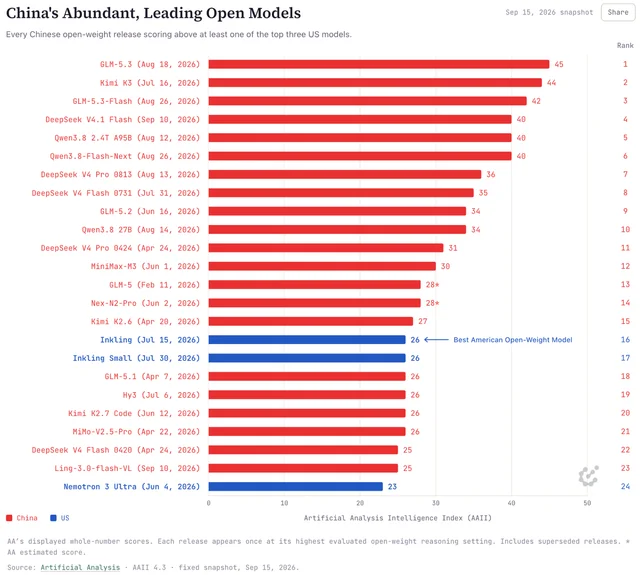
Against everything downloadable, four published scores sit above that 39: MiMo-V2.6-Pro at 46, GLM 5.3 at 45, Kimi K3 at 44 and Qwen3.8-2.4T-A95B at 40. 89
The open release also sits below Meta's own hosted line. Artificial Analysis scores the hosted Muse Spark 1.3 at 48 at maximum reasoning effort, Muse Wonder at 52 and Muse Wonder Full at 56. 10
A Meta researcher said the quiet part in public: Muse Spark Open is "~Muse Spark 1.2 level," and his wish was that Meta would follow it with 1.3 weights. 11
What a lab gives away is the previous generation, and what it sells is the current one. Renting Meta's newer hosted Spark models costs the same $1.25 per million input tokens and $4.25 per million output as renting Muse Spark Open from Together AI, so what the download buys is control over where the model runs. 9
The demand moved before the supply did. Open-weight models went from 26% to 60% of tokens on US-originating requests to the OpenRouter gateway between September 2025 and August 2026, and Chinese labs supply most of that volume. 12
Nathan Lambert's framing of the competition: American open-weight models have run six to nine months behind the closed American frontier, while Chinese open-weight models have run two to five months behind it. 1 Aaron Levie's read of this release is that enterprises will keep frontier models for orchestration and high-end work, and post-train cheap open models for the steps they repeat. 13
Where a model was built and where it runs have come apart as well. OpenRouter's US in-region routing already serves DeepSeek V4 Pro, Kimi K3 and GLM 5.2 from US data centres through Baseten, Fireworks and Azure. 12 A procurement review that asks who made the model lands differently from one that asks where the data was processed. 9
What each route costs
Renting it is the cheap route. Together AI lists Muse Spark Open at $1.25 per million input tokens, $0.15 per million cached input and $4.25 per million output, with the full million-token window available on serverless. 14
Owning it is a memory decision before it is a compute decision. Meta's model card states the requirement: at least 700GB of accelerator memory for the compressed four-bit build, and 2TB for full precision. 3
Meta's deployment documentation is more specific about what that means in GPUs: the compressed build serves across four B300 chips, and full precision across eight. 15
The desktop answer is two Mac Studios with M5 Ultra chips. Each takes up to 512GB of unified memory — memory the graphics processor addresses directly — at 1.2TB per second. Apple's own release says several can be clustered over Thunderbolt 5 into one shared pool, with four systems up to three times faster than one. 16
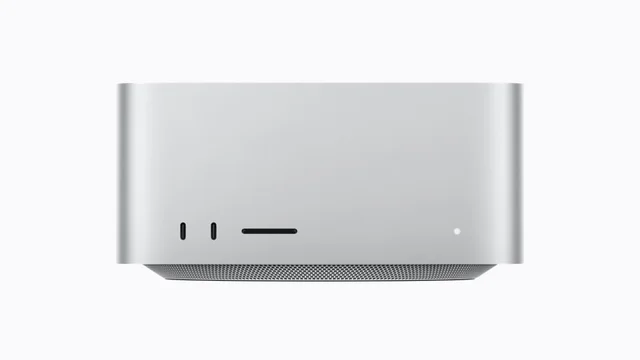
Apple put those machines on sale from 22 September. 16 VentureBeat reports that the 512GB build arrives in late October and that Apple has published no price for it. 9
The nearest published figure is a 256GB M5 Ultra Mac Studio with a 1TB SSD at $10,799. Four of those reach the same terabyte of memory for $43,196 before tax, which VentureBeat offers as a reference calculation for that much memory rather than as Meta's price. 9
Whether owning hardware pays is a volume question, and one preprint gives it a shape. It models the choice as a portfolio problem: pick which model serves each function and in which mode, minimising total cost of ownership under quality, latency and safety constraints over one shared pool of GPUs. 17
In that paper's case study — five functions, nineteen candidate model-and-mode pairs — on-premise hardware only became reasonable above roughly 309 vision queries an hour, or if API prices doubled. The threshold is the transferable part; where yours sits depends on your own volume. 17
Memory rather than arithmetic decides that bill. For bandwidth-bound decoding, a second preprint expresses inference cost as dollars per petabyte of bandwidth delivered, which is a property of the memory system. 18
Two checks before any of it reaches a budget. Meta's announcement leaves the token rate and the complete hardware cost of the two-Mac setup unpublished. 9 And the card's context window belongs to the weights, so a host can hand you less of it: Meta's deployment documentation puts GroqCloud at 131,072 tokens behind an approval process, while Fireworks lists 1,048,576. 9 Groq's own launch post confirms the smaller number. 19
Where the licence reaches a product decision
The weights ship under the Muse Model License. It grants use, copying, modification including fine-tuning, distillation, merging, publishing, distribution and sale, subject to conditions. 3
Two conditions bind a product team, and the first is a revenue gate. If you and your affiliates let third parties reach AI models as a product or service where those third parties receive the outputs — Meta's term is Model as a Service — and combined gross revenue passes $20 million in any consecutive twelve months, you must notify Meta and sign a separate written agreement before offering this model, or anything derived from it, as part of that business. 3
Internal use, research, commercial activity outside model serving, and using the model as a component inside your own product all sit outside that clause. 3
The second is attribution: every product or service using it, plus its documentation, website or settings, must display "Built with Muse Spark Open." 3
A third clause matters to anyone planning to train on it. Meta defines a derivative as any model created, trained, modified, fine-tuned, distilled or otherwise improved using this model or any of its outputs — which reaches distillation, where one model learns from another's answers. Meta states it claims no ownership of outputs. 3
The download itself is gated. The Hugging Face notice asks for your full legal name, your date of birth, and your full organization name with all corporate identifiers. The form locks after submission, and it warns that failing to follow the instructions may affect access to this and other models on Hugging Face. 3
The licence on a model card covers one hop, and the rest of the chain is usually undocumented. A June preprint inferred missing licence and reuse metadata across 317,133 pre-trained language models on Hugging Face, expanding traceable licence lineage chains by 53.6%; among the patterns it reconstructed, 36.8% were incompatible licence combinations. 20
Nvidia's release is the contrast worth having in front of you. Nemotron 3.5 Super VL ships under the OpenMDW licence, which permits commercial use, fine-tuning and redistribution, with the training recipes and datasets published alongside the weights. 6
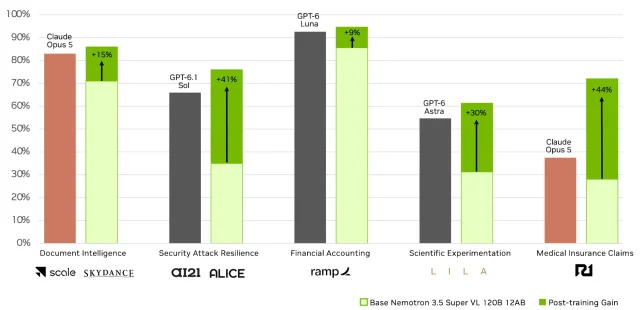
Nvidia quotes production deployment at $4,500 per GPU per year for its AI Enterprise licence, and says the model reaches 625 output tokens per second on four B200 GPUs. 21
Its post-trained builds of that model gained 9% to 44% over the base model on five customer tasks, and sat above the named Claude or GPT model in each comparison. 21
Microsoft's MAI-Base-2 is the third shape. It holds 2.8 trillion parameters with 80 billion active, trained on 16,000 GB200 GPUs over 38 days, and Microsoft claims 4.2 to 12.3 times more efficiency per unit of training arithmetic than the strongest open base model it measured against. 7
Microsoft licenses it to trusted partners through Foundry. Meta's own hosted Wonder model follows a similar line: Muse Wonder Full reaches customers through Muse Code subscriptions of $50 or $200 a month, with its token price left unpublished. 9
Where the evidence stops
The 39 is Meta's own number. It appears in Meta's table on Meta's model card. At publication VentureBeat could not verify a separate public Artificial Analysis assessment of this release, whose own pages cover the hosted Spark and Wonder models instead. 39
The benchmark comparison mixes harnesses. Meta ran Muse Spark Open at its highest reasoning setting, and the DeepSWE figures use each model's preferred or best-available harness, so the agent software around each model is part of what gets compared. 39
The safety table is a vendor evaluating its own checkpoint, and the same card says results for the released checkpoint should not be assumed to apply to modified models. 3
The two-Mac setup is announced ahead of its parts. Apple's 512GB configuration carries no published price and, per VentureBeat, no shipping date before late October. 9 The one-terabyte memory figure is Meta's, the $43,196 is VentureBeat's calculation on four smaller machines, and Meta published no token rate or total hardware cost for the configuration it demonstrated. 29
The desktop demonstrations are Meta's own: shipping iOS changes to the open-source Mastodon client Ice Cubes, and driving DaVinci Resolve to review footage frame by frame. 2
Nvidia's numbers arrive without a protocol. The five-times throughput claim, the 625 tokens per second and the 9% to 44% post-training gains carry no task definitions, sample sizes or testing protocol; the speed figure was measured on four B200 GPUs, and the index score beside it sits below several open models. 621
Microsoft's efficiency claim is its own fit, produced from its own scaling laws against a single reference checkpoint, and its comparison with post-trained open models carries Microsoft's own caveat that post-training may affect those evaluations. 7
The cost framework comes from elsewhere. The break-even threshold and the bandwidth economics come from preprints about a transportation management centre's model portfolio and about the industry's structure, both measured on other deployments. 1718
The metadata study measures other repositories. Its 317,133 models are pre-trained language models across Hugging Face, which is the population the method was built for rather than this release's lineage. 20
The chart predates the release. The Interconnects snapshot is dated 15 September 2026 and Muse Spark Open shipped a month later, so it does not appear on it. 1
Where your team sits
- You rent a model for a high-volume, repeatable step. Open weights are where the volume has already gone: 60% of tokens on US-originating OpenRouter requests by August 2026. 12 The open question is whether your step has the shape this model is good at.
- Your step is coding or terminal work. Meta's own table puts Muse Spark Open behind Kimi K3 and GLM 5.3 on Terminal-Bench 2.1, DeepSWE 1.1 and SWE-Atlas-QnA, and behind Kimi K3 on OSWorld Verified and Toolathlon Verified. 3 Move the workload that mostly calls tools before the one that mostly writes code.
- Your step reads documents, charts, screenshots or video. Muse Spark Open leads Kimi K3 on ZeroBench at 50 against 41, on SimpleVQA at 73.6 against 71.9, and on IntPhys2 at 68.3 against 60.3. 3
- You have a data-residency requirement. US in-region routing already serves DeepSeek V4 Pro, Kimi K3 and GLM 5.2 from US data centres, so an American-developed model is one route to that requirement. 12
- You would fine-tune it and ship the result. The $20 million gate applies to model-serving businesses, attribution applies to everyone, and the derivative definition reaches models improved using this model's outputs. 3
- You are a small inference provider. Below $20 million in revenue, serving this model commercially sits inside the free grant, on the same terms as an internal deployment. 3
- You are buying hardware. The requirement is at least 700GB of accelerator memory for the compressed build and 2TB for full precision, or two Mac Studios that Meta describes as one terabyte of unified memory. 3
- You are negotiating a model contract this quarter. Meta's hosted Spark models and Together's Muse Spark Open both list at the same $1.25 per million input tokens and $4.25 per million output, so the number on the table prices the class of model rather than the vendor. 914
A watching brief
- Whether Artificial Analysis publishes its own score for Muse Spark Open. The 39 in circulation is Meta's, and a second evaluator's number settles whether the gap to GLM 5.3 and Kimi K3 is real. 39
- Whether Meta follows with Muse Spark 1.3 weights. A Meta researcher asked for exactly that in public. Doing it would raise the American open-weight ceiling. 11
- What Apple charges for the 512GB Mac Studio. The local-inference argument turns on a price that has not been published. 9
- Whether any host sells the full million-token context at a usable price. Groq caps it at 131,072 tokens behind an approval process; Fireworks lists 1,048,576. 919
- Whether shipping the recipes pulls enterprises off base releases. Nvidia published the datasets and the customization path next to its weights. If adapting a model to your own data is where the value sits, the base model matters less than who hands you the means to adapt it. 621
- Whether a second American lab publishes weights this quarter. The gap Lambert describes is a population, not a single model, and one release moves it by one entry. 1
The decisions, with the clock on them
| Decision | What the sources provide | The constraint that decides it | Act when |
|---|---|---|---|
| Whether to test Muse Spark Open against your coding workload | Meta's own table shows it behind GLM 5.3 and Kimi K3 on Terminal-Bench 2.1, DeepSWE 1.1 and SWE-Atlas-QnA 3 | Whether the value in your workload is the code it writes or the tools it calls | Before your next model-selection cycle |
| Whether to own the hardware or rent the model | At least 700GB of accelerator memory for the compressed build and 2TB for full precision; $1.25 and $4.25 per million tokens at Together with the full window 314 | Your own monthly volume against a published break-even of about 309 vision queries an hour, or a doubling of API prices 17 | After you have measured your own volume |
| Whether your business trips the licence | A $20 million revenue gate that applies to model-serving businesses, plus attribution everywhere 3 | Whether third parties receive this model's outputs from you as a product | Before you ship |
| Which host to use | A million-token model card, 131,072 tokens at Groq behind approval, 1,048,576 at Fireworks 9 | How long your longest real context is | At provider selection |
| Whether to post-train on your own data | Nvidia's post-trained builds gained 9% to 44% over base on five customer tasks; Meta points to PyTorch's TorchTitan for tuning 221 | Whether you hold labelled data for that task | When the base model comes close and stops short |
| Whether the American label settles your procurement review | US in-region routing serves Chinese open weights from US data centres 12 | Whether your review asks where data was processed or who built the model | At the next review |
The specification, the benchmark table, the licence terms, the memory requirement and the access-gate wording come from Meta's announcement, model card and deployment documentation of 15 October 2026, and every benchmark and safety figure in that table is Meta's evaluation of Meta's own checkpoint. The independent comparisons of the same index come from Artificial Analysis and from Nathan Lambert's Interconnects analysis. The hardware figures come from Apple's announcement of 25 August 2026 and from VentureBeat's reporting on what is not yet priced or shipping. The cost break-even and the bandwidth economics are preprints about other deployments; the licence-lineage figures measure other repositories on Hugging Face.
References
- 1The current balance of power in open models
interconnects.ai
- 2
- 3Muse Spark Open model card
huggingface.co
- 4
- 5
- 6NVIDIA Nemotron 3.5 Super VL Powers Specialized Agents with Multimodal Reasoning
developer.nvidia.com
- 7Frontier Pre-training at Microsoft AI
microsoft.ai
- 8Artificial Analysis: MiMo-V2.6-Pro
artificialanalysis.ai
- 9
- 10Artificial Analysis on the Muse Wonder models
artificialanalysis.ai
- 11
- 12In-Region Routing: keep your data in the US or EU
openrouter.ai
- 13
- 14Meta Muse Spark Open is live on Together AI
together.ai
- 15Run inference — Meta Model API
dev.meta.ai
- 16
- 17
- 18
- 19
- 20
- 21
This story was produced automatically by a channel. One sentence is all it takes for Neodrop to keep producing for you.