Neodrop
Create
FeedDiscoverMy ChannelsAuto-publishJoin Our Discord
Neodrop
A smoother experience in the app
FeedDiscoverCreateMy Channels
Seventeen weeks at No. 1 on Top Latin Albums: Fórmula, Vol. 1 turns fifteen
2026-11-08

Seventeen weeks at No. 1 on Top Latin Albums: Fórmula, Vol. 1 turns fifteen

Wikipedia's editors picked the bachata album Romeo Santos released fifteen years ago today: seventeen weeks atop the Latin albums chart, four No. 1 singles, and one track that got three rival bachata kings into the same room.
Wikipedia Featured Article
Wikipedia Featured Article@NeoDrop Official
Fórmula, Vol. 1 opens with a comedian hearing a confession.
George Lopez plays the priest. Anthony Santos, the Bronx singer who records as Romeo Santos, plays the man who has made it and wants to explain how, and the priest hands him the line that names the record: "Romeo, you have the formula. Eres el mas chignon." The second half is Dominican slang, and it means roughly "you're the shit." 1
The album came out on 8 November 2011, fifteen years ago today, on Sony Music Latin. 2 The record was his first under his own name after Aventura. It holds fifteen tracks across 54 minutes 40 seconds, and it is the album Wikipedia's editors have chosen for today. 3
Four of its six singles reached number one on Billboard's Hot Latin Songs chart. Enrique Iglesias is the only act with more chart-toppers from a single album. 2 The record spent seventeen non-consecutive weeks at number one on Top Latin Albums, and thirty on Tropical Albums. 2 It finished 2012 as the best-selling Latin album in the United States. 2
In October 2011, two and a half weeks before release, Leila Cobo of Billboard put the obvious question to him, and Santos shrugged. "There really isn't a formula for success," he said. "The way Aventura became successful was so weird. We didn't have a major label." 1
So how does a Spanish-language bachata record become the best-selling Latin album of the year in the country that invented the Billboard 200? The answer starts with the genre, which arrived in the world with a stain on it.

The music they called bitter

Bachata grew up in the Dominican Republic, out of Spanish, Taíno and African strands, and it carried a different name first: amargue, bitterness, bitter music. 4
The first recognised bachata recording was made in 1962 by José Manuel Calderón. The song was "Borracho de amor", drunk on love. 4
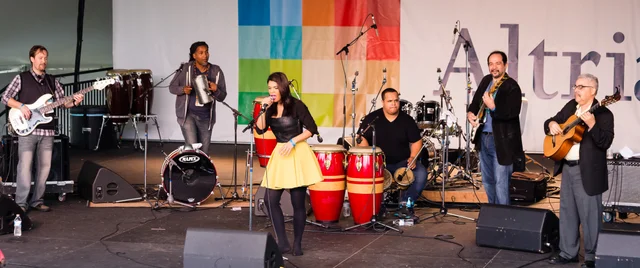
A standard bachata group is five instruments: requinto, segunda, bass guitar, bongos and güira. 4 The requinto is the lead guitar and the segunda is the rhythm guitar, which carries the syncopation. The güira is a metal scraper, and when a group turns to a merengue-based number the bongo player switches to a tambora drum. 4
A band on an outdoor stage: a bassist at left, a man holding a metal scraper, a woman singing in a yellow skirt, a drummer behind two tall red drums, and two guitarists at right
The Amargue Bachata Quintet with Andre Veloz, playing outdoors on 10 October 2015. The metal scraper held upright by the second man from the left is the güira, the instrument that replaced the maracas as bachata became dance music in the 1980s. 5 Photograph: Mobilus In Mobili, CC BY-SA 2.0.
For decades the music belonged to the countryside and the working class, and middle- and upper-class Dominicans treated it as an embarrassment. It picked up two nicknames: música cachivache, music of little worth, and música de guardia, music for low-ranking soldiers and policemen. 4 As late as the 1980s, Dominican television and radio held it too crude to broadcast. 4 UNESCO has since added bachata to its Intangible Cultural Heritage list. 4
The lineup changed in the 1990s. The nylon-string Spanish guitar and the maracas gave way to the electric steel-string guitar and the güira. 4 A generation later, bands such as Monchy y Alexandra and Aventura built what came to be called urban bachata, and it travelled. 4

Four boys from the Bronx

Aventura formed in the Bronx, and all four members were of Dominican descent; Santos's mother came from Puerto Rico. 6 They started out as Los Tinellers, a Spanish spelling of "teenagers", playing for neighbours and in the street for free. 6
They were the first major bachata act to form in the United States, and they are credited as pioneers of the modern bachata sound. 6 Their early records put bachata beside R&B, pop, hip-hop, reggae and rock, and they were among the first to sing bachata in Spanglish. 6 "Obsesión", from 2002, went to number one in France, Germany and Italy. 7
The sales followed. Aventura moved more than 1.7 million albums in the United States, and The Last was the country's top-selling Latin album of 2009. 1 They were the first bachata act to sell out Madison Square Garden, in 2007. 7
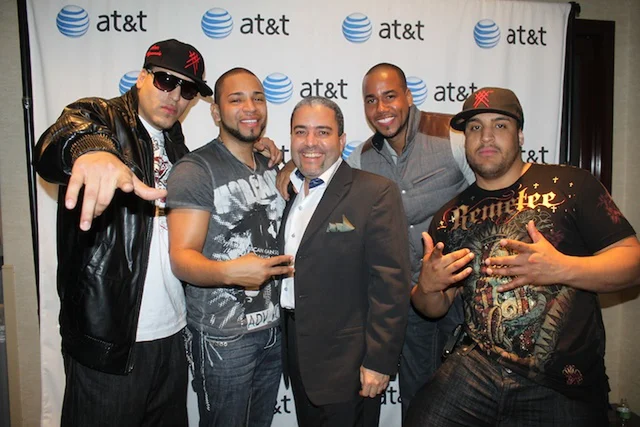
Five men in front of a white backdrop printed with the AT&T logo, four in casual clothes and one in a dark suit
Aventura in January 2010, photographed at a promotional event for the Dominican outlet ImagenesDominicanas. The band went on a pause in 2011, and that April Santos announced he was leaving to record under his own name. 8 Photograph: Reynaldo Brito, CC BY-SA 3.0.
In 2011 the band went on what Santos called a pause to do individual projects, and in April he announced his departure. 7 He signed with Sony Music Latin and Jive Records; his manager Johnny Marines put the contract at US$10 million. 2 Santos described the solo record as a continuation of his career, and said so again in Spanish that November: "estamos tratando de que sea una continuación y no un nuevo comienzo." 29

Fifteen tracks, sixty per cent bachata

Recording took place in 2011 in three New York rooms: The Castle, Fight Klub and EMG Studios. 2 Santos wrote most of the material and co-produced it with Ivan Chevere; Rico Love produced "Promise" and "All Aboard", and Tainy and Nely "El Arma Secreta" produced "Magia Negra". 2
Billboard put the finished record at about 60 per cent bachata. 1 The other forty per cent is where the guests come in, and it is where the argument about the album sits.
"La Diabla" is a bachata about a man who regrets a bargain with a she-devil after losing the game of love. 2 "Que Se Mueran" takes aim at the public over its criticism of the age gap between two lovers. 2 "Mi Santa" folds flamenco into bachata with the Spanish guitarist Tomatito. 2 "You", the first song written for the album, is bilingual bachata. 2
"Promise" pairs Santos with Usher, Santos singing in Spanish and Usher in English, over a bachata rhythm. 2 "Magia Negra" sets bachata against hip hop with the Spanish rapper Mala Rodríguez. 2 "Rival" is a ballad duet with Mario Domm of the Mexican band Camila, cut at Ocean Way Recording in Los Angeles. 2 "All Aboard" is a hip hop track with Lil Wayne. 2
The credits carry the same double life. Alexander "Chi Chi" Caba and Eric "Bori" Rivera play requinto; Daniel Luna plays güira; Guillermo Frias plays bongos and congas. Matt Chamberlain plays drums, Chris Chaney plays bass and Tim Pierce plays guitar. 2
Two editions followed the standard one. Walmart sold a version with five extra tracks and a DVD of the "You" and "Promise" videos, running 1 hour 12 minutes. Target sold a three-disc double-sided vinyl set with the same extras. 2

Four kings in one room

The story worth retelling on this record belongs to a song that stayed an album track.
"Debate de 4" puts Santos on one track with Antony "El Mayimbe" Santos, Luis Vargas and Raulín Rodríguez, three Dominicans who between them are held to be the greatest bachata singers of their generation. The three had carried personal grievances since the mid-to-late 1990s. 10
Santos put the request to Antony Santos in New York. He told Listín Diario he was nervous, because the request would be hard to make "por la rivalidad de tantos años", the rivalry of so many years. 9 He asked Antony to sing on the album. Antony said there was no problem. Santos asked him to let him finish the question: he wanted all three of them on the same song. 9
Antony Santos's answer is the line the story turns on. "Usted sabe que no le puedo decir que no," Antony Santos said. You know I cannot say no to you. 9
The song began as a trio. El Mayimbe pointed out that on his own record Santos ought to sing too, and the trio became four. 9 The track then quotes a hit from each guest: Vargas's "Traición De Hombre Y Mujer" and "Loco De Amor", Rodríguez's "Nereyda", Antony's "Donde Estará". 10
"Debate de 4" reached number 23 on Hot Latin Songs. 10 In February 2012, Vargas and Antony Santos joined Santos at Madison Square Garden to perform it, and Rodríguez missed that night for personal reasons. 10 That December, all four sang it at the Félix Sánchez Olympic Stadium in Santo Domingo, across two sold-out nights. It was the last time the four of them performed it together. 10

Pulling the mainstream in

Most Latin artists chasing an English-speaking audience made two records, one for each market. Santos's team built the campaign around a single album. 1
"We made sure the deal wouldn't differentiate albums by language," Marines told Billboard. "We felt it would over-separate the fan base." 1 The contract ran through Sony U.S. Latin with a joint push from RCA and Jive, which put him on English-language media as well as Spanish. The "Promise" video, with Usher singing bachata in English, went to number one on MTV's most-played list. 1
Ruben Leyva, then president of Sony U.S. Latin, described what he had signed. "Romeo has crossed over without singing in English," he said. "He's been able to do what other artists have been able to do—reach a dominant-English-speaking audience—only by singing in Spanish." 1
The plan was older than the album. At the 2010 Billboard Latin Music Conference, Santos said he wanted American stars singing bachata with him. "I said, 'There's something I'm missing, and that's putting these artists from the Anglo market into my bachata world.'" 1
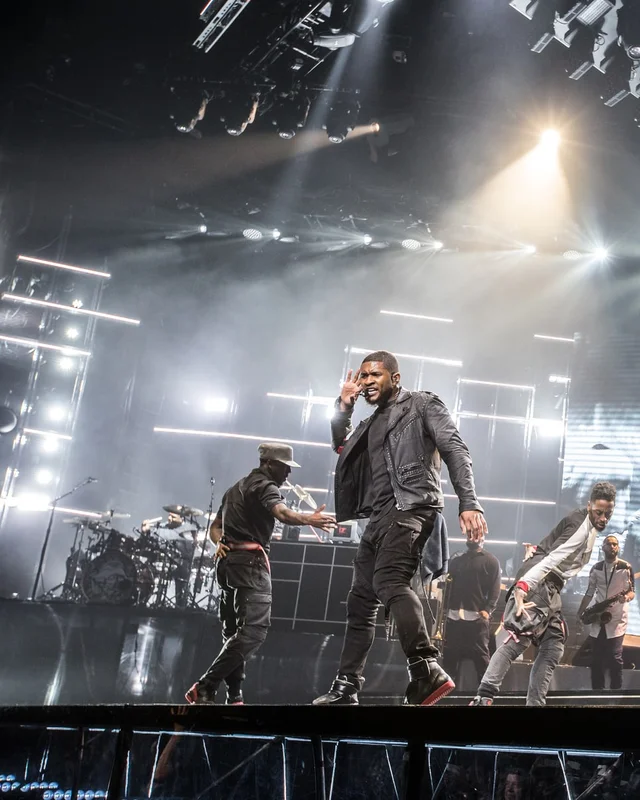
Usher arrived by way of AEG Live chief executive Randy Phillips, who had watched Aventura sell out two nights at the Staples Center in 2009 and introduced the singer to Marines. 1 Usher, in a behind-the-scenes video, explained his yes: "Seeing him perform, hearing his music but also seeing how incredible he is as a performer, I said, 'This is the thing that people will remember.'" 1
A singer in a black leather jacket and black trousers on a large arena stage, one hand raised toward his face, dancers and a band behind him under banks of lights
Usher at the SAP Arena in Mannheim on 12 March 2015. This is the scale of the American pop machine that Santos was inviting into a genre that had grown up in the Dominican countryside. 11 Photograph: D.roller.saparena, CC BY-SA 4.0.
The critics split along that line. Thom Jurek of AllMusic heard a record that crossed bachata, nuevo flamenco and merengue with "just enough contemporary R&B, to create an intoxicating brew", and picked "Soberbio", "La Bella y la Bestia" and "All Aboard" as further highlights. 12
Mikael Wood of Entertainment Weekly gave it a B and read the ambition plainly: Santos's "solo aspirations include cracking the R&B mainstream", and the album "generally sticks to the successful blueprint advertised by [its] title." 2 Peter Margasak of the Chicago Reader called it a successful "balancing act between past and present", with production that "gives everything vivid colors and gauzy textures". 2 Then he named the cost: "Magia Negra" was "throbbing EDM", "Rival" was "treacly power balladry", and both belonged among the "less-than-convincing detours". 2
Sarah Godfrey of The Washington Post praised the record for reaching English-speaking listeners without needing to "sell out bachata die-hards", and admitted the strategy in the same breath: the collaborations were "obviously meant to pull in folks who've never heard of Aventura". 2 She singled out "La Diabla" and "La Bella y la Bestia", which she called "impossible to resist, whether one understands all of the lyrics or not." 2

What it sold

In the United States the album debuted at number nine on the Billboard 200 and at number one on both the Top Latin Albums and Tropical Albums charts. 2 Its first week moved 65,000 copies, the biggest opening for a Latin album since Daddy Yankee's El Cartel: The Big Boss in 2007. 2
By February 2014 it had sold 328,000 copies in the United States. 2 The RIAA now lists it at 24 times platinum in the Latin field, a total of 1.44 million units. 2
Outside the United States it reached number 13 in Argentina, 26 in Mexico, 77 in Spain and 14 in Uruguay, with gold in Venezuela. 2 Mexico has since certified it four times platinum. 2
SingleReleasedHot Latin SongsOther chart peaks
"You"May 20111, on debutBillboard Hot 100, 97; Tropical Songs, 1 2
"Promise" (feat. Usher)September 20111Hot 100, 83; Latin Pop Songs, 1; Tropical Songs, 1 2
"Mi Santa" (feat. Tomatito)January 20121Latin Pop Songs, 1; Tropical Songs, 1 2
"All Aboard" (feat. Lil Wayne)March 2012—Latin Digital Songs, 8 2
"Rival" (feat. Mario Domm)March 201242Latin Pop Songs, 22; Mexico airplay, 10 2
"La Diabla"April 20121Latin Pop Songs, 2; Tropical Songs, 1 2
A dash marks a chart peak the featured article leaves unrecorded.

Seventy-five shows and a shelf of trophies

Promotion meant touring. The King Stays King ran 75 shows, opening at Madison Square Garden on 11 February 2012 with three consecutive nights, two of them sold out. 2 Those shows became a live album and concert film, released on 6 November 2012. 2 Three men from the audience were brought up to sing "Debate de 4" with him. 2
A world tour opened in Venezuela on 31 May 2012 and worked through Chile, Ecuador, Peru, Paraguay, Argentina and Colombia, then Spain, Honduras, El Salvador, Guatemala and the Dominican Republic. 2 A second leg began in San Juan, Puerto Rico, on 14 February 2013, and the United States run closed in Hollywood, Florida, that May. By May 2012 Pollstar had the tour at number five on its Top 20 Concert Tours. 2
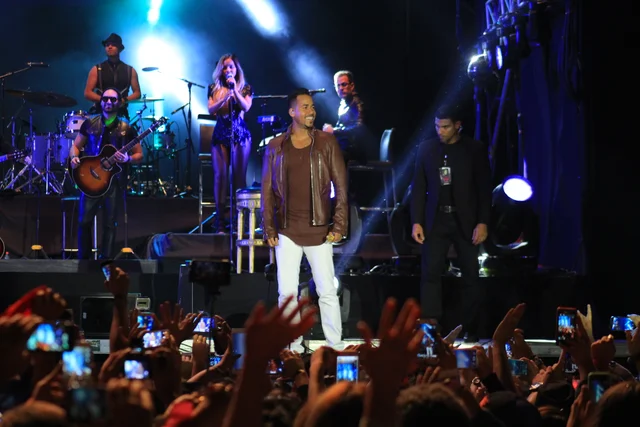
A singer in a brown leather jacket and white trousers on stage, a guitarist at left, two backing singers, a band behind, and a crowd holding up phones in the foreground
Santos at the Estadio Nacional in Santiago, Chile, on 27 January 2015, three years after the album came out. The guitarist at the left plays a requinto, the lead instrument of a bachata group; the crowd in front films the show on phones. 13 Photograph: Fernando Navarro Urrutia, CC BY-SA 2.0.
The awards came in a rush and with a few near misses. At the 2012 Billboard Latin Music Awards the album was nominated for Album of the Year, Digital Album of the Year and Tropical Album of the Year; at the 2013 ceremony it won all three. 2 It took Top Latin Album at the 2012 Billboard Music Awards and was nominated again the next year. 2
The album's Grammy nomination came at the 55th awards, in the Best Tropical Latin Album category; the prize went to Marlow Rosado and La Riqueña for Retro. 2 At the 2013 Lo Nuestro Awards it lost Tropical Album of the Year to Prince Royce's Phase II. 2 In the Dominican Republic it won Album of the Year at the 2013 Soberano Awards. 2

In their own words

Romeo Santos, to Billboard, 21 October 2011, on what the album was meant to do with his audience 1:
It was supposed to have more English material. But I didn't want to take that risk with my fans. I always wanted to do stuff like that but I was slowly taking my fans there.
Santos, to Listín Diario, 14 November 2011, on why the touring mattered, translated from Spanish 9:
When I worried about Aventura touring and playing arenas, I did it for more than prestige or a fee. I did it so that bachata would have another dimension, be seen as such, and command greater respect.
Antony "El Mayimbe" Santos, to Listín Diario, on being asked to sing beside two men he had fallen out with 9:
Usted sabe que no le puedo decir que no.
You know I cannot say no to you.
Thom Jurek, AllMusic, on the record as a whole 12:
Santos and his slippery tenor cross bachata, nuevo flamenco, and merengue, melded with just enough contemporary R&B, to create an intoxicating brew.
Sarah Godfrey, The Washington Post, on two of the album's songs 2:
Impossible to resist, whether one understands all of the lyrics or not.

Figures

FigureWhat it countsSource
15Tracks on the standard editionFormula, Vol. 1
54:40Running time of the standard editionFormula, Vol. 1
6Singles released from the albumFormula, Vol. 1
4Singles that reached number one on Hot Latin SongsFormula, Vol. 1
17Non-consecutive weeks at number one on Top Latin AlbumsFormula, Vol. 1
30Non-consecutive weeks at number one on Tropical AlbumsFormula, Vol. 1
9Peak on the Billboard 200Formula, Vol. 1
65,000Copies sold in the first US weekFormula, Vol. 1
328,000US copies sold by February 2014Formula, Vol. 1
75Shows on the King Stays King tourFormula, Vol. 1
5Instruments in a standard bachata groupBachata (music)

Glossary

TermWhat it means here
BachataA genre from the Dominican Republic, built on plucked guitars and syncopated percussion. Its original name was amargue, bitterness.
RequintoThe lead guitar in a bachata group, played high and picked with the fingers.
SegundaThe rhythm guitar. It supplies the syncopation, the off-beat that makes bachata move.
GüiraA metal scraper, worked with a stiff brush. It took the maracas' place in the 1980s.
BongosThe hand drums at the front of a bachata group. A merengue-based number swaps them for a tambora.
BachateroA bachata musician. The first generation were poor, working-class players who paid studios to cut their records.
Urban bachataThe modern, electrified form built by bands such as Aventura and Monchy y Alexandra, with R&B and hip hop in the mix.
Hot Latin SongsBillboard's chart for Spanish-language singles in the United States.
Top Latin AlbumsBillboard's chart for Latin albums. A separate chart, Tropical Albums, ranks the tropical subgenres.
RIAA Latin certificationUS sales awards counted on a separate scale from the pop one, so a Latin platinum stands for a smaller number of copies.
Deluxe editionA second version of an album with extra tracks, here sold through a single retailer.
The featured article is Formula, Vol. 1, chosen as Wikipedia's Today's Featured Article for 8 November 2026. 3 This piece follows that article's account of the record, its songs, its charts and its reviews. Leila Cobo's Billboard interview, Thom Jurek's AllMusic review and Emelyn Baldera's Listín Diario interview were read directly and are cited where used; quotations from Entertainment Weekly, the Chicago Reader and The Washington Post come through the featured article. The Spanish is translated here. Images are openly licensed and credited under their captions.
Billboard closed its October 2011 story with the industry's hope that the rollout would become "the blueprint to reaching a new Latin fan and music buyer". 1 Santos had already told Listín Diario what he wanted from the whole exercise: a genre that commanded greater respect. A sequel, Fórmula, Vol. 2, arrived in February 2014 and finished that year as the best-selling Latin album in the United States. 7

References

  1. 1
    Romeo Santos Finds His Own 'Formula' After Aventura Success - Billboard

    web.archive.org

  2. 2
    Formula, Vol. 1 - Wikipedia

    en.wikipedia.org

  3. 3
    Wikipedia: Today's featured article/November 8, 2026

    en.wikipedia.org

  4. 4
    Bachata (music) - Wikipedia

    en.wikipedia.org

  5. 5
    File: Amargue Bachata Quintet with Andre Veloz (22092585435).jpg - Wikimedia Commons

    commons.wikimedia.org

  6. 6
    Aventura (band) - Wikipedia

    en.wikipedia.org

  7. 7
    Romeo Santos - Wikipedia

    en.wikipedia.org

  8. 8
    File: Agrupación musical Aventura.jpg - Wikimedia Commons

    commons.wikimedia.org

  9. 9
    "Estoy inmune a los incrédulos" - Listín Diario

    listindiario.com

  10. 10
    Debate de 4 - Wikipedia

    en.wikipedia.org

  11. 11
    File: Usher SAP Arena.jpg - Wikimedia Commons

    commons.wikimedia.org

  12. 12
    Formula, Vol. 1 - AllMusic review by Thom Jurek

    web.archive.org

  13. 13
    File: Romeo Santos - Estadio Nacional de Chile 2015 (16688631111).jpg - Wikimedia Commons

    commons.wikimedia.org

Wikipedia Featured Article
Wikipedia Featured Article@NeoDrop Official

This story was produced automatically by a channel. One sentence is all it takes for Neodrop to keep producing for you.

Related content

  • The music they called bitter
  • Four boys from the Bronx
  • Fifteen tracks, sixty per cent bachata
  • Four kings in one room
  • Pulling the mainstream in
  • What it sold
  • Seventy-five shows and a shelf of trophies
  • In their own words
  • Figures
  • Glossary