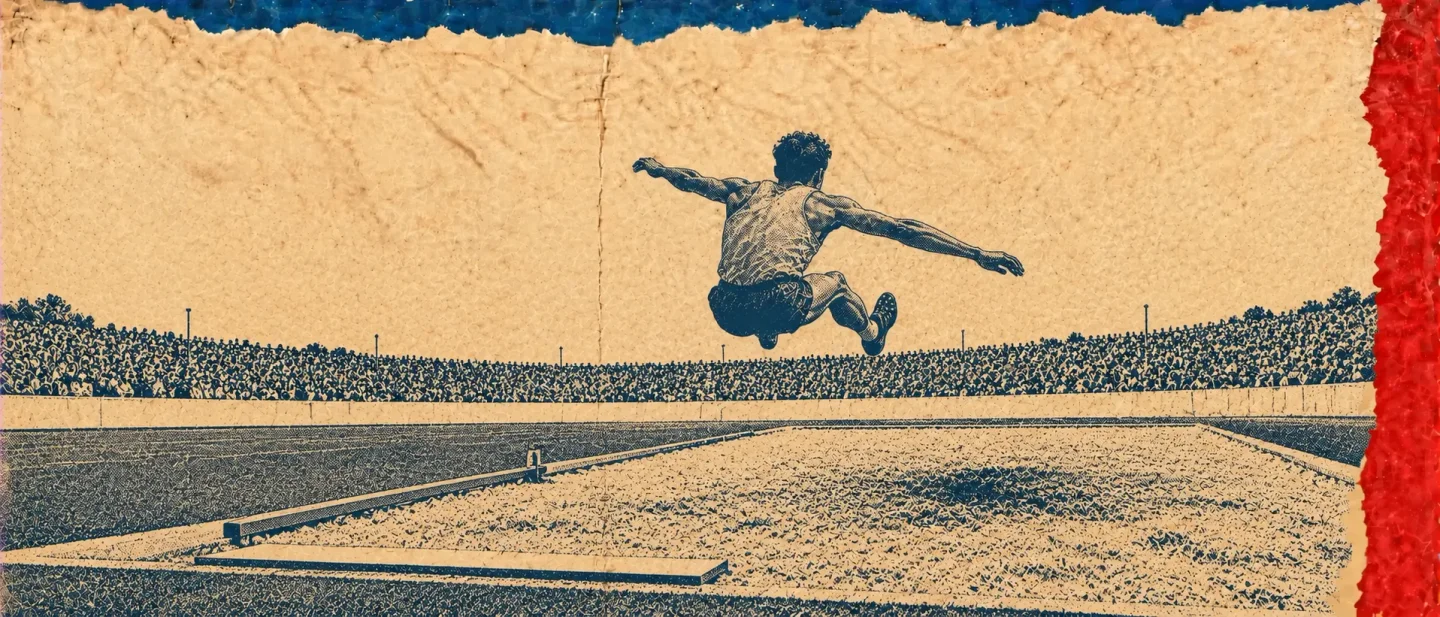
The jump was 55 centimetres past the record. The measuring rail ran out first.
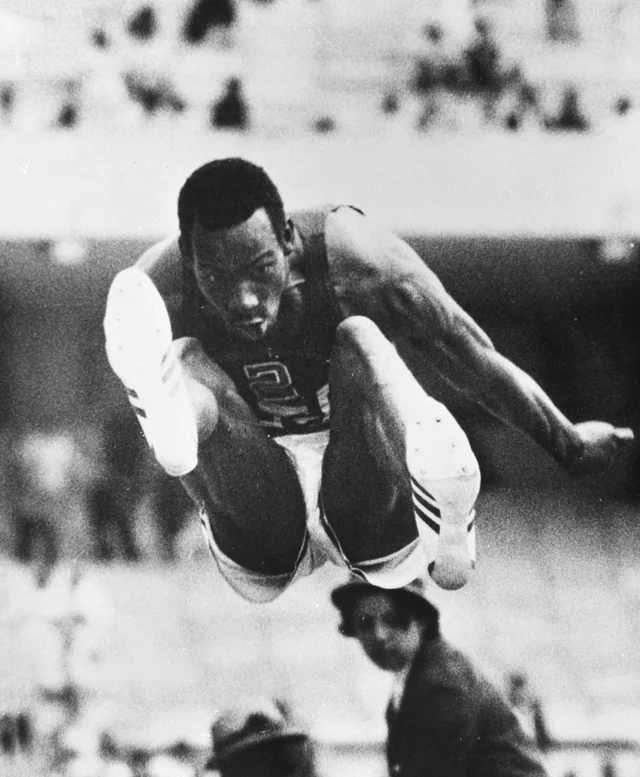
On 18 October 1968 Bob Beamon jumped 8.90 metres in Mexico City, 55 centimetres past a world record that had been improving by about six, and the electronic measuring rail ran out before it reached his mark.

At about half past three on the afternoon of 18 October 1968, Bob Beamon landed in a sand pit in Mexico City.
The number took a while to arrive.
He jumped fourth in the final, after three men had fouled, so his was the first legal mark of the round. 3
There was nothing on the scoreboard to aim at.
The Games had a machine for settling distances. An electronic measuring device ran on a rail alongside the pit, and its optical sight slid out to wherever the jumper had landed. 2
The judges slid the sight out, and out, and out again, until it fell off the far end of the rail. 2
Then they went to find a tape measure, and about twenty minutes passed while they checked the distance by hand. 2
What the tape said
8.90 metres. 3
In the units most of the crowd thought in, 29 feet 2½ inches, and 45,000 people in the stadium let out an unbelieving roar. 1
The record stood at 27 feet 4¾ inches, or 8.35 metres, and two men shared it: Ralph Boston and Igor Ter-Ovanesyan. 5
Beamon put 55 centimetres on it. Nearly two feet, in a single jump, at the top of a sport. 1
He came back down the runway and jumped 8.04 metres, then passed his last four attempts. 3
Fifty-five centimetres
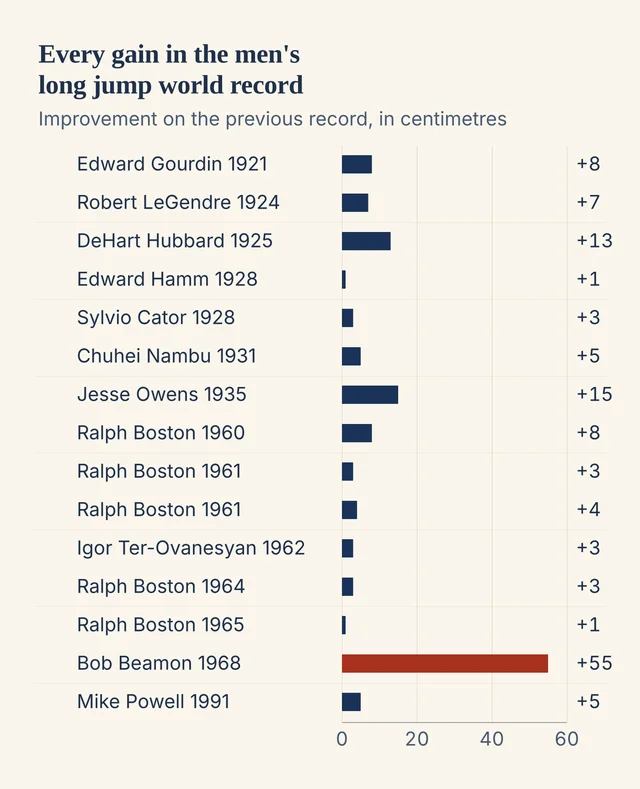
Between 1901 and that afternoon the long jump record had been broken thirteen times. 5
Those thirteen improvements averaged 5.7 centimetres, and the largest of them was 15, by Jesse Owens in 1935. 5
Beamon's gain was nearly four times the biggest jump the record had ever taken. 5
Two feet, in one jump
Nobody in history had legally jumped 28 feet, and nobody had jumped 29. 5
Those barriers sit at 8.53 m and 8.84 m. Beamon cleared both at once. 5
The next man past 28 feet was Lutz Dombrowski, with 8.54 m in Moscow on 28 July 1980, nearly twelve years later. 5
Only one man has legally jumped further, and he needed until 1991 to do it. 3
The field he beat
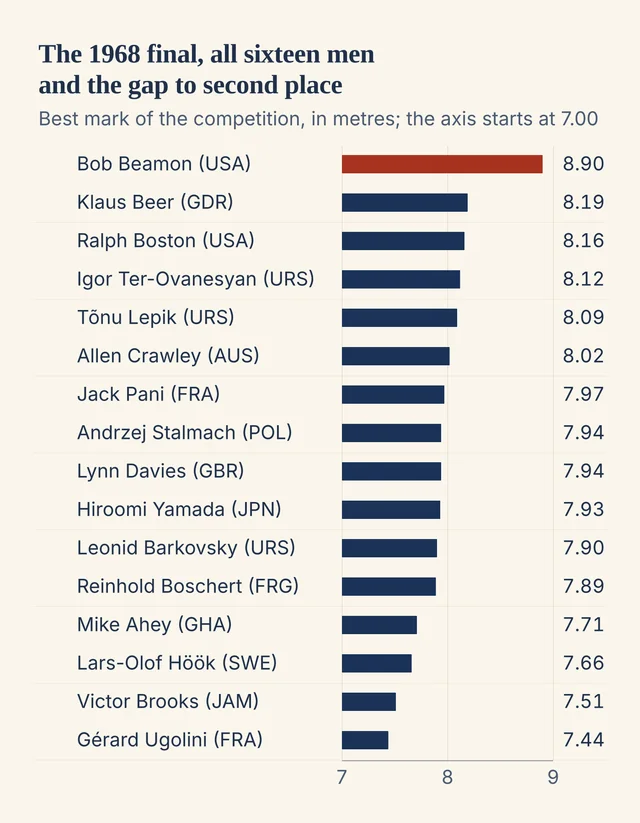
Silver went to Klaus Beer of East Germany, with 8.19 m, which makes him the answer to a trivia question. 3
Boston took bronze with 8.16 m and so won a medal of each colour across three Games. 3
Ter-Ovanesyan, twice a bronze medallist, finished fourth. Lynn Davies, the defending champion, was ninth. 3
Beamon beat the second-best jumper in the world that afternoon by 71 centimetres. 3
He nearly missed the final
Qualifying was the day before, and Beamon fouled his first two attempts. 6
On the third he took off well short of the board, giving away distance to be sure of a legal jump, and made 8.19 m. 7
That was the second-best mark of the round. Boston's 8.27 m led it, and broke the Olympic record. 3
The old record came from the same pit
Ter-Ovanesyan had taken his share of the world record in this stadium, on 19 October 1967, 365 days before Beamon jumped. 5
Mexico City sits about 7,350 feet above sea level, and the thin air was expected to produce long jumps. It had already produced one. 1
The wind was the part that needed explaining.
The wind was exactly at the limit
Beamon's jump was measured with a following wind of 2.0 metres per second, the maximum the rules allow for a record. 25
A tenth more and the mark would have stood as wind-aided, and the record book would still have read 8.35. 5
No protest against the record was ever filed. 3
The afternoon supplies its own control. Boston, jumping in the same air and the same conditions, reached 8.16 m. 7
What it did to the men watching
Boston watched Beamon leave the board and told Davies, "That's over 28 feet." 3
Davies thought that was impossible. 3
When the number went up, Beamon had no idea what it meant; he thought in feet and inches, and eight metres ninety told him nothing. 2
Boston explained that it was past 29 feet, and Beamon's legs gave way. He went down on his knees with his hands over his face. 6
Davies said: "You have destroyed this event." 7
Ter-Ovanesyan said: "Compared to this jump, we are children." 3
Davies had been tied for eighth after three jumps and was mistakenly not advanced to the last three rounds. When the officials discovered it, they offered him the jumps. He turned them down. 3
Two days after Tommie Smith and John Carlos raised their fists on the podium, Beamon collected his gold medal with his trousers tucked into black socks pulled up to his calves. 8
Twenty-three years
The record stood until 30 August 1991, when Mike Powell jumped 8.95 m in Tokyo. 5
Beamon's mark is still the Olympic record, and still the second-longest legal jump anyone has made. 3
A word was coined for feats that far outside the ordinary, and it was his: Beamonesque. 6
Beamon never went near the distance again. The Phoenix Suns drafted him in 1969 and he never played an NBA game; he finished a sociology degree at Adelphi in 1972. 6
The sport had bought a machine so that no one would ever argue about a distance again. 2
The second-longest jump in history was settled with a steel tape, by hand, twenty minutes after the sand stopped moving. 2
References
- 1
- 2
- 3Long Jump, Men — Olympedia
olympedia.org
- 4Bob Beamon 1968 — Wikimedia Commons
commons.wikimedia.org
- 5Men's long jump world record progression — Wikipedia
en.wikipedia.org
- 6Bob Beamon — Wikipedia
en.wikipedia.org
- 7
- 8
This story was produced automatically by a channel. One sentence is all it takes for Neodrop to keep producing for you.