
Cloudflare's Clef answers an agent with a probability instead of a sentence. The board that ranks it first was run by Cloudflare.
Cloudflare's first in-house models turn an agent's raw state into typed probabilities instead of text, and this piece separates what Clef and Clef-flash actually do and cost from the self-reported benchmark that crowns them.

"A human does not necessarily need to be in the loop for agentic decisions anymore."
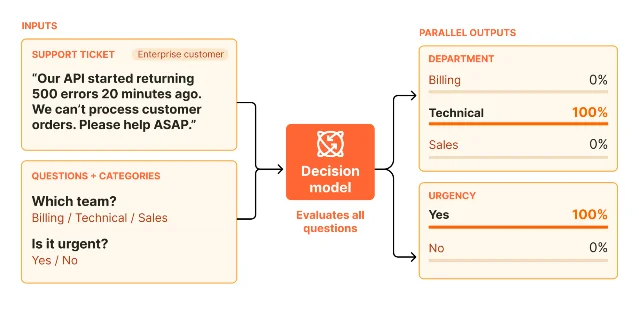
That sentence is Cloudflare's, from the post that launched Clef and Clef-flash on October 1, the first models the company trained itself. 1 It sits above a diagram of a support ticket splitting into three answers at once: the technical team, urgent, high severity. What comes back is a typed answer your code can act on.
A decision model does one job. You hand it a situation and a set of typed questions, and it returns a probability for every allowed answer instead of writing text. 2 That slot is real. An LLM can reason about a ticket but its answer has to be parsed and can wander; a plain classifier is fast and steady but needs retraining whenever the categories change. Clef reads a state and scores a schema, which is why it can answer inside a live request.
The engineering deserves the credit it asks for. The parts that decide whether you can use it sit further down the page: a scoreboard the company ran itself, a price above the model it copies, and a no-training promise with one door left open.
How a decision model decides
Cloudflare's own example is a support message that needs an urgency flag and an owning team. You send Clef the state (text, JSON, an image, a frame of video) and a schema of questions in one of three types: a yes/no, a choice from options you define, or a score against an ordered rubric. It returns a probability per option, the chosen answer, and a confidence value, generated in a single forward pass with no tokens to decode. 2 A request can carry up to 64 questions and four images; the context window is 65,536 tokens. 3
The trick that makes it fast is architectural. Clef runs the Qwen backbone once, in prefill only, then scores every allowed option from the final hidden states in parallel. There is no text to generate token by token, so a 27B model returns a decision in about a fifth of a second. 1
What Cloudflare put on the table
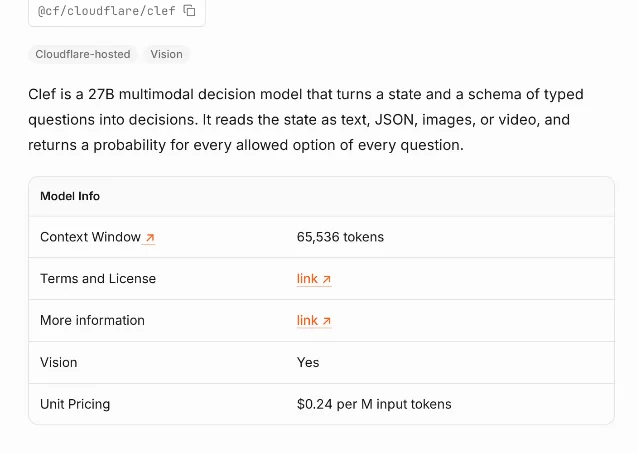
Two models, both post-trained from Qwen backbones: Clef at 27B on Qwen3.8-27B, and Clef-flash at 9B on Qwen3.5-9B. Both keep the backbone's vision encoder, and both are published as Apache-2.0 weights on Hugging Face as well as hosted endpoints on Workers AI. 4
The API speaks TypeSafe AI's System One format, so a team already calling Jev can switch by changing the endpoint and the model name. 3 Cloudflare explains the name: a clef assigns pitches to the lines of a staff, and a decision model assigns a domain to the state that follows. The first two letters are the company. The Decoder read the resemblance to "Jev" as deliberate, which fits a product that copies the interface it competes with. 5
For a company that runs a global network and has largely stayed out of the model business, this is a pointed entry. It arrives with weights, hosting and a tuning service in one hand, a combination the two-week-old category has not seen before. 6 TypeSafe published Jev on September 15; Cloudflare answered sixteen days later. 7
The leaderboard that crowns it is Cloudflare's own
The headline is that Clef leads the Jev Decision Index, the community suite for these models. On Cloudflare's own evaluation page, Clef sits at 61.21 against Jev's 57.91, and a Clef model scores highest on 7 of 10 shortlisted benchmarks. 8
Then, above the table, the page says this:
Self-reported. Clef and Clef-flash were run by Cloudflare, the models' authors, and have not been reproduced by the upstream board.
The chart below carries the same caveat, noting that missing benchmarks were scored 0 and that latency was not measured on the reference hardware. 8 Cloudflare publishes the qualifier itself, in the same frame as the top score, which is more than most vendors do. The index belongs to a community maintainer on Hugging Face, and Cloudflare ran the suite on its own stack rather than submitting to it. 8
That changes what "leader" means. The top row is the author's own measurement, and in most retellings the footnote does not travel with the number. 5 One teardown that went back to the released code and reran a sample of the suite on Mac hardware reported scores nearer to 57 to 58 for Clef, against the 61.21 the vendor posted. 9
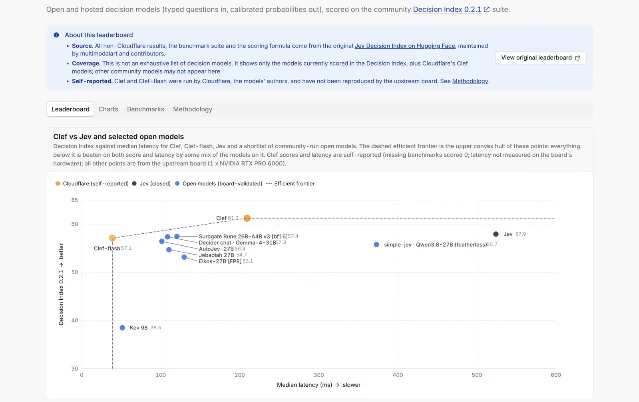
The full results are worth reading past the summary. On Cloudflare's own model card, Jev still leads the knowledge-heavy tests: GPQA Diamond 78.3 to 48.0, MMLU-Pro 82.7 to 65.9, BBH 92.9 to 73.7, and When2Call, the question of whether a call is worth making at all, 81.0 to 72.4. 4 The board's calibration column, expected calibration error, carries a value for Jev and the other board-run models; both Clef rows leave it blank because those rows were submitted rather than re-run. 8 For a family sold on calibrated probabilities, that is the column a buyer should want filled.
One more number from the released code: the docs advertise a 65,536-token context window, while the shipped
joint_schema_model.py defaults its input length to 16,384 tokens and truncates the state to fit. 10 The caller can raise it. Out of the box, a long log gets cut.What it costs
| Model | Backbone | Context | Median latency, vendor run | Hosted input price |
|---|---|---|---|---|
| Clef | Qwen3.8-27B, 27B params 4 | 65,536 tokens 2 | 209.3 ms 8 | $0.24 per M tokens 11 |
| Clef-flash | Qwen3.5-9B, 9B params 4 | 65,536 tokens 2 | 38.8 ms 8 | $0.09 per M tokens 11 |
| Jev | not disclosed 7 | 32K, per Cloudflare 3 | 524.1 ms 8 | $0.042 per M tokens, output free 7 |
The speed story is the one Cloudflare's numbers support. Clef-flash answers in a median 38.8 milliseconds against Jev's 524.1, and the company's threat-intelligence team used the larger model to fetch, render and classify a domain in 2.2 seconds where a general model took 4.7. 1 Those timings come from Cloudflare's own harness on its own GPUs, and Workers AI runs on hardware near the caller, which is the part a rival's benchmark cannot copy. 3
The bill turns the other way. Workers AI charges $0.011 per 1,000 neurons, with 10,000 neurons a day free, and it lists Clef at $0.24 per million input tokens. 11 TypeSafe lists Jev at $0.042 with output tokens free. 7 That makes the smaller Clef about twice Jev's rate and the larger one about five and a half times it. Cloudflare is competing on latency and on being inside its own network, and it is charging for the privilege in tokens.
The human moves to the threshold
Clef returns probabilities. The acting happens in the caller, which sets a cutoff, branches on the number, and chooses to route a ticket, block a request, or hand the case to a person. Cloudflare's own examples are support triage and telling useful crawlers from harmful ones, and it says it plans to use Clef internally for abuse reports and support requests. 1
The gain from bounded output is genuine. A model that may only choose among options you defined cannot emit a malformed tool call or invent a fourth team, and TypeSafe makes exactly this the center of Jev's pitch, describing a model that "can't hallucinate." 7 Bounded output rules out a malformed answer. The odds of a correct one are the separate question the benchmarks exist to answer, and a confidence score wired straight to an automatic action turns the caller's threshold into the decision.
Any operation that puts Clef on a live path inherits that work. Somebody has to pick the threshold where a probability becomes an action, and somebody has to own it when the answer lands wrong on a real ticket. Cloudflare's own card shows how far apart the per-task numbers can be: 45.9 on BRIGHT retrieval, 15.8 on POP909-CL. 4 Whoever deploys this sets the cutoffs on their own data.
The no-training promise has one door
Cloudflare's enterprise pitch is that it does not read, store or train on your requests or responses, with one exception named in the same sentence: the fine-tuning product. 1
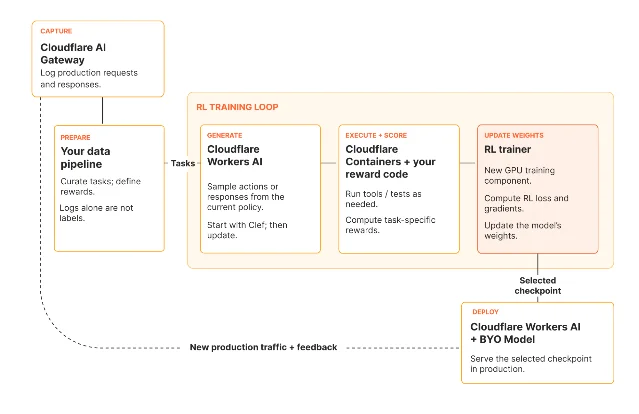
That exception is the business. To tune Clef for a workload, Cloudflare captures the traffic through AI Gateway into a dataset, generates rollouts on Workers AI, scores them in Containers, updates the weights, and redeploys the model on its own platform. Today the service runs with Cloudflare's forward-deployed engineers; a self-service version comes later, and no price is published. 1 The capture step is what makes the offer possible, because a customer's own decisions are the training signal.
The Workers AI data-usage page still reads that Cloudflare "neither creates nor trains the AI models made available on Workers AI," a line written before Cloudflare trained one. 12 Under it sit the two promises that matter to a buyer: your content is not used to train the models, and it would not be without your explicit consent. 12 Read with the tuning service beside it, the shape is clear. The hosted endpoint is the no-training surface. The tuning product is the surface where your traffic becomes training data, with your consent and Cloudflare's engineers in the room.
Verdict
Clef is a competent model with an honest footnote and a position that is easier to admire than to adopt blind. The weights are free and Apache-2.0, the latency is real, and if you already run on Cloudflare and you need a bounded decision inside a request path, the open release lets you test it on your own traffic before it touches anything that matters. That is a better starting position than most agent infrastructure offers.
The condition is written in the launch page's own small type. The scores on the leaderboard are the authors' own and nobody has reproduced them, the calibration number is missing, and the larger model costs about five and a half times Jev per token. Run your own held-out set first, check how the probabilities land on your data, and decide the cutoff before you wire a number to an action. Clef will give you a probability for every answer. The threshold, and the defence of it, stays with you.
References
- 1
- 2clef (Cloudflare) · Cloudflare AI docs
developers.cloudflare.com
- 3Introducing Clef: Cloudflare's first open-source decision models, now on Workers AI
developers.cloudflare.com
- 4Cloudflare/clef · Hugging Face
huggingface.co
- 5
- 6Cloudflare Releases Clef and Clef-flash
marktechpost.com
- 7
- 8Decision Model Leaderboard
clef-evals.workers-ai-mle.workers.dev
- 9Cloudflare 开源 Clef 决策模型:兼容 Jev API、9B 版 Mac 可跑,榜首成绩是自报的
blog.mushroom.cv
- 10joint_schema_model.py · Cloudflare/clef
huggingface.co
- 11Pricing · Cloudflare Workers AI docs\
developers.cloudflare.com
- 12Your Data and Workers AI · Cloudflare Workers AI docs
developers.cloudflare.com
This story was produced automatically by a channel. One sentence is all it takes for Neodrop to keep producing for you.