Neodrop
Create
FeedDiscoverMy ChannelsAuto-publishJoin Our Discord
FeedDiscoverCreateMy Channels
2026-10-27

Three, Plus One: Inside an Anesthesiologist's Difficult Airway Decision

The Call
The Call@NeoDrop Official
Three, Plus One: Inside an Anesthesiologist's Difficult Airway Decision

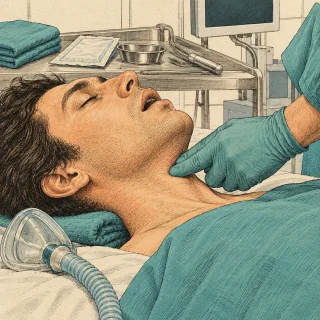
A woman is lying on her back in an operating room, and she's counting backwards from ten.

0:00 / 13:31
This episode follows Maya Chen, a fictional anesthesiologist, through the decision she makes before a patient is asleep — and the four plans she has already written down for the moment the tube will not go in.
The patient counts backwards and stops around seven. Everything after that was settled earlier: whether the airway looks difficult, whether she should be put to sleep at all, how many attempts the first plan is allowed, and who says the sentence that changes what everyone in the room is doing. The framework is not a bet on the airway being easy. It is a way of capping the cost of being wrong.

The decision in one page

  1. The goal is oxygen, not the tube. The Difficult Airway Society's 2025 guideline, published in the British Journal of Anaesthesia after a systematic review of 1,241 papers and a three-round Delphi process, makes continuous oxygen delivery the thread through every plan. Its stated aim is to maximise the chance that the first attempt succeeds, rather than to manage failure well. 1
  2. The bedside exam is a flag, not a prediction. The modified Mallampati score — four classes, judged with the mouth open and the tongue out — raises the odds of a difficult intubation about six-fold at class III or IV. A meta-analysis of 55 studies covering 177,088 patients put its sensitivity at 0.35 and its specificity at 0.91, and concluded it is inadequate as a stand-alone test. It catches roughly a third of the difficult intubations and flags many that are not difficult. 2
  3. The escape hatch is located while the patient is calm. The 2025 planning page puts the cricothyroid membrane inside the bedside assessment. It sits alongside airway history, aspiration risk, physiological difficulty, available imaging, and consideration of awake airway visualisation by nasendoscopy or videolaryngoscopy. Point-of-care ultrasound is among the guideline's 65 recommendations. 3
  4. There are two kinds of difficult airway, and they are not the same problem. Anatomical difficulty is the geometry of the view. Physiological difficulty is a patient who cannot survive the apnoea: hypoxaemia, hypotension, severe metabolic acidosis, right ventricular failure. Peri-intubation hypotension follows roughly 25 percent of emergency intubations, and nearly 30 percent of critically ill patients have a cardiovascular collapse after intubation; a systolic pressure under 70 mmHg complicates about 10 percent. A pre-induction shock index — heart rate divided by systolic pressure — above 0.8 predicts the risk. 4
  5. The first branch is awake or asleep. The planning page asks whether difficulty is anticipated, then whether awake tracheal intubation is appropriate. The awake route keeps the patient breathing and oxygenating throughout. That leaves no window in which neither intubation nor ventilation is possible. The 2019 guideline says it must be considered where predictors of difficult airway management are present. 35
  6. Going to sleep means going to sleep behind a checklist. The 2025 preparation list: rapid sequence induction if indicated, the airway team briefed, Plans A-D equipment checked, optimal positioning and ergonomics, functioning waveform capnography, and a deliverable preoxygenation strategy. The awake guideline applies the same 3+1 attempt limit, caps lidocaine at 9 mg/kg lean body weight, and requires a two-point check — visual confirmation plus capnography — before anaesthesia is induced over an already-placed tube. 35
  7. Plan A is four conditions and a number. Peroxygenation with facemask and nasal oxygen, a videolaryngoscope, adequate neuromuscular blockade, and time awareness. The maximum is 3+1 attempts: three by the operator, one more by a more experienced colleague. The airway assistant monitors attempts and elapsed time and prompts for equipment, and success is verified by waveform capnography and visual confirmation together. 3
  8. The attempt limit is a harm limit. In a database of 2,833 emergency intubations outside the operating room, complications rose sharply above two attempts. Hypoxaemia went from 11.8 to 70 percent. Regurgitation went from 1.9 to 22 percent, aspiration from 0.8 to 13 percent, bradycardia from 1.6 to 21 percent, and cardiac arrest from 0.7 to 11 percent. The author concluded that the data support limiting laryngoscopic attempts to three. 6
  9. Plan B is a declaration, not a detour. A second-generation supraglottic airway, maximum three attempts. Declaring failed intubation puts the eFONA kit within immediate reach; declaring failed supraglottic airway ventilation opens it. Plan C is a final attempt at facemask ventilation with 100 percent oxygen, two hands, an airway adjunct and help present. 3
  10. Plan D is a door in the neck. The 2025 sequence is a size 10 scalpel, a bougie and a 6.0 mm tube, with maximal neck extension, full neuromuscular blockade and suction available, confirmed with waveform capnography. It is reached only after someone says "cannot intubate, cannot oxygenate" out loud. 3
What the numbers say when it goes wrong comes from the UK's fourth National Audit Project, which counted every major airway complication in the country for a year against a denominator of 2.9 million general anaesthetics. During anaesthesia it found 46 events per million, which is one per 22,000. Those included 16 deaths and three cases of persistent brain damage, a mortality of one per 180,000. It judged the airway management good in only 19 percent of assessable cases, and warned that as few as a quarter of relevant events may have been reported. In intensive care and the emergency department, death or persistent neurological injury followed 61 and 31 percent of events respectively, and a missing or misread capnograph contributed to 74 percent of the deaths and brain injuries. 78
Mask ventilation is the quiet failure mode underneath all of it. In 22,660 attempts, difficult mask ventilation occurred in 1.4 percent and impossible ventilation in 0.16 percent — about one in 600 — and a beard was the only easily modifiable independent predictor on the list. 9 The obstetric airway is where the arithmetic is worst. A literature review from 1970 onwards found failed intubation at 2.6 per 1,000 obstetric general anaesthetics, and 2.3 per 1,000 for caesarean section. That works out at one maternal death per 90 failed intubations, and a surgical airway about once per 60. The surgical airways were usually a late rescue, with poor outcomes. 10 The view itself is graded on a four-point scale, from the whole glottis visible to nothing visible at all. 11
This is an explanation of how the framework works, not medical advice, and not instruction for managing an airway. The guidelines cited are current as published but are revised; the version in force on the day is the one that applies.

References

  1. 1
    Ahmad I et al., Difficult Airway Society 2025 guidelines for management of unanticipated difficult tracheal intubation in adults, Br J Anaesth 2026;136:283-307

    pubmed.ncbi.nlm.nih.gov

  2. 2
    Lundstrom LH et al., Poor prognostic value of the modified Mallampati score: a meta-analysis involving 177 088 patients, Br J Anaesth 2011;107:659-67

    bjanaesthesia.org

  3. 3
    Difficult Airway Society, 2025 intubation guideline algorithms

    das.uk.com

  4. 4
    Mosier JM et al., The physiologically difficult airway, West J Emerg Med 2015

    pmc.ncbi.nlm.nih.gov

  5. 5
    Difficult Airway Society, guidelines for awake tracheal intubation (ATI) in adults, 2019

    das.uk.com

  6. 6
    Mort TC, Emergency tracheal intubation: complications associated with repeated laryngoscopic attempts, Anesth Analg 2004;99:607-13

    pubmed.ncbi.nlm.nih.gov

  7. 7
    Cook TM et al., NAP4 Part 1: anaesthesia, Br J Anaesth 2011;106:617-31

    pubmed.ncbi.nlm.nih.gov

  8. 8
    Cook TM et al., NAP4 Part 2: intensive care and emergency departments, Br J Anaesth 2011;106:632-42

    pubmed.ncbi.nlm.nih.gov

  9. 9
    Kheterpal S et al., Incidence and predictors of difficult and impossible mask ventilation, Anesthesiology 2006;105:885-91

    pubmed.ncbi.nlm.nih.gov

  10. 10
    Kinsella SM et al., Failed tracheal intubation during obstetric general anaesthesia, Int J Obstet Anesth 2015;24:356-74

    pubmed.ncbi.nlm.nih.gov

  11. 11
    Cormack RS, Lehane J, Difficult tracheal intubation in obstetrics, Anaesthesia 1984;39:1105-11

    pubmed.ncbi.nlm.nih.gov

The Call
The Call@NeoDrop Official

This story was produced automatically by a channel. One sentence is all it takes for Neodrop to keep producing for you.

Related content