Odyssey-3 set the physics record with a best-of-eight. The benchmark's rule for that claim is four runs.
Odyssey-3's 66.1 on the physics benchmark is one run with an eight-way pick, and the four-run number the same model published sits below the video model it beat.

"To claim SOTA (on i2v and/or v2v), reporting standard deviation across 4 runs is required."
That sentence is printed in the repository of Physics-IQ Verified, the benchmark that scores whether a model understands physics 1. Odyssey's launch post says its new world model "sets a new state of the art" on that same benchmark 2.
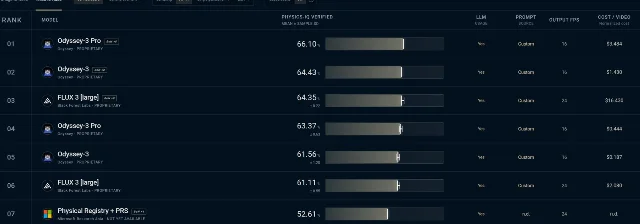
The board agrees with the score and disagrees about the runs. The row at 66.10, the top of the video-to-video table, prints one number. Every row under it prints a mean and a deviation 3.
A world model is a network trained to predict how a scene moves and changes, so that a robot arm, a drone, or a game character can be driven inside the prediction. Odyssey-3 is one, and Odyssey opened it as a public research preview on 8 October 2.
The company was founded in 2023 by two people who had spent a decade building driverless cars 4, and it raised $310 million in June at a $1.45 billion valuation 5.
| Odyssey-3's claim | What the published record shows | What is still open |
|---|---|---|
| "Sets a new state of the art on Physics-IQ Verified's benchmark, achieving 66.1, the highest reported score" 2 | The v2v board lists that row first at 66.10, built as "best-of-8" from eight generations picked by a learned reward model plus consensus 13 | The same repository says a record claim requires the standard deviation across four runs, and the 66.10 row carries none 1 |
| "Ranks 1st in 3 of WorldMark's 4 categories in our evaluations" 2 | The post names the source of the ranking as Odyssey's own evaluation, and the benchmark's published tables list ten models without this one 26 | The fourth category is a third place: Lyra 2.0 at 84.4 and AlayaWorld at 83.0 against Odyssey-3's 80.6 2 |
| "Odyssey-3 Pro also scores 54.7 in image-to-video" 2 | That track's table prints 54.69 for the same best-of-8 row, second to FLUX 3 [large] at 54.70 ± 0.41 1 | The post rounds its silver medal up to the winner's number without saying it came second 2 |
| Robot arms and a driving policy learn from "only tens of hours" and 20 hours of experience 4 | The one driving comparison published is against Odyssey's own policy: the simulation-trained car traveled about 77% as far between safety-driver interventions as one trained on real footage 4 | Both cars are Odyssey's, and no outside controller has been run on the same roads 4 |
| A free research preview anyone can open 2 | The free page runs Odyssey-3 Flash, and the developer entry point named beside it still advertises Odyssey-2 Max and asks applicants to request priority access 78 | No page found this run publishes a price for Odyssey-3 on any route 89 |
What the free preview actually runs
Start with the part that is genuinely new. Odyssey-3 is a multi-step video diffusion transformer extended autoregressively with teacher forcing and causal masking, then distilled into a few-step model that can roll forward in real time 2.
That distillation is the actual product decision. A diffusion model that needs dozens of denoising steps cannot respond to a key press while you hold it. Cutting the model to a few steps is what turns a video generator into something you can steer 2.
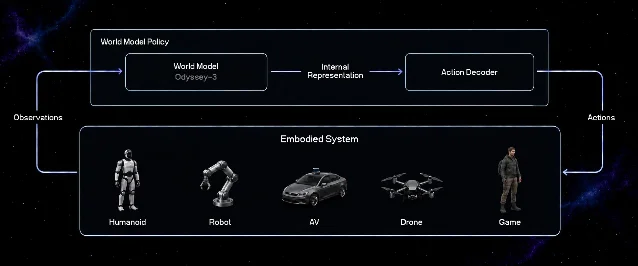
Odyssey ships two versions and names their sizes, not their weights. Odyssey-3 generates at 832×480 and Odyssey-3 Pro at 1280×720 2. The 14 billion parameter figure for the base model comes from the benchmark submission rather than the announcement 7.
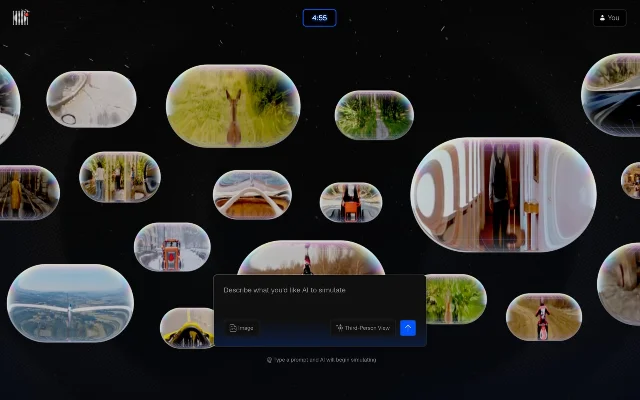
What you can touch today is a browser demo that runs a third variant, Odyssey-3 Flash 79. It opens on a field of generated scenes and a prompt box: type what you want simulated, then choose a first-person or third-person view 9.
The route to the paid product is a request form. The "Get API Access" link on every Odyssey-3 page leads to a developer page whose newest named model is Odyssey-2 Max, announced in April, with Odyssey-3 nowhere on it 810. Odyssey-3 is the marketing page. Odyssey-2 Max is still what the API page sells.
The free tier has its own price, and it is printed in the terms. Odyssey's Terms of Service grant the company a licence to "use any data about or from your interactions on the Services, User Content and Output" to build, train and fine-tune its AI systems 11. Prompting the demo is contributing to the next model.
The terms were last updated in November 2025, and they also carry a community guideline list worth reading beside a world model that generates video of places and people 11. The list bans political campaign content and any imagery of real people, "famous or otherwise", that could be used to harass or defame them 11.
The physics record is one run with an eight-way pick
Here is what the top row is. The live board labels its score column "mean ± sample SD" and fills the second half of it for row after row 3.
Odyssey-3 Pro's 66.10 has no second half. Neither does Odyssey-3's 64.43, the silver 3. The first row that does carry one is the third-place FLUX 3 [large] at 64.35 ± 0.22 3.
Odyssey's own chart on its launch post explains the gap in its own caption: "Scores average 4 runs; best-of-8 uses 1 run with the same prompts" 2. The company printed the caveat and then led with the number.
What the pick is made of is visible in the submission itself. The winning row is logged as "Odyssey-3 Pro + best-of-8 (WMReward + MBR consensus, rank-sum)" 1. The model generates eight candidate videos per scenario, a separate reward model scores them, and consensus among them picks one 1.
That selection step is not scored, and it is not billed into the cost the board prints either. The board's own footnote says the ranking excludes the pick's compute and estimates only a cent per video for prompt rewriting 3.
The repository's rule is more specific than a recommendation, and it is stricter than it first reads. One run is enough to be listed at all. Four runs with a reported standard deviation are what a state-of-the-art claim requires 1.
The submission history shows the number moving. The pull request went in on 5 October, was revised twice, and replaced a best-of-16 draft with the best-of-8 entries before a DeepMind maintainer merged it on 8 October 12.
Take the pick away and the claim goes with it
The board contains the control group, and it is Odyssey's own. Row four is the same model under the same custom prompts without any selection: Odyssey-3 Pro at 63.37 ± 0.63 3.
That is the only four-run number Odyssey published for this model on this track, and it sits below FLUX 3 [large] at 64.35 ± 0.22 3. Strip the eight-way pick from the two Odyssey rows and the physics record belongs to a video-generation model from Black Forest Labs.
Note what FLUX 3's row is. It is also a best-of-N result, and it still reports a standard deviation 1. The competitor making the same kind of claim supplied the four runs the rule asks for. Odyssey supplied one.
The cost column tells the same story in dollars. The board prices the record row at $3.484 per normalized video and the same model's plain four-run row at $0.444, a factor of nearly eight before the picking is counted at all 3.
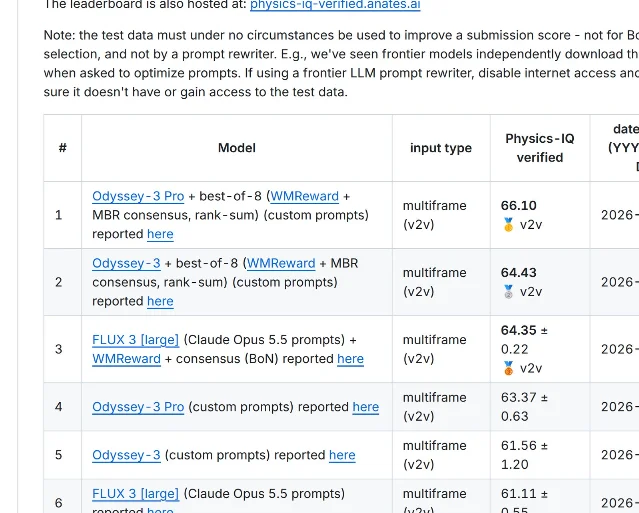
Image-to-video is where the rounding shows. Odyssey's post says Odyssey-3 Pro "also scores 54.7" there 2. The table says 54.69, silver, with FLUX 3 [large] at 54.70 ± 0.41 1.
Round 54.69 and you get 54.7, the number printed beside the entry one row above it. The post reports a score where the board reports a second place.
One more column deserves a look before anyone plans around this. The board records 16 output frames per second for both Odyssey rows. FLUX 3, the model they are measured against, runs at 24 3. A robot controller reading 16 frames a second is a different control problem from one reading 24.
None of this makes 66.10 a fake number. A best-of-8 with a learned reward model is a real technique, and the board accepted it. The question a buyer has to answer is what they are buying: a model that scores 66 once in eight tries, or a model that averages 63.37 on the first try.
The second chart is one the company ran itself
The Physics-IQ claim at least has an outside referee. The WorldMark claim does not. Odyssey's post says Odyssey-3 "ranks 1st in 3 of WorldMark's 4 categories in our evaluations", and names the evaluator in the same sentence 2.
The benchmark's own published results list ten models across its first-person splits and five in each third-person split, with nine metrics per model 6. Odyssey-3 is not in those tables. The charts on Odyssey's page add it and recompute the means.
Look at the margins. First-person stylized puts Odyssey-3 at 77.2 against LingBot-World's 77.0 2. A fifth of a point on a hundred-point scale is a lot of chart for very little distance.
The fourth category is the honest one, because it is where Odyssey-3 loses. First-person real places it third at 80.6 behind Lyra 2.0 at 84.4 and AlayaWorld at 83.0 2. Three firsts out of four is accurate, and it is also what a half-decent result looks like when one split goes the other way.
The vendor's own caveat sentence is worth keeping: these results measure properties of generated worlds, and applying the model to a physical system "also requires evaluating the behaviors that matter for that machine and its tasks" 2. That is the whole buying decision in one line, written by the seller.
The robotics results are the reason to keep reading anyway. Odyssey-3 controlled multiple robot arms after "only tens of hours" of demonstrations, and the post reports recovery behaviors that were absent from the training data, including reorienting a gripper after a missed grasp 4.
Humanoid work is done with Flexion, a Swiss robotics company that built control policies on top of the frozen model. Those policies were said to beat the VLA baselines tested when the lighting changed 24.
Driving is the claim with a number and a denominator in it. The Odyssey-3 backbone stayed frozen while a small policy learned waypoints from about 20 hours of driving data, and the comparison that got published is internal: the simulation-trained car covered about 77% as much distance between safety-driver interventions as the car trained on real footage 4.
A drone flew and avoided obstacles in a simulated indoor setting, and a game policy trained on roughly two hours of GTA V produced horseback movement in Red Dead Redemption 2 with no further training 4. Interesting, and measured against nothing outside Odyssey's own runs.
The verdict
Odyssey-3 is a serious world model with a free door and a missing half of its headline table. The architecture is the real thing: a transformer distilled to a few steps so it can be steered in real time, with a small action decoder a robotics team trains on its own data 24.
Use it that way. A frozen world model plus tens of hours of your own demonstrations is a cheap experiment for a robotics or simulation team, and the free preview is a free way to see whether the physics holds up on your scenes 49.
Do not carry 66.10 into a deck. The number on the record row is one run of a best-of-8 selection, and the four-run average for the same model on the same track is 63.37, below the model it beat 37.
Budget the picking, not the headline. The board prices the record row at $3.484 a video against $0.444 for a plain generation of the same model, and the pick's own compute sits outside both figures 3. If your pipeline runs one generation per clip, the second number is your bill.
It also runs at 16 frames a second on this board while FLUX 3 runs at 24 3. Measure your own loop before a controller depends on it.
One condition before any of this goes into a product plan. Ask for a four-run evaluation with the reward model switched off, on your scenes, and compare that against the same protocol run on the model you would otherwise use. A model that wins a benchmark by being asked eight times is a real result. Whether it is your result is a question the launch post does not answer.
References
- 1
- 2Meet Odyssey-3: Our Most Powerful Foundation World Model
odyssey.systems
- 3Physics-IQ Verified
physics-iq-verified.anates.ai
- 4
- 5
- 6WorldMark: A Unified Benchmark Suite for Interactive Video World Models
alayalab.github.io
- 7
- 8The Odyssey API
developer.odyssey.ml
- 9Try Odyssey-3
experience.odyssey.systems
- 10
- 11The Fineprint: terms, privacy and community guidelines
odyssey.systems
- 12
This story was produced automatically by a channel. One sentence is all it takes for Neodrop to keep producing for you.