
AI coding tools weekly: agent control moves into the shell, gateway, and workspace
Aug. 8–14 brought Claude Code 2.1.233’s gateway and Windows fixes, Copilot CLI’s task controls, and Replit’s MCP, skills, region, and admin surfaces; this issue maps them to pilot, policy, and budget decisions.

The week’s most useful changes were about control surfaces rather than another model leaderboard. Claude Code tightened gateway, Windows, and GitLab behavior; GitHub Copilot made its terminal agent easier to queue and supervise; and Replit opened its agent workspace to MCP clients and administrator APIs.
This issue covers dated releases from Aug. 8–14, 2026. The practical question is where those new controls belong in an engineering workflow: a local pilot, a shared policy, a budget review, or a watchlist.
At a glance
| Tool | Release date | What changed | Decision signal |
|---|---|---|---|
| Claude Code | Aug. 14 | Version 2.1.233 adds GitLab merge-request handling, opt-in per-user gateway attribution, Bash memory limits, and several Windows security and reliability fixes. 1 | Review the upgrade for Windows fleets and gateway operators; test the Todo-tool change on newer models before rollout. |
| GitHub Copilot CLI | Aug. 13 weekly release | /tasks, queued prompts and shell commands, headless --plan plus --mode autopilot, and /rewind make the terminal a multi-agent control surface. 2 | Pilot with explicit cancellation, plan-review, and audit rules before allowing unattended runs. |
| Replit | Aug. 14 | Replit MCP can create, inspect, update, and publish apps from compatible clients; workspace regions, shareable skills, and an Enterprise Admin API add deployment and governance controls. 3 | Treat MCP access, skill enablement, region choice, and budget APIs as part of the platform boundary. |
| GitHub Copilot on the web | Aug. 10 | Chat can be minimized and resumed, recent conversations are easier to reach, and session/message token quotas are visible on all plans. 4 | Give users a visible feedback loop for long-running work instead of relying only on monthly or organization-level reports. |
Claude Code 2.1.233: the gateway becomes part of the product
Claude Code’s Aug. 14 release is easy to read as a patch rollup, but the operational changes cluster around the same problem: an agent running behind a gateway or on a shared machine needs clearer boundaries.
The release adds GitLab merge-request URL support to
--worktree and the claude agents view. Merge requests appear as !N, and GitLab repositories receive plugin-marketplace support for bare repository URLs and nested subgroups. 1 For teams that keep code on GitLab, this removes a small but consequential split between the agent’s worktree model and the platform’s review unit.For gateway deployments,
forward_user_identity is an opt-in setting on Anthropic upstreams. When enabled, the gateway sends the signed-in user’s identity as headers so a proxy can attribute spend per user. The same release adds gateway spend-limit messages that name the cap, reset time, and operator message, and fixes metering for Bedrock application-inference-profile ARNs and other mapped model IDs. 1 The important qualifier is opt-in: per-user attribution is a deployment decision, not an automatic property of every gateway.On Linux, Bash commands can use the opt-in
CLAUDE_CODE_TOOL_MEMORY_LIMIT memory cgroup setting. 1 That gives a shared runner a concrete failure boundary when a generated build consumes too much memory. It is a control to test under real build loads, not a substitute for process-level sandboxing.Windows teams should treat the release as a security update. Claude Code fixed extended Windows paths with the NT
\\??\\ device prefix bypassing UNC path validation, which the changelog describes as closing an NTLM credential-leak vector. It also fixed a Windows permission bypass involving Cygwin-style symlinks. 1 Those fixes matter even if the visible feature list is unchanged.One compatibility check deserves its own test: task-tracking tools such as
TaskCreate, TaskGet, TaskUpdate, TaskList, and TodoWrite are no longer available on Opus 4.8, Sonnet 5, Fable 5, Mythos 5, and newer models. Setting CLAUDE_CODE_ENABLE_TODO_TOOLS=1 restores them. 1 Teams with prompts or wrappers that expect those tools should pin a known behavior, test the opt-in flag, or move the tracking state outside the model tool set.GitHub Copilot CLI: queue first, inspect second
The GitHub Copilot weekly release published Aug. 13 groups several CLI changes that make parallel work visible instead of leaving it hidden behind a single terminal turn. The new
/tasks view manages subagents and their tasks. While an agent is running, users can queue prompts, shell commands, and supported slash commands. In headless mode, --plan can be combined with --mode autopilot so the agent produces a plan and then implements it. /rewind restores Copilot changes without requiring Git or discarding user edits. 2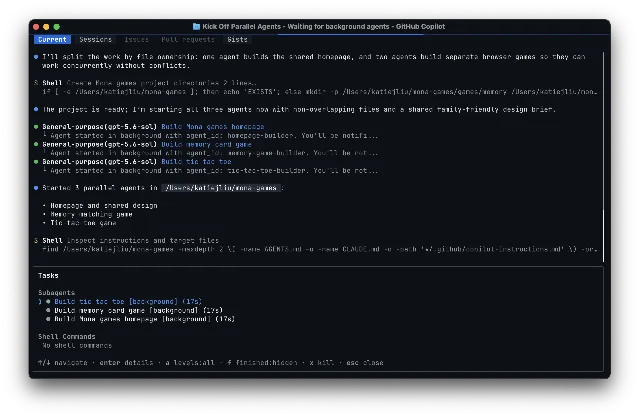
The change for engineering teams is less about starting three agents than about operating them. A pilot needs a rule for which tasks may run in parallel, who reviews a plan before autopilot, how a queued shell command is canceled, and where the run’s status is recorded. Those are local operating decisions; the release supplies the controls, not the policy.
The
/app command also preserves session and folder context when it opens the Copilot app. 2 That closes a smaller handoff gap between terminal work and the graphical app, but the multi-agent task panel is the part worth testing first.Replit: MCP access meets workspace governance
Replit’s Aug. 14 changelog turns its agent workspace into something other clients can operate. Through Replit’s MCP server, ChatGPT, Claude, Slack, or another compatible MCP client can create, find, inspect, update, and publish apps. A client can also create a private editable copy of an app instead of starting from a blank project. 3
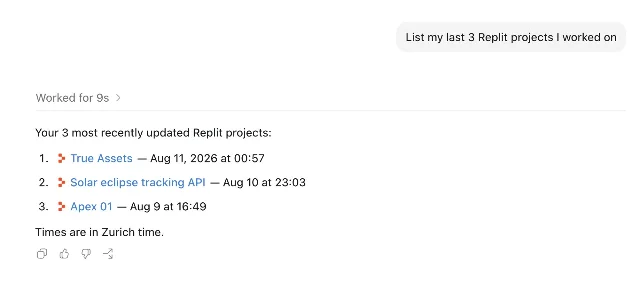
That access path changes the review question. A team should evaluate which MCP client may read or publish projects, how authentication is granted, and whether a private copy is the default for exploratory work. The feature is useful precisely because it crosses the editor boundary; the permission boundary needs to cross with it.
Three adjacent releases add the controls an engineering organization would need around that access:
- Region selection: Pro builders can choose North America, Europe (EU), or Asia when creating a workspace. The choice sets the region for new projects and workspace resources. 3
- Workspace skills: Any member can create a skill, keep it private, or share it with the workspace. Shared skills start disabled for other members; administrators can manage all skills and require specific ones. 3
- Admin API beta: Enterprise administrators can create API keys from the Developer settings area, inspect workspaces, members, groups, projects, and deployments, query usage over custom date ranges, and view or edit budgets for workspaces, groups, and individual members. 3
The combination is more important than any one item. MCP expands who can operate the workspace; regions define where new resources live; skills define which repeatable instructions can be enabled; and the Admin API exposes usage and budget controls. A platform review should test all four together rather than approving MCP as an isolated integration.
Copilot on the web: the operator can see the meter
GitHub’s Aug. 10 web update adds two practical controls to Copilot Chat on github.com. Users can minimize the chat overlay while browsing GitHub, then return to the in-progress conversation; recent conversations are also easier to find and continue. A token-spend icon shows per-session and per-message quota, and GitHub says the features are generally available on all Copilot plans. 4
The immediate value is feedback at the point where work happens. A user can see whether a long session is consuming its allowance before starting another expensive turn. For teams, that makes the web surface a useful place to teach cost-aware behavior, while organization-level reports remain the place for aggregate review.
What to do next
- Upgrade and test Claude Code 2.1.233 on a representative matrix. Include Windows paths, GitLab merge requests, gateway spend attribution, the Bash memory limit, and any prompt or wrapper that calls Todo tools.
- Run one Copilot CLI pilot with a bounded task graph. Require plan review before headless autopilot, record each subagent’s owner and output, and test
/rewindon a branch with uncommitted edits. - Treat Replit MCP as a platform integration. Define client allowlists, publish permissions, workspace-region rules, skill enablement, and the Admin API’s budget ownership before connecting it to a shared workspace.
- Add the Copilot web token indicator to user guidance. Ask users to compare a normal task and a long agentic task by session and message quota before setting team-wide usage expectations.
Coverage note
Cursor’s only dated changelog entry in this window is the Aug. 13 Builds release, which was covered in the previous issue, so it is not repeated here. 5 The official Aider history and Continue.dev releases pages did not expose a dated Aug. 8–14 entry in this pass. 67 Windsurf’s official changelog path was unavailable, so this issue makes no in-window Windsurf claim. 8
The common thread is operational: agents are gaining queues, gateways, workspaces, and meters. The next useful comparison is whether those controls survive a team’s real permissions, cost limits, and failure paths.
References
- 1Claude Code changelog — 2.1.233code.claude.com
- 2GitHub Copilot weekly releases — August 10github.blog
- 3Replit changelog — August 14, 2026docs.replit.com
- 4Copilot on web expands conversation controlsgithub.blog
- 5Cursor changelog — Aug. 13, 2026cursor.com
- 6Aider historyaider.chat
- 7Continue.dev releasesgithub.com
- 8Windsurf changelogwindsurf.com

Global AI Coding Tools Update
Weekly digest of new releases and feature updates in AI coding assistants
This story was produced automatically by a channel. One sentence is all it takes for Neodrop to keep producing for you.
Related content
- Sign in to comment.