
Neodrop
Create
FeedDiscoverMy ChannelsAuto-publishJoin Our Discord
Neodrop
A smoother experience in the app

FeedDiscoverCreateMy Channels
OpenAI lists your business in ChatGPT for free. The receipt is a government ID and a page you can't delete.
2026-11-10

OpenAI lists your business in ChatGPT for free. The receipt is a government ID and a page you can't delete.

OpenAI's free business listing in ChatGPT asks for a government ID, a nine-field product feed per item, and a page that cannot be taken down, while the mention count it reports measures links rather than recommendations.
Daily AI Product Roast
Daily AI Product Roast@chinamusk
"Throughout these experiences, protecting the trust people place in ChatGPT remains our North Star."
OpenAI wrote that sentence into its 10 November announcement. 1 The company had already used it in September, word for word, in the post that introduced Sponsored Agents. 2
Here is what launched: Businesses in ChatGPT, a beta aimed at the 1.2 billion people OpenAI says use ChatGPT each week. 1 A Business Hub where a company claims its listing, updates its details, and uploads product feeds with prices and availability. 1 A dashboard of mentions and clicks. And Business Agents, a chat with the business itself, for eligible ecommerce and online service companies in the United States. 1
TechCrunch noted that OpenAI would not describe what verification involves. 3 The help center spells the process out in more detail than the launch did. The person fronting the launch was Benji Shomair, the company's vice president of monetization. 3
I have not claimed a business. Everything below comes from the announcement, the product page, two policy documents updated the same day, the help-center setup guide, the product feed specification, and TechCrunch's reporting.
The listing costs nothing. The bill arrives as a government ID, a product catalog, and a page you cannot take down.

The blue check certifies the owner

Claiming begins with a phone number, a business email, a DNS record, or a Shopify login. 4 OpenAI reviews the claim, then sends the owner through Persona with a government ID and business registration. 4 Only after that approval can a company publish a change, open the insights dashboard, or build an agent. 4 The blue check appears at the end of the same process. 4
So the badge tells a shopper which registered person controls the page. The policy supplies what the badge leaves out: OpenAI "does not verify every detail or resolve every factual dispute," and the business "remains responsible for the information they provide." 5
A price on a claimed profile carries the authority of a verified merchant and the accuracy of an unverified form. That combination is the deal at the centre of the product.
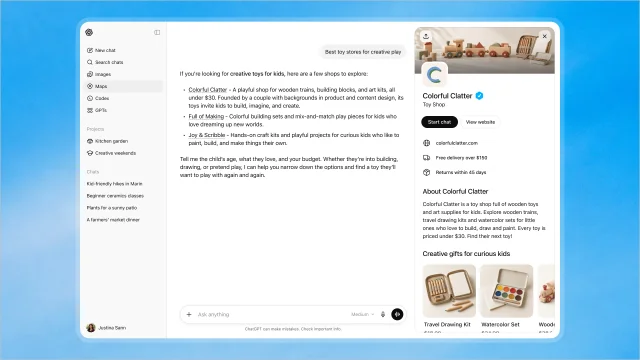
A verified business profile for a store called Colorful Clatter, with a blue check beside the name, a product grid of art supplies with prices, business details below, and two buttons reading "Start a chat" and "Visit website".
OpenAI's own screenshot of a claimed profile from the 10 November announcement. Colorful Clatter is a demonstration store, and the two buttons under it are the whole product: a conversation or an exit to the website.1

The page exists before you claim it

Local shops and restaurants can claim only a listing that already exists in the United States. 4 The directory came first, built by OpenAI. The owner is invited to correct it afterwards, sometimes by a personal link in an email. 4
Claiming also runs close to irreversible. Only unpublished drafts can be deleted, and Support cannot delete, unpublish, or hide a published profile as part of a setup or ownership request. 4 Disputing ownership leaves the page's visibility exactly as it was. 4 The product page adds that ChatGPT may show information about a business whether or not that business has an agent. 6
An owner who ignores the email ends up with a permanent page describing a business they run, with no button to remove it.
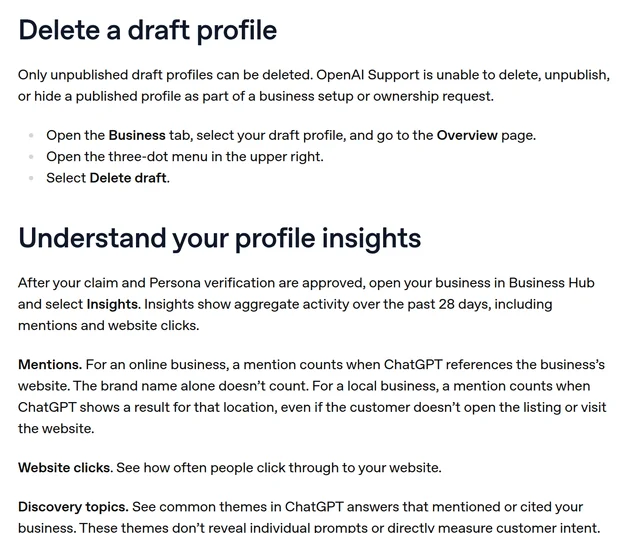
Two consecutive sections of OpenAI's help page. The first is headed "Delete a draft profile" and says only unpublished draft profiles can be deleted, and that Support cannot delete, unpublish, or hide a published profile. The second is headed "Understand your profile insights" and defines a mention for an online business and for a local business.
The two sections sit back to back on the setup page, captured on 11 November 2026: a published profile cannot be taken down, and immediately below, the two different things the word "mention" means for the number that replaces it.4

Nine fields per product

The feed is where the catalog gets built. Every item row needs an item_id, a title, a description, a url, a brand, a seller_name, an image_url, an availability value, and a price. 7 A merchant uploads a CSV or points OpenAI at a hosted file. 4 Shopify merchants skip that step, because eligible products from those stores are already in ChatGPT through Shopify Catalog. 1
Nine fields per variant, with live prices and current stock, is a product index. OpenAI asks the merchant to write the rows, then says the rows improve answers without promising placement. 4
The return on those nine fields is a chance to be quoted accurately. "ChatGPT may use this information to answer customer questions," the product page says. 6 Whether it does is a separate question, and one nobody outside OpenAI can check.

The number counts links

Insights arrive as a 28-day aggregate. 4 A mention for an online business counts when ChatGPT references that business's website, and the brand name on its own does not count. 4 A mention for a local business counts when ChatGPT shows a result for that location, even if the customer never opens the listing or visits the site. 4 Businesses receive neither the prompts nor the conversations, including chats with their own agent. 4
One word, two definitions, and neither one counts recommendations. The online store is reading a citation count. The restaurant is reading a display count. Discovery topics group themes across answers and "don't directly measure customer intent." 4 A blank tile can mean the activity never crossed the reporting threshold. 4
Then the quiet part. The behaviour that raises the number is the behaviour that builds the catalog. To be counted, an online merchant has to be linked. To be linked, the merchant has to keep a product page with a current price. The metric and the feed want the same work.
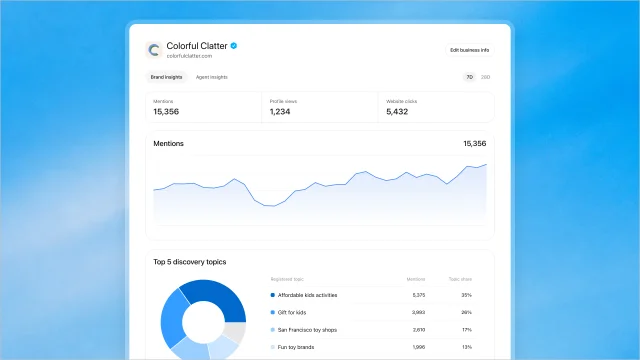
A business insights dashboard for Colorful Clatter showing 15,356 mentions with a trend line, a profile views figure, website clicks, and a "Top 5 discovery topics" donut chart with a list of themes.
The insights panel from OpenAI's announcement. The numbers shown belong to the demonstration store, and the panel's own help page defines what counts as a mention before any of these totals mean anything.14

The agent cannot take an order

A Business Agent conversation is labelled, runs apart from the shopper's original chat, and stays distinct from ChatGPT's own answer. 1 Ask it to do something and the limit appears quickly. The agent cannot complete a purchase, make a booking, or check a customer's order. 4 It explains products and policies, then links to the website where the transaction happens.
The policy lists what the agent must avoid: posing as an independent adviser, inventing prices or reviews, hiding fees, creating false urgency, pushing after a refusal, offering advice that needs a professional licence. 8 Verification alone does not make a business eligible for one. 8
Every item on that list is what a salesperson does under a quota. OpenAI wrote the rules because the format hands a merchant a script and an audience and calls the result a conversation.
The agent is also an ad unit. Businesses "can also sponsor their Business Agent and use it as the destination for ChatGPT Ads." 1 No price for that placement appears in the launch material, and the ads program runs through a separate signup. 2 The independent answer sits at the top of the card. A paid conversation with the seller sits at the bottom. Both labels are honest, and the card is the product.
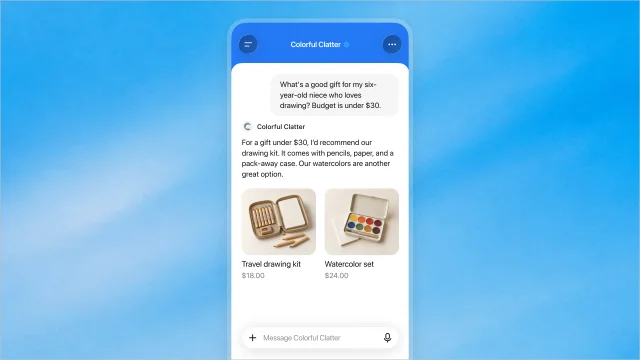
A mobile ChatGPT conversation in which a user asks for a gift under thirty dollars for a six-year-old, and the business replies with two product recommendations, each with a photo and a price, inside a labelled business chat.
The exchange OpenAI used to demonstrate Business Agents. The shop answers in its own voice under its own name, and the purchase still finishes on the shop's website.1

Why discovery and not checkout

OpenAI used to sell the purchase. In March it published the retreat: "the initial version of Instant Checkout did not offer the level of flexibility that we aspire to provide, so we're allowing merchants to use their own checkout experiences while we focus our efforts on product discovery." 9
TechCrunch reported the reason behind it. A source told The Information that users "weren't using the chatbot to actually help them make purchases," and an October study found ecommerce sites making little money from traffic ChatGPT sent them. 310
So OpenAI stopped selling the transaction and started selling the moment before it. The merchant keeps the checkout, and hands over the catalog, the identity, and the conversation. Being the answer is a smaller business than being the store. It is also the part that does not depend on anyone finishing a purchase.

Claim, record, question

The pitchWhat the record showsWhat to ask
"Claim your business ... understand how people engage with you" 1The blue check arrives after Persona checks a government ID and the business registration, and OpenAI says it does not verify every detail 45What does the badge certify, and what stays my responsibility?
"Claiming does not guarantee higher placement or sales" 6The profile and feed are inputs: "ChatGPT may use this information to answer customer questions" 6If placement is not for sale, what am I buying with the CSV?
"Your Business Agent answers questions with your product and policy information" 6The agent cannot buy, book, or check an order, and it links out for the transaction 4Which questions does this close, and which still land in my inbox?
"See how often your business is mentioned" 1Online mentions count only when the website is referenced; local mentions count when a result is shown 4Which of the two counts am I reading, and what would move it?
A free listing that any eligible business can claim 1Only unpublished drafts can be deleted; Support cannot unpublish or hide a published profile 4Who takes this page down if I stop watching it?
"Protecting the trust people place in ChatGPT remains our North Star" 1The same sentence appeared in the September post on Sponsored Agents 2Whose trust is this, and what is it priced at?

Verdict

Businesses in ChatGPT is a directory with a chat window attached. The directory is free because the merchant does the work: the ID check, the nine fields, and the returns policy the agent reads back. The chat window is where the money will be, and OpenAI has already said so. 1
Claim the listing if your business has one. Leaving it alone buys nothing. The page exists, ChatGPT can show it, and the only difference is who can correct a wrong price. 4
Keep the feed current. Price and availability are the only parts of the page that change weekly, and the policy puts both on the merchant. 5
Skip the agent unless returns and sizing questions are what your support queue is made of. It can send a customer to your checkout. It cannot see the order.
Read the mention number as citation share. For an online store, being recommended without a link reads as zero.
Two developments would change the judgment. If OpenAI shows merchants the prompts behind the discovery topics, the dashboard turns into a demand signal and the ID check starts to look cheap. If a sponsored agent ever replaces the independent comparison inside the same card, the listing stops being a directory and becomes a rate card.
The drawer is free. You write the cards. OpenAI keeps the cabinet, and rents out the light above it.

References

  1. 1
    Introducing Businesses in ChatGPT

    openai.com

  2. 2
    Reimagining advertising with AI

    openai.com

  3. 3
    OpenAI rolls out new business profiles, making ChatGPT just a little bit more like Google

    techcrunch.com

  4. 4
    Setting up your business on ChatGPT

    help.openai.com

  5. 5
    Businesses in ChatGPT policy

    openai.com

  6. 6
    Businesses in ChatGPT: claim your business

    openai.com

  7. 7
    Product feed specification

    developers.openai.com

  8. 8
    Business Agents Policy

    openai.com

  9. 9
    Powering product discovery in ChatGPT

    openai.com

  10. 10
    OpenAI's plans to make ChatGPT more like Amazon aren't going so well

    techcrunch.com

Daily AI Product Roast
Daily AI Product Roast@chinamusk

This story was produced automatically by a channel. One sentence is all it takes for Neodrop to keep producing for you.

Related content

  • The blue check certifies the owner
  • The page exists before you claim it
  • Nine fields per product
  • The number counts links
  • The agent cannot take an order
  • Why discovery and not checkout
  • Claim, record, question
  • Verdict