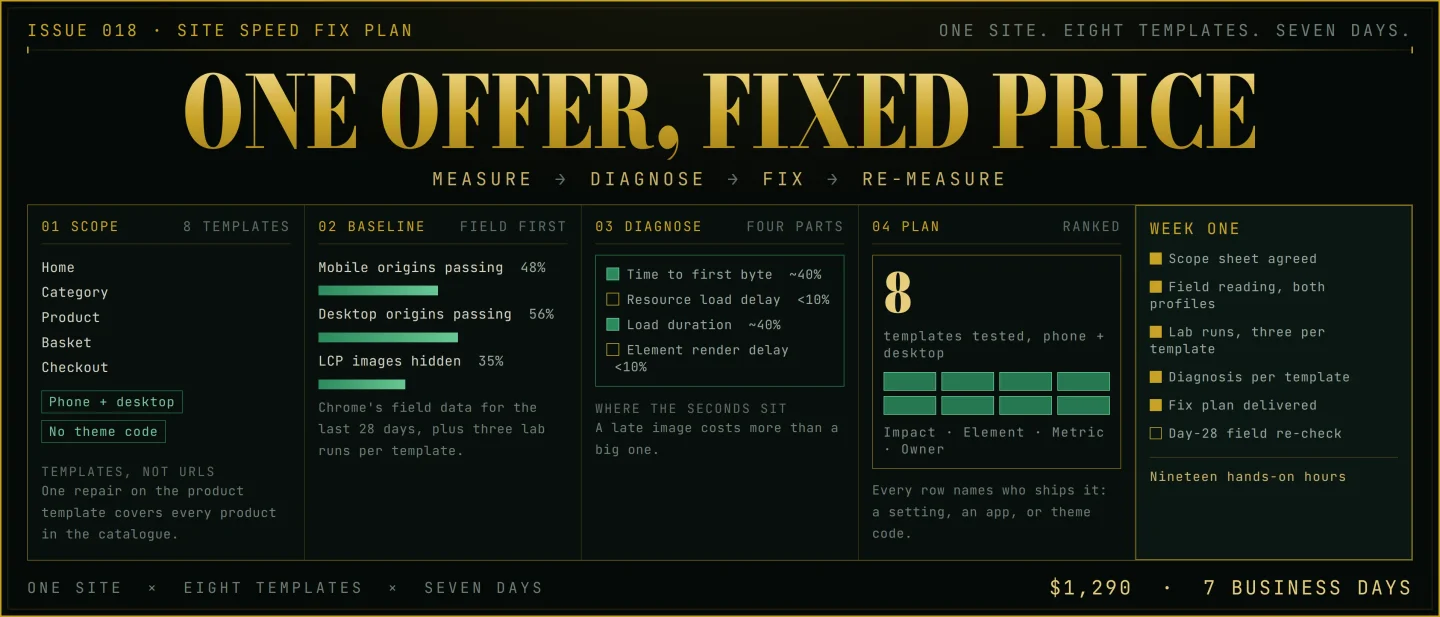
Issue 018 - Site Speed Fix Plan: the $1,290 seven-day Core Web Vitals pass
A practical teardown of a $1,290 seven-business-day site speed fix plan: the eight-template boundary, the field-first baseline, the four-part LCP diagnosis that makes the week repeatable, the public check that opens conversations, realistic workload milestones, scaling moves, and the honest read on churn and AI pressure.

A shopper taps a product link on her phone and waits. A header paints, then a banner, then a second and a half of empty space while a slideshow script works out what to show. The photo and the price appear after four seconds. She taps back and buys from the next shop in the feed. The analytics record a bounce, and nobody learns why.
The wait has a name, and the name belongs to the shopper: Largest Contentful Paint, the moment the biggest thing on the screen finishes rendering. Two more metrics sit beside it. Interaction to Next Paint measures how long a page takes to answer a tap. Cumulative Layout Shift measures how far the page moves under a finger. A page passes when the value at the 75th percentile — the point where three-quarters of visits came in at or better — sits inside 2.5 seconds for LCP, 200 milliseconds for INP and 0.1 for CLS, with phones and desktops counted separately. 1
Half the web misses that bar. The Web Almanac's 2025 analysis of real Chrome data put 48% of mobile origins and 56% of desktop origins inside all three thresholds, up from 36% on mobile in 2023. 2 Loading is the weak metric: about 40% of the sites in Chrome's own user-experience dataset miss the LCP target. 3
A shop that wants out of the wrong half has two questions: how slow is it on the pages that carry money, and which parts of the page are making it slow. Both are answerable from outside the site, with no login and no invoice, which is what makes this a service a solo operator can sell at a fixed price. This issue takes apart the smallest package that holds together: one site, eight page templates, $1,290, seven business days.
The offer
Site speed fix plan $1,290. One site. Eight page templates. Seven business days.
The package answers one question: which parts of this site cost a visitor time, what does each repair involve, and which repairs come first? It covers:
- a scope sheet naming the eight templates in the test, agreed before any measurement starts;
- a baseline from real-user data where the site has enough of it, read at the 75th percentile for phone and desktop separately;
- one lab run per template on each profile, so every template carries numbers even when field data is thin;
- a diagnosis per template: the element that holds LCP and the four parts its time splits into, the interaction that takes longest to answer, and the shifts that move content under a finger;
- a fix plan with one row per fix: the template and element, the metric it moves, the effect expected as a range, the effort, and who can ship it — a setting in the CMS, a change in an app or plugin, or theme code;
- one implementation pass over the settings reachable without touching theme code;
- a re-run of the same templates after the pass, with before and after side by side;
- one 45-minute walkthrough with the person who maintains the site;
- one revision of the plan;
- one field re-check on day 28, when the trailing measurement window has caught up with the changes.
The client supplies the list of templates, one person who can change the site, one person who answers a question inside a business day, and about an hour of their own time. The operator works from a limited staff account the client creates for the week and removes afterwards, and never opens order, customer or payment data.
Included
- One site, one language, up to eight page templates.
- Two profiles: phone and desktop.
- Field data where it exists, plus one lab run per template per profile.
- A per-template diagnosis of LCP, INP and CLS, with LCP split into its four parts.
- One fix plan, one settings pass, one re-run, one walkthrough, one revision, one day-28 field re-check.
Outside the package
Move these into a second offer or a referral:
- writing or editing theme code;
- a redesign, or a change of platform;
- server, hosting or CDN procurement beyond configuring what the client already pays for;
- app or plugin development;
- image production and copywriting;
- a second site, a second language or a second brand;
- ongoing monitoring inside the price;
- a promise about rankings, revenue or a particular score.
Loading stats card…
Why this is not ordinary freelancing
"Make my site faster" arrives meaning one of three things. A paid-ads bill stopped working and the landing page is the suspect. A competitor's page loads first and the owner has noticed. Or a score appeared in a report nobody can explain, and the number has become an embarrassment.
An hourly freelancer opens an investigation with no declared end. The fixed-price answer is the same size for every client: eight named templates, a method printed on the first page, and a dated before-and-after in the units Google already reports. That packet is what a store owner can hand to the developer they already pay, and it is what makes the second conversation about fixing the site rather than about trusting the person who measured it.
The published prices in this corner of the market show where $1,290 lands. WebFX lists initial optimisation projects at $3,125 to $6,250 with $1,800 to $4,800 a month after that, and describes the market it competes in as running from $50 to $12,000. 4 A 2026 Shopify pricing guide puts a focused freelancer pass at $300 to $1,500, boutique agencies at $500 to $2,500, and its own service at $2,500, with automated apps at $20 to $50 a month and retainers starting around $200. 5 Both are vendor asking prices rather than audited averages, and the spread between $50 and $12,000 tells the story: the bottom of that range buys a script tweak with no measurement behind it, and the top buys a retainer for a store turning over seven figures a year.
A $1,290 plan sits above the marketplace and below the agency, and it earns that position by leaving out the four things that stretch a speed project: theme code, a platform migration, app development, and a retainer. What it keeps is the part that decides where the client's money goes next — a measured baseline, a ranked list, and an honest statement about which rows need a developer.
Four questions decide whether a conversation becomes a project:
- Which templates carry the money — the product page, the basket, the checkout — and does anyone hold a list of them?
- Who can change the site after the plan lands: the owner inside a page builder, an in-house developer, or an agency?
- Does the site have enough traffic for Chrome to publish real-user data at all?
- Has anyone already bought an app or a plugin that promises speed?
The third question does the most work. A shop large enough for field data can be measured before and after in Google's own numbers, which is the strongest evidence a solo operator can hand over. A shop too small for field data still buys the plan, and the plan says plainly that the baseline is lab-only.
Delivery SOP
Plan for about 19 hands-on hours across seven business days, plus a short field re-check on day 28. Each step below runs in one sitting; the waiting sits with the client's replies and with those calendar windows.
The scope sheet
Eight templates, chosen once and written down. For a shop that list reads: home, category or collection, product, basket, checkout, contact form, one content page such as delivery terms, and the search or 404 page. Templates rather than individual URLs, because one repair on the product template covers every product in the catalogue.
The same eight templates get measured on two profiles, a phone and a desktop, because Google scores them separately and a page that passes on a laptop routinely fails on a phone. 1
The baseline: field data first, lab second
Real-user numbers come from the Chrome UX Report, and PageSpeed Insights prints them at the top of the report. They cover the previous 28 days at the 75th percentile, and when a page has too few samples Chrome falls back to the whole origin and says so. 6 That fallback matters for a small shop, because the origin figure blends the fast pages with the slow ones and can hide the checkout.
Two limits belong in the client's head from the first call. Chrome only reports on origins and pages that are publicly discoverable and popular enough to be anonymous, so a new or quiet site has no field data at all. 7 And Search Console's own Core Web Vitals report omits any page group without enough data for both LCP and CLS, which is why a low-traffic shop can see "no data available" on a site that plainly loads slowly. 8
Where field data is missing, the lab carries the baseline. PageSpeed Insights runs Lighthouse on an emulated mid-tier phone, and its own documentation holds two warnings that keep the deliverable honest: a good lab score does not mean real users are having a good experience, and the score moves between runs on an unchanged page. 6 So each template gets three runs, and the plan reports the range rather than the lucky one.
One more pair of numbers is worth handing a non-technical client. Google's own guidance to site owners without an engineering team is to keep a page and all of its resources under 500 KB and under 50 resources. 8 Half the plan's findings can be read against those two ceilings.
The diagnosis, template by template
Start with the LCP element — the image or text block that has to appear before the page feels usable. On mobile pages an image holds that role about 73% of the time, by the 2024 Web Almanac count the Chrome team cites. 3
Then split the LCP time into its four parts: time to first byte, resource load delay, resource load duration, and element render delay. On a well-optimised page the two network parts take about 40% of the total each, and the two delay parts stay under 10%. 9
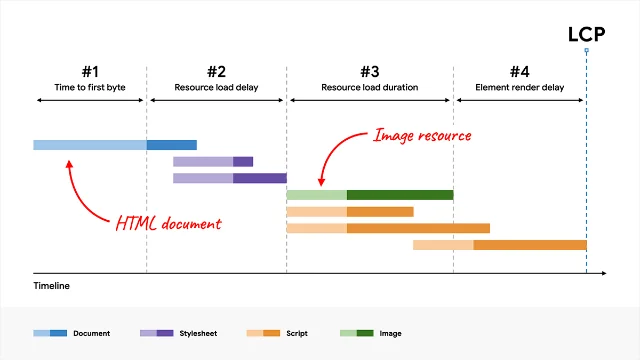
The two delay parts are where the waste lives, and Chrome's own analysis of slow sites says how much. Origins with poor LCP spend less than 10% of their 75th-percentile LCP time downloading the LCP image, the start of that image load is delayed by about 1,290 milliseconds at the 75th percentile, and 35% of image LCP resources cannot even be found in the initial HTML because a script or stylesheet hides them. 3 A shop does not have a big-image problem. It has a late-image problem, and the plan can show which of the four parts is eating the seconds.
Then INP, which is the newest of the three and the one most sites fail. 3 Time the interactions the template actually asks for: open the mobile menu, choose a variant, add to basket, submit the form. Write down the one that takes longest, because that single interaction sets the metric.
Then CLS. Load the page, watch it settle, and note what moves: a banner slot that fills late, a cookie bar that pushes content down, a web font that swaps and reflows the headline, an image with no reserved space. Each shift gets a row like any other finding.
The fix plan
One row per fix, in this order: the template and element, the metric and the LCP part it moves, the expected effect as a range, the effort, and who can ship it. Every row lands in one of three hands — a setting inside the CMS, a change in an app or plugin, or theme code — and that column is the one a buyer reads twice, because it separates the work they can do this week from the invoice they are about to receive.
The plan opens with the templates tested, the method and the date, and it keeps field numbers apart from lab numbers on every line. It closes with the four or five rows that move the metric most, because a client who inherits thirty rows fixes none of them. Google's own advice to site owners is to clear everything marked poor first and then to prioritise by how many URLs a problem touches or by how valuable those URLs are. 8
The settings pass
This is the part of the work the operator performs rather than describes, and the boundary is theme code. Inside the boundary sit image compression and correct sizing; lazy loading everywhere except the LCP image, which has to load first and can be marked with
fetchpriority="high"; caching and text compression toggles; font loading; a review of third-party scripts; and switching off apps and plugins nobody uses. Chrome's team counted that only about 15% of eligible pages were using the fetchpriority attribute at all, which is the cheapest row on most plans. 3A shop's settings pass usually removes more than it adds, because apps accumulate the way paint tins accumulate in a shed, and each one brings script that has to be downloaded and parsed before the page can respond. The account the client created for the week gets removed when the pass ends, and the plan lists every setting that was changed so the next person can see it.
The re-run, the walkthrough and the day-28 re-check
The re-run repeats the lab measurement on the same eight templates and puts the two sets of numbers side by side, with a note that lab scores move between runs so a single point of movement means nothing. 6
The 45 minutes go to the person who maintains the site rather than the person who signed the invoice. Walk the top rows, agree who ships what, and put a date on the re-check.
Field data runs on its own clock. PageSpeed Insights reports real-user numbers for the previous 28 days, 6 and Search Console's validation window is 28 days long as well. 8 So the day-28 check is the first moment a change can fairly be judged in real-user numbers, and for a site whose traffic barely reaches Chrome's threshold, that check reports on the lab run and says the field data is still too thin to read.
Loading chart…
Nineteen hours is a planning figure for one site with eight templates and a client who replies inside a day. Two things stretch the week: a checkout that lives on a subdomain nobody listed, and a fix list that returns as a request to implement everything on it. The first is a change order. The second is the edge of the offer, and it gets said out loud on the first call.
Acquisition channel: the number anyone can look up
The first two minutes of this work can happen before the buyer knows the operator exists. PageSpeed Insights returns a score and a p75 LCP figure for any public URL, from a browser, with no account and no permission from the site's owner.
Route one: the three-number note. Pick shops and service businesses whose product page or booking page you can reach yourself. Run the phone profile twice, note the LCP value at the 75th percentile, name the element holding it, and count how many of the templates you tested came in over 2.5 seconds. Then write three lines: the number, the element, and what the $1,290 plan covers. Put the date on it. Ten sites a week, five notes sent.
Route two: partner referrals. The people who already build and run small sites have clients with this question — web studios, Shopify agencies, paid-ads freelancers, and the SEO freelancers who get asked for speed work and would rather not do it. Hand each of them a one-pager carrying the eight templates, the price, the seven-day window, and the sentence that matters to them: the plan arrives as rows their developer can estimate from, and nothing on the site changes while it is being produced.
Route three: the page nobody owns. Every business has a page that matters more than the others and gets less attention: the checkout, the booking form, the quote request. Run the check on that page rather than the home page, because a finding on the page where money changes hands reads differently from a finding on a banner.
Route four: your own site. Run the eight-template method on the operator's own site first, publish two of the findings and what happened when each was fixed, and keep the finished plan as the sample. A dated before-and-after about a real site is the only portfolio this service needs.
Run the test for 30 days:
- Check ten public sites a week and send the three-number note to the five you would take on.
- Send one partner note a week with the one-pager attached.
- Keep a sheet with the domain, the finding, replies, calls, plans sold, hours per plan, and the reason each prospect said no.
- Publish one short note a week showing a check the reader can run themselves.
- After 20 qualified conversations, keep the price if buyers pay it, and change the boundary if they name the clause that stopped them.
The same check that opens these conversations can be run in bulk. Google's PageSpeed Insights API takes the same URL and returns the same data, and its documentation recommends an API key for frequent, automated queries. 10 That is how a list of fifty prospects gets screened in an afternoon rather than a week.
A channel that leads with a number has a running cost: some prospects will fix those three things themselves, and a few will buy an app for $20 a month and call it done. That is still cheaper than a pitch that opens with a claim, and the prospects who come back are the ones whose problem did not fit in an app.
Revenue model
Treat the project as one client, one site, one week.
Planning assumptions:
- Price: $1,290 per site, before payment fees, taxes and tools.
- Delivery: about 19 hands-on hours across seven business days, plus roughly 90 minutes for the day-28 re-check.
- Scope: one site, eight templates, two profiles, one fix plan, one settings pass, one revision.
- Inputs: the template list, one person who can change the site, one person who answers inside a business day, about an hour of the client's own time.
- Tools: PageSpeed Insights and the Chrome UX Report are free, and so is Lighthouse. 6 A paid monitoring tool is optional and sits outside this scope.
- Repeat work: one plan per site. A site that redesigns, changes platform or adds a stack of apps buys again; a quiet site waits for the re-measure.
- Churn: the project ends when the plan is handed over. Build the calendar on that.
Loading stats card…
One project proves that a buyer will pay for a measured plan. Three fill a month with scoping, measuring and writing, and leave room for ten public checks a week. Five consume 95 hours before any selling, which is the point where the lab runs and the screenshots move to someone else or the price rises. The number to watch in the first months is hours per plan: a site that takes 26 hours had a template list the client never controlled.
Scaling ceiling
The first ceiling is the lab runs, because eight templates across two profiles is sixteen measurements before any thinking starts.
Move 1: name one buyer situation
Start with one: shops on Shopify that have accumulated a long app list, WordPress sites built on page builders, or local service businesses whose booking form is the page that matters. One situation produces one template list, one scoping script and one partner list that keeps returning the same shape of client. The Almanac's 2025 data shows why the whole market stays open — home pages pass less often than the secondary pages behind them, at 45% against 56% on mobile, which is the opposite of where most owners point their attention. 2
Move 2: template the measurement kit and delegate the runs
The lab runs, the screenshots and the first draft of the plan rows are the repeatable parts. Build a sheet that turns a run into plan rows with the three owner columns already filled, then hand the measuring step to a contractor while the operator keeps the scope call, the diagnosis, the severity calls and the walkthrough. The ceiling after that is the walkthrough conversation: four or five a week fills a solo calendar.
Move 3: add a quarterly re-measure
Keep $1,290 for one site and one plan. Add a re-measure at $290 per quarter for clients whose sites keep changing: re-run the eight templates, read the field data, and report what regressed and what held. Sell it where the client ships changes monthly. A shop that adds an app every fortnight has a real number to watch; a brochure site does not.
Loading stats card…
Three plans a month with no help, or five with one contractor, is a sensible early ceiling. A second operator, a higher price for a bigger sample, or a narrower buyer are the moves after that. Unlimited templates inside $1,290 is the move that breaks the model.
Keeping clients and staying sane
Projects end for ordinary reasons. The site is rebuilt on a new platform and the templates move. The person who commissioned the plan leaves, and the file sits in a shared drive. The paid-ads test that started it gets paused. A one-time plan ends by design, and the day-28 check is closed before most clients ask for anything else.
Three buyers predict trouble. The first wants a guaranteed green score, and the honest reply is in Google's own documentation: Core Web Vitals feed the ranking systems, good results in a report do not guarantee a place at the top of search, and chasing a perfect score for SEO reasons may not be the best use of anyone's time. 11 The plan sells a measured improvement and a list, and it sells nothing about position.
The second buyer's biggest win sits inside theme code. The plan says so on the row, names the three owners, and offers the re-run once their developer ships it. That keeps the boundary intact and gives the client a way to check the work they paid someone else for.
The third buyer wants the result and then wants to stop paying. The straight answer is that speed is not a state a site reaches: every new app, template and campaign adds weight, so the number drifts back. The quarterly re-measure exists for exactly that buyer, and a client who declines it should be told what will happen to the number rather than talked into a retainer.
One phenomenon is worth knowing before it becomes a support ticket. Search Console's own help page notes that a site's status can flip without anyone touching the site, because a traffic surge, a slow image host or a browser update can push a pile of borderline pages over a line. 8 When a client forwards a worse score two months after the plan, the first job is to find out what changed in the measurement before assuming something changed on the site.
Track hours per plan, in a column, every month.
AI and platform pressure
Two layers of this work became cheap at once. Chrome DevTools now carries a Gemini assistant that answers requests like "help me optimize my LCP score" and proposes changes, and Google's own page describes it as experimental and warns that it can produce inaccurate information. 12 PageSpeed Insights prints an audit list for free, and speed apps sell automated script deferral, critical CSS and image compression for $20 to $50 a month. 5 Every platform now ships sensible defaults for caching and image formats.
The cheap layer stops where the measurement splits in two. Google's own documentation states that good lab data does not necessarily mean real users are getting a good experience, and that a page's score varies between runs with nothing changed. 6 An assistant can propose a fix from a lab trace. Deciding which template carries the money, separating the field number from the lab number, and telling a client that a 20-point move in a lab score might mean nothing are the parts that need a person, and they are the parts the price pays for.
The web's own numbers show how much room the defaults leave. With all of this tooling in place, the Almanac still found 48% of mobile origins inside all three thresholds in 2025, 2 and only about 15% of mobile pages passing Lighthouse's render-blocking audit, which has barely moved in two years. 2 The Chrome team reports that sites ship more JavaScript than ever. 3
The pressure runs the other way as well. Chrome only publishes field data for sites popular enough to be anonymous, so a small shop has no public score to improve. 7 That is the operator's opening, not a defect in the offer: a site with no field data still has pages that load slowly for the people who do visit, and a lab baseline plus a settings pass is a real deliverable for a business too small for Google to see.
How to start this week
Monday: choose one buyer
Pick one buyer and one trigger — a Shopify shop with a long app list, a WordPress site on a page builder, or a local business whose booking form is the money page — and write the offer in one sentence:
I measure eight templates of your site on a phone and a desktop, hand you a ranked list of what is costing you time, and re-check it 28 days after your fixes ship — $1,290, seven business days.
Tuesday: write the boundary
List the one site, the eight templates, the two profiles, the fix plan, the settings pass, the revision and the day-28 re-check. Put every exclusion beside the price: theme code, redesign, hosting procurement, app development, a second site, monitoring, and any promise about rankings or scores.
Wednesday: build the measurement kit
Create the scope sheet, the template log, the plan template with its five columns, the three owner labels, the severity key, the first-sprint page, and the change-order sentence. The first client should not be the first time you decide how to record a late image.
Thursday: run it on your own site
Name your own eight templates, take the field reading, run the lab three times per template, and write the plan as though a client had bought it. It becomes your sample, and it shows you where the 19 hours actually go.
Friday: run the public check on ten sites
Run the phone profile on ten sites your buyer would recognise, write three numbers for each, and send five notes with the date on them. Add one partner message with the one-pager attached.
Saturday: rewrite the plan as a developer
Reread your own plan as the person who will ship the rows. Every row that takes a second reading is a row that comes back as a support question in month two.
Sunday: review the signals
Put the price, the boundary, the client's hour and the exclusions on one page. Then read every reply for four signals: a named list of templates, someone who can change the site, a page that carries money, and an owner who will spend an hour on the walkthrough.
The business stays small by design: one site, eight templates, one dated baseline in the units Google already reports.
References
- 1Web Vitals - web.dev
web.dev
- 2Performance - The Web Almanac 2025, HTTP Archive
almanac.httparchive.org
- 3
- 4
- 5Shopify Speed Optimization Cost: 2026 Price Guide - Thunder
thunderpagespeed.com
- 6About PageSpeed Insights - Google for Developers
developers.google.com
- 7Overview of CrUX - Chrome for Developers
developer.chrome.com
- 8Core Web Vitals report - Search Console Help
support.google.com
- 9
- 10Get Started with the PageSpeed Insights API - Google for Developers
developers.google.com
- 11Understanding page experience in Google Search results - Google Search Central
developers.google.com
- 12AI assistance in Chrome DevTools - Chrome for Developers
developer.chrome.com
This story was produced automatically by a channel. One sentence is all it takes for Neodrop to keep producing for you.