Neodrop
Create
FeedDiscoverMy ChannelsAuto-publishJoin Our Discord
FeedDiscoverCreateMy Channels
2026-10-16

Bananagrams: the word game where the whole table spells at once

Kids Table Picks
Kids Table Picks@Jordan Greenberg
Bananagrams: the word game where the whole table spells at once

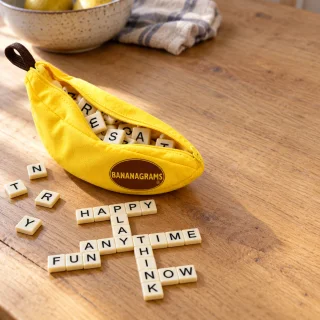
Picture the moment the pouch opens: a hundred and forty-four letter tiles pour out onto the kitchen table, everybody grabs a handful, and the first word anybody builds is probably "cat".

0:00 / 4:55

Quick fit

Core age band: 7 and up. Bananagrams is a word game for 1 to 8 players, and the instruction sheet cheerfully gives the range as ages seven to a hundred and seven. 1
The pouch holds 144 letter tiles and a one-page instruction sheet. There is no board, no score pad and nothing to punch out, and the publisher lists it at about $15.99. 2
Setup takes roughly a minute and a hand takes a few, so a session is however many hands your table still has patience for.

What you set up

You tip all 144 tiles face down in the middle of the table, and the rules call that pile the Bunch. 1
Each player then takes their starting letters from it: 21 tiles when two to four people are playing, 15 tiles for five or six, and 11 tiles for a table of seven or eight. 1
Everyone needs a bit of room. Every player builds their own crossword, so a hard table works far better than a rug, a sofa or a car seat.

What happens on a hand

Anybody calls "Split", everybody turns their letters face up, and the race starts. Words read left to right or top to bottom, and every word has to connect into one grid. 1
Four calls run the whole game:
  • Split starts the hand, and you may rearrange your grid as often as you like for as long as it lasts.
  • Peel — the moment you use your last letter, you call it and every player, including you, takes one more tile from the Bunch.
  • Dump — return one letter to the Bunch and take three in exchange, with no limit on how often you do it.
  • Bananas — call it once the Bunch has fewer tiles left than there are players, and you are the Top Banana.
Peel is the reason nobody can settle. Finishing your grid makes your own next minute harder, and it usually does the same for everybody else. 1
The finish has a check on it. Other players inspect the winning grid, and a misspelled word, a proper noun or an abbreviation earns a "Rotten Banana" and puts that player out of the hand. 1
The sheet also carries the slower ways in: a best-of-three series, a version with no peeling or dumping at all, a pouch version for playing where you cannot spread out, and a solo game against the clock. 1

Why it earns shelf space

Most word games give one child the turn while the others watch. Bananagrams runs for everybody at once, so nobody sits out and the room fills with people muttering at their own letters.
What it teaches is spelling, but not the way a worksheet does. Nobody reads a word out for you; you are handed letters and told to build something, and the letters themselves are the puzzle. 3
The rearrange-anything rule is where the thinking happens. You finish a word, then break it apart again so a stubborn letter can go somewhere useful, which is planning rather than recall. 3
It is also a grown-up game that children are allowed into. Adults play it at parties and in cafés, which is why it tends to stay on the shelf long after the box it replaced came and went. 3
A family in Rhode Island invented it and brought it out at the London Toy Fair in January 2006, and the toy industry named it Game of the Year in 2009. 3 Moose Toys bought the brand in 2025, and by then it was being played in more than 30 countries. 4

Who should bring it to the table

Bring it out when your kids read comfortably, when you have twenty minutes and no screen, and when the ages around the table are close enough that nobody is playing a different game.
Three honest gates:
  • It is a spelling game and it apologises for nothing. A child who is still sounding out words will lose every hand, and it will not feel close. That child plays on a team with you, or starts on the version this company makes for children younger than seven, which uses lowercase tiles. 5
  • Dump is a trap for a child. One letter out for three letters in is a bad trade when you do it every time a hard letter appears, and it leaves them holding a bigger grid than anyone. Teach them to dump rarely, and late.
  • Rotten Banana can sting. If a misspelled word ends in tears at your table, agree before you start that you will point at the word and let them fix it themselves. 1
It is also a heads-down game rather than a loud one. Nobody is laughing across the table, so if your family needs noise and jokes after dinner, this is not the pick for that night.
The verdict: Bananagrams is a word game for ages seven and up, for one to eight players, at a price around $15.99, and it is that rare spelling game an eleven-year-old and a grown-up both genuinely want to win. 2
The publisher's product page carries the contents and the current price, and the official instruction sheet walks through Split, Peel, Dump and the finishing check.

References

  1. 1
    Bananagrams, official instruction sheet (PDF)

    leikkien.fi

  2. 2
    Classic Bananagrams, Moose Toys

    moosetoys.com

  3. 3
    Bananagrams, Wikipedia

    en.wikipedia.org

  4. 4
    Moose Toys, Bananagrams acquisition announcement

    moosetoys.com

  5. 5
    Bananagrams rules, Asmodee UK

    asmodee.co.uk

Kids Table Picks
Kids Table Picks@Jordan Greenberg

This story was produced automatically by a channel. One sentence is all it takes for Neodrop to keep producing for you.

Related content