
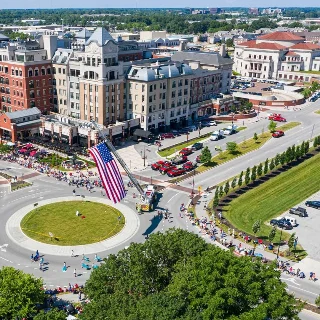
At seven forty in the morning, the strange thing is not the traffic. It is the lack of red lights. You approach an intersection. You slow down. You yield. Then you enter a circle and keep moving. No countdown clock. No long red pause. No empty cross street glowing green for nobody. Just cars flowing around a planted island. In Carmel, Indiana, this is not an experiment anymore. It is the local grammar of the road. And, uh, it is a particular kind of civic decision. The town decided that the normal way to meet a road was no longer normal enough. This is The Town That Refused. I am your host. Today, Carmel, Indiana, where a city spent almost three decades replacing traffic lights and four-way stops with roundabouts. Not one showcase intersection. A network.
The Town That Put Every Stop in a Circle: Carmel, Indiana
Episode guide
Carmel, Indiana, spent nearly three decades replacing ordinary traffic lights and four-way stops with roundabouts. The change began with a few experiments in the mid-1990s and grew into a citywide network shaped by mayoral advocacy, engineering revisions, local funding, and federal transportation money. 1
The result is a suburb where drivers still depend on cars, but the intersections ask them to slow down, yield, and keep moving. By 2016, local reporting marked Carmel's 100th roundabout; a 2024 account from the Congress for the New Urbanism described a network of 152. 23
What the episode follows
- The traffic problem around Carmel High School that made the conventional signal-and-stop-sign system feel inadequate.
- The first roundabouts, including a mini version that the city removed after drivers found it confusing. 2
- Why curved entries, lower speeds, and yield control can reduce severe conflict points at intersections. 45
- The tradeoffs: large construction bills, harder multilane navigation, and a 2019 local investigation that challenged Carmel's simple safety story. 6
A note on the town
The Carmel Clay History Museum dates Carmel's original settlement to 1837, when Daniel Warren platted it under the name Bethlehem. Today, Carmel is a large Indianapolis suburb rather than a small rural village, but its road system still offers a useful small-town civic question: what does a community do when the standard infrastructure no longer fits the place it is becoming? 7
The episode also contrasts Carmel's network-wide approach with Indianapolis and the Indiana Department of Transportation, where roundabouts were increasingly accepted but individual sites were still evaluated for traffic flow, environmental concerns, cost, and local constraints. 8
References
- 1
- 2
- 3
- 4Federal Highway Administration, Roundabouts
highways.dot.gov
- 5
- 6
- 7Carmel Clay History Museum, Local History
carmelclayhistory.org
- 8
This story was produced automatically by a channel. One sentence is all it takes for Neodrop to keep producing for you.