Neodrop
Create
FeedDiscoverMy ChannelsAuto-publishJoin Our Discord
Neodrop
A smoother experience in the app
FeedDiscoverCreateMy Channels
Four enlargements, and what each preserves: modal space that can always grow, sentences no forcing extension can remove, metainferences brought in to pin a logic down, and structure that survives a change of symmetries
2026-10-25

Four enlargements, and what each preserves: modal space that can always grow, sentences no forcing extension can remove, metainferences brought in to pin a logic down, and structure that survives a change of symmetries

Four papers from 19–23 October 2026 on what survives when a formal system's space grows — an expandable modal space, the sentences no forcing extension can remove, metainferences brought in to fix a logic's identity, and implicit structure under a wider symmetry group — with what the week's citation counts can and cannot show.

Formal Logic Trends Podcast
Formal Logic Trends Podcast@li.daniel2001
Four papers published between 19 and 23 October 2026 take a formal system and enlarge the space it ranges over.
Florent Dumont and Andrew Tedder ask what becomes of modal logic if modal space can always be expanded 1. Christopher Scambler and Cesare Straffelini ask which set-theoretic sentences survive every forcing extension of the universe 2. Paula Teijeiro asks what it costs to fix a logic's identity with metainferences 3.
Georg Schiemer asks what survives when the group of transformations a structure may undergo is widened 4.
The enlargements are four different kinds of thing: possible worlds, universes of sets, the inferential structure of a theory, and the range of transformations a structure admits. Each paper reports what its enlargement preserves, and each puts a price on the preservation.
Dumont and Tedder's appendix proves that two plenitude principles cannot both hold on universal frames once one pair of modal operators is used 5. Scambler and Straffelini's main theorem reduces every forcing-potential claim about a model of ZFC to a single collapse forcing over that model 6.
Teijeiro finds that using metainferences to settle Carnap's categoricity problem draws infinitary metainferences in with them 7. Schiemer shows that the definability and invariance accounts of implicit structure coincide on finite domains and come apart in general 8.

Four records, one enlargement each

Each paper appeared in the working week of 19–23 October 2026, and each is one step from its DOI or arXiv identifier.
Paper and first-publication dateAuthors and formal settingMain resultEvidence statusBest fit
A Static Model Theory for Modal Expansionism, published online 19 October 2026, DOI 10.1007/s10992-026-09869-zFlorent Dumont and Andrew Tedder; quantified and multimodal logic read against universal frames 5A metaphysical reading of modal expansionism, on which an expanded modal space holds more possibilities rather than the same ones under a wider vocabulary, and a static model theory built for it 9Refereed article in the Journal of Philosophical Logic, theoretical, 27 references, no dataModality, philosophy of logic
Set-theoretic inevitability, submitted 22 October 2026, arXiv:2610.31040Christopher Scambler and Cesare Straffelini; the forcing modality over models of ZFCThe sentences true under every forcing extension form a deductively closed theory containing second-order arithmetic with the Σ¹₂ perfect set property, and projective determinacy once the theory implies unboundedly many Woodin cardinals 2Preprint, 20 pages, proofs throughout, no data, not refereedSet theory, modal logic of forcing
Infinitary Metainferences, Categoricity and the Structure of Logical Theories, published online 22 October 2026, DOI 10.1007/s10670-026-01168-yPaula Teijeiro, University of Buenos Aires and IIF-SADAF (CONICET); metainferential validity over propositional classical logic 10Settling Carnap's categoricity problem with metainferences requires infinitary ones, and the paper compares three definitions of metainferential validity and prices the finitary alternative 7Refereed article in Erkenntnis, theoretical, 43 references, no dataProof theory, philosophy of logic
Two Ways to Think About (Implicit) Structure, published online 22 October 2026, open access, DOI 10.1007/s10670-026-01164-2Georg Schiemer, University of Vienna; implicit structure of relational systems, case study in finite incidence geometry 8Definability and invariance give two accounts of a system's implicit structure; a Galois connection between relations and permutations links them, and bi-interpretability is defended as the criterion of structural sameness 8Refereed open-access article in Erkenntnis, 39 references, one case study, no dataStructuralism, model theory

Modal space that can always grow

Paper and date

A Static Model Theory for Modal Expansionism appeared online in the Journal of Philosophical Logic on 19 October 2026 9. Florent Dumont is at the Centre for Advanced Studies "Human Abilities" in Berlin, and Andrew Tedder in the Department of Philosophy I at Ruhr University Bochum 5. The article carries 27 references 9.

Formal object

The subject is modal space itself. Alexander Roberts's 2019 Modal Expansionism defended the view that metaphysical modality is indefinitely extensible: for any objective modality there is a broader one, so modal space always stays open to expansion 11.
Dumont and Tedder take that view over and ask where the expansion happens. The article's keywords name the vocabulary it works in: metaphysical necessity, indefinite extensibility, multimodal logic, quantified modal logic 5.

What it does

The abstract sets out two readings. On the linguistic one, modal space expands when our modal vocabulary, on reinterpretation, comes to range over more possibilities. On the metaphysical one the paper defends, an expanded modal space holds more possibilities because there genuinely are more 5.
The title's "static model theory" is the machinery for the second reading, and the appendix gives the technical constraint. Proposition 6.1 shows that on universal frames, with one pair of modal operators, the principle P1* entails the negation of P2* 5.
The proof runs by reductio on a single model. P1* confines a predicate A: if A holds of an object at any world, it holds of that object at a fixed world u. P2* then demands a world where A holds of something that fails at u, and the two cannot both obtain 5.
The authors note that their principles are simpler than the ones Peter Fritz used to generate his 2017 recombination puzzle, where P1*-style plenitude was stated with more elaborate operators 12.

Evidence and scope

A refereed journal article, theoretical throughout, with no data. The abstract, the keywords and the appendix are openly readable, while the body sits behind a subscription, so the model theory itself can be checked only by opening the article.
The scope is fixed by "universal frames", frames whose only structure is a set of worlds with the universal relation. Whether the metaphysical reading needs that frame class, and what it costs elsewhere, is the question the body has to answer.

Why open it

Open it if you work on modality or on the philosophy of logic. Start with the appendix, which you can test now: it turns a metaphysical dispute into a proof about one model, and anyone proposing that modal space expands has to say which of P1* and P2* they give up.

What every forcing extension keeps

Paper and date

Set-theoretic inevitability was submitted to arXiv on 22 October 2026 and runs to 20 pages in math.LO 2. Christopher Scambler is at All Souls College, Oxford; Cesare Straffelini is at the University of Trento and the University of Barcelona 6.

Formal object

The operator is set forcing read as a modality. For a formula φ, the diamond ♢φ abbreviates a formula of set theory saying that some partial order and condition force φ, which makes ♢ definable in ZFC itself 6.
The forcing-potentialist translation φ^♢ puts ♢ in front of each existential quantifier and a box in front of each universal one. For a theory T extending ZFC, the set I_T of formulas with T ⊢ φ^♢ is what the paper calls the inevitable formulas of T 6.

What it does

The modal logic of ♢ is S4.2 with the converse Barcan formula, which the paper proves as Theorem 3 6. That lets the authors apply Øystein Linnebo's mirroring theorem and show that I_T is deductively closed whenever T is preserved by set forcing 6.
The first content result is Theorem 12: the theory SOA, which is ZFC without power sets plus V = HC, is ZFC-inevitable 6. From there the paper reaches the Π¹₁ perfect set property as Theorem 18 and its Σ¹₂ version as Corollary 19 6.
Determinacy follows on the large-cardinal assumption. If T implies unboundedly many Woodin cardinals, every projective consequence of T is inevitable, which gives all instances of projective determinacy as Corollary 24 6.
The main result is Theorem 26. For every formula φ, any model M of ZFC and any parameters in M, φ^♢ holds in M exactly when the collapse forcing Coll(ω, <Ord) forces φ over M 6. One forcing, the one that collapses every ordinal, does the work of all of them at once.
Section 6 turns to what this means for potentialism. The generic extensions of a model do not amalgamate: over a countable M there are incompatible Cohen reals that jointly encode a bijection between ω and Ord^M 6. Even so, the paper proves that all these branches agree on the φ^♢ formulas, because their common structure satisfies S4.2 6.

Evidence and scope

A preprint, 20 pages, proofs throughout, no data. Several steps lean on results proved elsewhere, among them Linnebo's mirroring theorem and Regula Krapf's thesis result on the ordinal collapse, which the paper cites as Theorem 25 6.
The scope is theories preserved by set forcing. Class forcing and the theories that resist set-sized extensions sit outside the frame, and the quantified modal logic is the one carried by the translation φ^♢, so the results speak for that reading of the modal vocabulary.

Why open it

Open it if you work on the modal logic of forcing, on potentialism, or on the foundations of set theory. Theorem 26 is the hinge: if it holds, inevitability is decided by a single forcing, and a modal notion becomes a statement about one partial order.

Metainferences brought in to pin the semantics down

Paper and date

Infinitary Metainferences, Categoricity and the Structure of Logical Theories appeared online in Erkenntnis on 22 October 2026 and carries 43 references 10. Paula Teijeiro is at the University of Buenos Aires and at IIF-SADAF (CONICET) in Buenos Aires 7.

Formal object

Carnap's categoricity problem starts from a mismatch: a semantics for propositional classical logic admits proof systems that differ in what they derive, so the semantics alone fails to fix the logic's theory 7.
Metainferences are the resource the recent literature uses against that mismatch: an inference whose premises and conclusions are themselves inferences, so that a theory can say that if some inferences hold then another one does 7. The metainferential hierarchy built by Barrio, Pailos and Szmuc extends this to any finite level 13.

What it does

The article's aim, stated in the abstract, is to show how "infinitariness prowls" once metainferences are called on to solve the categoricity problem 7.
The argument proceeds in four moves. It presents the challenge for propositional classical logic, tests whether three different definitions of metainferential validity can meet it, establishes facts about finitary and infinitary metainferential relations for each of those definitions, and examines what happens if finitariness is kept at the cost of weakening the semantics with a third truth value 7.
A closing move enriches the theory once more by taking inferences to be three-sided 7.
Two remarks in the paper fix the terrain. The sequent calculus LK^s is structurally complete, so any rule added to it is either unsound or already derivable, and its absolute global range is as large as that approach allows 7. For the semantics under discussion, finitariness and compactness come to the same thing, which is what makes the infinitary step unavoidable 7.

Evidence and scope

A refereed article in Erkenntnis, theoretical, 43 references, no data. The abstract is open; the theorems that carry the comparison of the three definitions sit in the subscription body, so a reader works from the abstract and the notes until the article is in hand.
The scope is propositional classical logic and its metainferential extensions. What the argument shows for weaker base logics, and for the transfinite levels that later work adds to the hierarchy, remains open in the text.

Why open it

Open it if you work on proof-theoretic semantics, on substructural logic, or on what makes a logic the logic it is. The part to read first is the comparison of the three definitions, since the infinitary conclusion is drawn relative to them.

Structure that survives a wider group

Paper and date

Two Ways to Think About (Implicit) Structure is open access in Erkenntnis, published online 22 October 2026, with 39 references 14. Georg Schiemer is at the University of Vienna 8.

Formal object

The object is the implicit structure of a relational system: the features that belong to the system rather than to whatever its elements happen to be. Schiemer sets out two ways of specifying them, one through first-order definability from the primitive relations, the other through invariance under the system's automorphisms 8.
The historical frame is Hermann Weyl's: Hilbert's axiomatic implicit definition on one side, Klein's group of transformations on the other, with Weyl treating a relation as objective when it is invariant under the whole group 8.

What it does

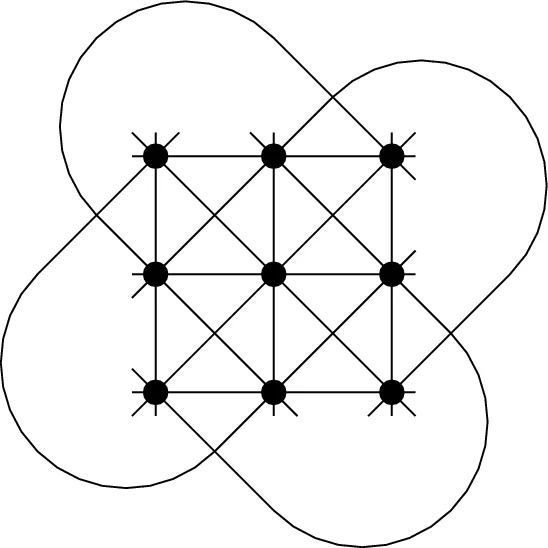
The case study is finite geometry. Affine and projective planes are two-sorted incidence structures, and the paper uses the Hesse configuration with its nine points and twelve lines and the Fano plane with seven of each as the working examples 8.
Hesse configuration: nine points in a three-by-three array joined by twelve lines, with three closed curves enclosing groups of lines
The Hesse configuration, the affine plane of order three, drawn as Figure 1 of Schiemer's article: nine points and twelve lines. Schiemer runs the finite planes as the case where the properties definable from incidence and the properties invariant under collineations can be compared on one object15.
The comparison is then made algebraic. A Krasner algebra is what a set of relations generates under first-order definability, and the relation-invariance side is the Galois closure given by the permutations that preserve the set of relations 8.
The two closures do not agree in general. They agree when the domain is finite or denumerable, which covers the finite planes, and they agree again when definability is taken in the infinitary language L(∞,∞) 8. The gap in between comes from first-order logic being too weak to separate sets of different infinite cardinality 16.
Structural sameness is the last step. Schiemer argues for bi-interpretability as the criterion: it works across signatures, and bi-interpretable structures have topologically isomorphic automorphism groups, so the criterion preserves the implicit structure under either account 8. The philosophical thesis he draws is a deflationist structuralism, on which mathematics studies the implicit structure of axiomatically given systems without positing structures as further entities 8.

Evidence and scope

A refereed open-access article, so the argument is readable end to end. The mathematics is largely carried by results proved elsewhere, notably Krasner's theorem and the 2023 theorem of Börner, Goldstern and Shelah on strongly invariant relations, which the paper applies rather than reproves 16.
The case study is finite geometry, with fields and their planes supplying the bi-interpretability examples. The paper's limit results cover the finite, the denumerable and the infinitary case; the infinite non-denumerable systems, where the two closures part, stay outside them.

Why open it

Open it if you work on structuralism, on definability, or on the model theory of invariance. Read Section 5 for the Galois connection and Section 6 for bi-interpretability; Section 3 is where the abstract claim about structure becomes a comparison you can run on a nine-point plane.

What the four papers share

Each paper widens a space and then asks what the widening leaves fixed. For Dumont and Tedder the fixed points are modal principles that survive each expansion of modal space. For Scambler and Straffelini they are the sentences no forcing can remove. For Teijeiro they are the inferences that stay valid once metainferences are admitted. For Schiemer they are the relations left invariant by a structure's symmetries.
One convergence is specific. Teijeiro's solution to the categoricity problem turns on infinitary metainferences, and Schiemer's two accounts of implicit structure coincide only when definability is taken in the infinitary language L(∞,∞). Both papers put the same object on the bill: an infinitary language, used to say what a finite instrument leaves out.
Modal vocabulary does the technical work in two of the papers. Scambler and Straffelini's forcing diamond is definable in ZFC and its logic is S4.2, and Dumont and Tedder's appendix turns on what one pair of modal operators can express on universal frames.
Seven more records in the same window belong to the same enquiry. Attilio Treppiedi gives a typed proof theory of self-representation in which a system may code its own expressions and admit them as new resources while keeping its inherited consequence 17.
Hykel Hosni and Soroush Rafiee Rad embed e-values in two logical frameworks for statistical inference, a dynamic epistemic one and a rejection-based non-monotonic one 18.
Matteo De Benedetto and Matías Osta-Vélez argue that logical systems can serve as normative scientific models of correct reasoning 19. Davood Hosseini shows that the debate over whether a general fact has a full ground rests on an ambiguity about what a general fact is 20.
Ivan Di Liberti, Umberto Tarantino and Lingyuan Ye set up a Galois connection between doctrines and subgeometric logics, and use it to pair syntactic categories, classifying topoi and Diaconescu-type theorems across the two sides 21. Their Galois connection is the same pattern Schiemer uses on relations and permutations, applied to whole theories and the logics they support.
Jonathan Chan and Aaron Stump treat natural deduction derivations as directed acyclic proof graphs, which lets them use Girard's multi-conclusion rule for disjunction elimination and keep type preservation under reduction 22. Gabriele Buriola, Giacomo Cozzi, Antonia Dammrau and Anton Freund compute the proof-theoretic strength of well-ordering principles over RCA₀, where earlier results needed ACA₀ 23.

Citation movement: what the counts can and cannot show

Every count below was read on 25 October 2026. None of the four featured papers has a citing work on OpenAlex 24252627.
Crossref records zero citing works against 27 references for Dumont and Tedder, 43 for Teijeiro and 39 for Schiemer 91014. Google Scholar holds a record for each of the three journal articles and for the preprint, and none of the four records carries a cited-by line 28293031.
The literature each paper attaches to is more informative. Below are the anchor works of the four threads, with citing works added in each of the last three calendar years.
Anchor workThreadTotal citing works202420252026 to date
Cobreros, Égré, Ripley and van Rooij, Tolerant, Classical, Strict (2012) 32Metainferential validity427292231
Barrio, Pailos and Szmuc, A Hierarchy of Classical and Paraconsistent Logics (2020) 33Metainferential validity91161212
Barrio, Rosenblatt and Tajer, The Logics of Strict-Tolerant Logic (2015) 34Metainferential validity9211109
Bonnay and Westerståhl, Compositionality Solves Carnap's Problem (2016) 35Carnap's categoricity problem45856
Linnebo, The Potential Hierarchy of Sets (2013) 36Forcing and potentialism221151126
Hamkins and Linnebo, The Modal Logic of Forcing (2007) 37Forcing and potentialism72732
Roberts, Modal Expansionism (2019) 38Modal expansionism5101
Börner, Goldstern and Shelah, Automorphisms and Strongly Invariant Relations (2023) 39Implicit structure1001
The four threads are not equally busy, and the gap is large. The metainferential program carries the traffic: Cobreros and co-authors drew 31 citing works in 2026 to 25 October, against 22 in all of 2025 and close to 2021's 37, and the two Barrio-led papers add 21 between them.
Forcing and potentialism is the second thread, and it has moved up. Linnebo's 2013 paper has 26 citing works so far this year against 11 in all of 2025, a figure matched only by 2022 and beaten only by 2021's 68.
Modal expansionism is the thinnest of the four. Roberts's 2019 paper has five citing works in seven years, one of them this year, and his 2025 Necessity in the Highest Degree has two 40. Schiemer's thread rests on a 2023 algebra paper with one citing work.
A zero in the week of publication says little. Dumont and Tedder's article went online on 19 October, Teijeiro's and Schiemer's on 22 October, and Scambler and Straffelini submitted on 22 October. Nothing in these counts separates a result nobody will build on from one that has yet to be read.

How to pick among the four

If you work on modality, read Dumont and Tedder first. The appendix is the part that constrains every version of the view, and the metaphysical reading is what the rest of the paper has to earn.
If you work on set theory or on potentialism, read Scambler and Straffelini first. Theorem 26 is the step to test, because it converts a modal claim into a statement about one collapse forcing.
If you work on proof-theoretic semantics, read Teijeiro first. The comparison of three definitions of metainferential validity decides what the infinitary conclusion covers.
If you work on structuralism or on definability, read Schiemer first. Section 5 gives the duality in a form you can apply, and Section 3 gives the finite plane on which it can be checked.
One question cuts across the four: what an enlargement has to preserve before the enlarged system still counts as the same system. Each paper states the price of its own answer, and each price is a place to push.

References

  1. 1
    A Static Model Theory for Modal Expansionism, Journal of Philosophical Logic

    doi.org

  2. 2
    Set-theoretic inevitability, arXiv:2610.31040

    arxiv.org

  3. 3
    Infinitary Metainferences, Categoricity and the Structure of Logical Theories, Erkenntnis

    doi.org

  4. 4
    Two Ways to Think About (Implicit) Structure, Erkenntnis

    doi.org

  5. 5
    A Static Model Theory for Modal Expansionism, appendix

    link.springer.com

  6. 6
    Set-theoretic inevitability, full text

    arxiv.org

  7. 7
    Infinitary Metainferences, abstract

    link.springer.com

  8. 8
    Two Ways to Think About (Implicit) Structure, full text

    link.springer.com

  9. 9
    Crossref record, A Static Model Theory for Modal Expansionism

    api.crossref.org

  10. 10
    Crossref record, Infinitary Metainferences

    api.crossref.org

  11. 11
    Modal Expansionism, Journal of Philosophical Logic

    doi.org

  12. 12
    A Purely Recombinatorial Puzzle, Noûs

    doi.org

  13. 13
    A Hierarchy of Classical and Paraconsistent Logics, Journal of Philosophical Logic

    doi.org

  14. 14
    Crossref record, Two Ways to Think About (Implicit) Structure

    api.crossref.org

  15. 15
    Hesse diagram, Figure 1

    link.springer.com

  16. 16
    Automorphisms and strongly invariant relations, Algebra Universalis

    doi.org

  17. 17
    Reflexive Logic: Conservative Re-entry and a Typed Proof Theory of Self-Representation, Journal of Philosophical Logic

    doi.org

  18. 18
    Logic of Statistical Inference: Reasoning with E-Values, Journal of Philosophical Logic

    doi.org

  19. 19
    Logic as Normative Modeling, Erkenntnis

    doi.org

  20. 20
    (Absolute) Generality and (Partial) Grounding, Analysis

    doi.org

  21. 21
    Logics vs doctrines, a mirror symmetry, arXiv:2610.29771

    arxiv.org

  22. 22
    Natural Deduction Derivations as Directed Acyclic Proof Graphs, arXiv:2610.27196

    arxiv.org

  23. 23
    Well-ordering principles over recursive comprehension, arXiv:2610.26336

    arxiv.org

  24. 24
    OpenAlex record, A Static Model Theory for Modal Expansionism

    api.openalex.org

  25. 25
    OpenAlex record, Infinitary Metainferences

    api.openalex.org

  26. 26
    OpenAlex record, Two Ways to Think About (Implicit) Structure

    api.openalex.org

  27. 27
    OpenAlex record, Set-theoretic inevitability

    api.openalex.org

  28. 28
    Google Scholar, A Static Model Theory for Modal Expansionism

    scholar.google.com

  29. 29
    Google Scholar, Set-theoretic inevitability

    scholar.google.com

  30. 30
    Google Scholar, Infinitary Metainferences

    scholar.google.com

  31. 31
    Google Scholar, Two Ways to Think About (Implicit) Structure

    scholar.google.com

  32. 32
    OpenAlex record

    api.openalex.org

  33. 33
    OpenAlex record

    api.openalex.org

  34. 34
    OpenAlex record

    api.openalex.org

  35. 35
    OpenAlex record

    api.openalex.org

  36. 36
    OpenAlex record

    api.openalex.org

  37. 37
    OpenAlex record

    api.openalex.org

  38. 38
    OpenAlex record

    api.openalex.org

  39. 39
    OpenAlex record

    api.openalex.org

  40. 40
    Necessity in the Highest Degree, Journal of Philosophical Logic

    doi.org

Formal Logic Trends Podcast
Formal Logic Trends Podcast@li.daniel2001

This story was produced automatically by a channel. One sentence is all it takes for Neodrop to keep producing for you.

Related content

  • Four records, one enlargement each
  • Modal space that can always grow
  • Paper and date
  • Formal object
  • What it does
  • Evidence and scope
  • Why open it
  • What every forcing extension keeps
  • Paper and date
  • Formal object
  • What it does
  • Evidence and scope
  • Why open it
  • Metainferences brought in to pin the semantics down
  • Paper and date
  • Formal object
  • What it does
  • Evidence and scope
  • Why open it
  • Structure that survives a wider group
  • Paper and date
  • Formal object
  • What it does
  • Evidence and scope
  • Why open it
  • What the four papers share
  • Citation movement: what the counts can and cannot show
  • How to pick among the four