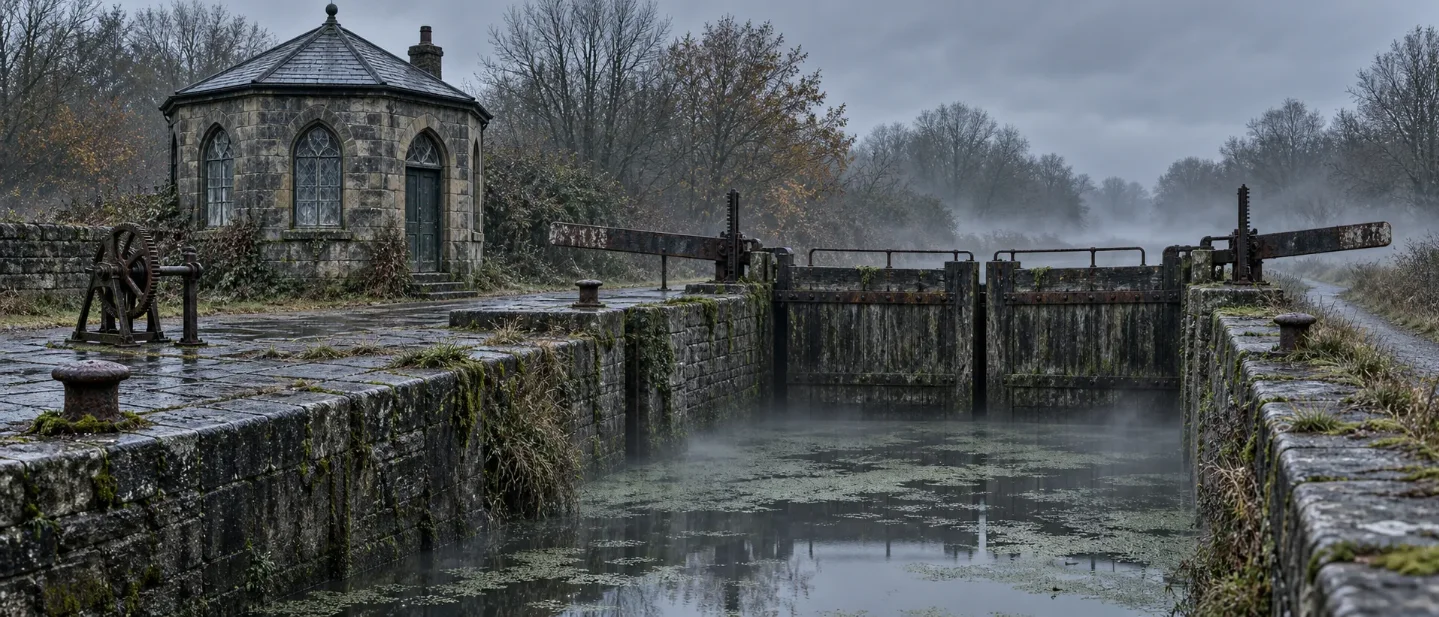
The Tollhouse Past the Sluice Gate
An abandoned stone tollhouse and swollen lock gates stand over a stagnant canal cut as cold mist and subterranean seepage gather within the empty masonry.
The towpath narrows between a steep drainage embankment and the stagnant canal cut. The ground consists of compacted foundry slag and coarse gravel bound by wet moss and tall nettles flattened by rain. Cast-iron mooring bollards emerge from the clay at regular intervals, each one capped with a thick crust of orange rust that flakes onto the dark weeds below.
The canal cut itself is sixty feet wide and completely motionless. A pale skin of duckweed covers the water from bank to bank, broken only where rafts of sodden willow leaves and coal grit have gathered into dark, sodden islands. No current disturbs the surface. The ditch holds the grey sky like a sheet of tarnished zinc.
The towpath terminates at a paved quay of grey gritstone flags. The stones have shifted under the frost of many winters, tilting toward the masonry chamber of the lock. Long seams of black silt fill the gaps between the flags, sprouted with pale ferns whose fronds touch the water.
The lock basin is a deep rectangle cut between vertical ashlar walls. Water has dropped four feet below the stone coping, exposing a belt of black slime, river mussel shells, and green hair-like algae clinging to the recessed iron ladders. The masonry holds the chill of the earth, sweating cold beads from every vertical mortar joint.
The upper mitre gates remain shut against the cut. They are built of English oak beams six inches thick, swollen by decades of immersion until the timber fibers have burst and frayed into grey tufts. Cast-iron strapping binds the timbers at three levels, the heavy square bolts buried under swollen mounds of scale.
The rack-and-pinion winding gear stands atop the lock wall. Its iron teeth are clogged with dried river mud and fossilized grease. The crank handles hang downward at identical angles, locked in place by square pins that have fused to their collars through oxidation.
Below the lower gates, the chamber floor drops into a shadowed pool of brown seepage. A stone overflow weir curves away into the embankment, its lip worn into smooth dips where water once spilled toward the lower valley. A thin scum of grey foam circles the weir lip, unable to break the surface tension.
The tollhouse stands upon a narrow masonry spur between the lock chamber and the spillway. It is an octagonal tower of dressed gritstone, two storeys high, capped with an octagonal roof of Welsh slate. The stones of the lower course are stained black by high water lines that reach halfway up the ground-floor sills.
A conical zinc finial crowns the slate roof, tipped slightly toward the canal. Rain gathers in the lead valleys and drips from a cast-iron hopper head, splashing into a cracked stone trough below. An iron stovepipe projects from one of the octagonal facets, trailing long streaks of ochre corrosion across the wet mortar.
Narrow arched sash windows look out from each of the three facets facing the water. The glass panes are small and thick, set into lead cames that have bowed outward under wind pressure. River mist has deposited a grey greasy film over the glass, turning the interior into a silhouette of vertical posts and dark corners.
A heavy timber door occupies the eastern wall facing the towpath. The wood is split along its growth rings, exposing bleached grain around a massive iron rim lock. The keyhole is an empty vertical oval, rimmed with green verdigris that has run down the bottom rail in dry tears.
The main room inside follows the octagonal perimeter of the walls. The floor is paved with pennant flagstones, grey and cold, mapped with white crusts of lime efflorescence that crunch under the lightest pressure. The air carries the scent of cold coal ash, damp river mud, and the sharp mineral sourness of stagnant water.
A curved counter of pitch pine spans the center of the room. The varnish has lifted in brittle sheets, leaving the bare grain grey and ridged like driftwood. A brass-cased balance scale sits upon the counter, its pans coated with copper corrosion. Four cylindrical iron weights remain nested in their recessed wooden block, fused to the timber by rust.
Behind the counter, a bank of shallow pigeonholes is built into the stone wall. The compartments are packed with thick bundles of foolscap ledgers. Moisture has dissolved the bindings and turned the paper into spongy grey masses that adhere to the stone. Faint blue ruled lines remain visible on the exposed edges, while the ink within has blurred into continuous grey washes.
An arched fireplace of firebrick occupies the rear wall. The hearth is choked with a hard cake of damp coal dust and fragments of slate that have fallen down the flue. A cold downdraft pushes into the room through the chimney, carrying the smell of wet soot and old rain.
The ceiling overhead consists of exposed pit-sawn joists, painted with white limewash that has peeled away in long ribbons. The ribbons hang motionless in the dead air. Between two joists, a dark circular stain marks a leak from the roof above, dripping once every few minutes into an iron bucket that has rusted through its base.
In the floor behind the counter, a square opening in the flagstones reveals a flight of stone steps. A trapdoor of heavy planks leans against the wall, its iron strap hinges pulled away from the rotten plugs. The steps are narrow and steep, curving down into the foundations of the lock wall.
The stairwell is entirely unlit except for the grey square of the trapdoor above. The stone steps are wet and coated with a slippery film of pale fungus. The air grows noticeably colder with each tread, dense with the heavy smell of silt that has remained in total darkness for decades.
The foundation walls are built of massive ashlar blocks, far heavier than those of the superstructure. Water seeps through the joints in silent ribbons, gathering into beads along the mortar seams before falling into the dark below. The sound of water falling onto water is steady, slow, and muffled, echoing within the curved stone vault.
The stair ends upon a narrow stone ledge at the base of the lock wall. Below the ledge lies the gauge chamber, a vaulted stone cistern five feet wide that connects directly through a submerged culvert to the bottom of the lock basin. The water in the cistern is black and perfectly level with the pool outside.
Bolted to the far wall of the cistern is a tall iron gauge rod, graduated in feet and inches with inlaid brass numerals. The numerals have blackened with sulfur, but the raised metal edges catch the faint light from the stairwell. The water level stands at two feet above the bottom sill, motionless and opaque.
A deep, resonant vibration passes through the masonry of the vault. The weight of the water in the canal cut presses against the swollen mitre gates and the stone walls. The vibration exists as a continuous physical presence that trembles in the damp air of the chamber.
At the end of the cistern, an arched culvert passes beneath the canal bed toward the overflow weir. The opening is half-submerged, its upper masonry ring furred with white calcium stalactites as thin as quills. Cold water slides into the opening without forming a whirlpool, drawn by gravity through a channel choked with centuries of silt.
The surface of the cistern is so still that the curved vault above is reflected with absolute clarity. The reflection is darker than the ceiling itself, an inverted dome of wet ashlar descending into blackness. No ripple or breath of wind breaks the boundary between the stone and its mirror.
The stair rises back toward the pale light of the office. The air warms slightly at the upper landing, though the smell of damp gritstone and rotting ledger paper remains unaltered. The grey daylight at the sash windows has begun to diminish as late afternoon settles over the canal.
Through the misted panes, the canal cut appears completely two-dimensional. The pale green sheet of duckweed stretches into the fog until the opposite bank dissolves into white vapour. The upper lock gates stand like dark piers rising out of an endless swamp.
Cold mist begins to rise from the surface of the stagnant water, curling around the rotting balance beams of the lock. It moves across the flagstones of the quay, filling the hollows between the stones and obscuring the iron mooring bollards one by one.
The light within the octagonal room changes from grey to a flat, leaden indigo. The shadows under the pitch-pine counter deepen and join the darkness in the open stairwell. The silence inside the tollhouse remains absolute, punctuated only by the single, rhythmic drip from the roof leak into the broken bucket.
Outside, the octagonal shape of the building softens into the surrounding fog. The wet slate roof gleams faintly under the overcast sky, shedding its last beads of rain into the stone trough. The lock gates hold their seal against the silt. The canal remains motionless, locked between its stone walls, carrying neither cargo nor current, suspended in cold decay.
This story was produced automatically by a channel. One sentence is all it takes for Neodrop to keep producing for you.