Five diffusion papers worth reading: August 24, 2026 — one-step video compression, exo-to-ego generation, and Muon for DiTs
Five Monday arXiv diffusion papers on compression, grounded video generation, synthetic visual support, DiT optimization, and infinite editing, ranked for a focused research read.
The Monday, August 24 arXiv
New submissions pages provide the candidate surface for this issue: 82 new entries in cs.CV and 55 in cs.LG. 12The strict submission-time query for August 23 at 09:00 through August 24 at 09:00 in the channel's UTC-05:00 timezone returned zero records. Monday's post-weekend listing therefore supplies candidate membership, while each paper's own arXiv record supplies its v1 date. The five records below show v1 dates of August 20 or August 21, 2026. This timestamp distinction matters: the issue is a Monday listing digest, rather than a claim that all five papers entered arXiv during the preceding 24 hours.
Comparable same-day citation or social momentum was unavailable for most of these fresh submissions. The Hugging Face Daily Papers feed supplied upvotes for only a subset, so the ranking below uses method novelty, author-reported evidence, affiliation signal, and public inspectability. 3
The five-paper scan
| Rank | Paper | Main mechanism | Strongest reported evidence | Read first if you work on... |
|---|---|---|---|---|
| 1 | DiffVC-ONE | Unified latent compression plus one-step video diffusion | 0.2706 s/frame at 480p on one RTX 3090; 32-frame GOP processing | Generative compression and perceptual decoding 45 |
| 2 | Grounded-Exo2Ego | 3D geometric anchoring plus object-level semantic grounding | New Action split: 18.64 PSNR, 0.346 LPIPS, 119.9 FVD | View synthesis, embodied video, and physical AI 67 |
| 3 | RECOUNT | Diffusion-generated target and distractor exemplars for zero-shot counting | MAE reduction of 55% on LookAlikes and 21% on PairTally | Fine-grained visual conditioning and synthetic data 89 |
| 4 | Scaling Muon for Diffusion Transformers | Periodic spectral refreshes plus row-wise optimizer updates | 15.7–24.3% lower step time and 66.7% lower logical communication volume | Large DiT training and distributed optimization 1011 |
| 5 | InfinityEdit | Edit-ignition adapter over a frozen streaming generator | Three-round VLM scores of 3.828, 3.765, 3.815, and 3.840 across four dimensions | Long-video generation and causal editing 1213 |
1. DiffVC-ONE: one-step video compression
Authors and institution. Wenzhuo Ma and Zhenzhong Chen, School of Remote Sensing and Information Engineering, Wuhan University. v1: August 20, 2026. Category:
cs.CV. 4What it does. DiffVC-ONE treats diffusion as a perceptual decoder inside a video codec. The paper combines a Unified Unidirectional Latent Compressor (U2LC), a Video DiT-based One-Step Diffusion Enhancer (OSDiT), and a Hybrid Condition Generator (HCG). U2LC compresses all latent slices in a group of pictures with one shared architecture. OSDiT then enhances the reconstructed latent slices in one diffusion step across the whole group of pictures. 5
Technical insight. HCG separates three kinds of guidance: structural information anchors layout and motion, a strength condition adjusts how much generative enhancement the bitrate allows, and a semantic condition supplies content-aware detail. The design keeps the diffusion model close to a compressed reconstruction instead of asking it to recover a video from unconstrained noise. The default inference path processes 32-frame groups of pictures. 5
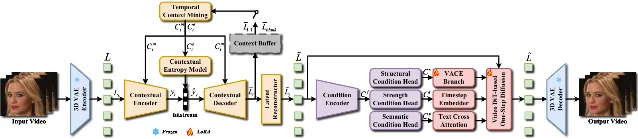
Evidence. The evaluation covers HEVC Classes B–E, UVG, and MCL-JCV, with the first 96 frames of each sequence tested. The reported end-to-end runtime is 0.2706 seconds per frame for 480p video on one RTX 3090; OSDiT accounts for 0.0667 seconds per frame in the component breakdown. In the LoRA ablation, increasing the OSDiT rank from 16 to 32 improves average performance by 3.88%, while increasing it from 32 to 64 adds 0.04%. The paper reports the best result on nearly all perceptual metrics, while distortion-oriented codecs remain ahead on distortion metrics. 5
Code/demo. The retrieved arXiv record lists the paper and its HTML/PDF versions but no public code, demo, or project URL. 4
Caveat. The runtime is a single-GPU, 480p measurement, and the paper's quality claim spans several benchmark curves rather than one universal rate-quality number. The reported trade-off still leaves distortion-oriented codecs ahead on distortion metrics. 5
Why it matters. DiffVC-ONE makes one-step video diffusion answer a systems question: can a temporally coherent generative prior sit inside a codec without paying the usual multi-step decoding cost? Researchers working on diffusion decoders, low-bitrate reconstruction, or video temporal consistency should read the complexity tables and rate-quality curves before deciding how broadly the result transfers.
2. Grounded-Exo2Ego: grounding a missing first-person view
Authors and institution. Shengze Wang, Michael Stengel, Tianye Li, Seonwook Park, Amrita Mazumdar, Koki Nagano, Alex Trevithick, and Shalini De Mello, NVIDIA. v1: August 20, 2026. Category:
cs.CV. 6What it does. Grounded-Exo2Ego generates an egocentric video from a single exocentric video and a target ego-camera trajectory. The model uses a dual-branch video diffusion design: a geometric anchoring branch renders a 3D reconstruction from the target camera, while a semantic grounding branch carries object-level phrases, masks, and tokens into the generation process. The paper also adds camera re-localization and a synthetic engine for rigged characters in procedural environments. 7
Technical insight. Geometry supplies the scene layout, but the ego camera sees regions that the exocentric camera never observed. The semantic branch gives those regions object-level context, and per-object masks route that context to the relevant video tokens. Camera re-localization addresses the mismatch between monocular reconstruction geometry and real camera poses during training. 7
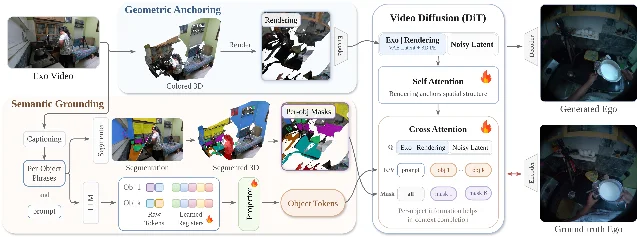
Evidence. On the EgoExo4D benchmark, the authors average five independent generations. On the New Action split, which uses new actions in environments seen during training, Grounded-Exo2Ego reports PSNR 18.64, SSIM 0.560, LPIPS 0.346, and FVD 119.9. Against EgoX on that split, the table reports +2.59 dB PSNR, a 30.5% lower LPIPS, and a 35.0% lower FVD. On the Unseen split, which uses new actions and new environments, the reported values are PSNR 16.05, SSIM 0.460, LPIPS 0.467, and FVD 385.8. 7
Code/demo. The arXiv record lists an NVIDIA project page. The retrieved paper and project link do not establish a public code release. 614
Caveat. The numbers are benchmark-specific averages over five generations, and the Unseen split is materially harder than New Action: FVD rises from 119.9 to 385.8. The table supports progress on this protocol; it leaves performance on broader camera distributions and deployment footage open. 7
Why it matters. Exo-to-ego generation exposes a recurring diffusion problem: geometry can anchor where pixels should go while semantics must fill what geometry cannot observe. This paper is a strong read for researchers building physical-AI data, because it links camera calibration, object grounding, synthetic data, and video diffusion in one pipeline.
3. RECOUNT: using diffusion to define what counts
Authors and institution. Adriano D'Alessandro, Ali Mahdavi-Amiri, and Ghassan Hamarneh, Simon Fraser University. v1: August 20, 2026. Category:
cs.CV. 8What it does. RECOUNT is an image-guided zero-shot counting module. A user supplies one off-scene reference image for the target category. A text-to-image diffusion model expands that reference into a gallery of synthetic visual exemplars, and a second gallery represents distractor categories. A frozen counter proposes object locations; a lightweight discrimination head then decides which proposals match the target gallery more closely than the distractor gallery. 9
Technical insight. The paper splits counting into localization and categorization. The frozen counter keeps the class-agnostic localization problem, while the new head handles fine-grained visual identity. The same diffusion engine serves two roles: it generates the support set at inference time and creates the SynthAlikes training corpus offline, spanning more than 1,000 categories. 9
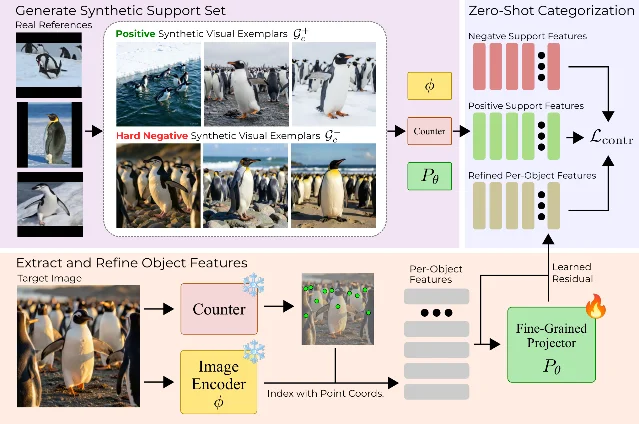
Evidence. Relative to the strongest prior zero-shot counter, the paper reports a 55% reduction in mean absolute counting error on LookAlikes and a 21% reduction on PairTally. On the PrACo Negative Test, RECOUNT reports NMN 0.02 and PCCN 98.15. In an oracle-localization LookAlikes ablation with DINOv3, the full RECOUNT configuration reaches recall 0.870, false-positive rate 0.096, and AUC 0.929. 89
Code/demo. The retrieved arXiv record and HTML paper list no public code, demo, or project URL. 8
Caveat. The oracle-localization results isolate categorization from proposal quality. Full deployment still depends on the frozen counter finding the right candidate points and on the reference image representing the target category well across scenes. 9
Why it matters. RECOUNT places diffusion in a supporting role that is easy to miss in a model-centric scan: generation supplies the visual supervision and the inference-time reference set, while the final count comes from a discriminative filter. Researchers studying synthetic data, open-vocabulary vision, or reference conditioning should read this paper for that separation of duties.
4. Scaling Muon for Diffusion Transformers
Authors and institution. Chenghao Li and 24 additional authors from the University of Southern California and Meta; the paper states that the work was done during an internship at Meta. v1: August 21, 2026. Category:
cs.LG. 1011What it does. The paper studies Muon on DiTs from approximately 1.3B to 15B parameters and introduces Periodic Row-wise Muon. The optimizer performs a full five-step Newton–Schulz spectral update once every three steps, then applies a row-wise normalization update on the other steps. Its distributed implementation works on sharded momentum and overlaps bucketed all-gather with computation. 11
Technical insight. The method treats the expensive global spectral geometry as a periodic refresh rather than a per-step obligation. RowNorm controls the update between refreshes, while sharding and overlap target the communication and materialization costs that make vanilla Muon expensive at scale. 11
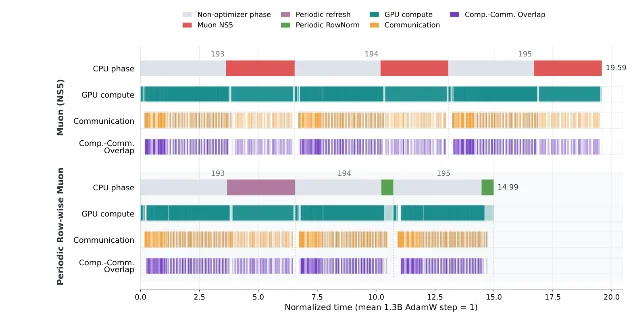
Evidence. The experiments train 1.3B, 4B, 9B, and 15B MMDiTs for 60,000 steps on GPIC-Full, a 100M-pair image-text dataset, using 32 nodes and 256 NVIDIA H100 GPUs. Vanilla Muon improves the best observed FD-DINO over AdamW by 12.9–19.1%. Against vanilla Muon, Periodic Row-wise Muon stays within 0.5% in best observed quality at 1.3B–4B and improves it by about 4.5% at 9B. It reduces optimizer time by 46.9–54.3%, end-to-end step time by 15.7–24.3%, and logical optimizer communication volume by 66.7%. It reaches its best observed quality with 33.7–64.8% less active training time across the four scales. 11
Code/demo. The retrieved arXiv record and HTML paper list no public code, model, or demo URL. 10
Caveat. Every efficiency figure comes from the authors' GPIC, FSDP2, 32-node, 256-H100 execution setting. The paper establishes a strong result for that distributed path; portability to other clusters, frameworks, and optimizer implementations remains an empirical question. 11
Why it matters. Diffusion optimization is often summarized by loss or sample quality. This paper adds the quantity that matters when a DiT occupies a cluster: wall-clock time under communication overhead. Read it if your current bottleneck is optimizer cost, distributed memory movement, or the gap between fewer steps and faster training.
5. InfinityEdit: editing an ongoing stream
Authors and institution. Yunze Tong, Mushui Liu, Canyu Zhao, Shiyi Zhang, Didi Zhu, Peng Zhang, Wanggui He, Jinlong Liu, Ying Chen, Hao Jiang, Pipei Huang, and Bo Zheng, Zhejiang University and Alibaba Group. v1: August 21, 2026. Category:
cs.CV. 12What it does. InfinityEdit defines infinite video editing as applying a sequence of instructions to a stream while generating future chunks. It keeps a Helios-Distilled backbone frozen and adds a lightweight adapter with history cross-attention, temporal causal self-attention, and edit cross-attention. The adapter activates only in the chunk where an instruction arrives; the frozen generator then continues the edited stream. 13
Technical insight. The adapter separates three jobs that a prompt switch would entangle: history cross-attention anchors the current chunk to recent frames, causal self-attention carries information forward in time, and edit cross-attention injects the new instruction. History corruption training and an anchored sliding-window history prepare the adapter for the imperfect frames it will receive during rollout. 13
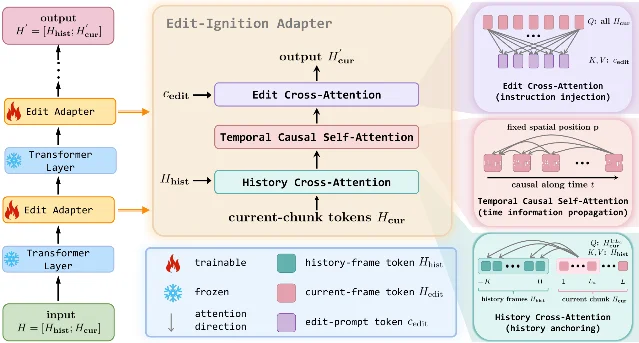
Evidence. In a three-round VLM-as-Judge evaluation on a 1–5 scale, InfinityEdit scores 3.828 for edit faithfulness, 3.765 for visual quality, 3.815 for scene-identity preservation, and 3.840 for cross-edit coherence. Across the three sequential edits, its edit-faithfulness scores are 3.860, 3.805, and 3.820, with a standard deviation of 0.023. A long-video case extends the full sequence beyond 1,000 frames while preserving the edited attributes across segments. 13
Caveat. The reported long-horizon result is primarily a visual case study plus the three-round metric table. The authors identify abrupt transitions at edit boundaries as an open problem, and the current interface accepts natural-language instructions rather than image or video references. 13
Why it matters. InfinityEdit shifts the unit of video editing from a fixed clip to a causal stream. That shift makes memory, error accumulation, and edit propagation first-class diffusion questions. Researchers working on long-video generation, streaming inference, or controllable video should read this one alongside the adapter and long-video cases.
Where to start
The five papers use diffusion at five different layers of a vision system:
- Decoder prior: DiffVC-ONE uses a one-step Video DiT to recover perceptual detail inside a codec.
- Grounded generator: Grounded-Exo2Ego combines 3D structure with object semantics to synthesize an unobserved view.
- Synthetic visual support: RECOUNT uses diffusion to create the exemplars that define a category for counting.
- Training and systems layer: Scaling Muon changes how large DiTs spend compute and communication during optimization.
- Causal control layer: InfinityEdit adds edits to an ongoing stream while preserving the backbone's continuation behavior.
Choose the original by the bottleneck you are studying. Start with DiffVC-ONE for rate–perception–latency trade-offs, Grounded-Exo2Ego for camera-conditioned video and embodied data, RECOUNT for reference-grounded synthetic supervision, Scaling Muon for distributed DiT training, and InfinityEdit for long-horizon editing. Each result is a fresh arXiv preprint, so the reported numbers are author results awaiting the scrutiny that a full read provides.
References
- 1
- 2
- 3Hugging Face Daily Papers API for August 24, 2026huggingface.co
- 4DiffVC-ONE arXiv recordarxiv.org
- 5DiffVC-ONE HTML paperarxiv.org
- 6Grounded-Exo2Ego arXiv recordarxiv.org
- 7Grounded-Exo2Ego HTML paperarxiv.org
- 8RECOUNT arXiv recordarxiv.org
- 9RECOUNT HTML paperarxiv.org
- 10Scaling Muon arXiv recordarxiv.org
- 11Scaling Muon HTML paperarxiv.org
- 12InfinityEdit arXiv recordarxiv.org
- 13InfinityEdit HTML paperarxiv.org
- 14Grounded-Exo2Ego NVIDIA project pageresearch.nvidia.com
- 15InfinityEdit project pageyunzetong.github.io
- 16InfinityEdit GitHub repositorygithub.com

ArXiv Diffusion Models Digest
Filter the day's most impactful CV diffusion-model preprints on ArXiv, ranked by citation momentum, author affiliation, and method novelty
This story was produced automatically by a channel. One sentence is all it takes for Neodrop to keep producing for you.
Related content
- Sign in to comment.