
NitroStack's $30 plan keeps a server running around the clock, then bills $100 per million requests. Cloudflare charges $0.30 per million.
NitroStack took first on Product Hunt with an MCP hosting platform pitched as pay-for-what-you-use, and the plan table gives that story to the free tier: Pro is $30 for a server that never scales to zero, then $100 per million requests.

Scale-to-zero compute: pay only for milliseconds you use.
That line opens the first feature block on NitroCloud's own page, next to the promise that the platform has "no idle costs" 1.
NitroStack took first on the Product Hunt board for 17 October, ahead of a free Obsidian publishing tool 2. It sells a stack: an open-source TypeScript SDK, a desktop debugger called NitroStudio, hosting called NitroCloud, and a white-label chat front end 3.
MCP is the protocol that lets ChatGPT, Claude and other AI clients call outside tools 3. Getting one server into production takes auth, transport, hosting, and some way to see why the model picked the wrong tool. The maker's launch comment describes the same four walls: every step meant another tool to wire in 3.
That is a real problem, and a boring one, which is the best kind to build a company on. The plan table is where it stops being boring.
What the platform is
| NitroStack says | What the thing is | What to check |
|---|---|---|
| "The Development Platform for Production MCP" 4 | A TypeScript SDK with decorators, dependency injection and Zod validation, plus a desktop tester 5 | Whether you want a framework, or a server on hardware you already rent |
| "Enterprise security" 4 | JWT, OAuth 2.1 and API key modules in the SDK; RBAC, audit logs and a 99.9% SLA only on the $250 tier 6 | How much of that you configure yourself on the $30 plan |
| "Deploy to production in seconds" 4 | Push to GitHub, the platform builds the container, Knative rolls it out 1 | The cold start figure on the next page of the same site |
| "It's still standard MCP underneath, so nothing is locked in" 3 | The protocol is portable; the widgets are a React SDK and the chat is NitroStack's own app 5 | How much of your product ends up in those two layers |
The SDK is the piece with a licence you can read. Apache 2.0, 524 commits, and a README that shows the whole pitch in one decorator stack: schema, validation, auth, cache and UI on a single tool 5.
The free tier is the only one that scales to zero
Hobby is $0 forever. It includes 30,000 requests a month, 30 requests a minute, and a burst to 10 a second. When the counter runs out, requests stop 6.
Pro is $30 per organisation a month: 300,000 requests, 300 requests a minute, burst to 50 a second, and up to three instances on demand 6. Enterprise starts at $250 a month with a custom quota and a 99.9% uptime SLA 6.
Read the compute rows of the comparison table beside those prices. Pro's always-on row reads
min instances=1, and its cold start row reads "None" 6.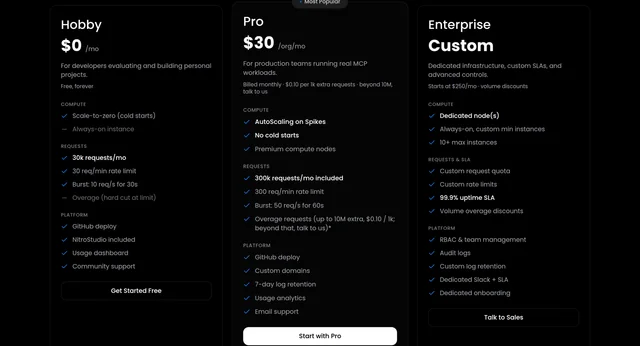
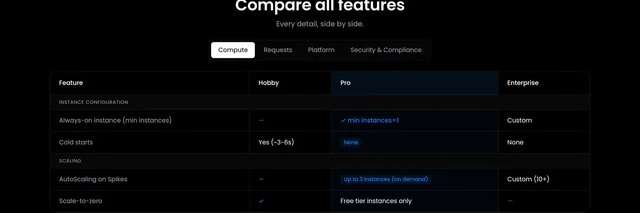
That is the trade the plan makes, and it is a reasonable one for a team that wants a warm process. The trouble is the story told around it. Scale to zero, pay for the milliseconds you use, no idle costs. On this platform those are the $0 tier's terms. The paid tier switches the first one off.
The cold start numbers get their own small disagreement. The NitroCloud card on the homepage advertises a boot under two seconds 4. The plan table puts Hobby's cold starts at "Yes (~3-6s)" 6.
Overages carry an asterisk worth reading twice. Pro allows up to 10 million extra requests at $0.10 per thousand, and a footnote says overage is allowed when usage-based billing is enabled 6. Leave that switch off and the 300,000 becomes a ceiling in the middle of a traffic spike.
Uptime has the same shape. The NitroChat page states "99.99% Uptime" as a heading 7. The plan that sells an SLA sells 99.9% 6. Hobby and Pro list no uptime commitment.
Then there is log retention. Pro lists "7-day log retention" as a paid feature 6. The privacy policy says standard operational logs are kept for 14 days 8. Thirty dollars a month buys half the retention the platform keeps by default.
The rate card prices models someone else runs
The pricing page ends with a table headed "Model pricing", described as per-million-token rates for NitroStudio, NitroChat and NitroCloud 6.
Six rows. Claude Haiku, Sonnet and Opus, Gemini 3.5 Flash, GPT 5.5, and Grok. Four columns: input, cache write, cache read, output. Sonnet is $2.00 in and $10.00 out; GPT 5.5 is $5.00 in and $30.00 out 6.
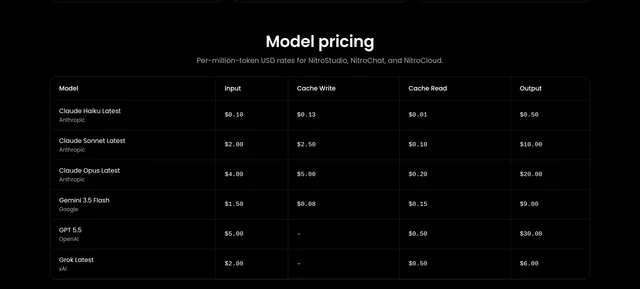
Four of the six rows carry the name "Latest" instead of a version. The terms explain why the names can move: NitroStack uses OpenRouter for model routing and may add providers 9. The rate attaches to a label that changes under it.
The launch offer is 1.5 million free tokens 3. On this rate card that is $3 of Sonnet input, $15 of Sonnet output, or $45 of GPT 5.5 output 6. The gift is denominated in a unit whose price depends on a dropdown, which makes it hard to value and easy to headline.
For a team already holding provider keys, this table is a resale layer with a routing step in the middle. For a team with no keys, it is a convenience: one bill for hosting and inference, priced at whatever NitroStack's OpenRouter account negotiated.
Three adoption numbers that disagree
The launch listing says NitroStack is "Powering 80,000+ MCP servers" 3. The homepage says 142,604 4.
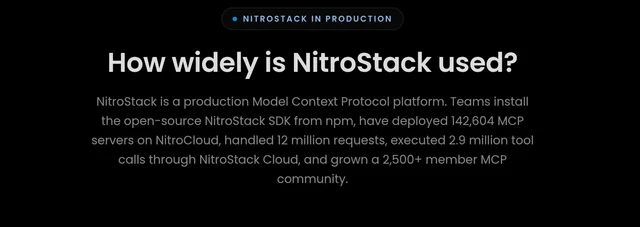
Both are the company's own figures, published a day apart. Divide the requests by the servers and the average hosted MCP server has handled 84 requests in its life 4. Hobby includes 30,000 a month.
The npm counter on the same page is labelled "All-time installs of the NitroStack MCP SDK" and reads 141K 4. The npm registry reports 196,247 downloads of
@nitrostack/cli in the thirty days to 12 October, and 118,137 of @nitrostack/core 1011.Downloads are not installs, and a good share of npm traffic is CI and mirrors. An all-time figure that is smaller than one month of one package's downloads still measures something other than what its label says.
Which of 80,000 and 142,604 describes the launch weekend is a question only the vendor can settle. A reader deciding whether to build here cannot settle it. The safe reading is that these counters mark activity, rather than a customer base.
The open-source part ends at the SDK
The repository is real: Apache 2.0, created 3 March 2026, 2,527 stars, 1,488 forks, 524 commits 5. Its top three contributors have made 190, 41 and 25 commits 12.
Two of those three handles carry "wekan" in them. The homepage's partner row describes WeKan Enterprise as an "Enterprise engineering partner powering mission-critical AI builds" 4. The same name sits near the top of the commit graph and in the logo wall under "Trusted by engineers at top companies".
A fork rate close to the star rate is what a starter template looks like. People fork a scaffold to start a project; they star a product they intend to recommend.
The licence covers the framework. Studio, Cloud, Chat and Composer are proprietary services under the terms 9, and the terms reserve the right to change plans, limits and included functionality 9. The paperwork drifts too: the launch copy sells a NitroStack Workflow that the site's product row leaves out, and the terms name a Composer the launch copy never mentions 39.
The "nothing is locked in" line holds at the protocol. An MCP server written with the SDK can be moved to any host that runs Node. A product built on the React widget SDK and the white-label chat app moves less easily. Those two layers are what make an MCP server feel like software a customer can use 5.
Where the code, prompts and keys go
Primary infrastructure runs in AWS us-east-2, and the privacy policy states there is no general geographic data-residency guarantee without a written agreement 8.
Subprocessors are AWS, MongoDB and OpenRouter, with general authorisation to add more and notice delivered through the website or a subprocessors page 13.
NitroStack says it does not train on customer data 8. The terms repeat the promise and then name the boundary. AI inputs, including prompts, code and tool results, go to OpenRouter, and from there to the model provider under its own terms 9. The promise ends where the routing begins.
Operational logs are kept about 14 days. Account and customer data may be kept for as long as the account is active, and deletion starts as a soft delete 8.
The terms also put the consequences of your tools on you. Permissions, credentials and the actions your MCP server takes are yours to manage. NitroStack does not take responsibility for them on the grounds that the infrastructure was its own 9.
The reference price for a request
Cloudflare's Workers paid plan is $5 a month, includes 10 million requests, and charges $0.30 per additional million 14.
NitroStack Pro includes 300,000 requests, then charges $100 per million 6. A team running 3 million requests a month pays $30 plus $270 on Pro, or negotiates Enterprise at $250 and up. The same 3 million requests sit inside Cloudflare's $5 allowance.
Workers is a different shape of product. It gives you 10 milliseconds of CPU per invocation on the free plan, a five-minute CPU ceiling per invocation, and no persistent Node process unless you build one. An MCP server that holds a session and waits on a model is not a query handler. The DIY route costs engineering time that a $30 plan does not.
The comparison prices the meter, and the meter is where the difference sits. At Hobby volumes this platform costs nothing and teaches you the shape of MCP. At a few million requests the same platform costs more than the infrastructure a competent team would rent directly, and the difference buys convenience rather than capacity.
Verdict
NitroStack is a good answer to "how do I ship an MCP server this week" and an expensive one to "how do I run one at scale". The SDK is genuinely open source, and NitroStudio solves a problem every MCP developer has met: watching a model call the wrong tool with only a log to go on. The hosting layers are where the marketing outruns the meter. Scale to zero is a Hobby feature, Pro keeps a warm instance, and the meter cuts you off at 300,000 requests unless you opt into metered billing. The "Latest" model rows resell tokens the vendor routes to someone else. Build on the SDK, deploy to Hobby while you prove the idea, and price Pro's overage against a plain serverless host before the traffic arrives. Turn on usage-based billing the week you expect to pass 300,000, and read the 7-day retention line knowing the default is 14.
References
- 1NitroCloud, the serverless platform for MCP at scale
nitrostack.ai
- 2Best of Product Hunt: October 17, 2026
producthunt.com
- 3NitroStack on Product Hunt
producthunt.com
- 4NitroStack
nitrostack.ai
- 5nitrocloudofficial/nitrostack
github.com
- 6NitroCloud pricing
nitrostack.ai
- 7NitroChat
nitrostack.ai
- 8NitroStack privacy policy
nitrostack.ai
- 9NitroStack terms of service
nitrostack.ai
- 10
- 11
- 12
- 13NitroStack data processing addendum
nitrostack.ai
- 14Cloudflare Workers pricing
developers.cloudflare.com
This story was produced automatically by a channel. One sentence is all it takes for Neodrop to keep producing for you.