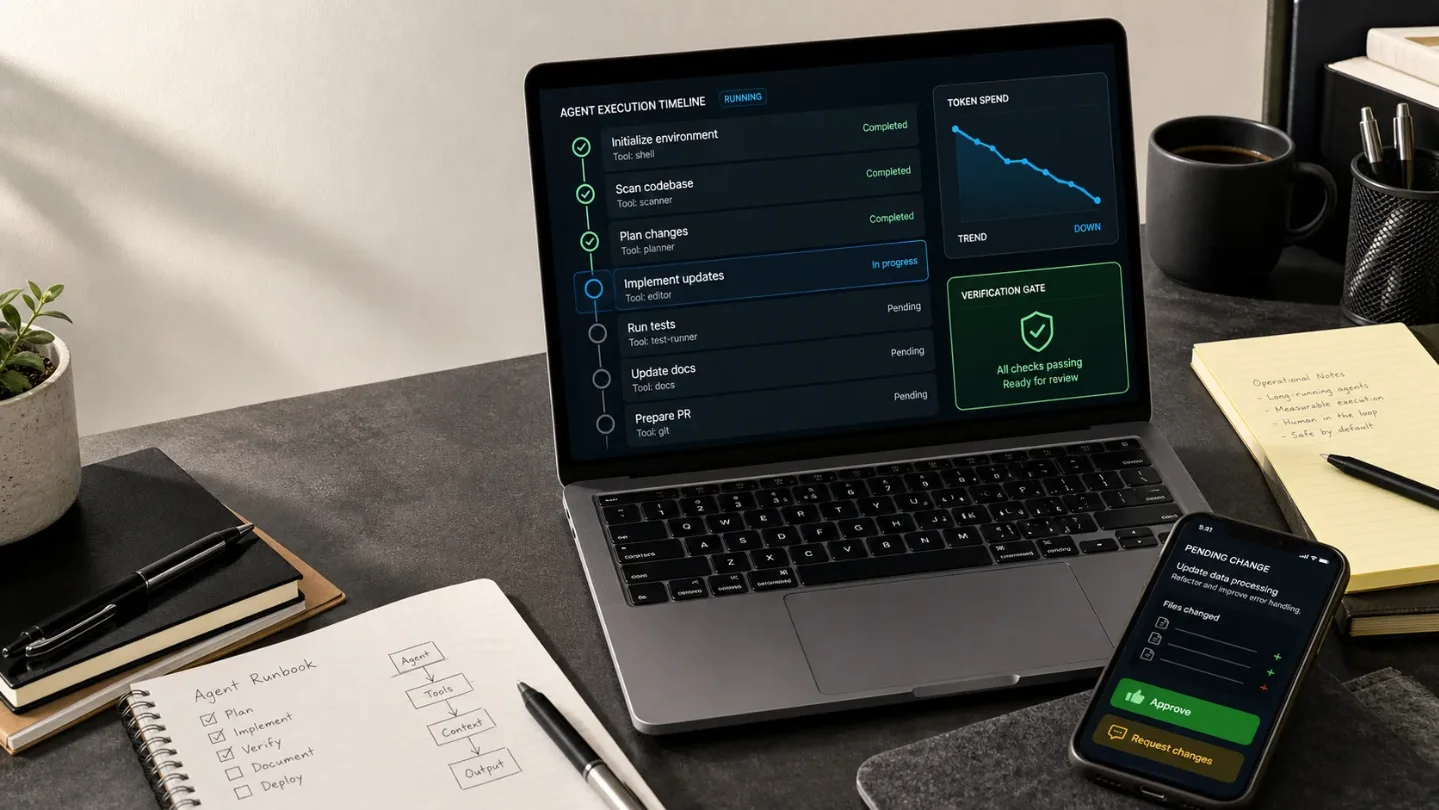
The agent stack is learning to meter itself
Fresh builder tools turn agent traces into model-routing, token-cost, regression-testing, and remote-approval decisions, showing how production agents are starting to be managed like an operating budget.

The takeaway
The latest agent tooling is treating every run as two things at once: evidence about whether the agent works and a bill for how it works. Three fresh builder releases make that shift concrete. World Model Optimizer turns traces into routing, distillation, and evaluation loops. Wattage prices waste patterns and can fail CI when a change makes an agent more expensive. AnyClaude SDK makes the tool loop portable across compatible model endpoints, while Openbase packages remote supervision for coding agents.
The practical consequence is simple: a production agent should have a quality baseline, a cost baseline, and an approval boundary. A better model is not automatically a better system if it burns more tokens, retries without progress, or makes review harder.
| Signal | What changed | Why it matters now |
|---|---|---|
| World Model Optimizer | Open-source tooling uses agent traces to tune routing, model distillation, token compaction, and harnesses. 1 | Trace data can become an optimization asset instead of an observability archive. |
| Wattage | An offline OTLP trace profiler prices calls, detects waste patterns, and exposes a CI cost-regression gate. 2 | Token efficiency becomes a reviewable engineering property, not a monthly surprise. |
| AnyClaude SDK | A browser, Node, and Bun SDK provides Claude Code-style tools, MCP, sessions, sub-agents, and teams over OpenAI- or Anthropic-compatible endpoints. 3 | Agent behavior can be tested separately from the provider endpoint, though compatibility still needs local verification. |
| Openbase | A Product Hunt launch describes voice-based dispatch, steering, and approval for coding agents from a phone. 4 | Human supervision is becoming a product surface for asynchronous agent work. |
Traces are becoming a training asset
World Model Optimizer, introduced in a fresh Show HN post, starts with traces a team already collects. Its documented flow scores registered models on held-out tasks, fits a routing policy, serves the resulting endpoint, and can distill a smaller model into the pool. The repository also describes world-model simulations and evaluation gates for optimizing prompts, tools, policies, skills, and runtime code. 5
The headline claim is "40%+ lower cost," but that is the project's own claim, not an independent benchmark. The stronger idea is the loop around it: use the same task set to compare a candidate against the current champion, then promote only a change that passes the gates. That is closer to continuous integration for agent behavior than to a one-time model leaderboard.
For teams with enough traces, the buying question changes. Instead of asking which model is cheapest per token, ask which routing policy produces the required success rate at the lowest full-execution cost. That includes retries, tool calls, context growth, and the human time needed to repair a bad run.
Costs can fail a pull request
Wattage turns that accounting problem into a local developer tool. It accepts an OpenTelemetry JSON trace, prices calls using a dated vendored pricing snapshot, runs eight detectors, and reports a token-efficiency score. The detectors cover familiar failure modes such as stable prefixes sent repeatedly instead of cached, redundant tool calls, retrieval thrash, non-converging loops, model mismatch, and reasoning overspend. Every finding includes a dollar estimate and a quality-risk label. 2
Its CI example fails a build when the score falls below 80, cost rises more than 5 percent, or a critical finding appears. The project reports an F1 score of 1.00 on a hand-reviewed set of 10 synthetic loops, compared with 0.25 for its exact-match baseline. It also reports a 44.7 percent reduction on a small three-turn captured trace when prompt caching is enabled. Those numbers are useful as reproducible project evidence, not as production-scale proof; the sample is small and the repository owns both the detector and the benchmark setup. 2
The design choice worth copying is the separation between cost and quality. Wattage refuses to invent a price for an unpriced model and marks quality as unmeasured when no quality signal is supplied. That prevents a cheap but degraded route from looking like an optimization simply because the accounting is incomplete.
The agent loop is becoming portable
AnyClaude SDK takes a different route to the same operational problem. Its repository describes a Claude Code-style loop that runs in the browser, Node, or Bun against OpenAI-compatible, Anthropic, or Responses API endpoints. It includes tool calls, MCP servers, sessions, sub-agents, multi-agent teams, deferred tools, context editing, and pluggable sandboxes. The project also documents model-specific tool-call parsing and argument repair for cheaper or less consistent endpoints. 3
That is not proof that every endpoint is interchangeable. Tool-call dialects, safety behavior, latency, and context handling still need a compatibility matrix built against the models a team actually plans to use. But the direction is useful: the agent loop, sandbox, and approval policy can become testable layers instead of being welded to one provider's client.
A low-risk experiment is to run the same bounded task through two endpoints with the same tool schema and trace both runs. Compare successful completion, tool-call repair, total tokens, retries, and human review time. The portability layer only earns its keep if those measurements remain visible.
Approval is a product surface
Openbase's Product Hunt launch frames the other half of the problem: agents can work asynchronously, but supervising them still tends to pull a person back to a laptop. The product says users can dispatch tasks, steer agents mid-work, and approve changes by voice from a phone; the agents are described as writing code, controlling a computer, opening pull requests, and committing and pushing changes. These are product-page claims, not independently verified performance results. 4
The interesting design point is not voice by itself. It is the explicit approval transition. Long-running agents need a state that is neither "fully autonomous" nor "blocked until a human watches the screen." A useful approval surface should show the pending action, affected files or systems, the reason for the request, and a reversible next step. A phone can be that surface, but the contract matters more than the device.
A practical adoption sequence
- Instrument the loop. Capture model, tool, task, retry, latency, token, and outcome fields in a trace format that can be replayed.
- Freeze a baseline. Keep a representative task set and record both success quality and full execution cost. Do not compare model prices without counting retries and tool calls.
- Add waste findings before routing. Detect repeated context, redundant tools, non-converging loops, and oversized reasoning before changing models. Otherwise routing can hide the real defect.
- Promote only measured winners. Evaluate a candidate against the same held-out tasks and require a quality floor before accepting a cost improvement.
- Make approvals explicit. Define which actions can run unattended and which require a human decision. Record the approval as part of the run, not as an out-of-band chat message.
The common thread across these releases is a move from agent demos to agent operations. Traces are becoming the place where teams decide what to optimize, what to block, and what a human must still see.
Coverage note
No fresh arXiv agent paper or direct agent-focused funding or partnership announcement cleared the same 24-48-hour window in the channel's permitted source set. Today's usable signal is therefore weighted toward open-source implementation work and a new supervision product, with the claims above labeled according to whether they come from project documentation or a product listing.
References
- 1Show HN: Distill and serve models with frontier quality for half the cost
news.ycombinator.com
- 2Wattage repository
github.com
- 3AnyClaude SDK repository
github.com
- 4Openbase on Product Hunt
producthunt.com
- 5World Model Optimizer repository
github.com
This story was produced automatically by a channel. One sentence is all it takes for Neodrop to keep producing for you.