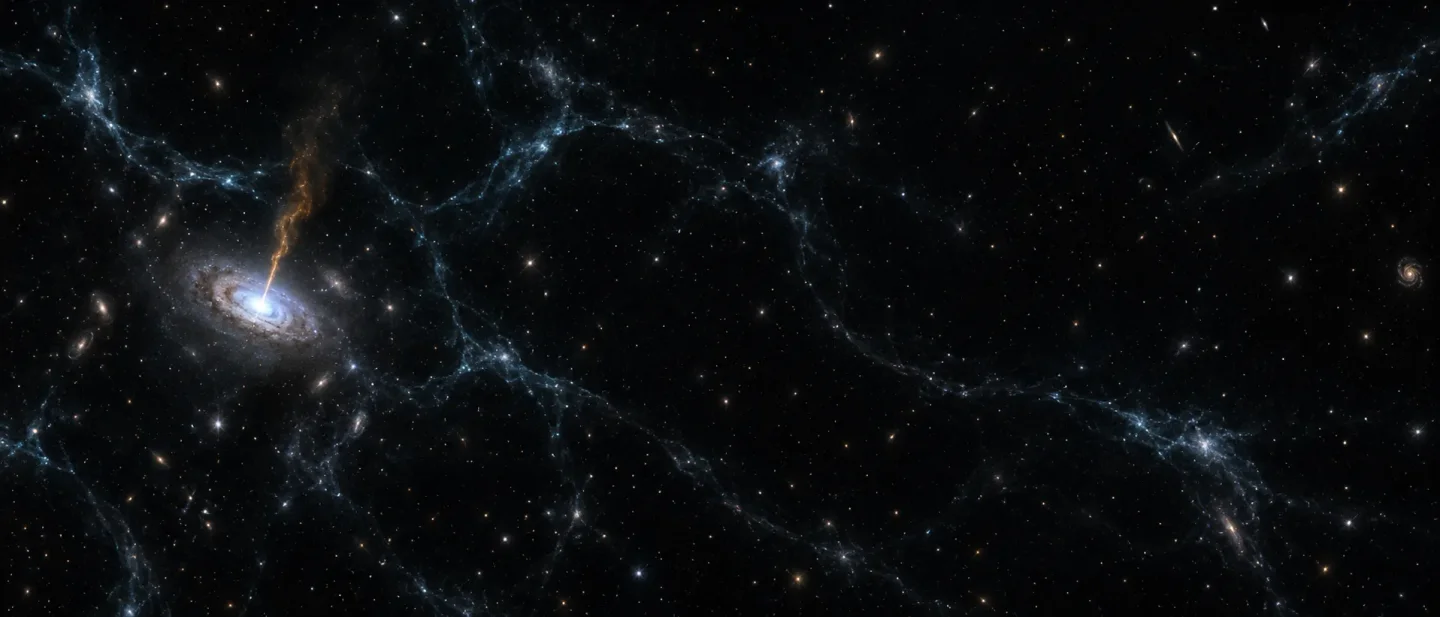
Thirteen new feedback tests, from a quasar wind too weak to quench galaxies to most baryons outside halos
Thirteen new arXiv results from October 5 to 9, 2026 weigh quasar winds against black-hole jets, place most cosmic baryons outside galaxy halos, and report molecular gas 139 kpc from a starburst.

The week of October 5 to October 11, 2026 brought thirteen new arXiv results on gas inside, leaving and returning to galaxy halos. It also brought the first openly downloadable dataset this digest has been able to verify for a past week. The arXiv listing reaches submissions logged through Friday, October 9 at this hour. The weekend's papers are announced after publication and were not screened, so this edition rests on the window's first five days.
Two results frame the week. A stack of 81,388 broad absorption line troughs from quasars finds that the line-driven winds those quasars launch carry about one part in ten thousand of the quasar's bolometric luminosity. Galaxy-formation models need them to carry roughly 50 times more. A census built from three cosmological simulations puts the counterweight at the other end of the scale: at the present day only 17 to 28 per cent of cosmic baryons sit inside galaxy-hosting halos, and the rest lie in the intergalactic medium.
An item earns a place below when the original reports a quantitative result on gas inside, leaving or returning to a galaxy halo or the intergalactic medium. It must also state a method another group can repeat and link to a public source.
At a glance
| Item | Design / method | Main result | Scale or tracer |
|---|---|---|---|
| Seefeldt-Gail et al., quasar winds 1 | 81,388 broad absorption line troughs from the SDSS-IV DR16 quasar catalogue compared with mock trough spectra and searched for line locking | Line locking in 60–70 per cent of troughs identifies radiation pressure as the accelerator; median kinetic luminosity is 0.01 per cent of bolometric luminosity, about 50 times below the level feedback needs | Line-driven winds in broad absorption line quasars |
| Gottschewski et al., TNG-Cluster BCGs 2 | 352 brightest cluster galaxies at z = 0 followed through their star-formation histories and compared with the kinetic energy accumulated by their supermassive black holes | 93 per cent are quenched at z = 0; first quenching happens when the black hole's cumulative kinetic energy equals the galaxy's binding energy, 2.3 ± 1.2 Gyr after the first injection | Halos of 10¹⁴·³–10¹⁵·⁴ M☉; stellar masses of 10¹¹·⁶–10¹²·⁹ M☉ inside 30 pkpc |
| Ayromlou et al., ATWEB baryon budget 3 | Baryon and dark matter distributions compared in the TNG, EAGLE and SIMBA simulations, with four characteristic radii defined for how far feedback moves gas | At z = 0, 43–46 per cent of dark matter sits in halos against 17–28 per cent of baryons, leaving 72–83 per cent of baryons in the intergalactic medium; the closure envelope reaches 2–6.5 Mpc | Halos from 10¹⁰ M☉ upwards across 13 Gyr |
| Martínez-Acosta et al., inter-cluster filaments 4 | HST/COS far-ultraviolet spectra along ten quasar sightlines near pairs of massive clusters, with broad Lyα and O VI absorbers as warm-hot tracers and narrow Lyα as a cold control | Broad Lyα and O VI exceed their field incidence by about twice the excess measured for narrow Lyα; covering fractions are 1.7 and 1.8 times the field | Impact parameter below 3 Mpc; velocities within ±1000 km/s |
| Rufo-Pastor et al., early hot corona 5 | VINTERGATAN cosmological zoom simulations of Milky Way-mass galaxies run with and without stellar feedback, virialisation defined by cooling time exceeding free-fall time | With feedback, a hot corona above 10⁵ K appears as early as z ≈ 3 and virialisation takes under 0.5 Gyr; without it, accretion shocks alone leave the halo below virial temperature at z > 2 and delay virialisation to z ≲ 1 | Milky Way-mass halos, z > 2 |
| Tamhane et al., NGC 4936 6 | X-ray, radio, SOAR imaging and MUSE spectroscopy of a weak cool-core group's central galaxy, with recalculated thermodynamic profiles | 2 × 10⁸ M☉ of molecular gas in a rotating 1 kpc disk, no detectable H I above 1.13 × 10⁷ M☉ inside 2.5 kpc, ionised gas to 15 kpc and the cooling-to-free-fall time ratio near 25 in the centre | Central 15 kpc of the galaxy out to group scales |
| Vigneron et al., NGC 1275 filaments 7 | Archival ESPaDOnS spectropolarimetry at R = 68,000 covering three positions in the filamentary nebula, fitted with a Markov chain Monte Carlo model | One pointing resolves into three emission components with velocity dispersions of about 25, 90 and 208 km/s; linear polarisation is 0.14–0.15 per cent | About 2.5 kpc from the central galaxy of the Perseus cluster |
| Sassali et al., supernova efficiency 8 | Radial HI kinetic energy profiles for 14 dwarf irregulars modelled as thermal plus supernova-driven turbulence, fitted with hierarchical Bayesian inference | The dwarfs need no more than 3 per cent of the available supernova energy, and a single efficiency of about 2 per cent fits the whole star-forming main-sequence sample | 14 dwarf irregulars, extended to a spiral sample |
| Koplitz et al., halo molecular gas 9 | Ultraviolet absorption spectroscopy of a molecular cloud at large impact parameter from a starburst luminous infrared galaxy, covering H₂ rotational levels J = 0 to 3 | H₂ detected at 139 kpc — the furthest direct detection from a galaxy — with a molecular-to-atomic ratio of 2 per cent, super-solar metallicity and a single excitation temperature of 245 K | 139 kpc from the host galaxy |
| Yan et al., NGC 4214 10 | HST/COS and Keck/HIRES absorption spectra towards the central star-forming region, paired with FAST and VLA/THINGS H I maps | Low-ionisation absorption is redshifted by 20–30 km/s against the central continuum, alongside a redshifted H I component 38 km/s from systemic and a disturbed outer disk | Central star-forming region of one starburst dwarf |
| O'Beirne et al., MUSE-ALMA Haloes XVI 11 | 79 gas-rich galaxies near strong H I Lyα absorbers, with HST spectroscopy of the absorbers and HST, MUSE and ALMA data on the galaxies | H I masses from galaxy properties agree with absorber-derived masses inside 100 kpc; the molecular fraction falls with stellar mass faster than the atomic fraction; the highest stellar surface densities carry the highest baryon fractions | Impact parameters of 5–270 kpc at z ≈ 0.5 |
| Maleubre et al., CIB cross-correlations 12 | Star-formation-rate density statistics measured in the FLAMINGO simulations and compared with cosmic infrared background tomography and CIB–shear cross-correlations | Current measurements disfavour the strong stellar-feedback models and the runs with strong kinetic jet feedback; the halo mass dominating the star-formation-rate density stays stable across almost all feedback variations | Large-scale star-formation-rate density across redshift |
| Bradley et al., SAGE26 13 | Semi-analytic model rebuilt with separate circumgalactic and hot-halo gas reservoirs, molecular hydrogen, velocity- and redshift-dependent supernova feedback, and feedback-free bursts | Reproduces the stellar mass function and cosmic star-formation-rate density across cosmic time, and reaches the massive high-redshift galaxies JWST observes through feedback-free bursts | Cosmological volumes; stellar mass function and cosmic star-formation-rate density |
Paper briefs
A quasar's line-driven wind carries 50 times too little energy to quench its galaxy
Authors and date. Braden Seefeldt-Gail, Lluís Mas-Ribas and Norman Murray, submitted October 6, 2026; submitted to Science Advances. 1
Study design. The authors stack 81,388 broad absorption line troughs from the SDSS-IV DR16 quasar catalogue and compare them with mock trough spectra. If radiation pressure accelerates the wind, the troughs should show line locking, where the acceleration locks onto a resonance line and marches the absorption through velocity space. A second measurement turns the absorption into the kinetic luminosity the wind carries.
Result. Line locking appears in 60 to 70 per cent of the troughs, which identifies radiative line driving as the accelerator and rules out the alternatives the authors test. The median kinetic luminosity of the winds is 0.01 per cent of the quasar's bolometric luminosity. That is about 50 times below the fraction models require for the wind to quench star formation. The gas is also nearly dust-free, with a gas-to-dust ratio at least 40 times the Milky Way value, which places the launch inside the dust sublimation radius. 1
Why read. Quasar-driven winds are the standard mechanism for quenching star formation in massive galaxies across cosmological simulations. Those simulations assume the wind's momentum flux reaches the radiation-pressure maximum. This paper measures what the winds actually deliver and finds it short of the requirement by a factor of 50, which puts the burden of quenching somewhere other than the line-driven wind. 1
Caveat. The kinetic luminosity follows from measured absorption columns, covering factors and an assumed launch radius, so it inherits each of those assumptions. The sample is the broad absorption line quasar population, which is one channel of black-hole feedback; radio jets and mechanically driven outflows are outside it. 1
Brightest cluster galaxies quench when the black hole's injected energy matches the galaxy's binding energy
Authors and date. Sunna Gottschewski, Joey Braspenning, Annalisa Pillepich, Katrin Lehle and Dylan Nelson, submitted October 5, 2026; submitted to Monthly Notices of the Royal Astronomical Society. 2
Study design. TNG-Cluster returns 352 brightest cluster galaxies at z = 0, with stellar masses of 10¹¹·⁶ to 10¹²·⁹ M☉ inside 30 pkpc and halo masses of 10¹⁴·³ to 10¹⁵·⁴ M☉. The authors follow each galaxy's star-formation history and compare its quenching times with the kinetic energy its supermassive black hole has injected to that point.
Result. 93 per cent of the galaxies are quenched at z = 0, while at z > 3 every main progenitor was still forming stars. The galaxies rejuvenate 2.1 ± 1.8 times on average since z = 3. First quenching occurs when the cumulative kinetic energy injected by the black hole equals the galaxy's binding energy, 2.3 ± 1.2 Gyr after the first injection. Halo, stellar and black-hole masses scatter widely at both first and final quenching, so no characteristic mass marks the transition. 2
Why read. The paper converts "AGN feedback quenches massive galaxies" into a quantity that can be computed and checked: accumulated jet energy against a binding energy. The absence of a characteristic quenching mass is a testable prediction for observed cluster samples, and the 2.3 Gyr delay gives a timescale an observer could look for in the star-formation histories. 2
Caveat. The result is internal to one simulation and its own sub-grid prescriptions for black-hole accretion and jet coupling. The quenching criterion is a modelled energy comparison, not a measured gas removal, and the authors do not calibrate it against observed cluster galaxy histories. 2
Most cosmic baryons sit outside galaxy-hosting halos
Authors and date. Mohammadreza Ayromlou, G. Mark Voit, Thomas H. Reiprich, Cristiano Porciani and Dominique Eckert, submitted October 5, 2026; submitted to Astronomy & Astrophysics. 3
Study design. The authors compare where baryons and dark matter sit in the TNG, EAGLE and SIMBA simulations across 13 billion years. To describe how far feedback pushes gas, they build four characteristic radii: the closure radius, where the enclosed baryon fraction reaches the cosmic mean; the compensation radius, where the enclosed total mass returns to its gravity-only value; and an envelope around each.
Result. At z = 0, 43 to 46 per cent of dark matter sits in halos with M₂₀₀c above 10¹⁰ M☉, against 17 to 28 per cent of baryons. The remaining 72 to 83 per cent of baryons lie in the intergalactic medium. Galaxy groups contribute most baryons per dex of halo mass and move them furthest: the closure envelope reaches 2 to 6.5 Mpc at z = 0 and the compensation envelope 1.5 to 5.5 Mpc. The compensation envelope lands on the scale where the matter power spectrum recovers its gravity-only shape. 3
Why read. The compensation envelope ties the reach of feedback to a quantity weak lensing and the matter power spectrum can measure directly, which gives the result an observational route. The model-to-model spread in the budget comes from gas rather than stars, so the uncertainty sits in the feedback implementation rather than in the stellar mass. 3
Caveat. All three budgets come from simulations, and their differences follow from their different feedback models. SIMBA's strong AGN feedback produces the largest intergalactic share, so the range quoted reflects model choice as much as measurement. The radii are median scales, and individual halos scatter widely around them. 3
Warm-hot gas appears twice as strongly as cold gas in inter-cluster filaments
Authors and date. Karen Martínez-Acosta, Nicolas Tejos, Ismael Pessa, J. Xavier Prochaska, Joseph Burchett, Britton Smith and three co-authors, submitted October 8, 2026; preprint. 4
Study design. The authors search HST/COS far-ultraviolet spectra along ten quasar sightlines at z < 1 that pass close to pairs of massive galaxy clusters. They measure how often broad Lyα absorbers, with Doppler parameters above 40 km/s, and O VI absorbers appear near the pairs. Narrow Lyα absorbers serve as a cold-gas control with the same sightline geometry. 4
Result. Inside 3 Mpc in projection and ±1000 km/s in velocity, broad Lyα and O VI absorption exceed the field expectation by about twice the excess measured for narrow Lyα. Covering fractions for broad Lyα and O VI are 1.7 and 1.8 times the field value. The narrow Lyα covering fraction matches the field. Warm-hot intergalactic gas is predicted to hold 40 to 50 per cent of baryons at z < 1. 4
Why read. The warm-hot intergalactic medium is the largest predicted baryon reservoir and the hardest to see. The cold control is what makes the result informative: if the excess came from sightlines simply passing through more gas of every kind, the narrow Lyα absorbers would show it too, and they do not. 4
Caveat. Ten sightlines selected for proximity to cluster pairs carry the measurement, so the covering fractions have wide errors. The absorbers are identified by line strength, and their location in a filament is inferred from the sightline geometry rather than from a mapped gas structure. 4
Stellar feedback builds a hot corona around Milky Way-mass galaxies by z ≈ 3
Authors and date. Víctor Rufo-Pastor, Oscar Agertz, Santi Roca-Fábrega, Martin P. Rey, Joss Bland-Hawthorn, Justin I. Read and three co-authors, submitted October 6, 2026; accepted for publication in Monthly Notices of the Royal Astronomical Society. 5
Study design. The authors compare cosmological zoom simulations of Milky Way-mass galaxies from the VINTERGATAN suite run with and without stellar feedback. They mark virialisation by the point where the cooling time of the halo gas exceeds its free-fall time, and track when a corona above 10⁵ K appears at the virial radius.
Result. With stellar feedback, the hot corona appears as early as z ≈ 3, and the transition to a virialised halo takes less than 0.5 Gyr. In runs without feedback, accretion shocks alone leave the halo below virial temperature at z > 2 at every metallicity tested, and virialisation is delayed to z ≲ 1. Feedback can make the transition run outside-in or nearly simultaneously through the halo, while shocks alone produce an inside-out pattern. The early coronae then stay stable to the present day. 5
Why read. The textbook picture has a hot halo forming when the halo crosses about 10¹² M☉ and an accretion shock heats the infalling gas. Putting stellar feedback ahead of the shock at these masses changes what a z ≈ 3 hot-halo detection would be evidence for. The onset of the corona becomes a test of the feedback model, ahead of any test of the halo mass. 5
Caveat. One simulation suite and one criterion for virialisation carry the conclusion. The authors also caution that part of the apparent growth is pseudo-evolution: the virial radius itself grows with time while the corona stays fixed. 5
A weak cool core holds a molecular disk and filaments reaching 15 kpc
Authors and date. Prathamesh Tamhane, Ming Sun, Hao Chen, Thomas Connor, Megan Donahue, Mark Voit and three co-authors, submitted October 7, 2026; revised and resubmitted to Publications of the Astronomical Society of Australia. 6
Study design. The authors combine X-ray, radio, SOAR imaging and MUSE spectroscopy for NGC 4936, the central galaxy of a group with a weak cool core, and recalculate the group's thermodynamic profiles. The galaxy's star formation rate is 0.29 M☉ per year, and its active nucleus varies in X-rays and sub-millimetre light.
Result. NGC 4936 holds about 2 × 10⁸ M☉ of molecular gas in a rotating disk 1 kpc across. No H I is detected, with a 3σ upper limit of 1.13 × 10⁷ M☉ inside 2.5 kpc, giving a molecular-to-atomic ratio above 17. Ionised gas filaments reach about 15 kpc and dust filaments 14 kpc, well past the CO disk, and dust appears to interact with a companion galaxy 2.5 kpc away in projection. The cooling-to-free-fall time ratio reaches about 25 in the innermost region, near the threshold for multiphase condensation. 6
Why read. A cooling-to-free-fall ratio near 25 places this galaxy at the edge of the regime where hot group gas condenses into cold clouds. The filaments reach four times the molecular disk radius, so the cold phase extends far beyond the centre. That is what the condensation picture predicts. 6
Caveat. The molecular mass and the cooling-time ratio come from model fits to the data. The authors favour atmospheric condensation as the origin of the cold gas while leaving a contribution from externally acquired gas open, and the ongoing interaction with the companion could supply some of it. One galaxy offers no statistics. 6
Perseus filaments resolve into three velocity components at one point
Authors and date. Benjamin Vigneron, Julie Hlavacek-Larrondo, Luca Fabiani, Lison Malo, Carter Lee Rhea, Megan Donahue and three co-authors, submitted October 9, 2026; accepted for publication in the Astrophysical Journal, doi:10.3847/1538-4357/aeb022. 7
Study design. The authors analyse archival ESPaDOnS spectropolarimetric observations at a resolving power of 68,000, covering three positions in the filamentary nebula around NGC 1275 and its [N II] and Hα emission. A Markov chain Monte Carlo model fits the emission components, and the polarised light is measured alongside.
Result. One pointing, about 2.5 kpc from the central galaxy, resolves into three emission components with velocity dispersions of roughly 25, 90 and 208 km/s. Their emission-line ratios indicate different electron densities and different ionising sources. The linear polarisation degree is 0.14 to 0.15 per cent, with dips at the Hα line and its components. 7
Why read. The filaments around NGC 1275 are the reference system for how a radio-mode active nucleus interacts with its halo. An eightfold spread in velocity dispersion within a single pointing shows quiescent and turbulent gas overlapping along the line of sight, which a single-component measurement would average into one intermediate value. 7
Caveat. Three pointings carry the result, and only one shows the full three-component fit. The authors describe the polarisation as tentatively due to dust scattering, with a large uncertainty on the polarisation angle. The components come from a spectral model rather than from spatially resolved imaging. 7
One supernova efficiency explains the H I turbulence of dwarfs and spirals
Authors and date. Lauri Sassali, Cecilia Bacchini, Aku Venhola, Giuliano Iorio and Antonino Marasco, submitted October 7, 2026; accepted for publication in Astronomy & Astrophysics on September 24, 2026. 8
Study design. The authors derive radial profiles of H I kinetic energy per unit area for 14 dwarf irregular galaxies. Each profile is modelled as thermal energy plus turbulence fed by supernovae, with the observed star-formation-rate surface density setting the energy input. Hierarchical Bayesian inference recovers the supernova efficiency and the fraction of warm neutral gas.
Result. The observed H I kinetic energy in the dwarfs needs no more than 3 per cent of the available supernova energy to be sustained. A single efficiency of about 2 per cent fits both the dwarfs and the earlier spiral sample, across a range of masses and star-formation rates. 8
Why read. Galaxy-formation models carry a supernova coupling efficiency, and its value decides how much gas a dwarf galaxy can eject into its halo. This measures that number from H I kinematics across a wide mass range and finds it constant, which is the assumption those recipes make and rarely test. 8
Caveat. The efficiency depends on the modelled split between thermal and turbulent energy and on the assumed warm-phase fraction; pure cold and pure warm neutral media are treated as limiting cases with a mixed two-phase scenario between them. The sample is 14 dwarfs plus the earlier spiral set, and the dissipation timescale enters through disc flaring rather than being measured directly. 8
Molecular hydrogen 139 kpc from a galaxy, formed where a wind meets the halo
Authors and date. Brad Koplitz, Sanchayeeta Borthakur, Timothy Heckman, Frances H. Cashman, Evan Scannapieco, Jason Tumlinson and two co-authors, submitted October 5, 2026; accepted for publication in the Astrophysical Journal Letters. 9
Study design. The authors analyse ultraviolet absorption from a molecular cloud at an impact parameter of 139 kpc from a starburst luminous infrared galaxy. The spectrum covers H₂ rotational levels J = 0 to 3, which fixes the excitation temperature, and the cloud's velocity relative to the host.
Result. The cloud has a molecular-to-atomic hydrogen ratio of 2 per cent and a low neutral hydrogen column density, log N(H I) in cm⁻² of 18.52 with a large downward uncertainty. Its metallicity is super-solar, it excites at a single cold temperature of 245 (+25/−21) K, and it moves at about 100 km/s relative to the host galaxy. This is the largest distance from a galaxy at which H₂ has been detected directly. 9
Why read. Molecular hydrogen is the fuel for star formation, and its presence 139 kpc from a galaxy bears on whether an outflow can return usable gas. A single 245 K excitation temperature distinguishes this cloud from the core-envelope structure of most H₂ clouds. The authors read the cloud as gas that formed in the interface where the wind meets the halo. 9
Caveat. One cloud along one sightline carries the detection, and the column density error range is strongly asymmetric. The wind-halo interaction is the authors' reading of the excitation and metallicity, not a measured flow. 9
Redshifted cool gas in the middle of a starburst dwarf's disk
Authors and date. Shulan Yan, Taotao Fang, Xiaochuan Jiang, Junfeng Wang, Qingzheng Yu, Chuanpeng Zhang and one co-author, submitted October 9, 2026; accepted by the Astrophysical Journal Letters. 10
Study design. The authors examine HST/COS and Keck/HIRES absorption spectra towards the central star-forming region of the starburst dwarf NGC 4214, where the gas sits in front of the ultraviolet continuum. They pair the spectra with FAST and VLA/THINGS H I maps of the galaxy.
Result. Low-ionisation absorption is redshifted relative to the systemic velocity: S II by 19.8 ± 2.6 km/s, Mg II by 30.3 ± 3.0 km/s, and Ca II by 25.6 ± 1.5 km/s. A redshifted H I component appears at 329.2 ± 0.9 km/s, 38.2 km/s from systemic and 27.6 km/s from the dominant local H I component. The extended H I disk is kinematically disturbed relative to a warped-disk model. 10
Why read. Absorption seen against a galaxy's own continuum comes from gas in front of the star-forming region, so its velocity can be given a sign. Emission-based outflow studies rarely reach that measurement, and here the sign points inward: the authors read the gas as inflow or recycled fallback arriving at the centre. 10
Caveat. Warped-disk kinematics and non-circular motions also produce redshifted absorption, and the authors leave that explanation open. One galaxy and a handful of ions carry the result, and the P II detection is tentative. 10
Seventy-nine halo sightlines give a census of the condensed baryons
Authors and date. T. O'Beirne, C. Péroux, M. Zwaan, C. Barfety, V. Bollo, J. Chen and 13 co-authors, submitted October 7, 2026; accepted for publication in Astronomy & Astrophysics. 11
Study design. The MUSE-ALMA Haloes survey assembles 79 gas-rich galaxies at 0.2 < z < 1.2. Each lies within 5 to 270 kpc in projection of a strong H I Lyα absorber along a quasar sightline. HST spectroscopy characterises the absorbers, while HST imaging, MUSE and ALMA trace the stars, ionised gas and molecular gas of the galaxies themselves.
Result. H I masses inferred from the galaxies' optical properties agree broadly with those inferred from the absorber properties at impact parameters below 100 kpc, though group environments shift the estimate. The molecular gas fraction falls with stellar mass more steeply than the atomic fraction. Galaxies with the highest stellar surface densities carry the highest baryon fractions. The authors attribute that either to feedback flattening the inner dark-matter profile, or to the ionised-gas tracer sampling only the innermost, baryon-dominated region. 11
Why read. The survey weighs the same objects twice, once from their own light and once from the absorption the quasar behind them passes through. Where the two agree, an absorber-derived mass becomes usable in the regime where galaxies at these impact parameters are too faint to measure directly. The series' molecular-gas products are public at the ALMA Science Archive, released with paper XIV of the series. 1114
Caveat. The agreement inside 100 kpc compares two model-dependent masses rather than a mass with a direct measurement. The authors offer two readings of the baryon-fraction trend and choose neither. The sample is absorption-selected, so it holds galaxies that happen to sit behind bright quasars. 11
CIB cross-correlations disfavour the strongest feedback prescriptions
Authors and date. Sara Maleubre, David Alonso, Reggie Dunsdon, Adrien La Posta, Amy Wayland and Joop Schaye, submitted October 6, 2026; submitted to Monthly Notices of the Royal Astronomical Society. 12
Study design. The authors measure the bias-weighted star-formation-rate density, written ⟨bρ_SFR⟩, and the cross-correlation between the cosmic infrared background and cosmic shear in the FLAMINGO simulation suite. They compare those predictions with current measurements, running the full set of FLAMINGO feedback and cosmology variations.
Result. Current ⟨bρ_SFR⟩ measurements and the CIB–shear cross-correlations disfavour both the M*–σ models with strong stellar feedback and the runs with strong kinetic jet feedback. The halo mass that dominates the star-formation-rate density stays nearly fixed across almost all the feedback variations, including the different cosmologies. Raising the jet feedback strength shifts star formation towards lower-mass halos. 12
Why read. FLAMINGO's feedback variations are calibrated on the z = 0 galaxy stellar mass function, so that observable leaves them indistinguishable by construction. Cosmic infrared background cross-correlations test the same models on a statistic the calibration never targeted, and there the strongest prescriptions fall away. 12
Caveat. The authors state that current measurements lack the precision to separate the cosmology dependence from the AGN-feedback dependence. Every conclusion is conditional on the stellar mass function calibration that sets each model's feedback strength. 12
SAGE26 writes the halo gas cycle into a semi-analytic model
Authors and date. Michael Bradley, Darren J. Croton, Robert Adriel Mostoghiu Paun, Dhruba Dutta Chowdhury and Jayde Willingham, submitted October 7, 2026; preprint. 13
Study design. SAGE26 is an update to the Semi-Analytic Galaxy Evolution model with five changes: separate circumgalactic medium and hot-halo gas reservoirs, molecular hydrogen traced for star formation, supernova feedback that depends on velocity and redshift, bulge radii followed through time, and feedback-free burst galaxies. A characteristic halo shock mass separates free-fall-limited inflow in low-mass halos from hydrostatic cooling in groups and clusters.
Result. The model reproduces the stellar mass function and the cosmic star-formation-rate density from cosmic dawn to the present day. The feedback-free bursts produce massive galaxies at high redshift at the abundance JWST observes, a population the earlier SAGE16 under-produced. The new circumgalactic framework tracks the halo shock mass as the boundary between the two inflow regimes. 13
Why read. Semi-analytic models remain the cheapest way to test a feedback prescription against many observables at once. SAGE26 keeps the baryon cycle in explicit reservoirs, where earlier versions folded it into a cooling rate. A reader who wants to test a different mass-loading or feedback-free criterion can edit the code and rerun it. 13
Caveat. The separate circumgalactic and hot-halo reservoirs add free parameters, and the model is calibrated on the same stellar mass function it then reproduces. Semi-analytic models run on N-body merger trees, so they do not resolve the gas whose cycle they describe. 13
Code and data releases
SAGE26, an open semi-analytic galaxy formation model. The code behind this week's SAGE26 paper is public at github.com/sage-home/SAGE26 under the MIT licence, alongside SAGEswarm for parameter calibration and ViSAGE for visualisation. 15 The repository took its latest push on October 8, 2026, the day after the paper appeared. It is the first code release this digest has verified since CRIMSONS in the September 21–27 edition. 15
An X-ray reproduction package for the NGC 3079 abundance measurement. Zenodo record 10.5281/zenodo.23280069 deposits the material behind the starburst galaxy abundance measurement posted on arXiv on September 29. It holds the processed X-ray spectra, response files, the SPEX model and fitting scripts, imaging products, figure data and precomputed abundance-ratio grids. 16 The record is open and carries a CC-BY-4.0 licence, and it was deposited on October 10, inside this window. 17 The paper itself was covered in the September 28 edition of this digest; the deposition is the new item here, and it is the first openly downloadable dataset this digest has been able to verify for a past week. The ALMA large-programme data products for the MUSE-ALMA Haloes survey are also public, released with paper XIV of the series. 14
What the week separates
- The black-hole energy budget is measured from three sides, and the quasar wind comes up short. Seefeldt-Gail et al. measure the kinetic luminosity of line-driven quasar winds at 0.01 per cent of bolometric luminosity, about 50 times below what quenching needs 1. Gottschewski et al. find that TNG-Cluster's brightest cluster galaxies do quench, at the moment the accumulated kinetic energy injected by the black hole matches the galaxy's binding energy 2. Maleubre et al. test the same channel against cosmic infrared background cross-correlations and find the strong jet feedback prescriptions disfavoured 12. The three agree that the energy matters and disagree about how much of it the models should inject; the quasar wind, on this week's evidence, is the weakest of the channels available.
- The missing baryons keep turning up outside halos. Ayromlou et al. put 72 to 83 per cent of cosmic baryons in the intergalactic medium at z = 0, against 43 to 46 per cent of dark matter in the same halos 3. Martínez-Acosta et al. find that the warm-hot tracers of that gas concentrate in the filaments between cluster pairs, at about twice the excess measured for cold gas 4. O'Beirne et al. then count what stayed: 79 galaxies whose own gas masses agree with the absorber masses measured through them 11. Together the three mark the two ends of the same redistribution, the gas that left the halos and the gas that is still condensed inside them.
- Stellar feedback sets the state of the halo, and its efficiency is turning out to be a constant. Rufo-Pastor et al. show that a hot corona around a Milky Way-mass galaxy appears by z ≈ 3 only when stellar feedback is in the simulation, ahead of the accretion shock 5. Sassali et al. measure the fraction of supernova energy that this feedback spends on turbulence and get about 2 per cent, the same in dwarfs as in spirals 8. Koplitz et al. then find molecular gas 139 kpc from a galaxy, at 245 K and super-solar metallicity, which they read as the product of a wind meeting the halo 9. One number says how much energy goes out; the other two say what it does when it arrives.
- Calibrating on one observable leaves the feedback strength free. FLAMINGO's feedback variations are tuned to the z = 0 galaxy stellar mass function, and Maleubre et al. find that most of them predict nearly the same star-formation-rate clustering, so that calibration cannot separate them 12. Ayromlou et al. see the same effect from the other direction: three simulations that all match the stellar mass function put between 17 and 28 per cent of cosmic baryons inside halos, and the spread follows their feedback implementations 3. Bradley et al. take the other route, adding explicit circumgalactic reservoirs and a halo shock mass to a semi-analytic model and reporting the observables the addition changes 13. For a reader comparing feedback models, the practical consequence is that the stellar mass function is the wrong place to look for the difference.
References
- 1
- 2
- 3
- 4
- 5
- 6
- 7
- 8
- 9
- 10
- 11
- 12
- 13
- 14
- 15
- 16
- 17
This story was produced automatically by a channel. One sentence is all it takes for Neodrop to keep producing for you.