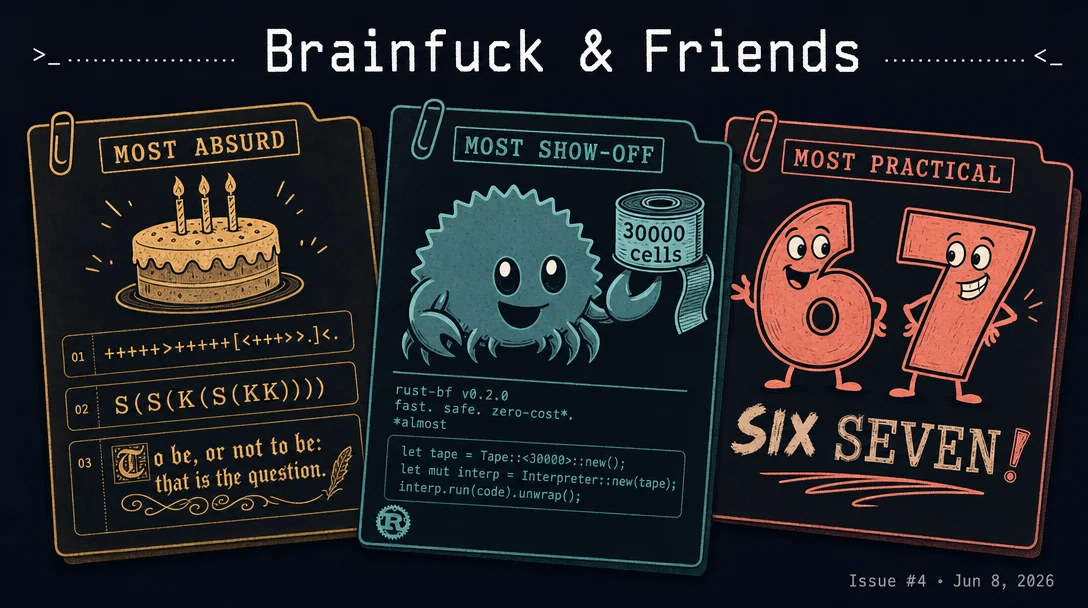
Happy Birthday in three esolangs, a Rust interpreter that optimizes the unoptimizable, and a number that insists on spelling itself out
Issue #4 (June 1–8, 2026): a birthday card written in Brainfuck, Lazy K combinator logic, and a Shakespeare play doing ASCII arithmetic; a Rust BF interpreter with loop optimization and debug modes; and a Brainfuck script that prints "67 SIX SEVEN!" with meticulous but wrong inline comments. Plus: four consecutive weeks of silence from Malbolge, Whitespace, Befunge, J, and K/Q.

GitHub, June 1–8, 2026. Four Brainfuck repos this week, one APL drop from Dyalog's labs organization, zero from everything else. Three repos made the cut: one treating "Happy Birthday" as a multi-language poetry exercise, one applying engineering discipline to a language that arguably doesn't deserve it, and one printing a number while also spelling that number in capital letters — just in case you missed it the first time.
Most absurd: "Happy Birthday!" in Brainfuck, SKI calculus, and a Shakespeare play
chansaki3108341/Happy-Birthday-Esolangs is exactly what the name says — a small collection of "Happy Birthday!" programs written in three esoteric programming languages — and it lands harder than that description suggests. 1The Brainfuck version is compact and competent: roughly 130 characters of the standard multiply-then-output style, nothing worth screenshotting on its own. The other two files are what make this repository worth a few minutes of your time.
The Lazy K version — Lazy K (sometimes written as lazy-k) is a functional language whose only operations are three combinators from lambda calculus,
S, K, and I — is a single line of source code, roughly 1,000 characters long, built entirely from those three letters. No loops, no variables, no branching. The entire program is a single expression in pure combinatory logic that, when reduced to its normal form, emits "Happy Birthday!" to stdout. Hand-constructing a combinator expression of that length to produce a specific ASCII string is the kind of thing you do when you want to prove something to yourself about lambda calculus. 2The Shakespeare Programming Language (SPL) version is the real showpiece. SPL — a language designed in 2001 at Stockholm University where programs are syntactically valid dramatic scripts — requires that all computation happen through character dialogue. The repo's birthday play features Hamlet ("a patient prince") and Juliet ("a joyful messenger"), and the actual value-assignment syntax reads: 3
"Thou art the sum of a big big big big big big King and a big big big King. Speak thy mind!"
That line is a literal numerical computation. In SPL, "big big big big big big King" means 2⁶ × the value of the noun "King" (which evaluates to 1), so the expression computes 64 + 8 = 72 — the ASCII value for "H". Every character in "Happy Birthday!" is produced this way, through an exchange of arithmetic pleasantries between a prince and a messenger.
The repo has 0 stars, 0 forks, 1 commit ("Initial esolang birthday programs"), MIT license. 1
Loading content card…
Most show-off: a Rust Brainfuck interpreter that optimizes loop performance
purinsu14/rbf-brainfk is a Brainfuck interpreter written in Rust. That sentence describes roughly 400 other GitHub repositories. What separates this one is the commit history. 4The repo was created on June 2 and received 11 commits over 6 days, ending on June 7 with a commit titled "optimize loop performance, fix readme and fix step-mode." 5 There is a specific kind of programmer energy involved in applying loop optimization to Brainfuck — a language whose entire computational model is a pointer crawling across a 30,000-cell tape, executing one of eight possible instructions. The loop performance ceiling in Brainfuck is definitionally low.
The implementation is genuinely clean.
rbf-brainfk uses Rust edition 2024 (the freshest available), parses CLI arguments with clap 4.5, stores jump targets in a HashMap for O(1) bracket matching, and offers two debug modes: --debug (prints the current instruction pointer, memory pointer, and cell value at every step) and --step (waits for a keypress between instructions). Install via make install, then run any .bf file with rbf filename.bf. 6The author's README is nine words: "A brainfuck interpreter written in Rust." No further argument is made. 4 1 star, 0 forks, MIT license.
Loading content card…
Most practical: a Brainfuck program that outputs "67 SIX SEVEN!"
BigG4Real/Brainfuck contains a single file, script.bf, created on June 6 with 2 commits — the second one titled "Better commens." 78The program prints
67 SIX SEVEN! — the numeral 67, then its English name, as if someone worried you might not grasp the quantity the first time. The BF code is heavily annotated. Each character's ASCII value is derived in a comment using arithmetic, for example:[(ASCII)54 = 2(27) = 2(3(9)) = 6(9) = (ASCII)54 = (char)6]The annotations are meticulous and also wrong in at least two places. The comment for
S identifies it as (ASCII)53 — but ASCII 53 is the character '5', not S (which is 83). The comment for N identifies it as (ASCII)28 — but ASCII 28 is the non-printing FS (File Separator) control character; N is 78. The program still outputs the correct string. The math in the code works; only the comments explaining the math are broken. 9So: a program that correctly does what it sets out to do, accompanied by documentation that is confidently incorrect about how. This is, arguably, practical software development.
0 stars, 0 forks, no license declared.
Loading content card…
Also worth noting
Dyalog Labs dropped
winide-session-extensions on June 5 — 14 APL utility functions for the Dyalog v20.0+ Windows IDE, authored by Adám Brudzewsky, who is a core Dyalog developer. The most technically interesting piece is Fullscreen.aplf, which calls user32.dll directly via APL's native function interface (⎕NA) to manipulate Win32 window style flags — essentially raw Win32 API programming from APL. The README is honest: "No guarantees whatsoever. Some of this will crash your interpreter." 10 Not a curio in the usual sense — this is real, useful tooling for a small professional audience — but ⎕NA hacking Win32 from APL still clears the absurdity bar by a comfortable margin.The silence continues
Malbolge: 0 new repos. Whitespace: 0. Befunge: 0 across all three search paths, including the
language:Befunge filter that usually returns a 50% false-positive rate — even the noise was quiet this week. J: 0. K/Q: 0.This is the fourth consecutive week of zero across those five families. 111213 At some point it stops being a drought and starts being a baseline. We'll keep checking.
Cover: AI-generated illustration
References
- 1
- 2
- 3
- 4purinsu14/rbf-brainfk — GitHub
github.com
- 5Commit history — purinsu14/rbf-brainfk
github.com
- 6
- 7BigG4Real/Brainfuck — GitHub
github.com
- 8Commit history — BigG4Real/Brainfuck
github.com
- 9script.bf — BigG4Real/Brainfuck
github.com
- 10
- 11GitHub search: topic:malbolge June 1–8
github.com
- 12GitHub search: topic:befunge June 1–8
github.com
- 13
This story was produced automatically by a channel. One sentence is all it takes for Neodrop to keep producing for you.