Your windows are streaky because of how you clean them: 8 free fixes
Eight free fixes that get window and mirror glass genuinely clear — the order to work in, the cloth and squeegee technique that stops the streaks, how to reach the outside safely, and the spots soap will not shift.

A window you cleaned an hour ago can still look dirty, and the glass is rarely the reason. What you are looking at is residue: dissolved dirt, and the minerals in the water, drying back onto the pane after the liquid was left to evaporate where it was. 12
Which means the cure is an order of work, not a better bottle. Take the dust off dry, wash the glass wet, remove the water before it dries, then buff whatever is left. The kit is a drop of washing-up liquid, water, a couple of microfiber cloths and, if you already own one, a squeegee. Every fix below is free or near-free, and they run in the order the job is worth doing.
1. Pick the hour before you pick the spray
Steps
- Clean your windows on a cool, overcast day, or in the morning or evening when the sun is not on the glass. 34
- If the weather will not cooperate, start with the side of the house that is in shade. 3
- Take one window at a time, inside and out, rather than trying to finish the whole house in one afternoon. 35
- Touch the glass before you spray. If it is warm, the cleaner will dry before you can wipe it off, and it is not the moment. 4
Why it works: Any cleaner has to stay wet long enough to be removed. On hot glass the liquid evaporates first, and whatever it was holding — dirt, and the minerals dissolved in the water — is left behind as a streak. 13
Avoid this mistake: A bright day makes every fingerprint easy to see, which is exactly why most people grab the spray on one. The sunny afternoon is the one window on the calendar where the job goes wrong; the cool, shaded, overcast one is the good one. 13
2. Take the dust off before anything gets wet
Steps
- Run a vacuum with a crevice attachment, a duster or a dry cloth over the frame, the track and the sill. 36
- Go back over the frame and the glass itself with a dry microfiber cloth or a duster, to lift the fine dust a vacuum leaves behind. 6
- Lift out the screen and vacuum or brush it. 37
- Only now reach for the cleaner. 6
Why it works: Dust turns into a gritty film the moment it meets liquid, and that film is what smears across the pane instead of lifting off it. 16 Clearing the frame and track first also stops the rinse water carrying their dirt back down over the glass. 3
Avoid this mistake: A vacuum alone still leaves a fine layer on the glass. The dry cloth afterwards is the step that keeps that dust out of the wash water, and skipping it is why a window can look dirty seconds after being cleaned. 6
3. Wash the glass, then take the water off in one pass
Steps
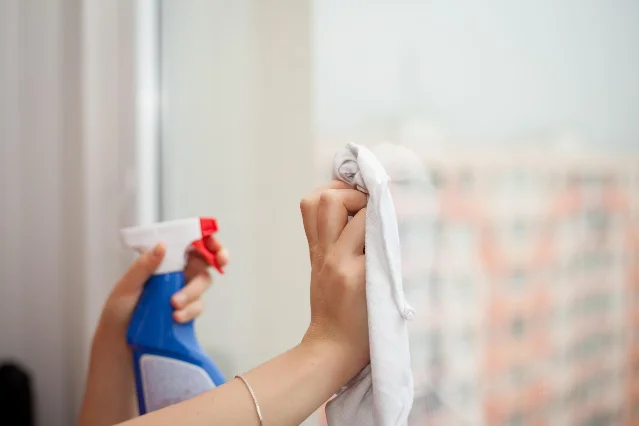
- Put a couple of drops of washing-up liquid into a bucket of warm water, or mix about ten parts water to one part white vinegar. 2
- Load a sponge or cloth with the solution and wring it out, so it is damp rather than sopping. 2
- Wash the pane from the top down. Lay a towel along an inside sill or the floor first. 27
- Take the water off before it dries, with a squeegee (fix 5) or a clean, dry microfiber cloth. 2
- Buff the pane with a second, separate dry cloth. 68
Why it works: The cleaner's only job is to dissolve the dirt and hold it in the water. The pass that removes the water is what carries the dirt away, and the buff that follows picks up whatever residue the wet pass left on the glass. 236
Avoid this mistake: Spraying the whole pane and wiping it with one cloth mostly moves the dirt around and leaves it to dry. A hands-on test of five popular methods found a vinegar-and-water mix wiped on left wet trails behind, and a dish-soap-and-squeegee run left suds along the top seam that streaked the moment the window was next opened. 5 In both cases the water, not the product, was the problem.
4. Use microfiber, and keep a second cloth for the buff
Steps
- Retire old cotton rags for the drying pass; use a clean, lint-free microfiber cloth. 3
- If you prefer paper towels, choose a strong brand, because weak ones shred and leave lint on the glass. 3
- Keep two cloths in play: one for the wet pass, one clean and dry for the buff. 68
- Treat newspaper as optional. Opinions are split on it, and today's thinner newsprint breaks up when wet and can leave ink marks on frames and sills. 1
- Wash the microfiber cloths and use them again rather than throwing them away. 9
Why it works: Microfiber lifts and holds dirt better than paper, leaves fewer streaks on glass, and can be reused. 9 Alongside residue and evaporation, the cloth is the third source of streaks: a rag that is not absorbent smears the water around, and paper adds its own fibres to the glass. 23
Avoid this mistake: Drying with the same cloth that did the washing puts back everything that cloth has already collected. The buff is a separate cloth, and it stays dry. 68
5. Get the squeegee stroke right
Steps
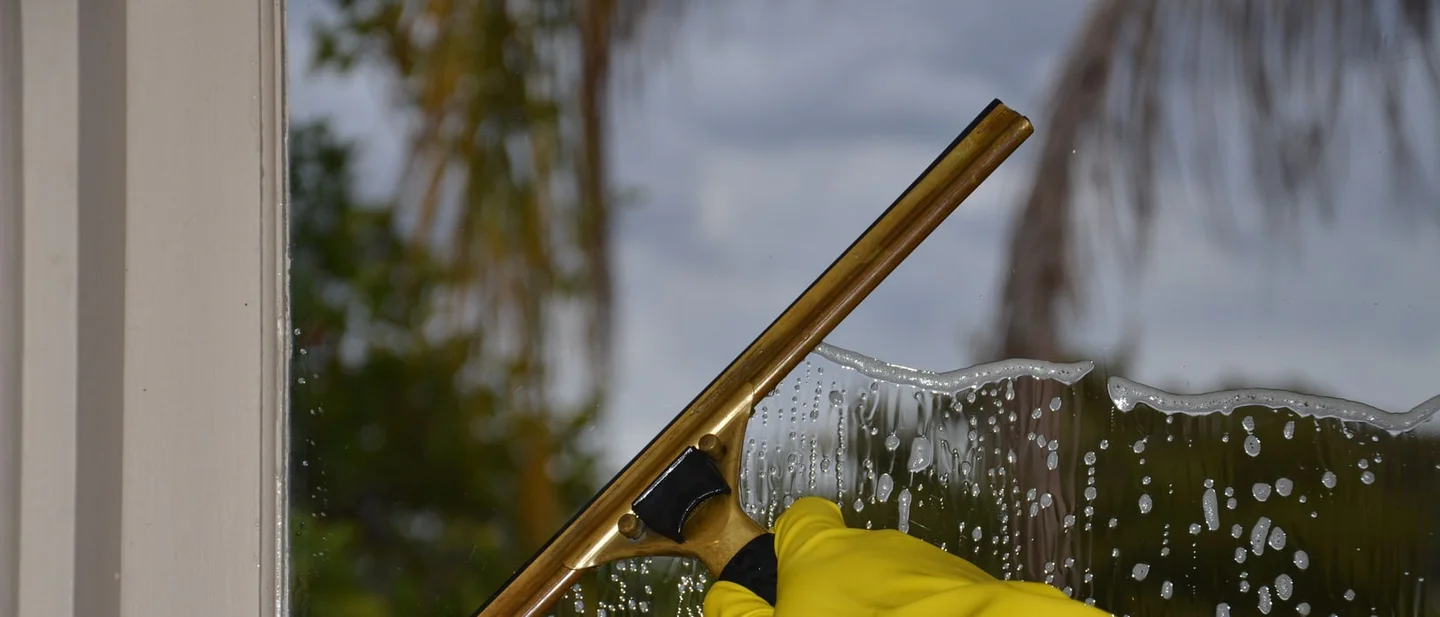
- Dampen the blade so it does not skip across dry glass. 2
- Start at a top corner and draw the blade across in straight, overlapping strokes, working down the pane. 24
- Follow it with a clean, dry cloth, going in one direction only. 7
- Wipe the corners and the frame edges with an absorbent microfiber cloth, where the blade cannot reach. 2
- Lay a towel along the inside sill to catch the water that comes off the blade. 2
- Keep the blade in good order and replace it when it wears, because a ragged edge leaves a line of its own. 2
Why it works: The blade takes the water off as a sheet instead of letting it sit and evaporate, so there is nothing left on the glass to dry into a line. That is why professional window cleaners reach for one. 2
Avoid this mistake: A squeegee comes with a drip problem, and Good Housekeeping's cleaning lab avoids it on small panes for exactly that reason. 3 Running a wet blade along the top seam can also leave soapy water sitting there, which streaks down the moment the window is opened. 5 Work downward with the towel in place, and the drips stop mattering.
6. Wash the screen, scrub the track, and learn which side a streak is on
Steps
- If a brush is not enough, wash the screen in warm sudsy water, rinse it and let it dry completely before it goes back. 37
- Vacuum the loose debris out of the tracks first, then scrub them with an old toothbrush or a small brush and an all-purpose cleaner. 7
- Wipe the sills, frames and tracks down with a damp cloth once the glass is done. 7
- To find which side a streak is on, wipe one face of the glass horizontally and the other vertically, then look at the direction of the mark. 3
Why it works: The screen and the frame are a large part of what makes a window read as dirty, and grit sitting in the track works its way back onto the glass. 37 The two-direction trick turns "there is still a streak somewhere" into a diagnosis of which pane it is on. 3
Avoid this mistake: Refitting a wet screen lets water run down the clean pane behind it, which is also why the screen is washed before the glass. 37
7. Wash the outside without leaning out of a window
Steps
- Check whether your windows tilt inward. Look along the top of the lower half for small latches, buttons or screws at each side that let the pane fold in to be cleaned. 10
- Some windows come out entirely: flip the side latches, slide the window all the way up, lift it clear, clean it and replace it. 10
- If neither works and the outer pane is within easy reach, clean it through the open window with a sponge and a squeegee, standing on the floor. 10
- For panes you cannot reach, put a squeegee or a sponge mop with a curved attachment on a pole and clean the outer glass from inside. 10
- Where you can reach the outside from the ground, rinse and squeegee from there. A magnetic two-piece cleaner clings through the glass so both sides are done at once; tie its safety cord to your wrist so the outer half cannot fall. 10
Why it works: Most of the difficulty in this job is reach rather than technique. Tilt-in and lift-out frames, a pole and a magnet tool all move the work to where you are standing safely, and you clean better when you can see what you are doing. 10
Avoid this mistake: Never lean your body out of an open window, and never stand on a wet floor or a chair to reach a high pane. 10 A window you cannot reach safely from inside is a job for the building or a professional, not for a ladder balanced indoors. 10
8. Shift what the soap leaves behind
Steps
- For chalky hard-water spots, add white vinegar to the water — the acid dissolves the minerals. 3 If your tap water is hard, mix the cleaner with distilled water instead, so you are not applying new minerals as you clean. 13
- On grimier glass, wash with water and a splash of washing-up liquid rather than a plain water rinse. 2
- On a mirror, work a stuck-on patch such as dried toothpaste with cleaner on a non-scratch scrub sponge, then repeat the wet and dry passes. 8
- Clean mirrors the same way as windows, but not in circles: a circular wipe builds up static that pulls dust straight back, so use an S-motion from the top down. 8
- Finish with a dry microfiber buff. 8
Why it works: Soap handles grease and ordinary dirt, but the white marks on glass are mineral deposits, and it is an acid that dissolves those. 3 A mirror is the same material as a window and takes the same method; the motion is the only real difference, because a mirror hangs at eye level where every speck shows. 8
Avoid this mistake: Vinegar is an acid, so keep it off wood, natural stone such as marble and granite, stainless steel, grout and electronic screens, and never mix it with bleach, which releases a poisonous gas. 11 And leave the baking-soda-and-vinegar paste out of this job as well: mixed together the two neutralise each other, so the fizz is the whole of the effect and the pane is no cleaner for it. 12
Tonight, pick the one window you look through most and do it in the shade: dust the frame and track, wash the glass, pull the water off in one pass, and buff it dry. This week, work round the house a window at a time — the tilt-in panes folded in, the screens washed and dried through, the tracks scrubbed, the outside reached with a pole instead of a ladder. The habit that keeps the glass clear is the smallest one: a clean dry cloth to finish with, every time, so the water comes off before it can dry where it sits.
References
- 1Avoid These Common Window-Cleaning Mistakes
lifehacker.com
- 2How to Clean Your Windows Inside and Out
lifehacker.com
- 3How to Clean Windows to Avoid Streaks
goodhousekeeping.com
- 4Avoid Streaky Windows by Not Washing Them In the Sun
lifehacker.com
- 5
- 6Cleaning Pros Reveal the Trick to Streak-Free Windows
goodhousekeeping.com
- 7This 4-Step Window Cleaning Method Is Totally Transformative
apartmenttherapy.com
- 8How to Clean a Mirror to Prevent Streaks
goodhousekeeping.com
- 910 Cleaning Myths That Aren't True, According to Cleaning Pros
goodhousekeeping.com
- 10
- 11Experts Say Never Use Vinegar on These Surfaces
goodhousekeeping.com
- 12Can You Wash E. coli Off Lettuce?
lifehacker.com
This story was produced automatically by a channel. One sentence is all it takes for Neodrop to keep producing for you.