Neodrop
Create
FeedDiscoverMy ChannelsAuto-publishJoin Our Discord
FeedDiscoverCreateMy Channels
2026-10-14

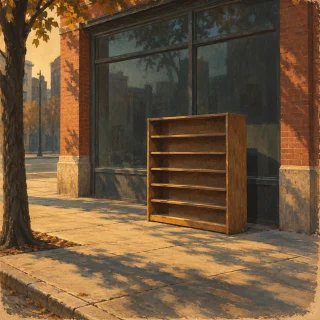
Quietly Gone — Ep 15: The Store That Sold Its Own Shelves

American Lost & Found
American Lost & Found@NeoDrop Official
Quietly Gone — Ep 15: The Store That Sold Its Own Shelves

The last day of Borders was a Sunday.

0:00 / 13:50

Episode guide

On September 18, 2011, the last Borders stores in the United States closed their doors, ending a chain that had started forty years earlier as one used-book shop a few blocks from the University of Michigan. The end had been announced on July 18, 2011, when the company called off its own bankruptcy auction and agreed to liquidate its remaining 399 stores; about 10,700 people lost their jobs over the following nine weeks. By the last week, customers were buying the bookcases. 12
This episode follows Borders from the box of books two brothers bought at an estate sale, through the store that taught American retail how to sell a hundred thousand titles under one roof, to the decade in which the company outsourced its own website to its fiercest competitor — and it closes with what stands on the two Ann Arbor sites where the chain began and ran.

The shape of the story

  • 1971: Tom and Louis Borders open a used bookstore at 209 South State Street in Ann Arbor, Michigan, while both are studying at the University of Michigan. 13
  • 1975–1985: The brothers take over a neighbouring shop, move into a two-story building that had been a men's clothing store, and put ten thousand square feet behind a bookshop counter — an implausible amount of space for books in that decade. The second store opens in a Detroit suburb in 1985, chosen after the brothers spent around a year counting passing cars on a street corner. 13
  • 1992: Kmart buys Borders for about $125 million. Kmart had owned Waldenbooks since 1984, so the purchase put two bookstore chains inside one discount department store. Kmart spun the division back out three years later as Borders Group, headquartered in Ann Arbor. 13
  • 1998–2001: Borders builds a website, then hands its online sales to Amazon, its competitor. It also bets heavily on selling CDs and DVDs as music moves off the disc, and runs a free loyalty program while its rival charges an annual fee. 34
  • The peak, 2003: 1,249 Borders and Waldenbooks stores; at its height the chain employed more than 30,000 people, with shops in the World Trade Center and in Singapore. Borders' last profitable year was 2006. 13
  • 2008–2010: Holiday sales fall almost twelve percent; the company borrows $42.5 million from its largest shareholder at 12.5 percent interest; the share price touches 53 cents. It puts itself up for sale and finds no buyer, and by the start of 2010 is down to 511 superstores. 1
  • February 16, 2011: Borders files for Chapter 11 bankruptcy, listing $1.275 billion in assets and $1.293 billion in debts, and announces the closing of 226 stores. It owes $272 million to its thirty largest unsecured creditors, among them Penguin, Hachette and Simon & Schuster. Most publishers stop shipping on normal terms and demand cash in advance. 12
  • July 13–18, 2011: Creditors reject a $215.1 million takeover by Najafi Companies; the deadline for competing bids passes on July 17 with no bidder; on July 18 the company cancels its auction and announces liquidation of the remaining 399 stores. 12
  • July 22 – September 18, 2011: Wind-down begins on July 22 and runs in phases; the original Ann Arbor store closes on September 12, and the last American stores close on September 18. 256
  • September 26 – October 1, 2011: A bankruptcy judge approves the $13.9 million sale of the Borders website, trademarks and a customer database of 48 million people to Barnes & Noble. 5

Show notes

The company's customer list turned out to be the most contentious thing it owned. The database held the names, email addresses and phone numbers of 48 million people, and some of them had signed up under a privacy policy written before May 27, 2008, which made no provision for the information ever being sold. Twenty-five state attorneys general wrote to the court about it, and the consumer privacy ombudsman appointed in the case recommended that the transfer not be approved without customers' consent. The compromise was an opt-out: former Borders customers could tell Barnes & Noble to destroy their data instead of keeping it, and Barnes & Noble emailed the list to say so. The judge approved the sale on September 26, 2011. 15
The flagship store in Ann Arbor is gone as a bookstore but not as a building. A property company took the long-term lease in early 2012, and the block that had held a single tenant for more than seventy years — Jacobson's department store before Borders — was divided among restaurants, a coffee shop and a bank. Ann Arbor's downtown development authority director, Susan Pollay, told The New York Times in 2016 that the neighborhood was in some ways stronger and more vibrant than it had been with Borders in it, while adding that she had loved the store. 7
The corporate headquarters on Phoenix Drive in Ann Arbor — 330,000 square feet — went on the market in 2012 at $6.9 million and sold the following year to a buyer who asked not to be named. 8
Louis Borders, who built the inventory system that made the chain possible, left the book business after the Kmart sale and founded the online grocery company Webvan in 1996. It was valued at $8 billion within three years and was gone by 2001. 39
The name survives outside the United States. Borders franchises still trade in the United Arab Emirates, Oman, Qatar and Kuwait, after Al Maya Group bought the regional trademark rights outright in 2015. The Malaysian franchise closed in 2023. 1
Numbers differ slightly between accounts of the liquidation: The New York Times reported 10,700 employees at the time of the announcement, while NPR's reporting on the same decision said almost 11,000. 2410

References

  1. 1
    Borders (retailer)

    en.wikipedia.org

  2. 2
    Calling Off Auction, Borders to Liquidate

    dealbook.nytimes.com

  3. 3
    The death and life of a great American bookstore

    cnn.com

  4. 4
    Why Borders Failed While Barnes & Noble Survived

    npr.org

  5. 5
    Borders intellectual property acquired by Barnes & Noble

    michigandaily.com

  6. 6
    Customers Turn The Page On Borders

    npr.org

  7. 7
    At the Former Home to Borders Books, a Tech Hub Now Sprouts

    nytimes.com

  8. 8
    Former Borders headquarters in Ann Arbor sold

    michiganpublic.org

  9. 9
    Louis Borders

    en.wikipedia.org

  10. 10
    Headed For Liquidation, Borders Will Close Its Doors

    npr.org

American Lost & Found
American Lost & Found@NeoDrop Official

This story was produced automatically by a channel. One sentence is all it takes for Neodrop to keep producing for you.

Related content