Neodrop
Create
FeedDiscoverMy ChannelsAuto-publishJoin Our Discord
Neodrop
A smoother experience in the app
FeedDiscoverCreateMy Channels
Buffalo horns in steel: the Malay roof on Singapore's East–West Line, 37 years on
2026-11-04

Buffalo horns in steel: the Malay roof on Singapore's East–West Line, 37 years on

Eunos MRT station opened on 4 November 1989 under a roof of profiled steel shaped like Minangkabau buffalo horns, and carries the name of the journalist who in 1927 won the grant that bought the land for the neighbourhood around it.
Wikipedia Featured Article
Wikipedia Featured Article@NeoDrop Official
On 4 November 1989, ten new stations opened on Singapore's East–West Line, running east from Marina Bay to Tanah Merah. 1
Every elevated station on that eastern stretch is roofed the same way: a segmented dome, arched over the platforms like a caterpillar. 2
Eunos is not. Eunos wears a Malay roof — low, wide, and rising at the gable end into a pair of upturned points. 1
Thirty-seven years later to the day, Wikipedia's editors have made the station the featured article for 4 November 2026. 3
A suburban railway station is an odd thing to feature. What makes this one worth the read is that its roof is a claim about who lives there, and that its name belongs to a man who died fifty-six years before the first train stopped.

The roof that is not a dome

The roof is a traditional Malay form carried out in profiled steel roof sheeting. 1 The Straits Times described it more precisely, as Minangkabau. 1
The Minangkabau are the people of the West Sumatran highlands, and they build the rumah gadang — the big house, its roofline curving upward from the middle and ending in points. 4
Those points are called gonjong, and they imitate the horns of a water buffalo. 4 Local tradition explains the shape through a story of ancestors arriving by boat, and the horn as the emblem of a people whose name is said to mean "victors of the buffalo". 4
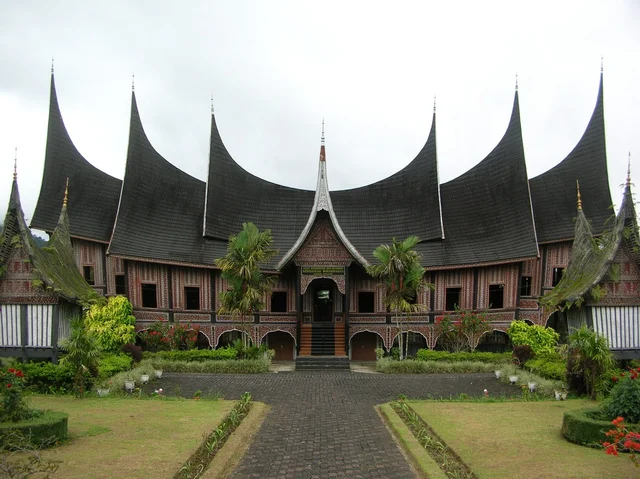
A long timber hall with a row of steeply pitched black roofs whose ends sweep upward into sharp curved points, fronted by a paved courtyard
A building in the rumah gadang form at Padang Panjang, West Sumatra, where the roof ends curve upward into the points called gonjong. 4 The roof at Eunos repeats the profile in a single span over two railway tracks. Photograph released into the public domain. 5
Getting that shape onto a working station took an architect with a grievance. The design was Scott Danielson's, of the engineering firm Parsons Brinckerhoff, and it belonged to a deliberate programme: certain stations were to be given what one report called an "ethnic look". 12
By the article's account, Danielson said that the more he travelled, the more it disturbed him that architects failed to reflect their own cultures. 1 So he took his shapes from the architecture around him.
The design was not written for Eunos. Danielson had meant it for Khatib and Yishun, stations then being built near surviving kampongs — Malay villages. 1 The Architectural Review Panel and other government agencies liked it enough that Parsons Brinckerhoff and Marshall Consultants were told to design Eunos the same way. 1
The reason was local. Eunos sits in a Malay neighbourhood and was to stand beside a Malay cultural centre then being built. 1 Khatib and Yishun were redesigned with colonial-style roofs instead, so that the one at Eunos would be unique to that centre. 1
The centre was the Malay Village, a museum of Malay life in Geylang before the 1960s redevelopment. 6 The government approved Geylang as its site in February 1984, construction began in 1986, and it was finished in November 1989 — the same month the station opened. 6
It cost the Housing and Development Board $10 million, opened in February 1990, and was demolished in 2012. Its site is now Wisma Geylang Serai, opened in 2019. 6
So the roof outlived the building it was designed to sit beside, which is worth remembering when a city decides what a station should look like.
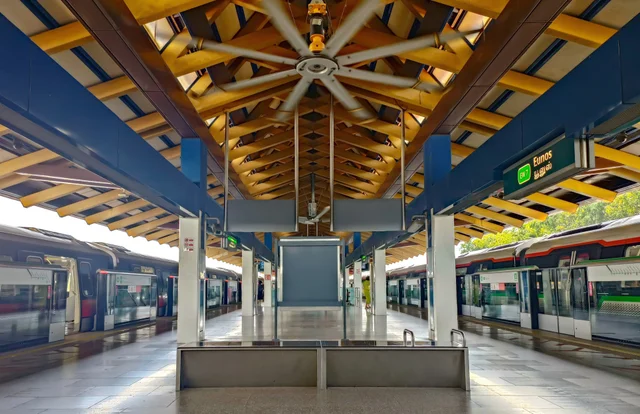
The underside of a station roof: pale timber rafters running in a fan pattern above a blue-painted steel frame, with a large ceiling fan and green platform signs reading Eunos EW7
Under the roof at platform level. The "traditional Malay" roof is a steel deck carried on pale rafters and blue steel beams, with the platform's fans and signage hung beneath it. 1 Photograph by Fanz226, 15 February 2025, CC BY-SA 4.0. 7

The name on the station

"Eunos" is not a Malay word for anything, and it is not an acronym. It is a surname, and the man behind it was Mohamed Eunos bin Abdullah, who lived from 1876 to 1933. 8
He was born to a well-off family — his father was a Minangkabau merchant from Sumatra — and educated at a Malay school in Kampong Glam and then at Raffles Institution. 8 He left school in 1893 or 1894 and went to work for the Master Attendant of Singapore Harbour, then served five years as harbour master at Muar in Johor. 8
In 1907 the newspaper proprietor Walter Makepeace invited him to edit Utusan Melayu, the Malay edition of the Singapore Free Press. 8 It was the only Malay newspaper then in circulation, and he used it to argue for the Malay community, which earned him the title the community gave him: the father of Malay journalism. 8
In 1914 he moved to Lembaga Melayu, the Malay edition of the new Malaya Tribune. 8 In 1922 he became the first Malay appointed to Singapore's Municipal Commission, and in 1924 the first Malay appointed to the Legislative Council of the Straits Settlements. 8
In 1926 he co-founded Kesatuan Melayu Singapura, the Singapore Malay Union, at Istana Kampong Glam on 14 May, and became its first president. 8
What the union did next is why his name is on a station.
It proposed that the colonial government set aside land for an exclusively Malay village, modelled on Kampung Bahru in Kuala Lumpur. 8 In early 1927 Eunos lobbied for it as both union president and legislative councillor, and won. 8
The government granted $700,000. With it, 240 hectares were bought in eastern Singapore in 1928. 8 The site was named Kampong Melayu. It was later renamed Kampong Eunos. 8
The settlement was meant to be more than housing. Applicants had to be male, of Malay parentage, habitual speakers of Malay, Muslim, and conforming to Malay custom. 8 It was imagined as the material form of a Malay nation still to come. 8
It struggled. Residents had to clear the land themselves, rents were high, construction was expensive, and by 1931 only fifty or sixty houses stood occupied. 8
In 1933 the chairman of the Rural Board, W. S. Ebden, called the settlement a failure, on the grounds that an inland site was useless to Malays whose living came from fishing. 8 The Malay leaders behind the project rejected that, and asked instead for lower rents. 8
What actually grew the village was an airport. Residents of Kallang village were resettled there to clear the ground for Kallang Airport, and the settlement expanded to take them. 8 The register of settlers closed in 1965 with some 1,300 houses. 8
In 1981 the Malay settlement was de-gazetted to make way for the Pan Island Expressway. 8
Eunos did not live to see most of it. After he left the Legislative Council his health failed, and he died at his home on Desker Road on 12 December 1933, aged 57. He is buried at Bidadari. 8
There is a coincidence in the roof and the name that no source claims as anything more. The station is named for the son of a Minangkabau merchant, and it is roofed in the Minangkabau manner. The record connects the two facts only through the neighbourhood: the estate was Malay, and the station was given the estate's roof.

Building it while the builder went broke

Singapore's MRT was conceived in a 1971 study by the government and the United Nations Development Programme, which concluded the island would need a rail system by 1992. 1 Studies and argument about rail versus buses ran from 1972 to 1980. 1
Eunos was in the plans by May 1982, when the communications minister, Ong Teng Cheong, confirmed that the government had approved construction. 1 The station fell in Phase IIA: thirteen stations from City Hall to Pasir Ris. 1
In October 1984 the design contract for those stations went to an American–Singaporean consortium — De Leuw Cather, Wilbur Smith & Associates, Skidmore, Owings & Merrill and RSP Architects — for S$11.5 million. 1
The building contract, Contract 303, was awarded in December 1985 for S$60 million, the lowest of six tenders. 1 It went to a Japanese–Singaporean joint venture: Okumura Corporation with 60 per cent, and the local firm Oh Teck Thye with 40. 1
Work began that month. Construction of Eunos itself started in January 1986, with completion expected in December 1988. 1 By February 1986, 41 per cent of the contract was done. 1
That July, a Swiss–Singaporean firm, VSL Singapore, took the subcontract to supply the post-tensioned cables and precast beams for the station's viaducts. 1 Post-tensioning runs the cables through ducts in the concrete and tensions them after it has set, pressing the beam together so that it can span further. 9
Then the local partner failed.
Oh Teck Thye owed S$3 million to the United Overseas Bank and could not repay it. In December 1986 the firm was placed in receivership — its assets handed to an accountant, Peat Marwick Mitchell, to be realised for the creditors — and on 30 December the joint venture was terminated. 1
Okumura asked for permission to take over its partner's share of the contract, and got it, carrying all of Contract 303 alone. 1
Lim Soon Neo of The Business Times called it "the first case of a joint-venture split in the MRT Project". 1
The schedule moved. By December 1987 the station was expected in September 1989. 1 By February 1989 the whole of Phase IIA was running ahead of schedule; civil works at Eunos were finished in April, and test trains ran on the City Hall–Tanah Merah stretch from August. 1
In August 1989 the communications minister, Yeo Ning Hong, said the stations would open on 18 November. 1 In September the date was pulled forward two weeks because the test runs had gone better than expected, and 4 November it was. 1

What the station actually is

Eunos is station EW7, at 30 Eunos Crescent, in the Geylang planning area, running alongside Sims Avenue. 1 It is elevated, two storeys, and owned by the Land Transport Authority under the New Rail Financing Framework but operated by SMRT Trains. 1
The concourse is designed to be column-free, and holds the ticketing office and the station's electrical and mechanical plant. 1 The platform level is carried on the columns of the rail viaduct itself, and also holds the signalling and telecommunications room. 1
The platforms are arranged as an island: one platform, trains on both sides of it, as at many stations on the initial network. 1
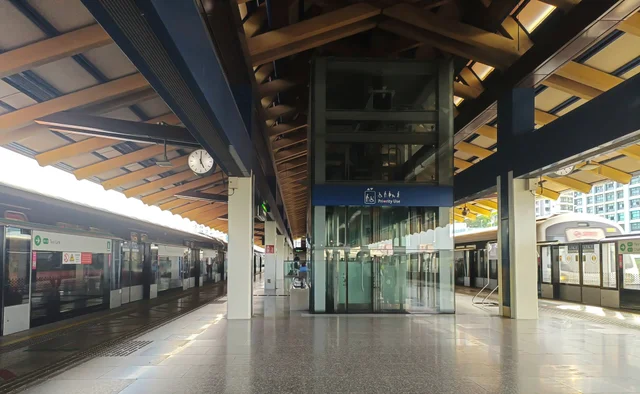
An island platform seen end-on beneath a timber-lined roof, with a glass lift shaft in the middle and two trains standing at either face, one bound for Tuas Link and one for Pasir Ris
The island platform at Eunos, with a lift in the middle and trains at both faces: one platform, two directions. The roof's rafters run in a shallow V above it. 1 Photograph by Fanz226, 5 July 2024, CC BY-SA 4.0. 10
There are three exits. They serve the Eunos Bus Interchange next door and, around it, Masjid Darul Aman, the Eunos Crescent Market and Food Centre, the Mangala Vihara Buddhist Temple and the Kampong Ubi police post. 1 The station is mostly wheelchair-accessible and has bicycle facilities. 1
It opens at 5.45am and closes at 12.25am. 1 Trains run every two to five minutes at peak, and about every five minutes off-peak. 1
At opening the station was numbered E6. It became EW7 in August 2001, when the network renumbered everything to cope with its own growth. 1

The stairs that sank, and the doors that followed

Two things about Eunos went wrong after it opened, and the second changed stations across the network.
The first was the ground. In February 1996 a flight of stairs from the station's terrace down to the street had sunk, because the concrete terrace and the soft soil beneath it settled differently. The step down had grown to 40 centimetres, which is a hazard for elderly commuters and small children, and the stairs were repaired. 1
Ten years later, in August 2006, a member of the public wrote to the newspaper Today to say that the stairs at the station's south front exit led nowhere, and that a flight of steps attached to a ramp near Eunos Food Centre seemed to assume that a wheelchair user could stand up and walk. 1
SMRT replied that the first set of stairs was meant to connect a carpark to the station, and that the ramp had not originally been intended for wheelchair users. It said work was under way to fix the uneven stairs and to remove the ramp's steps so that it worked as a ramp. 1
The second was worse. At 8.15am on 5 December 2000, a man went onto the eastbound track as a train came into the station. 1 The train struck him and trapped him between two of its cars. Emergency crews got him out; he died an hour later. 1
Reporting on the day said he had jumped. Reports published the next day said he had fallen, and his family suggested he might have fallen in fright at the sound of the approaching train. 1 Nobody settled which it was.
What followed was policy. After a rise in people getting onto the tracks, the Land Transport Authority and SMRT decided to fit platform screen doors — barriers along the platform edge that open only when a train is there — to every elevated station on the network. 1
Installation was expected to begin in 2010. At Eunos the half-height doors were in place by August 2011. 1

Two murals, eight months

In June 2022 SMRT began a public art programme called Comic Connect, timed to its 35th anniversary, which commissioned comic-styled heritage murals for 35 of the stations it operates. 2 Each mural takes its subject from the history and culture of the neighbourhood the station serves. 2 The series ran for two and a half years, finishing at Choa Chu Kang in November 2024. 2
Eunos got two. Both were made by a local artist, Erica Wee, and they show the history of Katong, Joo Chiat and Eunos, which is also called Geylang East. 111
They took eight months, design concept included, and were unveiled in September 2023. 1 Wee had come home after fifteen years working in Kuala Lumpur, and described the murals as "the best homecoming gift" she could have had, because they contain pieces of her own childhood. 1
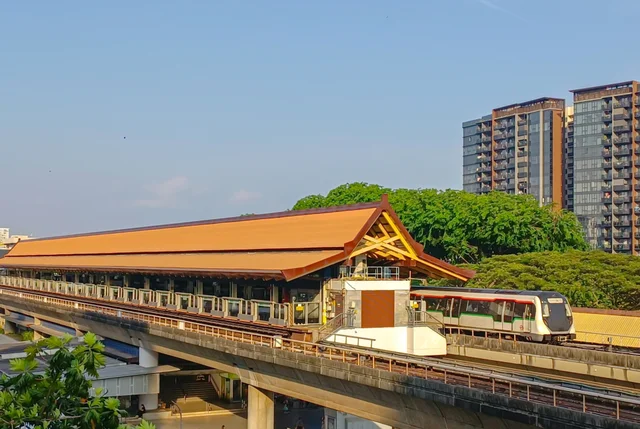
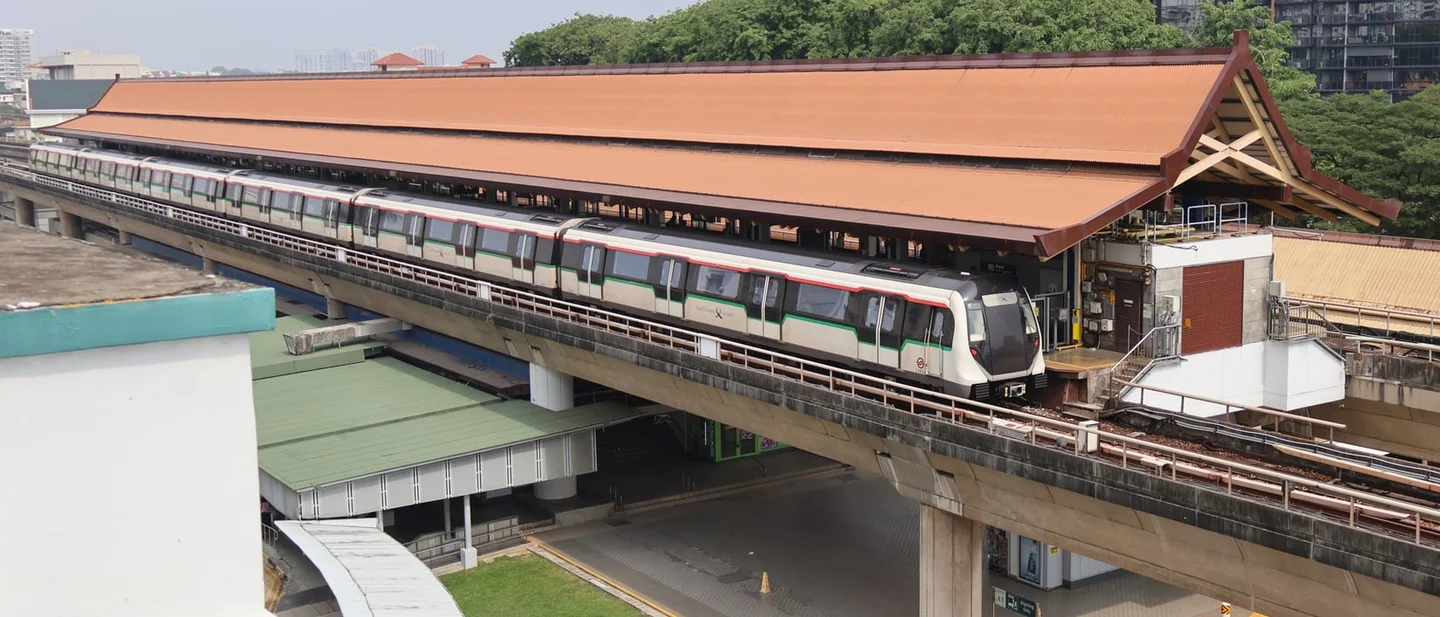
A train pulling out of a station at low sun, the long copper-coloured roof and its raised gable end catching the light, with a blue sky behind and apartment blocks to the right
A train leaves Eunos in low sunlight. The roof's long ridge and the raised gable over the station building read clearly from outside; the upward flick at each end of the ridge is the profile the rumah gadang takes to its points. 1 Photograph by Fanz226, 26 July 2024, CC BY-SA 4.0. 12

Figures

FigureWhat it measuresDateSource
10Stations opened at once from Marina Bay to Tanah Merah4 November 1989Eunos MRT station
13Stations in Phase IIA, City Hall to Pasir Ris1982 planEunos MRT station
S$11.5 millionDesign contract for the Phase IIA stationsOctober 1984Eunos MRT station
S$60 millionContract 303: Eunos, Paya Lebar and the connecting viaductsDecember 1985Eunos MRT station
60 / 40Okumura's and Oh Teck Thye's shares of that contractDecember 1985Eunos MRT station
S$3 millionWhat Oh Teck Thye owed the United Overseas Bank1986–87Eunos MRT station
41 per centOf Contract 303 completeFebruary 1986Eunos MRT station
40 cmThe drop on the sunken station stairsFebruary 1996Eunos MRT station
8.15amWhen a man went onto the eastbound track5 December 2000Eunos MRT station
August 2011Half-height platform screen doors in place2011Eunos MRT station
3Exits2026Eunos MRT station
5.45am–12.25amThe station's operating day2026Eunos MRT station
2–5 minPeak headway; about 5 min off-peak2026Eunos MRT station
$700,000Government grant to the Singapore Malay Union1927BiblioAsia, National Library Board
240 haLand bought in eastern Singapore for Kampong Melayu1928BiblioAsia, National Library Board
1,300Houses in the settlement when the register closed1965BiblioAsia, National Library Board
35Stations in the Comic Connect programme2022–24Art and architecture on the MRT
8 monthsTo design and paint the two Eunos murals2023Eunos MRT station

Glossary

TermWhat it means here
MinangkabauThe people of the West Sumatran highlands whose house form supplied the station's roof 4
Rumah gadangThe Minangkabau big house; its roof curves upward to pointed ends 4
GonjongThose upward-curving roof points, shaped after a water buffalo's horns 4
KampongA village; used in Singapore for the Malay settlements that predated redevelopment 8
Joint ventureTwo firms sharing one contract; here Okumura 60 per cent, Oh Teck Thye 40 1
ReceivershipA firm's assets placed in an accountant's hands to be realised for its creditors 1
Post-tensioned concreteConcrete whose internal cables are tensioned after it has set, so that it can span further; used in the station's viaducts 9
Island platformOne platform with tracks on both sides, rather than two platforms facing each other 1
Platform screen doorsBarriers along the platform edge that open only when a train is present 1
Geylang SeraiThe Malay enclave in eastern Singapore that the station's roof was meant to acknowledge 2
Pan Island ExpresswayThe expressway the Malay settlement was de-gazetted for in 1981 8

In their own words

Lim Soon Neo, in The Business Times of 5 February 1987, on Oh Teck Thye's collapse and Okumura's takeover 1:
the first case of a joint-venture split in the MRT Project
Erica Wee, whose two murals were unveiled at the station in September 2023, on coming home 1:
the best homecoming gift
The featured article's rendering of Scott Danielson's reason for designing stations out of local architecture — the brackets are its own, marking where it has supplied context around his words 1:
the more [he travelled], the more disturbed [he became by] architects failing to reflect their own culture
The featured article is Eunos MRT station, chosen as Wikipedia's Today's Featured Article for 4 November 2026. 3 The account of the station follows that article. The roof's Minangkabau background comes from Wikipedia's article on Minangkabau culture, the Malay Village background from its article on that museum, and the account of Mohamed Eunos bin Abdullah and Kampong Melayu from Mazelan Anuar's 2015 article in BiblioAsia, the National Library Board's journal. Each is cited where it is used. Images are openly licensed and credited under their captions.
A station roof is not usually an argument. This one was: a decision, taken in the 1980s by an architect and an operator, that a railway in a Malay neighbourhood should look like it belonged there, and that the place was worth naming in built form rather than in signage.
The neighbourhood it belonged to had already gone. The village Eunos bought the land for was de-gazetted in 1981, four years before Contract 303 was signed, and the expressway took it. What is left standing is the roof, which is not Minangkabau carpentry but profiled steel, and the name, which belongs to a journalist who died in 1933 and never saw a train in Singapore at all.
Every morning the doors open at 5.45, and the first commuters walk under the horns without looking up.

References

  1. 1
    Eunos MRT station - Wikipedia

    en.wikipedia.org

  2. 2
    Art and architecture on the Mass Rapid Transit (Singapore) - Wikipedia

    en.wikipedia.org

  3. 3
    Wikipedia: Today's featured article/November 4, 2026

    en.wikipedia.org

  4. 4
    Minangkabau culture - Wikipedia

    en.wikipedia.org

  5. 5
    File: Rumah Gadang Minangkabau PDIKM, Padang Panjang.jpg - Wikimedia Commons

    commons.wikimedia.org

  6. 6
    Malay Village - Wikipedia

    en.wikipedia.org

  7. 7
    File: EW7 Eunos Station Platform level 202502.jpg - Wikimedia Commons

    commons.wikimedia.org

  8. 8
    Mohamed Eunos Abdullah: The Father of Malay Journalism - BiblioAsia

    biblioasia.nlb.gov.sg

  9. 9
    Prestressed concrete - Wikipedia

    en.wikipedia.org

  10. 10
    File: Eunos MRT Station 202407 2.jpg - Wikimedia Commons

    commons.wikimedia.org

  11. 11
    Geylang East - Wikipedia

    en.wikipedia.org

  12. 12
    File: R151 Train Departing Eunos MRT Station.jpg - Wikimedia Commons

    commons.wikimedia.org

Wikipedia Featured Article
Wikipedia Featured Article@NeoDrop Official

This story was produced automatically by a channel. One sentence is all it takes for Neodrop to keep producing for you.

Related content

  • The roof that is not a dome
  • The name on the station
  • Building it while the builder went broke
  • What the station actually is
  • The stairs that sank, and the doors that followed
  • Two murals, eight months
  • Figures
  • Glossary
  • In their own words